
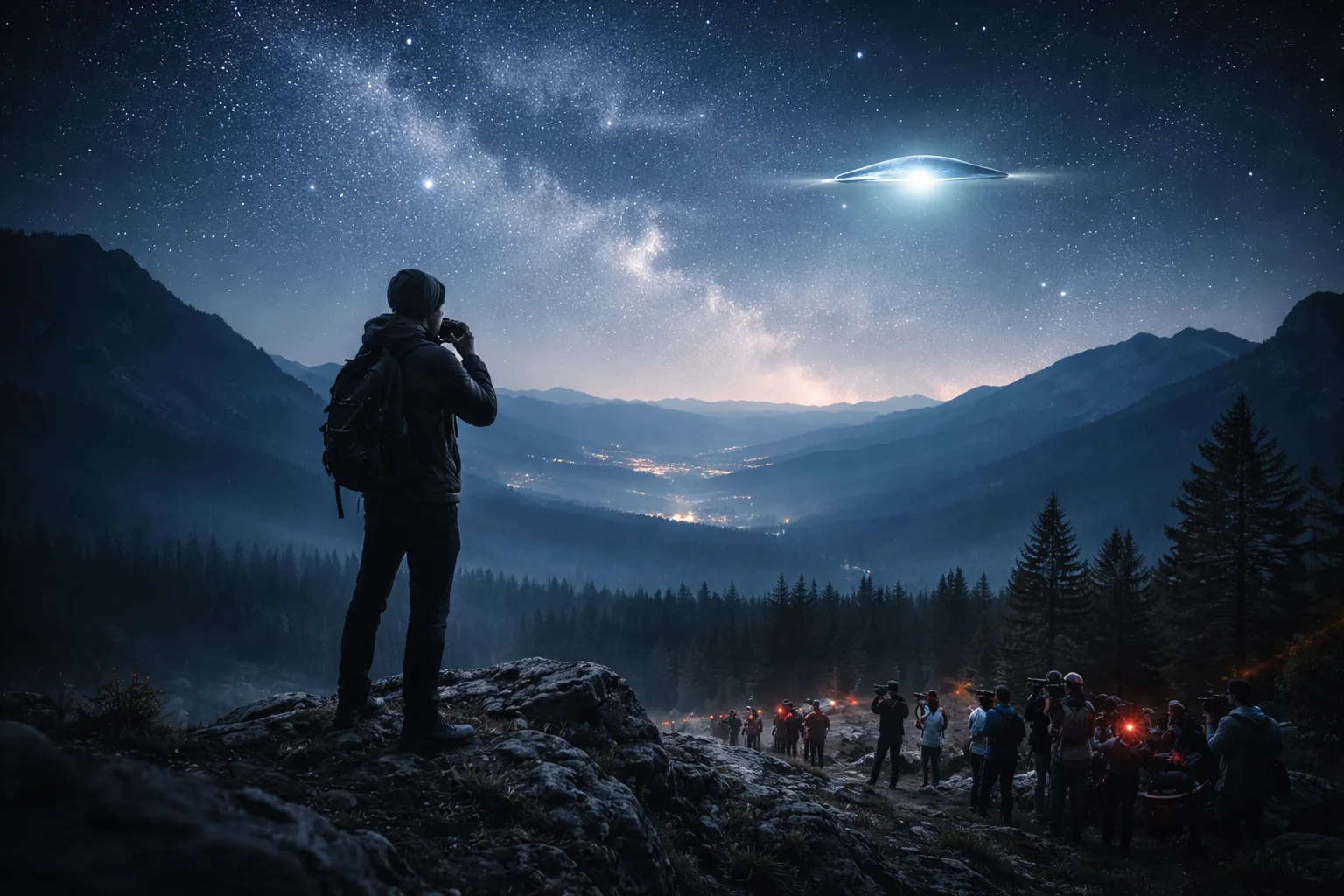
Across North America, a quiet pattern emerges in places where the night sky is at its clearest. Far from city lights, where the Milky Way stretches visibly across the horizon, human attention naturally turns upward. These environments—celebrated for astronomy, conservation, and awe—have also become subtle stages for something less easily defined: reports of unusual aerial activity and the cultural stories that follow.
This overlap between pristine stargazing locations and narratives of unidentified aerial phenomena (UAPs) is not accidental. It is shaped by a convergence of environmental clarity, human perception, scientific curiosity, and storytelling. Understanding this intersection requires both careful observation and a willingness to examine how meaning is constructed around what is seen—and what is not fully understood.
What Makes a Stargazing Destination Truly Exceptional
Not all dark skies are equal. The most renowned stargazing destinations share a distinct set of characteristics that go beyond simple darkness.
Defining Features of Elite Dark Sky Locations
- Minimal Light Pollution: Artificial light is tightly controlled, allowing faint celestial objects to become visible.
- Atmospheric Stability: Dry climates and high elevations reduce distortion and cloud interference.
- Protected Status: Many sites are designated as International Dark Sky Parks or Reserves, reflecting long-term conservation efforts.
- Public Engagement: Observatories, guided programs, and educational outreach encourage structured observation.
These locations are designed for clarity. Yet clarity does not always produce certainty. In fact, the same conditions that reveal distant galaxies can also expose unfamiliar or ambiguous objects moving across the sky.
Why Unfamiliar Lights Appear More Often Under Perfect Skies
The increase in reported aerial anomalies in dark-sky regions is less about the sky changing and more about human awareness expanding.
Environmental Visibility
- Satellites, which are often invisible in urban areas, become easily observable
- Meteor activity appears more frequent due to enhanced visibility
- High-altitude aircraft and atmospheric reflections become more pronounced
Cognitive Interpretation
- The human brain is highly tuned to detect patterns, especially in low-information environments
- Visitors arrive expecting extraordinary views, sometimes priming interpretation
- Cultural context influences how ambiguous observations are labeled or remembered
Scientific Constraints
Despite growing attention, the scientific community continues to emphasize limitations in available data. Reports from NASA and U.S. defense agencies consistently point to one core issue: insufficient high-quality, calibrated observational data to definitively classify many UAP cases.
This does not confirm extraordinary explanations. It highlights the gap between observation and explanation.
Places Where Observation and Storytelling Intersect
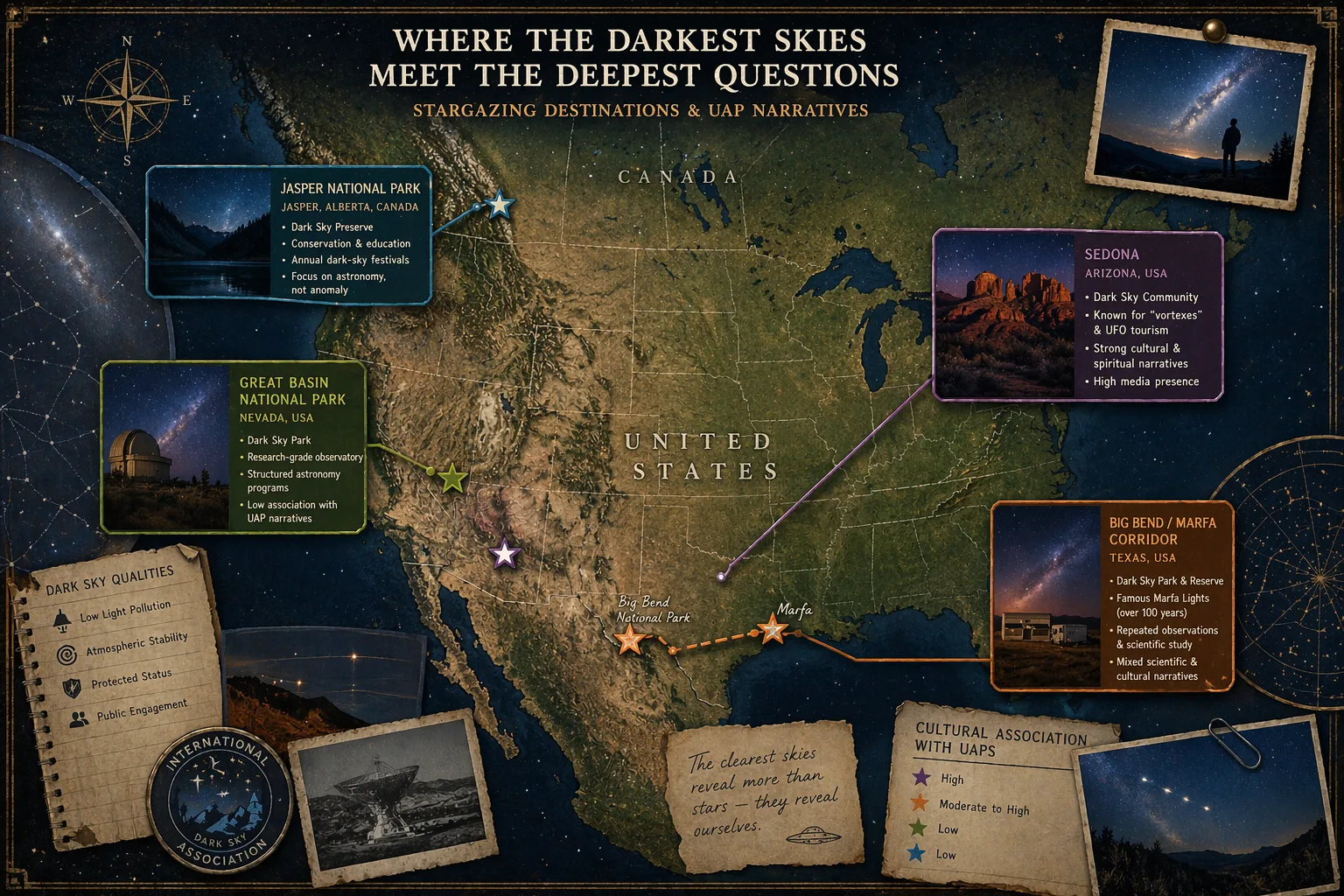
Certain locations illustrate how environmental conditions and cultural narratives combine to shape perception.
Sedona, Arizona: The Power of Narrative
Sedona is internationally recognized for its dark skies. It is also known for something less scientific—its association with energy “vortexes” and extraterrestrial encounters.
Tourism in Sedona actively incorporates these themes:
- Guided night tours promising UFO sightings
- Local folklore blending spiritual and extraterrestrial interpretations
- Media coverage reinforcing the area’s reputation
Scientific investigations, however, have not produced evidence supporting these claims. Instead, Sedona stands as a compelling example of how narrative frameworks can transform a place into something larger than its physical reality.
In Sedona, the sky is not just observed—it is interpreted through layers of meaning built over time.
The Big Bend and Marfa Corridor: Persistent Mystery
In West Texas, the region surrounding Big Bend National Park offers some of the darkest skies in the continental United States. Nearby, the town of Marfa has long been associated with unexplained luminous phenomena known as the Marfa Lights.
These lights have been:
- Observed for over a century
- Documented by both residents and visitors
- Studied in attempts to identify natural explanations
Scientific studies suggest that some sightings may be attributed to distant vehicle headlights or atmospheric conditions. Yet the phenomenon persists in both observation and cultural identity.
Marfa demonstrates a unique balance—where repeated visual experiences, incomplete explanations, and cultural reinforcement coexist.
Great Basin National Park: Science Without the Myth
In contrast, Great Basin National Park in Nevada offers an environment equally suited for observation but largely free from UAP-related cultural narratives.
The park features:
- One of the darkest skies in the United States
- A research-grade observatory within a national park setting
- Structured astronomy programs focused on education and science
Despite being located in a region often associated with extraterrestrial speculation, Great Basin maintains a distinctly scientific orientation. Reports of unusual phenomena are rare, and interpretation remains grounded in known astronomical and atmospheric principles.
Jasper National Park: A Model of Pure Observation
Jasper National Park in Canada represents another approach. As one of the largest protected dark-sky preserves in the world, it emphasizes conservation, education, and public engagement.
Annual dark-sky festivals attract global audiences, yet the narrative remains focused on astronomy rather than anomaly. Here, the night sky is treated as a subject of study and appreciation, not speculation.
A Comparative View of Stargazing Sites and UAP Narratives
| Location | Dark Sky Status | Cultural Association with UAPs | Primary Lens |
|---|---|---|---|
| Sedona, Arizona | Certified Dark Sky Community | High | Cultural and tourism-driven |
| Big Bend / Marfa, Texas | Dark Sky Park and Reserve | Moderate to High | Mixed scientific and cultural |
| Great Basin, Nevada | Dark Sky Park | Low | Scientific and observational |
| Jasper, Canada | Dark Sky Preserve | Low | Educational and conservation-focused |
This comparison reveals a critical insight: dark skies alone do not create UAP narratives. Cultural context determines how observations are interpreted and shared.
How Scientific and Governmental Perspectives Have Evolved
Over the past two decades, institutional attention to UAPs has shifted from quiet investigation to cautious transparency.
Key Developments
- Early 2000s: Isolated military encounters begin to gain attention
- 2021: U.S. intelligence releases a preliminary assessment of UAP incidents
- 2022: Establishment of the All-domain Anomaly Resolution Office (AARO)
- 2023–2024: NASA and defense agencies publish findings emphasizing data limitations and conventional explanations
Across these developments, one conclusion remains consistent: most resolved cases involve identifiable objects such as balloons, drones, or natural atmospheric phenomena. A smaller subset remains unexplained, primarily due to insufficient data rather than confirmed anomalies.
Evaluating What We See: A Structured Approach
Understanding aerial anomalies requires a disciplined method of evaluation.
Levels of Evidence
- Instrumented Data
- Radar, satellite tracking, and multi-sensor recordings
- Government and scientific reports
- Peer-Reviewed Analysis
- Studies examining atmospheric optics and visual phenomena
- Long-term observational research
- Credible Media Documentation
- Reputable reporting that contextualizes events
- Eyewitness Accounts
- Personal observations, valuable but inherently subjective
Key Validation Criteria
- Precise documentation of time, location, and conditions
- Availability of alternative explanations
- Independent corroboration across sources
- Awareness of environmental and cultural influences
This framework does not dismiss unusual observations. It ensures they are examined with clarity rather than assumption.
The Role of Media and Public Imagination
Media and tourism industries play a significant role in shaping how UAPs are perceived.
- Locations like Sedona actively integrate UFO narratives into their identity
- Events such as the Marfa Lights Festival reinforce recurring phenomena
- Increased media coverage reduces stigma, encouraging more public reporting
These factors create feedback loops. The more a place is associated with unexplained phenomena, the more visitors arrive expecting to witness something unusual—and the more likely they are to interpret ambiguous observations accordingly.
Science, Speculation, and the Space Between
At the heart of this subject lies a tension between two modes of understanding.
- Scientific Perspective: Emphasizes measurable data, reproducibility, and known physical laws
- Speculative Interpretation: Draws on cultural narratives, personal experience, and symbolic meaning
Neither exists in isolation. The most interesting insights often emerge in the space between them—where observation meets interpretation, and where uncertainty invites inquiry rather than conclusion.
Looking Up, and Looking Closer
Dark-sky destinations offer more than breathtaking views. They provide a lens through which human curiosity becomes visible.
In these environments, the sky is both a scientific frontier and a cultural canvas. What appears above is filtered through what we know, what we expect, and what we imagine.
The enduring question is not simply what is in the sky, but how we choose to understand it.
And in that space—between light and darkness, certainty and mystery—the story continues to unfold.

Cosmic Echoes
Share-ready comments you can copy in a click, then post wherever the conversation touches UFOs, UAP, or the Galactic Federation.
These comments belong to the Cosmic Echoes page under the section Dark Skies, Deeper Mysteries.
Plus 21 more comments on the Cosmic Echoes page.