
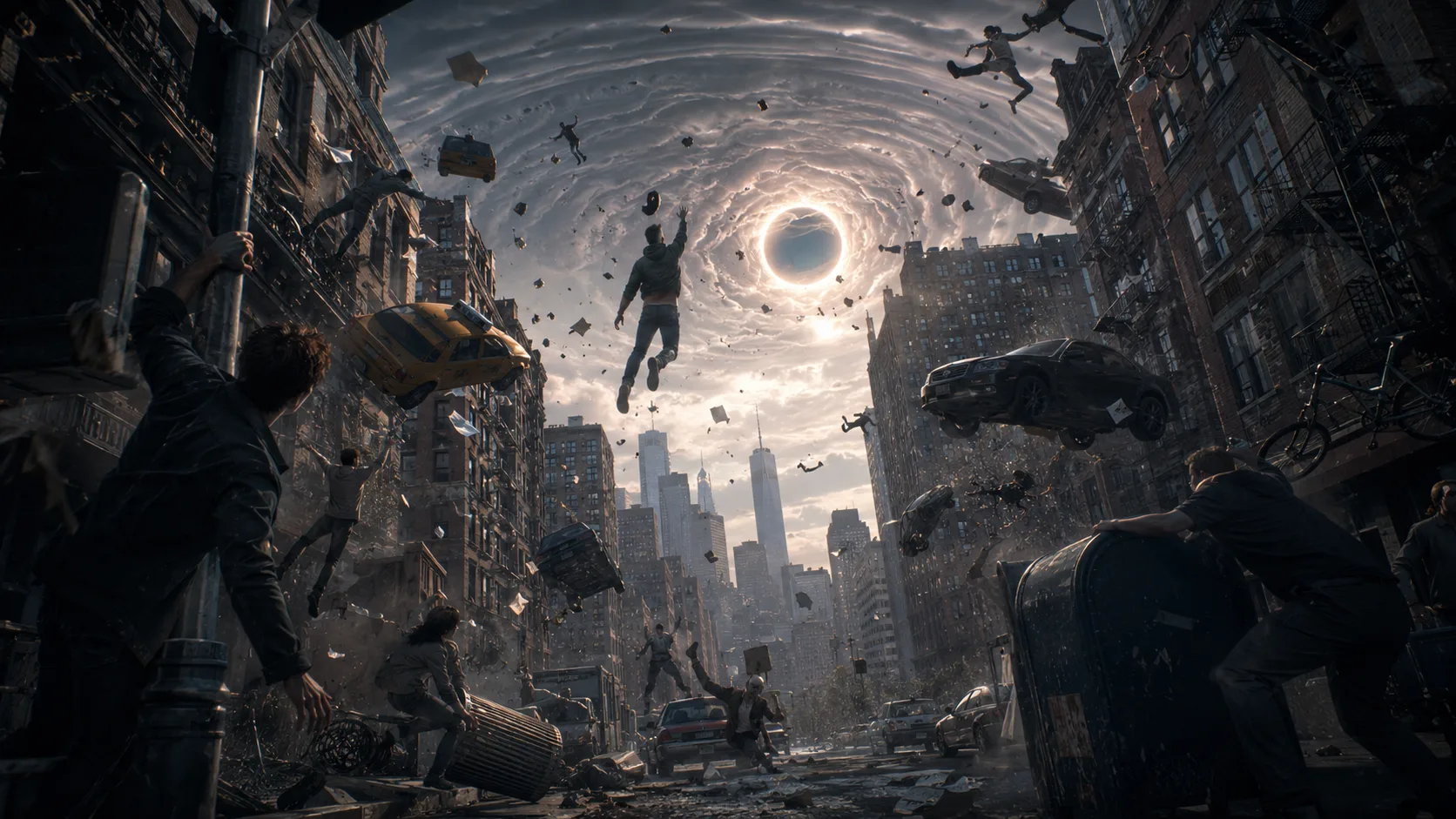
A leaked document. An $89 billion emergency budget. A vanished physicist. A dead researcher. And a warning precise enough to be chilling: at 14:33 UTC on August 12, 2026, Earth’s gravity will disappear for approximately seven seconds.
According to the story, gravitational waves produced by merging black holes were amplified by an enormous dark-matter filament and aimed directly at Earth. When the waves intersect near the planet, their interference pattern will supposedly cancel the gravitational field holding everything to the surface.
The alleged probability of the event is 94.7 percent.
It’s an unforgettable premise, especially because it combines genuine scientific concepts with the atmosphere of a classified disaster file. But precision isn’t the same as proof. Once the claim is traced to its source and its proposed mechanism is examined, a much clearer picture emerges.
The “Project Anchor” warning is not an authenticated government disclosure. It is a fictional narrative built around real scientific mysteries.
The Story Behind Project Anchor
The account centers on a physicist named Thomas Webb, who supposedly noticed an unusual signal while studying gravitational-wave data. In the story, Webb calculates that a focused wave will reach Earth on August 12, 2026, temporarily eliminating the planet’s gravity.
Webb sends his findings to his former MIT adviser, Dr. Minji Park. His paper is then retracted, his access is suspended, and he disappears. Park receives a flash drive containing his calculations, copies the files to several servers, and begins making calls. Within 48 hours, she is dead.
The final message attributed to Webb reads like a warning from beyond the grave:
August 12. 14:33 UTC. Get underground. Hold on to something.
This narrative closely follows the opening of a February 2026 episode of The Why Files about “Project Anchor.” Crucially, the episode’s own description states, “The document is a hoax,” and the program later explains that NASA never detected the alleged gravity-canceling waves because the mechanism does not work as described. (PodScripts)
That source history matters. It does not merely show that officials dispute the document. It shows that the publisher of the story presented it as a fictional doorway into a broader discussion of gravity, antigravity research, classified programs, and the limits of modern physics.
Evaluating the Claim Without Dismissing the Larger Questions
Extraordinary subjects deserve more than a reflexive appeal to authority. Government agencies can withhold information. Classified programs can remain hidden for decades. Witness testimony, leaked documents, contractor records, independent research, and historical archives can all contribute valuable evidence.
A responsible investigation should therefore separate established evidence, witness-based evidence, research analysis, and speculation rather than forcing every claim into a simple “official” or “conspiracy” category.
Using that standard, Project Anchor encounters several serious problems:
- No authenticated document has been produced.
- No verifiable chain of custody exists for the alleged flash drive.
- No identifiable gravitational-wave event number accompanies the calculations.
- No paper title, preprint, laboratory record, or technical dataset is provided.
- The story’s own publisher identifies the emergency document as a hoax.
- The proposed physical mechanism conflicts with how gravitational waves and Earth’s gravity behave.
None of those points depends solely on trusting NASA. They concern provenance, corroboration, testability, and internal scientific consistency.
What Is Real in the Story?
Project Anchor is effective because it borrows several real pieces of science and history.
The August 12, 2026 Eclipse Is Real
A total solar eclipse will occur on August 12, 2026. Its path of totality will cross parts of Siberia, the Arctic, Greenland, Iceland, and Spain. NASA has published maps and scientific visualizations of the event. (NASA Scientific Visualization Studio)
But the eclipse timing does not support the Project Anchor prediction. NASA’s astronomical calculations place the greatest eclipse at approximately 17:46 UTC, more than three hours after the alleged 14:33 UTC gravity event. (NASA Eclipse)
Solar eclipses also do not weaken Earth’s gravity. The Sun and Moon continue exerting gravitational influence during an eclipse, just as they do during every other alignment. An eclipse is primarily a matter of shadows and orbital geometry, not the suspension of gravitational law.
The date appears to have been chosen because a rare celestial event makes the warning feel more plausible and memorable.
Gravitational Waves Are Real
Gravitational waves are distortions in spacetime produced by accelerating masses, including colliding black holes and neutron stars. They travel outward at the speed of light.
LIGO’s first direct detection came from two black holes that merged about 1.3 billion light-years away. By the time the signal reached Earth, the effect was extraordinarily small. LIGO describes the resulting change in its instruments as thousands of times smaller than the width of a proton. (LIGO Lab | Caltech)
That is a remarkable scientific achievement. It also illustrates the central problem with Project Anchor: gravitational waves reaching Earth are not ordinarily powerful enough to throw people, buildings, oceans, or the atmosphere into space.
Gravitational-Wave Lensing Is a Genuine Research Area
Massive objects can bend and magnify gravitational waves, just as gravitational lenses can bend light. Depending on the lens and geometry, researchers may observe magnified signals, delayed copies, or interference patterns.
This part of the Project Anchor story is based on legitimate theoretical work. LIGO scientists actively search for evidence of gravitational-wave lensing. However, LIGO’s published assessment says no lensing event has yet been identified with confidence, although some unusual signals remain under investigation. (LIGO Scientific Collaboration)
More importantly, lensing can magnify or redirect a passing wave. It does not transform that wave into a switch capable of shutting down Earth’s gravitational field.
Why the Proposed Mechanism Fails
A Wave Detected by LIGO Has Already Arrived
The story suggests Webb detected the dangerous wave years before it was due to reach Earth. That creates an immediate timing problem.
LIGO does not observe a gravitational wave while it is still billions of miles away and heading toward Earth. It records the minute distortion produced as the wave passes through the detector.
In other words, if LIGO detected a particular wave in 2019, that wave reached Earth in 2019.
A gravitational lens could theoretically create a second image arriving by a longer path at a later time. Astronomers search for such delayed signals. But Project Anchor provides no authenticated event, lens model, delay calculation, sky position, or corresponding second image. Even if a delayed copy existed, it would remain a gravitational wave, not a mechanism for erasing Earth’s gravity.
Wave Interference Is Not a Planetary Gravity Switch
Two waves can interfere. At certain points, one wave’s crest can overlap another wave’s trough, reducing the combined oscillation.
But Earth’s gravitational field is not simply a passing wave. It is the persistent curvature associated with the planet’s mass and energy.
A useful comparison is water. Two ripples can briefly cancel each other at one place on a lake. That does not eliminate the lake, the water beneath the ripples, or the gravitational attraction of Earth.
Similarly, interference between gravitational waves can reduce a particular oscillating disturbance in spacetime. It cannot remove the underlying curvature created by the mass of an entire planet.
Gravity also has no known positive and negative charges that can be aligned like equal and opposite electrical signals. The story treats gravity as though it were a broadcast frequency that could be jammed. Modern gravitational physics provides no support for that assumption.
A Dark-Matter Filament Would Not Solve the Problem
Dark matter is inferred through its gravitational effects on galaxies, galaxy clusters, and the large-scale structure of the universe. A sufficiently massive concentration could act as a gravitational lens.
But the length of a filament alone tells us almost nothing about its lensing power. Researchers would need its mass distribution, density, position, distance, orientation, and relationship to the source and observer.
The Project Anchor narrative offers a dramatic measurement, an 800-light-year filament, without the information required to calculate the proposed amplification. Even a strong lens would magnify the wave’s strain. It would not convert an oscillating distortion into the disappearance of Earth’s own gravitational field.
Would Everything Fly Into the Sky?
Even the story’s description of the alleged seven seconds is misleading.
If Earth’s gravity somehow vanished instantaneously, objects would not automatically be blasted upward. An upward launch requires an upward force. A person standing still would initially continue moving according to inertia and Earth’s existing rotation.
There would still be catastrophic complications if gravity truly disappeared. The oceans, atmosphere, satellites, structures, and the planet itself depend on gravitational equilibrium. But seven seconds would not resemble a universal springboard throwing every unsecured object straight into the sky.
The popular warning to “hold on to something” also raises an obvious question: hold on to what? If Earth’s gravitational field were genuinely removed, a building, bunker, mountain, or anchor point would be affected by the same underlying event.
The survival advice is narratively effective, but it does not follow from the proposed physics.
The $89 Billion Budget Problem
The alleged document assigns Project Anchor an $89 billion budget.
NASA’s entire enacted budget for fiscal year 2026 is approximately $24.4 billion. An $89 billion NASA program would therefore cost more than three and a half times the agency’s publicly enacted annual budget. (NASA)
That discrepancy does not logically prove that no classified funding could exist. Sensitive programs can be financed through other agencies, concealed appropriations, compartmentalized contracts, and restricted budget lines.
But an undertaking of this scale would require more than a classified memo. It would likely involve extensive construction, engineering, transportation, contractors, specialized materials, personnel, procurement activity, and international coordination. The Project Anchor story supplies no financial records, contracting evidence, facility imagery, named program participants, or independently obtained documents.
The budget figure creates an impression of institutional reality without providing an evidentiary trail.
What About Thomas Webb and Minji Park?
A credible whistleblower case depends heavily on identity and access.
Investigators would normally seek to establish:
- Whether the individuals existed.
- Where they worked and what positions they held.
- Whether they had access to the relevant instruments and data.
- Whether colleagues could confirm their research.
- Whether the alleged paper existed.
- Whether disappearance or death records matched the story.
- Whether the technical material could be independently reproduced.
The Project Anchor narrative does not provide those foundations. Webb and Park appear inside the story, but no authenticated academic histories, publications, university announcements, missing-person documentation, or independently verified witnesses establish them as real participants in a gravity emergency program.
That places their accounts outside the category of witness-based evidence. A named character is not automatically a verifiable witness.
An Evidence-Based Assessment
Established Evidence
A total solar eclipse will occur on August 12, 2026. Gravitational waves exist. Black-hole mergers produce them. Massive objects can theoretically lens and magnify them.
These facts are documented and independently measurable.
Witness-Based Evidence
No independently verified Project Anchor witness has emerged with demonstrable access to the alleged program. The story does not provide a verifiable Webb, Park, program employee, contractor, military official, or scientist who can be questioned and corroborated.
Research-Based Analysis
The predicted time does not correspond to the eclipse’s greatest phase. The alleged budget is several times NASA’s entire annual funding. A LIGO detection means the wave has already reached the detector. Wave interference cannot cancel the persistent gravitational field generated by Earth’s mass.
Each of these findings weighs against the claim.
Speculative Theory
Classified aerospace programs, unconventional propulsion research, quantum-gravity experiments, and undisclosed studies of spacetime remain legitimate areas for investigation.
But their possible existence does not establish Project Anchor. A broad possibility cannot substitute for evidence supporting a precise event, date, probability, mechanism, and budget.
Why the Warning Feels Convincing
Project Anchor uses several storytelling techniques that make fabricated documents feel authentic.
It includes exact numbers: $89 billion, 14:33 UTC, seven seconds, 94.7 percent, and an 800-light-year filament. It combines real terminology with fictional conclusions. It invokes LIGO, MIT, NASA, black holes, dark matter, and classified emergency planning.
It also creates an apparent suppression pattern. A scientist discovers something dangerous. His paper disappears. His access is revoked. He vanishes. A second scientist receives the evidence and dies after attempting to expose it.
That sequence discourages skepticism because every missing piece becomes part of the alleged cover-up. No paper exists because it was retracted. No scientist can be interviewed because he disappeared. No adviser can confirm the story because she died. No agency will verify the program because it is classified.
This structure makes the claim difficult to disprove inside its own fictional world. It also makes it impossible to verify.
A serious investigation cannot treat the absence of evidence as automatic proof that evidence was suppressed. Suppression may be a hypothesis, but it must eventually produce something testable: a document with traceable origins, a corroborating witness, financial records, instrument data, physical evidence, or predictions that succeed under controlled examination.
The Real Mystery Is Still Worth Exploring
Rejecting the Project Anchor prediction does not mean every question about gravity has been answered.
Physicists still lack a complete theory uniting gravity with quantum mechanics. The nature of dark matter remains unresolved. Gravitational-wave astronomy is still developing, and future observations may reveal lensing events, unfamiliar compact objects, or phenomena not anticipated by current models.
There is also a legitimate historical record of military and government interest in advanced propulsion, gravity modification, and unconventional aerospace concepts. Such research deserves document-based investigation without assuming that every dramatic claim attached to it must be genuine.
Open-minded inquiry works in both directions. It allows unusual evidence to be considered, but it also allows a precise claim to be rejected when its provenance, corroboration, and mechanism fail examination.
Conclusion
The August 12, 2026 gravity warning is not supported by an authenticated emergency document, identifiable witnesses, reproducible calculations, instrument data, or a physically credible mechanism.
The story’s own source identifies the document as a hoax. Its scientific language is assembled from real concepts, but those concepts do not produce the claimed result. Gravitational waves do not function as an off-switch for Earth’s gravity, and nothing in the available evidence indicates that humanity will experience seven seconds of weightlessness.
August 12 will still offer a remarkable celestial event. Across parts of the Arctic and Europe, daylight will briefly give way to the shadow of the Moon.
That spectacle is real. Project Anchor is not.

Cosmic Echoes
Share-ready comments you can copy in a click, then post wherever the conversation touches UFOs, UAP, or the Galactic Federation.
These comments belong to the Cosmic Echoes page under the section Project Anchor: Earth’s Gravity Vanishing for 7 Seconds?.
Plus 21 more comments on the Cosmic Echoes page.