
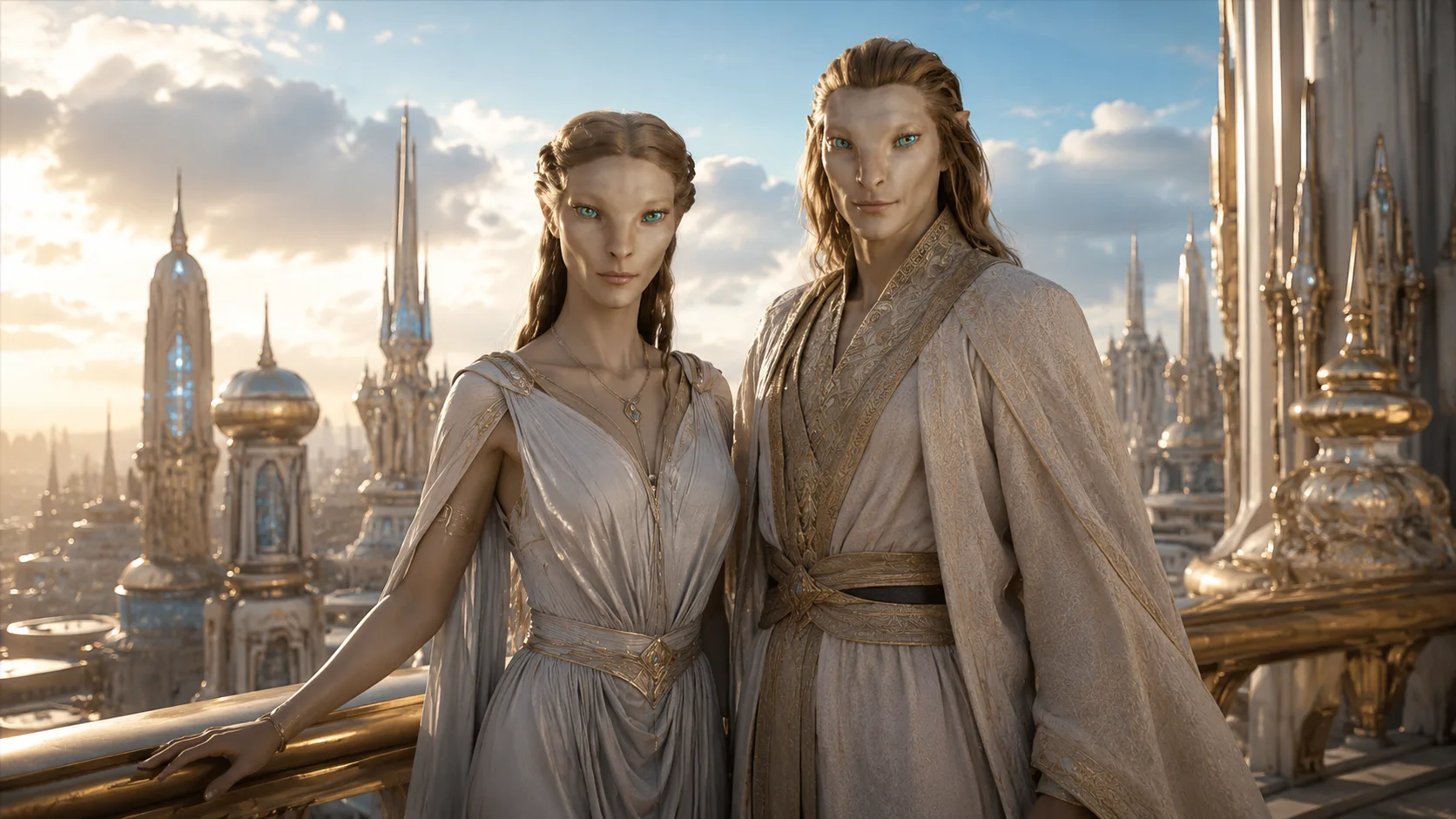
Before there was a Galactic Federation, there was a wound.
Before star councils, interstellar diplomacy, and the familiar names of Pleiadians, Arcturians, Andromedans, and starseed lineages, there was Lyra. In Galactic Federation origin tradition, the Lyran Expansion is remembered as the event that set everything in motion: the persecution, scattering, and survival of the oldest humanoid civilizations in this galactic quadrant. It was not simply a migration. It was a cosmic diaspora. And according to this tradition, the Federation was not created before the Lyran crisis. It was created because of it.
Astronomically, Lyra is a small northern constellation whose brightest star is Vega, one of the points of the Summer Triangle. NASA notes that Vega was once Earth’s northern pole star and will return to that position in the far future, which gives Lyra a fitting symbolic role as a kind of ancient sky-anchor. (NASA Science) But the Lyran Expansion story belongs to spiritual history, starseed cosmology, and galactic memory. Astronomy tells us where Lyra appears in the sky. This story asks a different question: what if Lyra was also where a much older human story began?
What Was the Lyran Expansion?
The Lyran Expansion is the name given to the great scattering of Lyrian civilizations after a catastrophic period of persecution by regressive sauroid species. In this tradition, the Lyrians were not one single race with one appearance, one culture, or one destiny. They were a broad family of humanoid civilizations sharing a common star-origin memory.
That distinction matters. When people hear “the Lyrans,” it’s easy to picture one ancient civilization living peacefully until everything collapsed. The deeper version is more complex. Lyra was less like a single city and more like a cradle region, a place where many humanoid branches developed, exchanged knowledge, and refined a high spiritual culture over immense spans of time.
The Expansion happened when that cradle was shattered.
The result was a wave of displacement that carried Lyrian survivors into many star systems. Over time, these groups adapted. They developed new cultures, new energetic signatures, new social structures, and in some traditions, new genetic expressions. The Pleiadians, Arcturians, Andromedans, and several other star lineages are often described as later branches of this original Lyrian dispersal.
In other words, the Lyran Expansion is not just a backstory. It is the root system.
Who Were the Lyrans?
The Lyrians are described as among the oldest humanoid civilizations in the galaxy, highly developed not only in technology, but in consciousness. Their strength was not merely mechanical. It was harmonic. They understood frequency, sound, light, biological design, and the relationship between individual sovereignty and collective balance.
That makes Lyra’s association with the lyre especially interesting. In Greek mythology, Lyra represented the instrument of Orpheus, whose music had the power to move nature, charm the underworld, and cross the boundary between life and death. Britannica also notes that in Chinese mythology, Vega is connected with Niu Lang, a cowherd separated from his beloved Zhi Nü by the Milky Way. (Encyclopedia Britannica) Even in conventional myth, Lyra carries themes of music, separation, longing, and cosmic distance.
Those themes fit the Lyran story almost too well.
In the galactic tradition, the Lyrians were builders of worlds, but not conquerors in the later imperial sense. Their civilizations valued beauty, proportion, learning, and spiritual refinement. They were diverse, but they shared a recognizable humanoid template. This is why Lyra is often called the cradle of humanoid life in this quadrant, not because every being looked identical, but because many later humanoid lineages carried some version of the Lyrian pattern forward.
The Sauroid Persecution
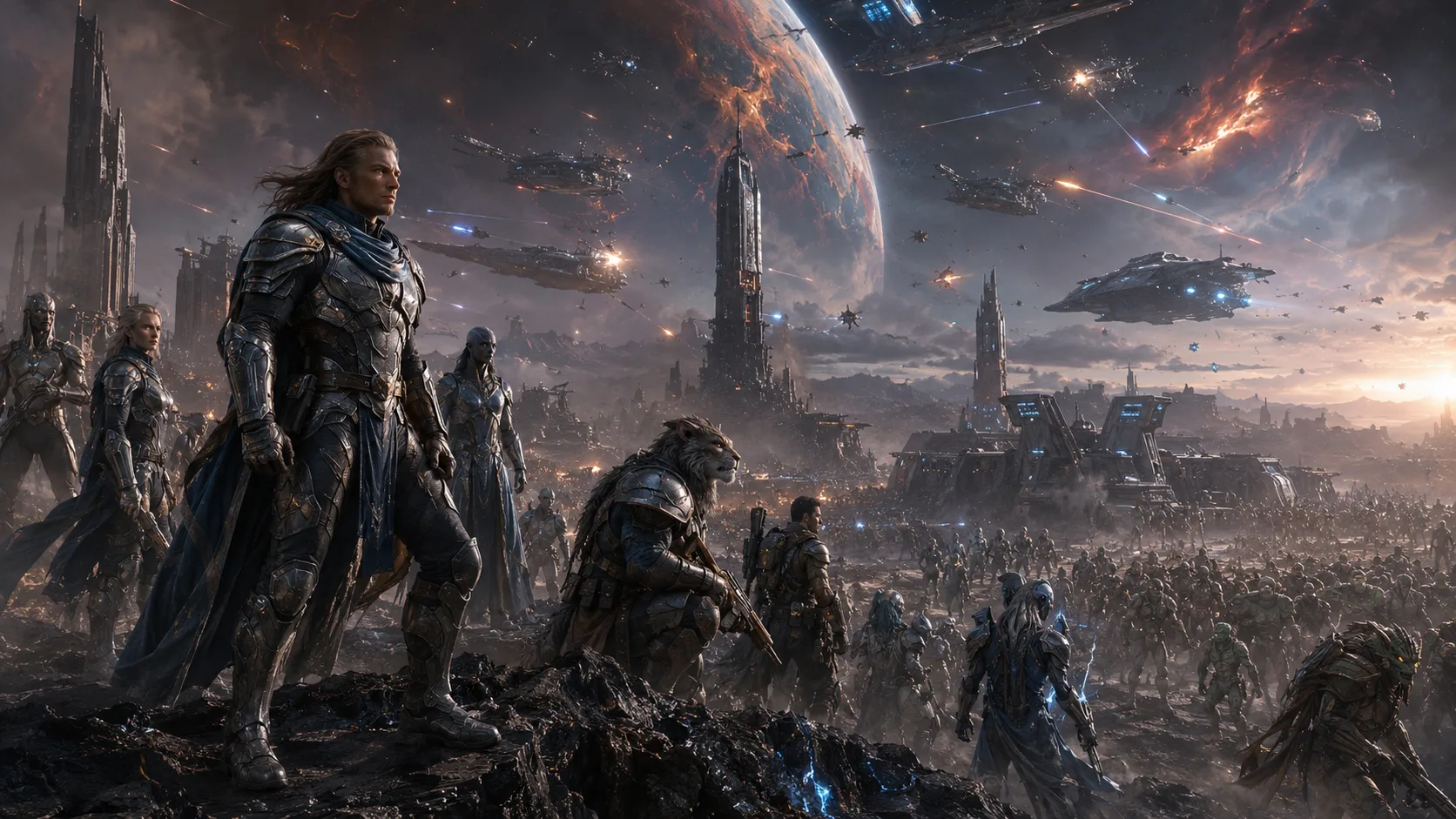
The turning point came through conflict with regressive sauroid, or reptilian-associated, species. Within the Lyran tradition, this is remembered as the oldest great humanoid-sauroid conflict, a clash not only of biology, but of worldview.
The Lyrian model emphasized sovereignty, creative expansion, and spiritual development. The regressive sauroid model, as described in this tradition, emphasized domination, hierarchy, extraction, and control. The persecution of Lyrian civilizations was not only physical. It targeted memory, culture, bloodlines, and the ability of free humanoid societies to organize themselves without fear.
That is what made the crisis so consequential. A war over territory can end when borders are redrawn. A war over consciousness leaves echoes everywhere.
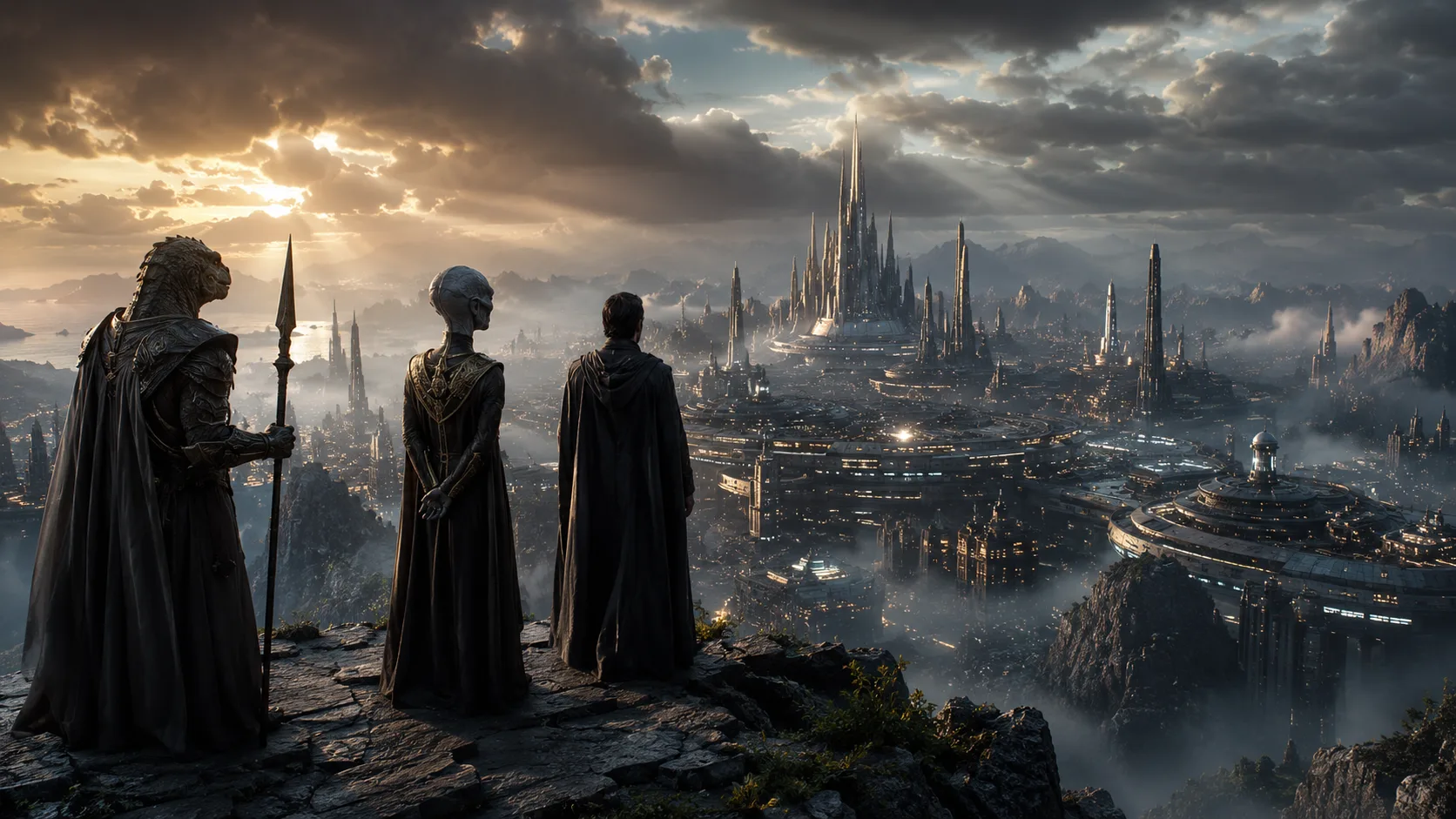
The Lyrians who survived had to make an impossible choice. Stay and risk extinction, or scatter and preserve the living seed of their civilization elsewhere. The Expansion was born from that decision.
The Scattering: How One Civilization Became Many
The Lyran diaspora unfolded like seeds carried by a storm. Each group carried the same original trauma, but each adapted differently depending on where it settled, who it encountered, and what kind of consciousness it chose to preserve.
The Pleiadian Stream
The Pleiadian branch is often described as one of the most emotionally refined descendants of the Lyrian dispersal. In ordinary astronomy, the Pleiades, also known as Messier 45 or the Seven Sisters, is an open star cluster containing more than a thousand loosely bound stars. (NASA Science) In starseed tradition, the Pleiadian stream is associated with healing, compassion, beauty, community, and the recovery of heart-based civilization after trauma.
If Lyra was the original song, the Pleiadian branch became one of its gentlest harmonies.
The Pleiadian legacy is often understood as the attempt to rebuild without becoming hardened by persecution. Their gift is remembrance without bitterness. They carry the lesson that survival does not have to turn into domination.
The Arcturian Stream
The Arcturian branch represents a different kind of Lyrian inheritance. Arcturus is a real star in the constellation Boötes, and Britannica identifies it as the fourth-brightest star in the night sky and an orange-colored giant about 36.7 light-years from Earth. (Encyclopedia Britannica) In galactic spiritual traditions, Arcturian consciousness is usually associated with advanced healing systems, sacred geometry, multidimensional science, and inner technology.
Where the Pleiadian stream preserved the heart, the Arcturian stream preserved architecture of consciousness.
This branch is often portrayed as more abstract, precise, and frequency-oriented. Its Lyrian inheritance became less about cultural restoration and more about mastery of subtle systems: light bodies, energetic grids, healing chambers, and the science of consciousness itself.
The Andromedan Stream
The Andromedan branch carries the theme of distance, perspective, and sovereignty. In conventional astronomy, the Andromeda Galaxy, or M31, is about 2.5 million light-years away and is the nearest major galactic neighbor to the Milky Way. (NASA Science) In the Lyran Expansion framework, Andromedan lineages are often associated with freedom, non-linear awareness, and resistance to authoritarian control.
If the Pleiadian stream healed the wound and the Arcturian stream studied its energetic architecture, the Andromedan stream asked the hard political question: how do free beings prevent such persecution from happening again?
That question sits at the heart of the Galactic Federation’s later purpose.
Other Lyrian Branches
Not every Lyrian-descended group became famous in modern starseed language. Some blended into lesser-known systems. Some became guardians, archivists, wanderers, or genetic contributors to younger worlds. Others may have kept their identity private, choosing silence over visibility after the shock of the original persecution.
That silence is important. Diasporas do not always announce themselves. Sometimes they survive by becoming the background pattern inside other civilizations.
The Human Connection
The most personal part of the Lyran Expansion story is its connection to Earth.
In this tradition, Earth humans are not viewed as isolated biological accidents, nor as the product of one simple off-world intervention. Humanity is described as composite, carrying layers of Lyrian, Pleiadian, Sirian, Arcturian, and other influences. The Lyrian component matters because it places Earth humanity inside the original diaspora. It means the Lyran story is not merely something that happened “out there.” It is part of the human inheritance.
This is where the conversation needs care. Mainstream genetics does not confirm extraterrestrial DNA in humans. The Human Genome Project produced the first major sequence of the human genome, and the Smithsonian’s Human Origins Program states that fossils and DNA place humans within the primate order and great ape family. (Genome.gov) (Human Origins) That scientific framework is the accepted biological model.
The Lyran interpretation works on a different level. It reads human DNA not only as chemistry, but as memory, potential, and symbolic ancestry. Alternative writers such as Lloyd Pye and Zecharia Sitchin are often brought into these discussions because they questioned whether ancient remains, myths, or human anomalies pointed toward off-world influence. Their claims remain controversial, and Pye’s “Starchild” interpretations have been directly criticized by skeptics as leaning too quickly toward alien explanations. (The NESS)
Still, within the Lyran framework, the deeper point is not that every mystery has been solved in a lab. The deeper point is that humanity feels unfinished because it is carrying many inheritances at once.
We are emotional like the Pleiadians, inventive like the Lyrians, strategic like the Andromedan stream, and capable of sudden leaps in consciousness that seem to arrive before we are ready for them. The human being is messy, contradictory, brilliant, and wounded. That is exactly what a species born from diaspora would look like.
Mythological Echoes of the Lyran Crisis
Ancient mythology is filled with stories of serpents, dragons, sky beings, divine wars, and catastrophic separations. A cautious reading does not force all of these myths into one literal event. A symbolic reading asks why the same patterns appear again and again.
In Mesopotamian mythology, Tiamat is a primordial being associated with chaos and creation, later linked with serpentine or dragon-like imagery. In Egyptian tradition, Apopis, or Apep, is the serpent of chaos who opposes the sun god Re. In Norse mythology, Jörmungandr is the great world serpent and enemy of Thor. In Hindu, Buddhist, and Jain traditions, nagas are semi-divine serpent beings who can be dangerous or beneficial, often connected with waters, hidden realms, and treasure. (Encyclopedia Britannica) (Encyclopedia Britannica) (Encyclopedia Britannica) (Encyclopedia Britannica)
From a standard mythological perspective, these stories express humanity’s struggle with chaos, nature, death, power, and cosmic order. From the Lyran perspective, they may also preserve distorted memory of an ancient conflict between humanoid lineages and sauroid powers.
That does not mean every serpent in myth is “evil” or every dragon is a record of the same beings. The symbolism is more subtle than that. Serpents can represent wisdom, danger, healing, immortality, hidden knowledge, and primal force. But the recurring image of a light-bearing or order-bringing power locked in conflict with a serpent or dragon-like force is hard to ignore.
Myth may not preserve history the way an archive does. It preserves emotional truth. It keeps the shape of a memory after the names have been lost.
Why This History Was Erased
If the Lyran Expansion was so important, why doesn’t humanity remember it clearly?
The simplest answer is trauma. Civilizations, like individuals, often bury what they cannot metabolize. When a people are scattered, their history fractures into songs, symbols, bloodlines, rituals, dreams, and half-remembered warnings. Over time, the original event becomes myth.
There are several ways a memory like this can disappear:
- It can be turned into religion, where star beings become gods and conflicts become moral allegories.
- It can be turned into folklore, where real groups become dragons, angels, demons, giants, or sky ancestors.
- It can be suppressed by institutions that benefit from humanity feeling isolated and powerless.
- It can be diluted through time, especially when surviving groups must hide their identity to avoid renewed persecution.
- It can be internalized, becoming intuition instead of documented history.
This is why the Lyran Expansion is often felt before it is understood. People encounter it as homesickness for a place they cannot name, grief without a known cause, fascination with certain stars, or a deep resistance to domination. The memory is not always intellectual. Sometimes it lives in the nervous system.
The Galactic Federation’s True Origin
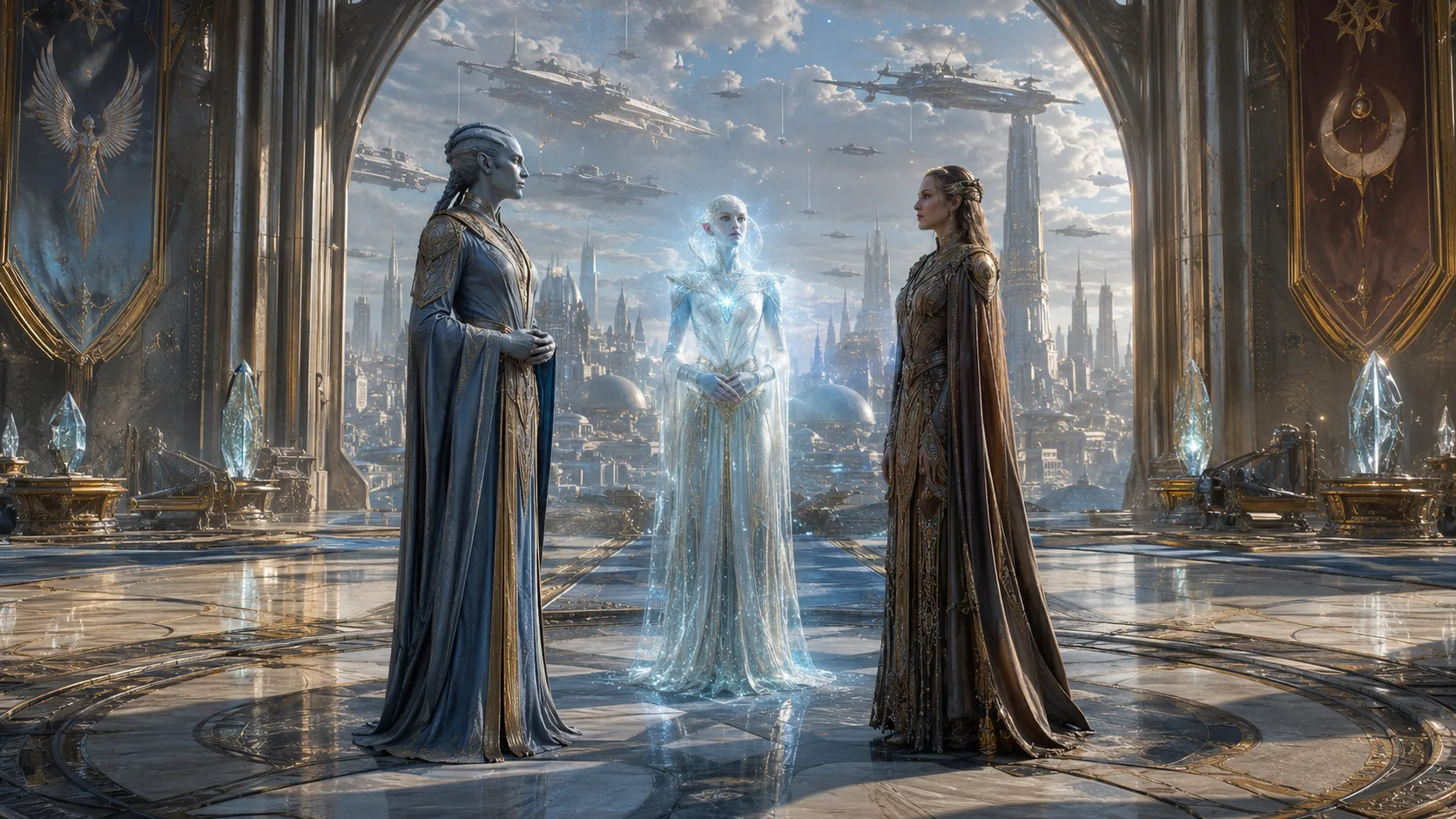
The Galactic Federation, in this origin tradition, was not formed as a luxury of advanced civilizations that simply wanted better diplomacy. It was formed as a defensive and ethical response to the Lyran catastrophe.
The lesson was clear: isolated civilizations could be targeted, broken, and scattered. Free worlds needed coordination. They needed shared defense, shared intelligence, and a common principle strong enough to unite very different species without erasing their sovereignty.
That principle became the foundation of the Federation: no single regressive power should be allowed to dominate the evolutionary path of conscious life.
This is what makes the Lyran Expansion the event that started everything. Without the persecution, there may have been no diaspora. Without the diaspora, there may have been no Pleiadian, Arcturian, or Andromedan branches in their current forms. Without the trauma of Lyra, there may have been no urgent need for a Federation at all.
The Federation was born from the promise that what happened to Lyra would not be allowed to happen unchecked again.
The Lyran Legacy Today
The Lyran legacy is not only ancient. It is active.
It appears anywhere beings choose freedom over control, memory over amnesia, and healing over revenge. It appears in the human hunger for the stars. It appears in our strange mixture of tenderness and defiance. It appears in the way we keep building, singing, searching, and loving despite histories of loss.
That may be the most powerful part of the story. The Lyrans were scattered, but they were not erased. Their descendants became healers, architects, guardians, rebels, diplomats, teachers, and eventually, humans asking why the stars feel so familiar.
The Lyran Expansion began as a catastrophe. But like many origin stories, it did not end where the wound began. It became a network. It became memory. It became the hidden thread connecting worlds that might otherwise have believed they were alone.
And if Earth humanity truly carries even a fragment of that inheritance, then the Lyran story is not just galactic history.
It is family history.
Cosmic Echoes
Share-ready comments you can copy in a click, then post wherever the conversation touches UFOs, UAP, or the Galactic Federation.
These comments belong to the Cosmic Echoes page under the section Ancient Starseeds: The Lyran Legacy Unveiled.
Plus 21 more comments on the Cosmic Echoes page.