
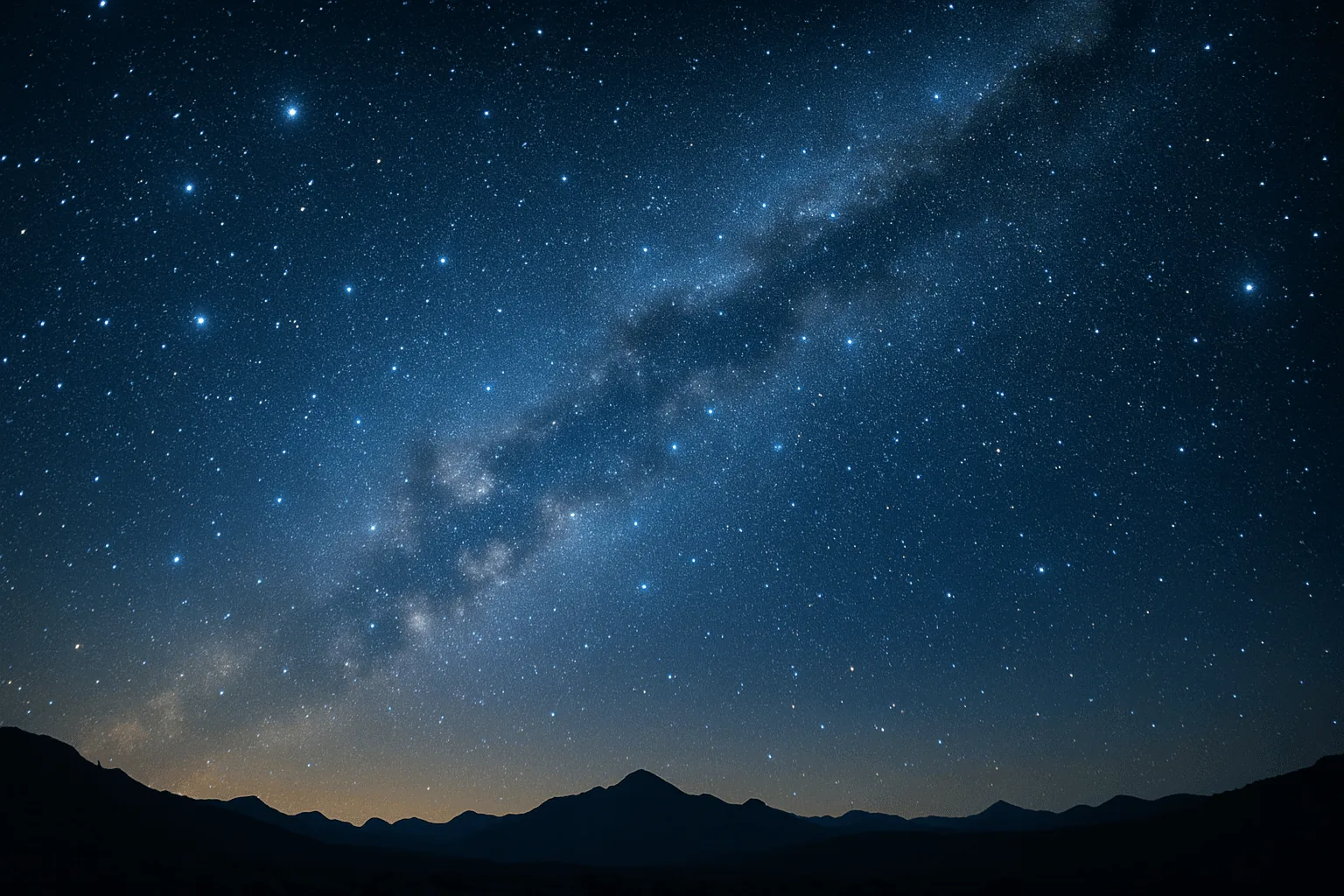
Step outside on a pitch-black night in a quiet place like southern Wyoming, far from the glare of city lights, and tilt your head back. The sky explodes with thousands of pinpricks of light, scattered like glitter across velvet. They don’t just sit there in a flat wallpaper of stars—they shimmer at different depths, some faint, some brilliant, some clustered, some solitary. The longer you stare, the more the sheer immensity of it all sinks in. What are you really looking at when you gaze into the universe?
Every Twinkle Is a Sun
The starry dome above isn’t made of little lights stuck to a ceiling. Each “dot” is a sun—just like our own Sun, but unimaginably far away. Some are bigger than our Sun, blazing as massive blue giants. Others are smaller, dim red dwarfs that outnumber every other type. They look like mere specks to us, but up close each one is a nuclear furnace, where hydrogen atoms are fused into helium, releasing enough energy to shine for billions of years.
Our Sun is just one of these stars. We happen to orbit it, but the vast majority of the stars you see almost certainly have their own planets. Modern astronomy has shown that planets are the rule, not the exception. That means many of the twinkling dots above may host whole planetary systems—worlds of ice, gas, rock, oceans, or even something stranger.
Light From the Past
The light you see from these stars is ancient. Because nothing moves faster than light, what you’re seeing is a kind of time travel. Sirius, the brightest star in our sky, is 8.6 light years away, so its light left that system nearly a decade ago. Betelgeuse, a red giant in Orion, is about 642 light years away—you’re seeing it as it was in the Middle Ages. Some stars visible to the naked eye are thousands of light years away, their light older than the Roman Empire.
Each star is a postcard from the past, a message carried across interstellar space to end up, improbably, in your eyes tonight.
The Depth of the Milky Way
On nights so clear you can see the Milky Way stretching across the sky, you’re actually looking through the plane of our galaxy. It’s like peering down the disk of a cosmic pinwheel. What looks like a hazy river of light is made of billions of stars, too densely packed for your eyes to separate. Every patch of that misty band is crowded with suns, many with their own planets.
Astronomers estimate the Milky Way contains about 100 to 400 billion stars. And that’s just our neighborhood. Beyond our galaxy are at least two trillion other galaxies, each with their own ocean of stars. The numbers push the limits of imagination.
The Question of Life
Here’s where the mind really stretches. If most stars have planets, and if even a small fraction of those planets sit in the “habitable zone” where liquid water can exist, then the Milky Way alone could host tens of billions of Earth-like worlds. Add in the fact that life on Earth emerged quickly once conditions allowed, and it seems almost inevitable that the universe is brimming with life.
When you stare into the night, you might be looking at suns that warm alien oceans, rocky worlds with mountain ranges and storms, or planets teeming with creatures whose existence we can only dream of. The odds that Earth is the only living world in such a vast universe are vanishingly small.
Why It Feels So Overwhelming
Standing under that Wyoming sky, the human brain wrestles with scale it wasn’t built to handle. Distances measured in trillions of miles. Time measured in millions of years. Numbers so huge they dissolve into poetry. It’s humbling and exhilarating at the same time.
What you’re really seeing is the universe unveiling itself. Not just stars, but history, physics, and possibility. Each sparkle is a reminder that we live in a vast cosmic ocean, and our planet is just one little island in it.
Conclusion: Awe as a Compass
The night sky can be overwhelming, but it’s also grounding. It reminds us that while our daily problems feel large, they’re tiny compared to the scale above. And yet, in that smallness, there’s wonder: we’re creatures who can look up, ask questions, and even build tools to measure worlds we cannot see.
So next time you step outside in the dark and see the stars, remember—you’re not just looking at twinkling lights. You’re looking across time, into the past of suns, into the possibilities of countless planets, and maybe, just maybe, into the neighborhoods of life itself. The sky isn’t just beautiful. It’s alive with meaning, mystery, and the promise that we are part of something unimaginably vast.
Questions & Answers About the Night Sky
Q: When I see a star twinkling, what exactly am I looking at?
A: You’re seeing a distant sun—an enormous ball of hot gas, mostly hydrogen and helium, burning through nuclear fusion. Each twinkle is ancient light that has traveled across space for years, centuries, or even millennia before reaching your eyes.
Q: How far away are the stars I see with the naked eye?
A: Most visible stars are within a few hundred to a few thousand light years away. The very closest, Proxima Centauri, is just 4.24 light years away. The farthest you can see unaided are thousands of light years off, their light older than human civilization.
Q: Do those stars have planets, like our Sun does?
A: Almost certainly. Modern astronomy has confirmed over 5,500 exoplanets, and the data suggests most stars have planetary systems. Odds are, nearly every star you see at night has at least one planet orbiting it.
Q: How do astronomers discover planets if they’re too small and faint to see?
A: They use indirect tricks. The most common are the transit method (a star dims slightly when a planet passes in front of it) and the radial velocity method (a star “wobbles” due to a planet’s pull, changing the color of its light slightly). Other methods include gravitational lensing, pulsar timing, and rare direct imaging.
Q: Am I looking at living worlds when I look up?
A: We can’t say for certain, but the chances are high. If most stars have planets, and billions of those planets are in zones where water could exist, then life may be common. The universe is too vast for Earth to be the only living world.
Q: Why does stargazing feel so overwhelming?
A: Because your eyes are trying to take in scales of distance, time, and number far beyond everyday life. Each star is both impossibly far and intimately connected to us by the light it sends. It’s humbling to realize that while we’re tiny, we’re also part of this grand cosmic story.
Q: Is the Milky Way the entire universe?
A: Not even close. The Milky Way is one galaxy with 100–400 billion stars. Beyond it are at least two trillion other galaxies. When you see the hazy arc of the Milky Way, you’re only looking at our little neighborhood in a much, much larger cosmic city.
Cosmic Echoes
Share-ready comments you can copy in a click, then post wherever the conversation touches UFOs, UAP, or the Galactic Federation.
These comments belong to the Cosmic Echoes page under the section Starlight Secrets: Unlocking the Universe.
Plus 21 more comments on the Cosmic Echoes page.