
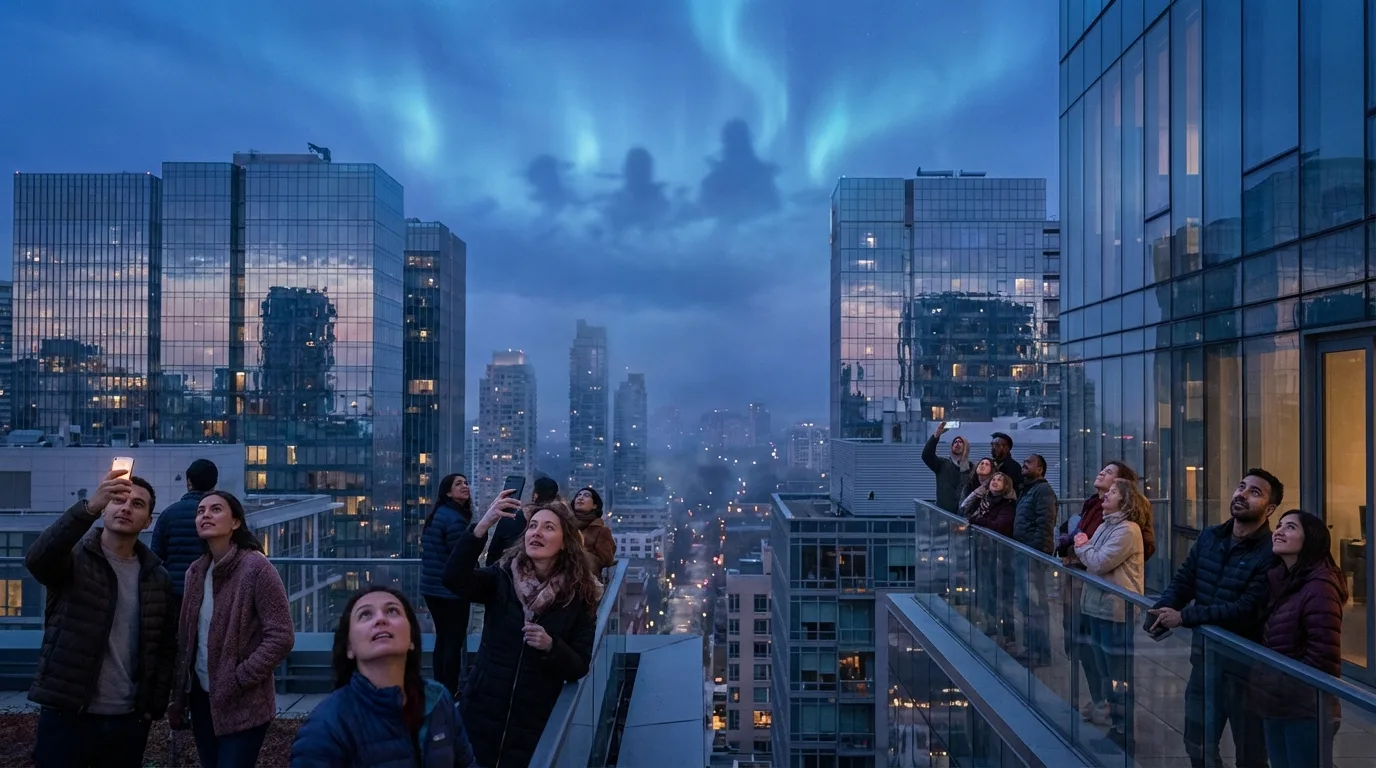
A Steven Spielberg science fiction film about UFOs would be notable in any year. In 2026, it lands differently.
Disclosure Day, scheduled for U.S. release on June 12, 2026, is being discussed not only as a major studio event, but as a cultural timing signal. The topic it touches, unexplained aerial observations, government transparency, public trust, and the psychological shock of not knowing, has moved from late-night punchline to official acronym. UFO became UAP. The joke became a hearing.
That shift is not a tidy story with a single reveal. It is a messy, modern story: sworn testimony alongside official denials, low-quality videos alongside serious policy language, genuine curiosity alongside misinformation ecosystems that can spin up a full alternate reality in a weekend.
In that atmosphere, a Spielberg-scale movie does something fascinating. It does not confirm anything. It does not need to. It amplifies the question: when institutions decide to speak, can they do it without turning truth into theater?
“Disclosure isn’t just a data release. It’s a trust event.”
Why Spielberg matters, even before we know the plot
Spielberg has spent decades filming the unknown with a particular kind of gravity. Even when his stories turn tense, he understands the human scale: families, neighborhoods, the quiet panic of ordinary people looking up and realizing the sky is not a backdrop, it’s a stage.
That’s why Disclosure Day is already interesting without a detailed public synopsis. The director’s fingerprint suggests the movie will lean toward wonder, dread, and moral weight rather than cheap apocalypse spectacle. It also suggests something else: mainstream readiness.
Pop culture can be an early warning system for what a society is prepared to process. Spielberg returning to a UFO-adjacent idea in the mid-2020s reads like a cultural nod: this topic has matured enough to be treated as adult drama, not novelty.
The cast reinforces that tone. Emily Blunt, Josh O’Connor, Colin Firth, Eve Hewson, and Colman Domingo signal a story that wants credibility and character over camp. According to the film’s public listings, Blunt plays a Kansas City TV meteorologist, a choice that feels almost symbolic. Meteorology is the art of explaining uncertainty to the public without causing a stampede. Models, probabilities, incomplete data, public safety messaging. That is disclosure in miniature.
The civilian lens is the point
If disclosure ever happens in a meaningful way, it will not be experienced first as a classified briefing. It will be experienced as a news alert, a group chat, a shaky live stream, a press conference, and a thousand competing interpretations fighting for dominance.
A meteorologist protagonist fits that world. A person trained to speak clearly while the sky misbehaves.
The real world shift: from ridicule to record
The modern UAP era is defined less by a single smoking gun and more by institutional behavior changing in daylight.
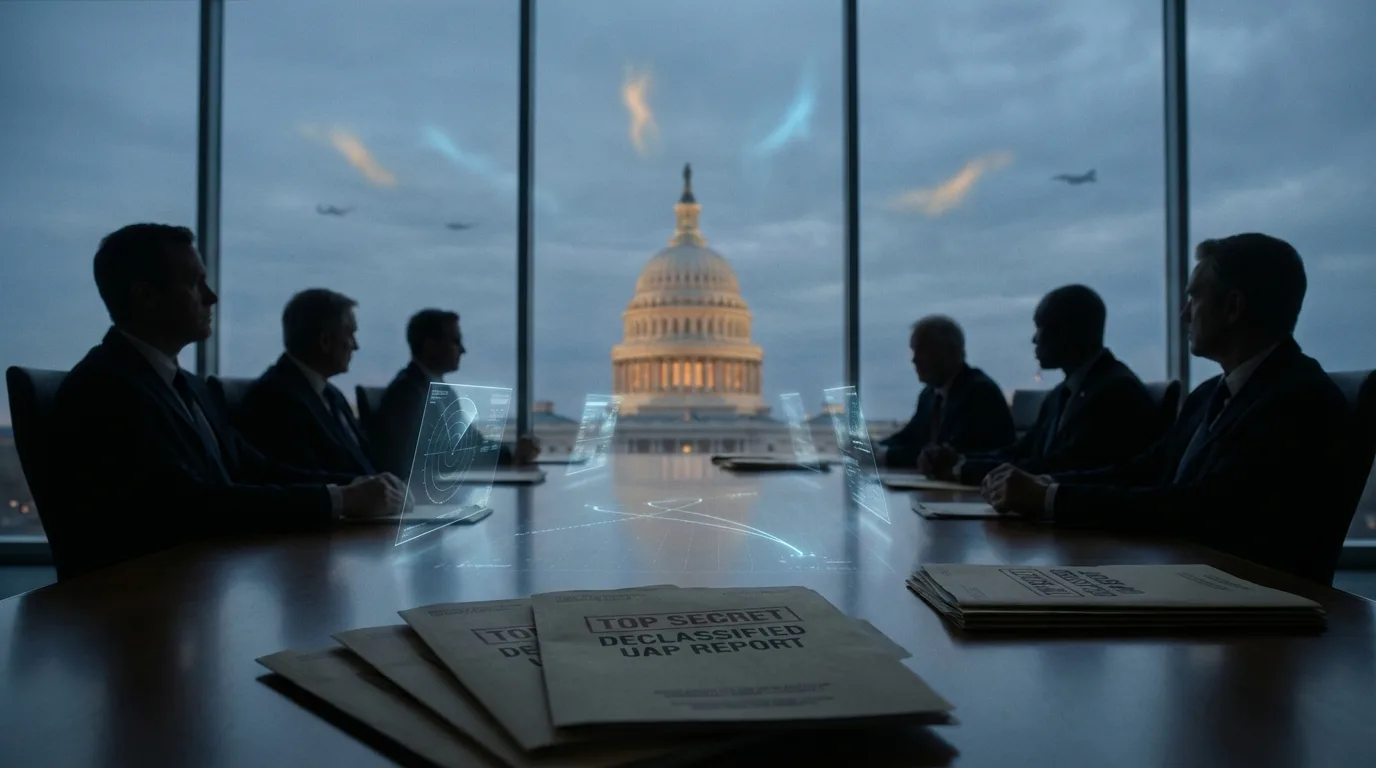
In July 2023, the U.S. House Oversight subcommittee held a high-profile public hearing on “Unidentified Anomalous Phenomena,” featuring testimony from former Navy pilots and former intelligence official David Grusch. The mere fact of that hearing matters: UAP as a formal subject of government transparency discussion, on the record, in a room built for accountability.
At the same time, official statements consistently emphasize limits. The Department of Defense’s All-domain Anomaly Resolution Office (AARO), established to improve UAP reporting and analysis, presents itself as data-driven and methodical. Public-facing updates and imagery pages reflect a basic truth that rarely survives internet retellings: many cases are resolved as ordinary objects or sensor artifacts, and some remain unresolved due to insufficient data, not necessarily exotic explanations.
NASA enters the conversation from a different angle. Its independent UAP study team releases a final report in September 2023 emphasizing an evidence-based approach and the need for better data. That matters because it reframes the topic as a scientific measurement problem, not a belief war.
So the shift is not “the government admits aliens.” The shift is subtler and, in many ways, more significant: governments and major institutions now acknowledge that reports exist, that pilots and sensors capture anomalies, and that processes are being built to standardize reporting and analysis.
A quick timeline of the modern UAP mainstreaming
| Year | Public-facing milestone | Why it matters culturally |
|---|---|---|
| 2022 | AARO is established to coordinate UAP reporting and analysis | Signals institutionalization of the topic as an ongoing process |
| 2023 | NASA UAP study team releases final report (Sept 2023) | Frames UAP as a data problem and calls for rigorous methods |
| 2023 | U.S. House Oversight subcommittee holds public UAP hearing (July 26, 2023) | Moves UAP discussion from stigma to official record |
| 2024 | ODNI releases a consolidated annual UAP report (unclassified version) | Normalizes periodic reporting and reduces “black box” mystery |
| 2025–2026 | Conferences, panels, and reporting continue | Keeps pressure on transparency, standards, and trust |
This is the environment Disclosure Day drops into. Not a world of certainty, but a world of process, pressure, and narrative struggle.
The dangerous part is not the unknown, it is the storytelling
A society can handle uncertainty. People live with uncertainty every day. What we are less good at is uncertainty plus manipulation.
That is why “disclosure” is such a loaded word. It’s not only about releasing information. It’s about how information is framed, who controls the framing, and what emotions are activated to steer public behavior.
In an era of deepfakes and content floods, any announcement about UAP would be instantly surrounded by counterfeit versions of itself. Fake documents. Fake videos. Fake “leaks.” Confident voices telling you what to feel, who to blame, and what must be done next.
That is where the fear of psychological operations grows. Not as a guaranteed plot, but as a reasonable civic anxiety: if disclosure happens, could it be used to manufacture consent, distract from failures, or justify new powers?
The responsible posture is not to declare that kind of manipulation is happening. It is to admit the vulnerability exists, and to build better immune systems.
“The first casualty of disclosure wouldn’t be normal life. It would be consensus.”
Evidence-first is not boring, it’s survival
For readers who live in UAP culture, it can be tempting to treat any official move as either proof or cover-up. Both instincts are emotionally satisfying. Both are intellectually hazardous.
An evidence-first approach looks more like this:
- Separate testimony from physical evidence
- Separate unresolved from unexplainable
- Ask what sensors captured, under what conditions, with what error bars
- Track what was actually said in public record versus what is repeated online
- Accept that multiple explanations can coexist: misidentification, classified tech, sensor artifacts, and genuinely anomalous cases
That mindset is not anti-wonder. It is pro-reality.
Disclosure as a trust event, not an alien event
If tomorrow a government stood up and announced, “We have definitive evidence of nonhuman technology,” the biggest immediate story would not be the technology. It would be legitimacy.
Who would believe it?
Who would reject it?
Who would try to monetize it?
Who would weaponize it?
How quickly would markets, religion, geopolitics, and social media begin rewriting their own rules?
And what if the announcement was more modest, more realistic, and therefore more destabilizing? Something like: “We have persistent unexplained observations. We don’t know what they are. We are releasing data and improving collection.” That kind of disclosure does not satisfy the hunger for answers, but it still forces a reckoning: the world is less legible than we assumed.
Spielberg has always understood that the scariest thing is not a monster. It’s the collapse of the familiar story we tell ourselves about reality.
Ethical disclosure principles that actually help
If leaders ever attempt public disclosure in a serious way, the ethical version would likely include some boring, beautiful fundamentals:
- Plain language, not militarized metaphor
Avoid framing the unknown as an enemy by default. Words like “threat” have consequences. - Evidence standards stated upfront
What counts as verified? What remains unresolved? What is still classified and why? - Data release with context, not raw dumps
A flood of files without interpretation invites conspiracy, confusion, and grift. - Independent oversight and cross-checking
Credibility rises when multiple institutions can validate claims. - Media responsibility agreements
Encourage reporting that distinguishes confirmed facts, hypotheses, and speculation. - Misinformation mitigation
Provide authentication tools for official videos and documents so deepfakes can be challenged quickly.
This is the unglamorous scaffolding of public trust. Without it, “disclosure” becomes just another content war.
Conferences, panels, and the slow normalization of the weird
While Hollywood builds a spectacle, the real world has been doing something quieter: building a culture of discussion in public.
UAP conferences and panels now range from sensational to sober, but the overall trend is unmistakable: the subject is no longer automatically disqualifying. Researchers talk about sensor fusion. Journalists talk about oversight. Pilots talk about safety. Policy people talk about reporting pipelines. Even skeptics are engaging more thoughtfully, focusing on data quality and institutional incentives rather than ridicule.
That matters because cultural readiness is not just belief. It’s vocabulary. It’s the ability to talk about something strange without immediately turning it into either comedy or panic.
Disclosure Day can ride that readiness and amplify it. It can also stress-test it. A big movie can reignite lazy tropes: invasion narratives, heroic militarism, the public as helpless. Or it can do something more useful: portray how adults actually behave when reality shifts.
The societal implications that a serious film can’t avoid
Even without claiming answers, a disclosure story inevitably touches deep cultural nerves:
Science: the demand for better instruments
If the unknown persists, the next chapter is not a press conference. It is measurement. Better sensors, better reporting standards, better public datasets. NASA’s approach underscores this point: without reproducible, high-quality data, confidence collapses into argument.
Faith: meaning absorbs shock in different ways
Faith traditions are not monoliths. Some interpret cosmic plurality as compatible with theology, others as destabilizing, others as irrelevant. A disclosure moment would not erase belief. It would remix it, sometimes peacefully, sometimes with friction.
Identity: what happens to “human exceptionalism”
A large chunk of modern identity is built on a quiet assumption: we are the primary characters. Disclosure, even partial, challenges that story. Not necessarily in a humiliating way, but in a growing-up way.
Geopolitics: the race to define the narrative
If something truly unknown exists, nations will compete to control the interpretation, not just the data. Even the language used in official statements can become strategic.
Media: the difference between informing and inflaming
The media ecosystem is now optimized for velocity and emotion. Disclosure requires slowness and nuance. That mismatch could be the real crisis.
“The question is not ‘Are we alone?’ The question is ‘Can we tell the truth without turning it into a weapon?’”
So what should we watch for as the release approaches?
If Disclosure Day becomes a genuine cultural moment, it will likely happen in the conversation around it, not only on screen.
Watch for:
- Whether mainstream coverage treats UAP as a governance and data issue, not just entertainment
- Whether misinformation accelerates around trailers, “leaks,” and fake clips
- Whether public trust language enters the discussion: oversight, evidence standards, transparency
- Whether the film sparks healthier curiosity or reverts to panic tropes
- Whether audiences leave with questions that are better, not just louder
Practical media literacy for the UAP era
A short checklist for readers navigating the coming noise:
- Verify primary sources when possible: official hearing pages, agency sites, published reports
- Be wary of “confirmed” language without documentation
- Treat viral clips as untrusted until authenticated
- Separate “unresolved” from “unexplained by any means”
- Notice emotional manipulation: urgency, fear, scapegoating, certainty theater
This is not cynicism. It’s hygiene.
The big ending question: what would trustworthy disclosure look like?
The most interesting thing about Disclosure Day may be what it forces us to articulate.
Not “what do you believe,” but:
- What evidence would you need to change your mind?
- Who do you trust to validate that evidence, and why?
- What would responsible government transparency look like, step by step?
- How should media cover uncertainty without turning it into panic content?
- How do we keep wonder alive without abandoning skepticism?
If a real disclosure day ever arrives, it will not be a single moment. It will be a sequence of moments: data releases, hearings, arguments, corrections, new instruments, revised assumptions. It will be slow and loud at the same time.
Spielberg’s film will not be the event. But it might be the mirror. And the reflection it shows us is the part worth studying: a species learning, awkwardly, how to look up without hallucinating, and how to demand truth without turning it into a weapon.

Cosmic Echoes
Share-ready comments you can copy in a click, then post wherever the conversation touches UFOs, UAP, or the Galactic Federation.
These comments belong to the Cosmic Echoes page under the section Cosmic Echoes: Disclosure Day Awakens.
Plus 21 more comments on the Cosmic Echoes page.