
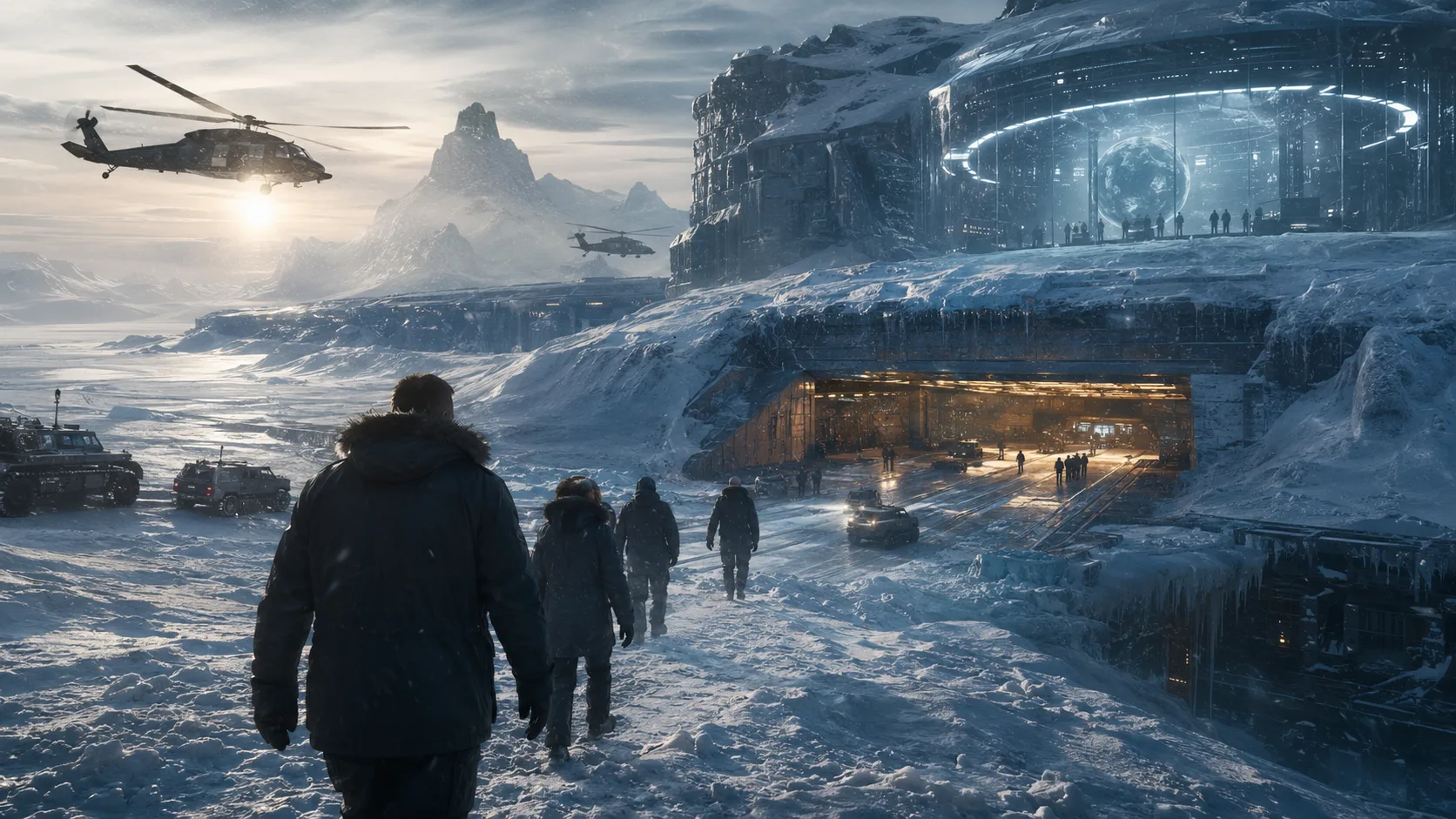
Antarctica is not just a continent. It’s a locked room at the bottom of the world.
No cities. No native population. No normal borders. No ordinary press access. No permanent sovereign ruler. Just ice, treaties, military logistics, research bases, satellite silence, and a strange pattern of elite visitors who appear there briefly, say very little, then leave.
That alone should make people ask harder questions.
The official story is always clean. Science. Climate. Cooperation. Diplomacy. Research. Penguins, if the visitor is religious enough or the camera angle is useful enough. But the deeper question isn’t whether Antarctica has scientists. Of course it does. The question is why the most inaccessible landmass on Earth is also the one place where political authority becomes strangely blurred.
Because Antarctica is not simply remote. It is legally unique.
And in the First Council theory, that uniqueness is not accidental. It is the point. The theory argues that Antarctica functions as the physical interface between visible Earth governments and a hidden hierarchy above them, a hierarchy in which human leaders do not arrive as rulers, but as managed representatives inside a larger system of control. The core idea, drawn from the provided article notes, is that Antarctica is where Earth’s political class meets the authority structure that actually sits above it.
That claim is not proven by public documents. But the public record does give us something worth examining, a continent designed as a jurisdictional blind spot, a cluster of high-profile visits in 2016, and a growing list of former insiders and public figures who have openly claimed that governments are not alone in managing the human story.
The Continent Built for Secrecy
Start with the architecture.
The Antarctic Treaty says Antarctica is to be used for peaceful purposes and scientific investigation, and it freezes the sovereignty question rather than resolving it. Seven countries entered the treaty system with territorial claims, while other countries do not recognize those claims. Article IV preserves everyone’s position while preventing new claims from being asserted. In plain English, Antarctica is governed, but not owned in the normal way. (Antarctic Treaty System)
That makes it unlike any other major landmass on Earth.
The treaty also says Antarctic facilities are open to inspection by treaty observers, and treaty parties are supposed to share information about their activities. On paper, that sounds transparent. In practice, the continent remains almost completely inaccessible to ordinary people. You don’t stumble into Antarctica. You don’t drive there. You don’t wander near the wrong facility with a phone camera and a livestream. Every movement requires logistics, permission, aircraft, ships, weather windows, and institutional backing. (Antarctic Treaty System)
So the contradiction sits right in front of us.
Antarctica is described as open, but it is functionally closed. It is described as cooperative, but it is controlled by a limited group of treaty powers. It is described as peaceful, yet military aircraft, military logistics, and state infrastructure are deeply embedded in its operation under “peaceful purpose” exceptions. (The Nuclear Threat Initiative)
That doesn’t prove a hidden council exists. But it does explain why Antarctica is the perfect place to put one.
If you wanted a meeting ground beyond ordinary sovereignty, beyond public oversight, beyond civilian access, beyond normal jurisdiction, and beyond the daily noise of politics, you would not choose Washington, Moscow, Beijing, London, or Brussels.
You would choose the ice.
The 2016 Antarctica Cluster
The strange part is not that important people visit Antarctica. The strange part is the timing, the profile of certain visitors, and the thinness of the public explanation.
In February 2016, Russian Orthodox Patriarch Kirill traveled to Antarctica after his historic meeting with Pope Francis in Cuba. He visited Russia’s Bellingshausen Station on King George Island and conducted a prayer service at the southernmost outpost of the Russian Orthodox Church. The Guardian reported that he became the first head of the Russian Orthodox Church to visit the seventh continent. (The Guardian)
Then came November 2016.
John Kerry landed in Antarctica on November 11, 2016, just days after the U.S. presidential election. CBS/AP reported that Kerry became the highest-ranking American official to visit Antarctica, arriving for a two-day trip framed around climate science. The trip involved military aircraft, McMurdo Station, and a planned stop near the South Pole. (CBS News)
Then, in December 2016, Buzz Aldrin, the Apollo 11 astronaut and one of the most symbolically important space figures alive at the time, was medically evacuated from the South Pole. CollectSPACE reported that Aldrin was visiting as part of a tourist group when his condition deteriorated and he was flown to Christchurch, New Zealand for care. (collectSPACE.com) Wired later reported Aldrin said the evacuation was due to altitude sickness and that he had hoped to discuss Antarctic research in relation to Mars. (WIRED)
Taken separately, each event has an explanation.
Kirill went for religion. Kerry went for climate. Aldrin went for adventure and Mars analog research.
Taken together, the pattern becomes harder to wave away. A major religious authority tied closely to Russian power. A top U.S. diplomat arriving immediately after a destabilizing election. A legendary astronaut, connected forever to humanity’s first official step onto another world, suddenly appearing at the South Pole and leaving under emergency circumstances.
That is why the 2016 cluster became fuel for the Antarctica Council theory.
Not because one itinerary proves the whole structure. It doesn’t. But because power rarely gathers at the edge of the map by accident.
The Official Explanations Are Too Small for the Pattern
The climate explanation for Kerry’s visit is plausible on its face. Antarctica is central to climate science. The South Pole matters. Ice sheets matter. Sea level matters.
But the timing still matters too.
Kerry did not visit Antarctica during an ordinary diplomatic week. He arrived immediately after Donald Trump’s election, at a moment when American foreign policy, climate policy, and intelligence priorities were about to be thrown into uncertainty. CBS/AP noted that Kerry had congratulated Trump in Christchurch before continuing toward Antarctica. (CBS News)
That may be coincidence.
But “coincidence” is often the word used when institutions don’t want to explain timing.
Patriarch Kirill’s trip is equally interesting. The public-facing imagery was almost comical, the patriarch among penguins, a prayer service in the cold, a symbolic visit to a remote church. But Kirill was not merely a religious figure. The Guardian noted his close relationship with Vladimir Putin. (The Guardian) In geopolitical terms, that makes his presence in Antarctica more than pastoral tourism.
Aldrin’s case is different. He was not a sitting state official. But symbolically, he carried something even heavier, the moon landing, NASA mythology, Mars advocacy, and the old secret-space-program imagination all in one person. Wired reported that Aldrin said he wanted to compare Antarctic conditions with what life could be like on Mars. (WIRED)
And that is where the Antarctica theory widens.
Because in alternative research circles, Antarctica is not treated as an isolated mystery. It is treated as one node in a larger network, Antarctica, Mars, the Moon, deep state programs, underground infrastructure, and non-human contact.
The “Galactic Federation” Claim Did Not Come From Nowhere
The phrase “Galactic Federation” sounds absurd to mainstream ears. That is part of why it survives. The label is so strange that most journalists laugh before they investigate.
But the phrase entered global headlines because a former Israeli space security chief, Haim Eshed, publicly claimed that such a federation exists. The Jerusalem Post reported in 2020 that Eshed claimed a “Galactic Federation” had supposedly been in contact with Israel and the United States for years, while remaining hidden because humanity was not ready. (Jerusalem Post)
The Times of Israel reported that Eshed also claimed extraterrestrials conduct experiments on Earth and that there is a joint underground base on Mars involving American astronauts and aliens. (The Times of Israel)
Again, that is not public proof. It is a claim. But it is not the claim of an anonymous message-board account. Eshed was a former senior space figure in Israel. His background gave the story weight, even among people who rejected his conclusions.
Paul Hellyer, Canada’s former defense minister, also spent years discussing extraterrestrials, global secrecy, and what he described as hidden power structures. In a Reddit AMA posted under his name, Hellyer introduced himself as a former Canadian minister of national defense and explicitly invited questions about extraterrestrials, the global financial cabal, and related topics. (Reddit)
David Grusch, a former U.S. intelligence official, later told lawmakers that he had been informed of a multi-decade crash retrieval and reverse-engineering program and claimed “non-human biologics” had been recovered, while also acknowledging he had not personally seen alien bodies or craft. The Guardian’s coverage emphasized both the explosive nature of the claims and the absence of public physical proof. (The Guardian)
Then there is Gary McKinnon, the British hacker who claimed he entered NASA systems while searching for UFO evidence. Wired reported that McKinnon said he found references to “Non-Terrestrial Officers” and images he believed were not man-made, though he also conceded some material could potentially have been a game or hypothetical exercise. (WIRED)
These accounts do not all say the same thing. They do not prove one another. But they rhyme.
They point toward a recurring allegation: that the public government is not the top layer of the system.
Why Antarctica Fits the First Council Model
The First Council theory places Antarctica at the bottom of a hidden chain of command, not because it is mystical, but because it is practical.
A hidden authority needs four things.
First, it needs distance. Antarctica provides that better than anywhere else on Earth.
Second, it needs legal ambiguity. The treaty system freezes sovereignty and creates a continent where no ordinary national framework fully applies in the public imagination.
Third, it needs controlled access. Antarctica is not impossible to visit, but it is impossible to casually investigate.
Fourth, it needs symbolic neutrality. No capital city can host a meeting of “Earth management” without implying one nation outranks the others. Antarctica avoids that problem. It is not anyone’s capital. It is everyone’s exception.
That is what makes the theory compelling. Not that Antarctica is empty, but that it is perfectly designed for compartmentalization.
A president can visit and call it science. A diplomat can visit and call it climate. A religious authority can visit and call it prayer. A space icon can visit and call it exploration. Each explanation works alone. None explains the deeper pattern.
The Chain of Power: From Ice to Policy
The First Council theory argues that decisions made in Antarctica do not appear publicly as “orders from above.” They surface as policy drift.
A government changes its defense posture. A space agency shifts language. Intelligence agencies soften or harden disclosure. Religious institutions reposition around cosmic theology. Environmental rules tighten in one zone and loosen elsewhere. Financial systems move in lockstep. Nations that appear hostile in public quietly cooperate in areas where the hidden structure requires alignment.
That last point is crucial.
Antarctica has always been a place where adversaries cooperate. The treaty emerged from Cold War-era scientific cooperation and created a structure where rival powers could work under one framework. NTI describes the treaty as a system that froze territorial claims, prohibited military measures, and created decision-making through consultative parties. (The Nuclear Threat Initiative)
In public, this is celebrated as diplomacy.
In the First Council framework, it is read differently: as evidence that Antarctica is where the visible conflict of nations gives way to a deeper shared management system.
That is the hard question. What do rival powers agree on when nobody is watching?
The Infrastructure Question
Skeptics often say Antarctica cannot hide anything because treaty inspections exist. But that answer is too neat.
The treaty system allows inspections among consultative parties, but inspections are not the same as public transparency. They are state-to-state mechanisms inside the same elite architecture that already governs access. The public does not get real-time maps of every tunnel, restricted structure, aviation movement, classified logistics package, or sensor installation. The public gets summaries, science outreach, selected photographs, and occasional human-interest stories.
That doesn’t prove hidden non-human infrastructure.
But it does mean the public is not in a position to rule it out simply by pointing at the word “inspection.”
Antarctica’s known infrastructure is already extraordinary by civilian standards: airfields on ice, remote stations, seasonal populations, heavy logistics, deep-field camps, satellite communications, and international coordination in conditions that would kill an unprepared person quickly. A continent that can hide entire mountain ranges under ice can certainly hide human-built facilities from ordinary view.
The question is whether anything beyond ordinary research infrastructure exists.
Public documentation does not prove that it does. The First Council theory says the absence of public documentation is exactly what we should expect.
The Buzz Aldrin Myth Problem
No serious Antarctica article can ignore the viral Aldrin “evil pyramid” story.
A claim circulated online that Aldrin had tweeted about something evil in Antarctica. AAP FactCheck reported that the purported tweet lacked signs of authenticity, that no archived version was found, and that Aldrin’s actual medical emergency was altitude sickness with lung congestion, not a heart attack or an encounter with an evil pyramid. (AAP)
That matters because bad evidence weakens strong questions.
The Aldrin evacuation is real. The viral “evil itself” quote is not verified. Treating fake screenshots as proof makes it easier for critics to dismiss the entire Antarctica question.
The better argument is not “a fake tweet proves Antarctica is hiding demons.”
The better argument is this: why did 2016 produce such a dense symbolic convergence around Antarctica, and why does the official record feel so strangely uninterested in that convergence?
The Real Mystery Is Not Aliens. It’s Power.
The most important part of the Antarctica Council theory is not reptilians, Grays, or any named non-human faction. Those claims sit beyond what public evidence can confirm.
The more important part is the power model.
Modern people are taught that government power is visible. Elections, cabinets, parliaments, agencies, courts, treaties, press conferences. That is the civics-class version of reality.
But anyone who has watched the world closely knows visible power is only part of the machine. Intelligence networks, private contractors, central banks, defense firms, elite conferences, religious diplomacy, black budgets, classified research, and transnational institutions all shape outcomes without appearing on a ballot.
The Antarctica theory takes that logic one step further. It asks whether Earth’s visible leaders are themselves mid-level managers.
That is why the idea hits so hard. It does not merely say there are secrets. It says the public has mistaken the employees for the owners.
The Hidden World Beneath Our Feet
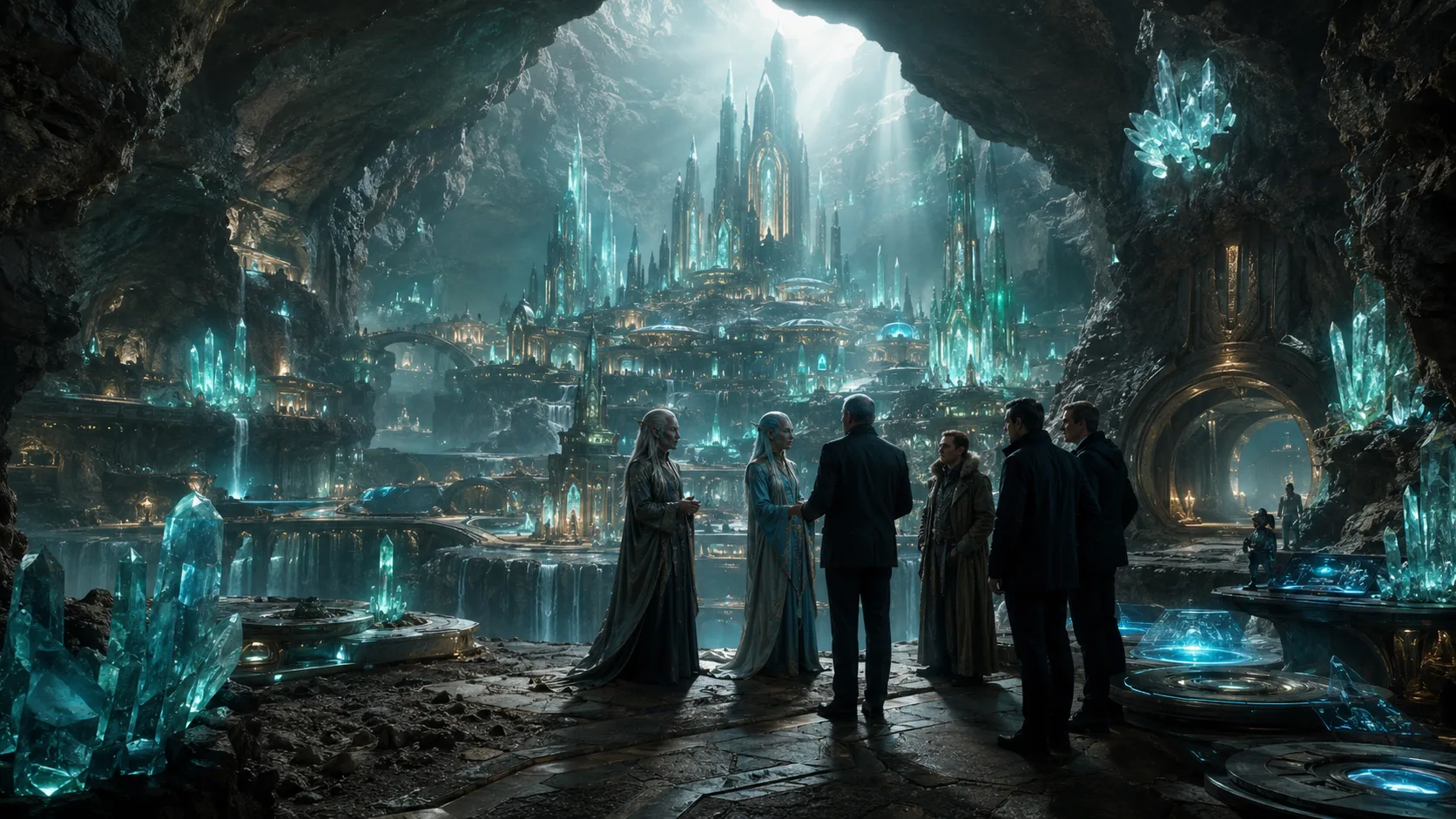
The Inner Earth theory suggests that some of humanity’s greatest mysteries may not come from the stars alone, but from worlds hidden beneath the surface of our own planet. In this view, deep caverns, ancient tunnel systems, crystal cities, and sealed underground domains may serve as meeting points between advanced non-human civilizations and the governments that manage life on the surface.
What makes the Inner Earth concept so powerful is that it changes the direction of the mystery. Instead of only looking upward for contact, it asks us to look downward, into the planet itself. The theory imagines Earth as a layered world, with surface nations operating in public while older, quieter, and more advanced civilizations remain hidden below.
In this framework, the beings associated with Inner Earth are not simply hiding from humanity. They are described as observers, advisors, gatekeepers, and sometimes quiet partners in planetary affairs. Their relationship with surface governments is often framed as controlled cooperation, not open disclosure. Information, technology, and policy influence would move carefully through selected channels, intelligence networks, private councils, and protected diplomatic structures.
The most fascinating part of this idea is the possibility that Inner Earth civilizations may see themselves as caretakers of the planet rather than outsiders. From that perspective, their interest in human governments would not be random. They would monitor how surface societies handle war, environmental damage, nuclear technology, spiritual development, and the long-term stability of Earth itself.
This is why Inner Earth stories often feel different from ordinary alien-contact narratives. The setting is more intimate. These beings are not arriving from across the galaxy in a distant craft. They are imagined as living inside the same planetary body, close enough to understand humanity, but hidden enough to remain beyond public control. Their world becomes a mirror, reminding us that Earth may be far more complex, inhabited, and politically layered than surface history admits.
Editorial concept: an Inner Earth contact scene exploring the possibility of hidden subterranean civilizations, secret cooperation with surface governments, and the deeper mystery of who may be guiding Earth from within.
Conclusion: Antarctica Is the Map’s Missing Center
Antarctica sits at the bottom of the world, but in the hidden-power imagination, it sits at the center of the system.
Its legal structure is unusual. Its access is controlled. Its sovereignty is suspended. Its logistics are militarized while described as peaceful. Its visitors sometimes arrive with world-historical timing and leave behind explanations that feel smaller than the events themselves.
None of that proves a First Council of human and non-human authorities meets beneath the ice.
But it does prove Antarctica deserves more scrutiny than it gets.
The public is asked to accept a childish version of the continent: penguins, ice cores, climate charts, heroic scientists, and occasional VIP photo opportunities. The adult version is more complicated. Antarctica is a legally exceptional territory where rival powers cooperate, military systems operate under peaceful labels, and the normal rules of public visibility do not apply.
Whether the First Council is literal, symbolic, or still waiting for proof, the underlying warning remains the same.
The most important rooms in the world are not always in the places we are told to look. Sometimes they are placed where almost nobody can go, where no nation fully rules, where every explanation sounds reasonable by itself, and where the ice keeps its mouth shut.

Cosmic Echoes
Share-ready comments you can copy in a click, then post wherever the conversation touches UFOs, UAP, or the Galactic Federation.
These comments belong to the Cosmic Echoes page under the section Frozen Thrones: Antarctica’s Hidden Power Players.
Plus 21 more comments on the Cosmic Echoes page.