
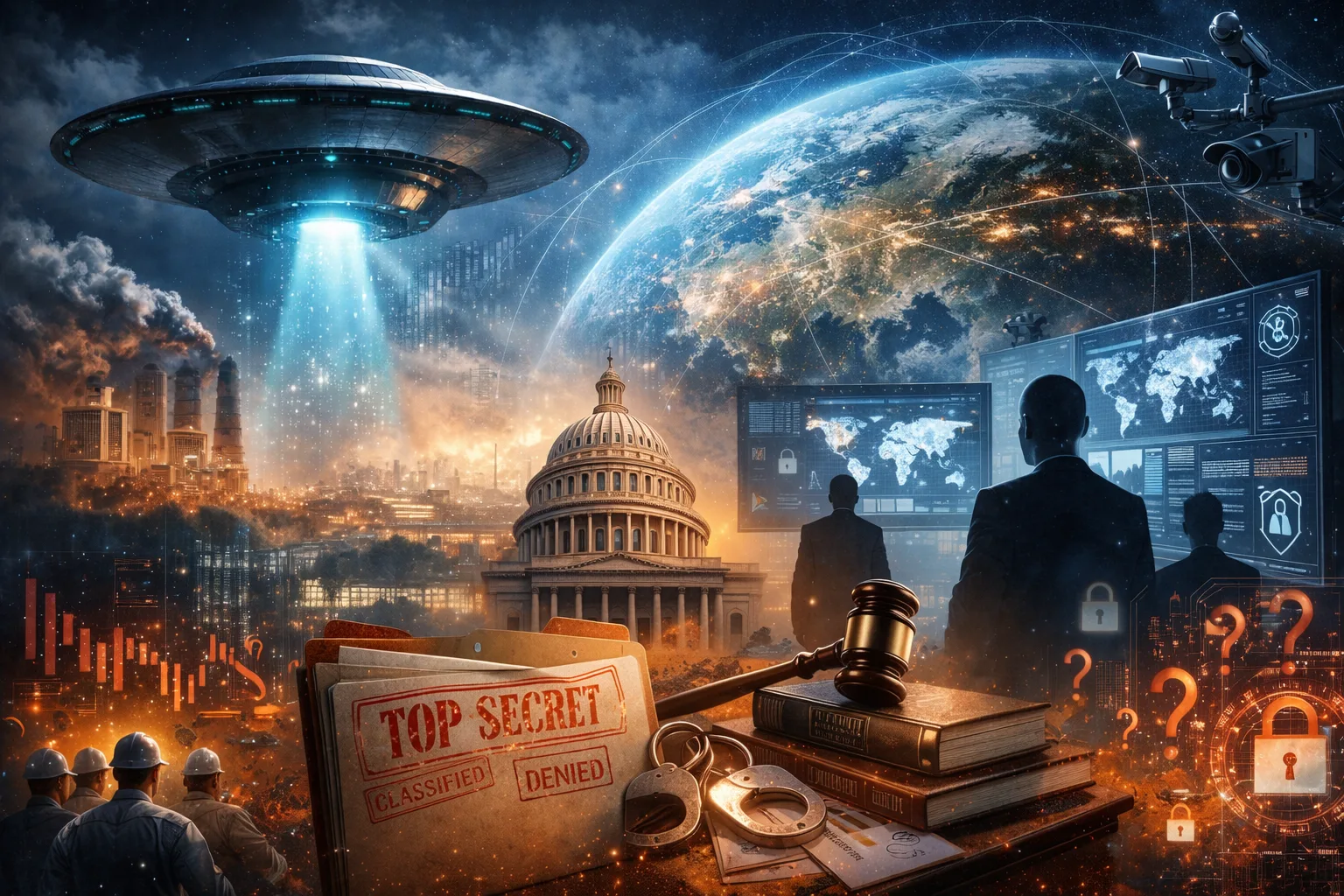
It’s About Power and Knowledge Control
The loudest arguments in the UFO debate are also the least important.
Are they real.
Are they extraterrestrial.
Are governments hiding bodies or craft.
Those questions dominate headlines and comment sections, but they miss the deeper issue entirely. The true conflict underneath the UFO debate is not about beings or machines. It’s about who controls knowledge, who decides when society is ready, and who bears the authority to withhold reality itself.
Strip away the spectacle, and what remains is a power struggle over information.
Knowledge Has Always Been a Strategic Asset
Throughout history, societies have been shaped less by what exists than by who is allowed to know it.
Navigation techniques were once state secrets.
Gunpowder formulas were guarded.
Nuclear physics was classified.
Cryptography was restricted.
In every case, knowledge was treated not as a public good, but as a strategic weapon. Access determined power. Timing determined stability. Disclosure was never moral by default. It was calculated.
The UFO debate sits squarely inside this tradition.
If anomalous technologies or unexplained phenomena exist at the edge of understanding, the question isn’t why they’re hidden. The question is why people assume they wouldn’t be.
The Illusion of a Fully Informed Public
Modern democracies are built on the idea of informed consent. Citizens believe legitimacy flows from transparency, debate, and shared understanding.
In practice, no complex system functions that way.
Governments already operate with layers of restricted knowledge. Military planning, intelligence gathering, cybersecurity vulnerabilities, and economic stabilization strategies are not crowdsourced for a reason.
Total transparency is not a working model. It’s a philosophical ideal.
UFO discourse exposes the discomfort people feel when they confront that reality directly.
The Problem Isn’t Secrecy
It’s Asymmetry
What destabilizes societies is not hidden information alone. It’s asymmetric awareness.
When institutions know radically more than the public about forces that shape reality, trust erodes. Every decision begins to feel manipulated. Every official statement sounds incomplete, even when it’s accurate.
That gap becomes fertile ground for speculation, paranoia, and radicalization.
Ironically, attempts to preserve stability through secrecy can produce the very instability they were meant to prevent.
Why UFOs Trigger a Unique Anxiety
Unidentified phenomena hit a psychological nerve that other classified topics don’t.
They challenge assumptions about:
- Humanity’s place in the universe
- The limits of scientific understanding
- The completeness of public knowledge
- The legitimacy of authority
Even without confirmation, the possibility destabilizes certainty. That makes UFOs less like a technical issue and more like an epistemological one.
They force a question most systems avoid:
What if reality is bigger than what you’re allowed to see?
Control Over Narrative Is Control Over Meaning
When institutions manage UFO discourse, they aren’t just controlling data. They’re shaping interpretation.
Language matters. Objects become “phenomena.” Sightings become “incidents.” Unknowns become “anomalies.” Each term reduces existential weight and contains public reaction.
This isn’t deception in the cinematic sense. It’s framing.
Every system that governs large populations understands this principle: meaning is more dangerous than facts.
A single ambiguous video can spark panic or curiosity depending on how it’s contextualized. Information without narrative creates chaos. Narrative without information creates suspicion.
Balancing the two is a power exercise, not a moral one.
The Myth of the Final Reveal
Pop culture trains people to expect a moment of disclosure. A press conference. A document dump. A clean line between before and after.
That’s not how complex truths enter society.
Revelations that destabilize worldviews are introduced gradually, indirectly, and often ambiguously. They leak through language shifts, policy changes, funding reallocations, and institutional restructuring.
The absence of a dramatic reveal does not mean nothing is happening. It means the system is avoiding shock.
Shock Is the Enemy of Control
Rapid truth destabilizes hierarchies. It creates uncontrollable reactions. It invites actors with agendas to exploit confusion.
From a governance perspective, slow normalization is safer than sudden clarity.
That doesn’t make it ethical. It makes it predictable.
Why “Just Tell Us the Truth” Isn’t a Strategy
Public frustration often coalesces around a simple demand: honesty.
But honesty without preparation is not neutral. It’s a force multiplier.
Imagine confirming that certain technologies exist without explaining their limits, origins, or implications. Markets react. Adversaries adapt. Citizens reinterpret past events. Trust fractures.
Truth does not arrive alone. It drags consequences with it.
Institutions don’t fear truth because it’s embarrassing. They fear it because it’s destabilizing.
UFOs as a Mirror, Not a Mystery
At its core, the UFO debate reflects a deeper discomfort.
People sense that:
- Power is increasingly centralized
- Systems are opaque
- Decisions feel remote
- Accountability feels diluted
UFO secrecy becomes a symbol of that broader anxiety. Whether or not the phenomena are extraordinary, the governance structures around them feel alienating.
The debate persists because it isn’t resolved by answers about craft. It’s resolved by answers about authority.
The Real Question No One Wants to Ask
The most unsettling question in the UFO debate isn’t “Are they real?”
It’s this:
Who decides what humanity is ready to know?
That question has no comfortable answer. Every historical example of controlled knowledge reveals tradeoffs between stability and autonomy.
Too much secrecy breeds distrust. Too much transparency breeds chaos.
There is no equilibrium. Only management.
Living With Uncertainty as a Feature, Not a Bug
Perhaps the hardest realization is that uncertainty is not a temporary flaw in the system. It is a permanent feature of large-scale governance.
Not everything can be known publicly. Not everything should be. Not everything hidden is malicious.
The discomfort people feel around UFOs isn’t about aliens. It’s about confronting the limits of participation in a world governed by complexity.
And that discomfort isn’t irrational.
It’s human.
Why This Debate Isn’t Going Away
As long as institutions control knowledge unevenly, people will search for meaning in the gaps.
UFOs occupy those gaps because they sit at the intersection of science, power, mystery, and identity. They force societies to confront uncomfortable truths about governance, trust, and epistemic authority.
The debate will persist not because people want spectacle, but because they want agency.
And agency begins with understanding who holds the keys to reality—and why.



Cosmic Echoes
Share-ready comments you can copy in a click, then post wherever the conversation touches UFOs, UAP, or the Galactic Federation.
These comments belong to the Cosmic Echoes page under the section Cosmic Echoes: Power, Secrets & The UFO Paradox.
Plus 21 more comments on the Cosmic Echoes page.