
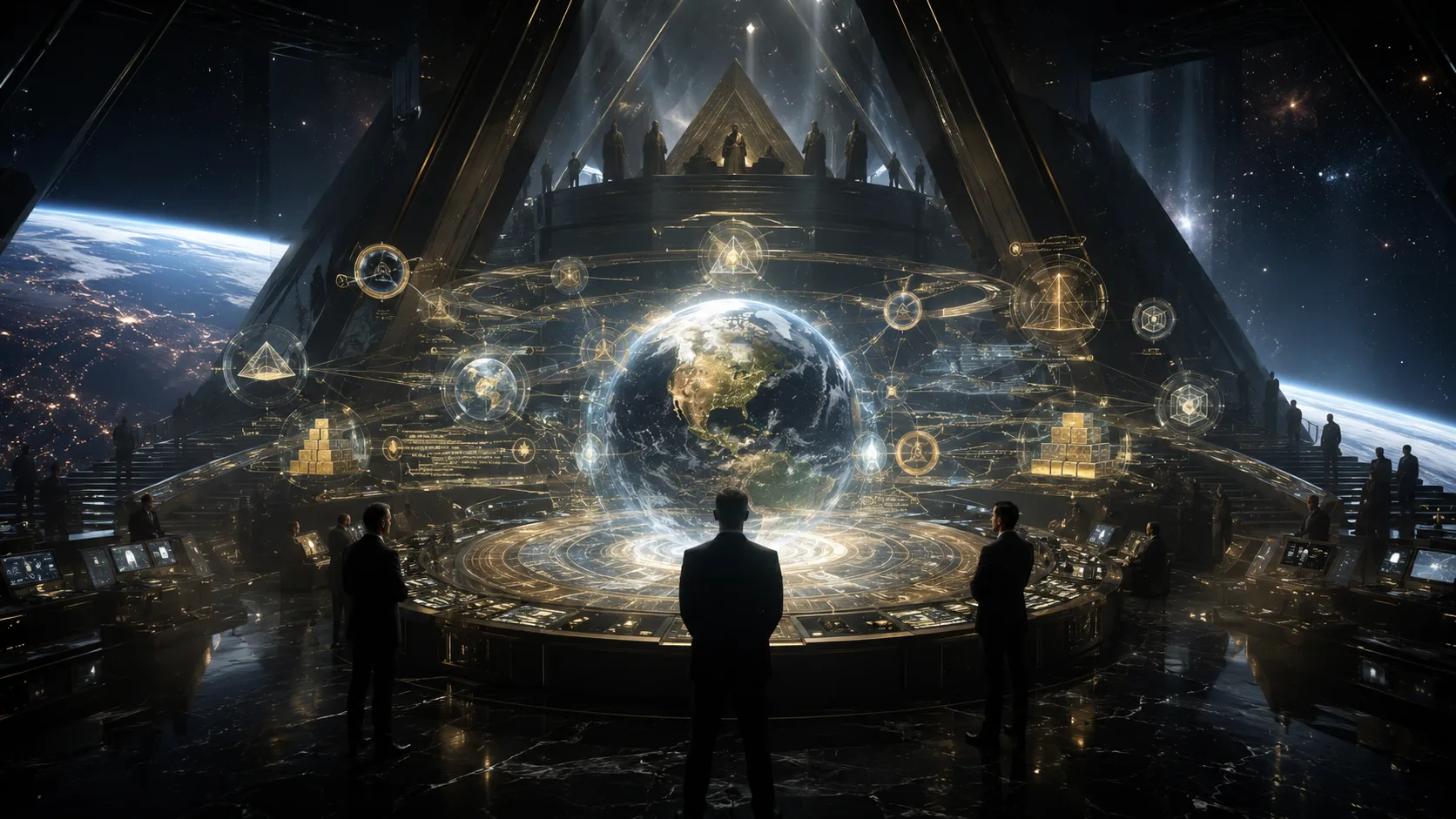
Money is usually presented as a human invention. We’re told it began with barter, evolved into coins, became paper, moved into banking ledgers, and now lives as digits on screens. That explanation is useful, but it doesn’t fully answer the deeper question: why does financial power keep reconcentrating after every revolution, war, collapse, reform, and currency reset?
The names on the surface change. Empires fall. Governments rewrite laws. New banks are born. Old currencies die. But the structure remains strangely familiar: wealth rises upward, debt spreads downward, and the people who actually produce the world’s value rarely own the system that measures it.
Within the Galactic Federation control framework, this pattern is not accidental. It suggests that Earth’s money system may not be fully human-owned at all. The theory argues that the financial pyramid we see, central banks, global institutions, elite banking families, sovereign debt, gold reserves, and digital currencies, may be the Earth-facing layer of a much larger command structure.
That does not mean every banker knows this. It does not mean every official is part of a conscious extraterrestrial agenda. It means the system may be designed so that human institutions perform local functions inside a hierarchy whose upper levels are hidden from public view.
The Core Claim: Money as a Planetary Control System
In the Swaruu framework, the Galactic Federation is described as using financial grants assigned to stellar races operating on Earth. According to that testimony, races that need money for operations on Earth request funding, explain its intended use, and receive or are denied grants through a Federation council process. The same account says this gives the Federation leverage over which non-human groups can operate among humans and how far their influence can go. (Swaruu)
That claim belongs in the category of witness-based evidence, not established public documentation. But it is important because it offers a mechanism. It doesn’t simply say, “the Federation controls money.” It explains how control could function operationally:
The Federation would need to know which groups are present on Earth.
It would need to know what those groups are doing.
It would need a way to approve, deny, limit, or monitor their activity.
And it would need access to Earth’s financial rails so those operations could be funded without exposing the larger structure.
If this model is correct, money is not just an economic tool. It is an authorization system. Whoever controls access to funding controls movement, logistics, influence, and permitted activity.
Why Wealth Keeps Returning to the Same Heights
Mainstream economics already recognizes that wealth tends to concentrate. The World Inequality Report 2026 states that the top 10% own around three-quarters of global wealth, while the bottom half holds only about 2%. (World Inequality Report 2026) Research on Florence across 1427 to 2011 also found long-term persistence in wealth inheritance and elite occupations across centuries.
Those findings matter because they show that wealth concentration is not imaginary. The debate is over why it happens.
The standard explanation points to inheritance, compounding returns, political access, asset ownership, tax advantages, and institutional capture. All of that is real. But the Federation-control thesis asks a sharper question: why does the system keep preserving itself even after events that should have destroyed it?
Wars should break old power.
Revolutions should redistribute wealth.
Currency collapses should wipe ledgers clean.
Political reforms should open opportunity.
Yet again and again, the basic pyramid rebuilds. The names change, but the architecture survives.
From this perspective, elite families and institutions may not be the true top of the system. They may be managers, custodians, or beneficiaries of a deeper monetary architecture whose actual ownership exists above the human political layer.
Gold: Organic Money or Planted Standard?
Gold is one of the strangest pieces of the puzzle. Across history, it repeatedly appears as a store of value, a symbol of authority, and a foundation for monetary systems. The World Gold Council notes that gold has long been connected with money and that the classical gold standard fixed national currencies to specified amounts of gold. (World Gold Council)
The normal explanation is simple: gold is durable, scarce, beautiful, divisible, portable, and hard to fake. That explanation makes sense.
But the alternative question is still worth asking. Why did so many cultures, separated by geography and time, arrive at similar conclusions about the same metal? Why did gold become not only valuable, but almost sacred? Why did it sit at the center of temples, empires, banking reserves, royal treasuries, and modern monetary settlements?
Under the Federation-control interpretation, gold may have functioned as a planetary compatibility layer. It gave different cultures a common value anchor before global digital accounting existed. In other words, gold may have been the old-world interface between human civilization and a larger off-world accounting system.
That remains speculative. But it is not an empty question. Gold’s role in money is documented. The open question is whether humans chose it entirely on their own, or whether its monetary importance was encouraged, guided, or reinforced from outside the visible historical record.
Ancient Banking: The Temple as the First Financial Interface
Ancient Mesopotamia complicates the simple story of money even further. Economic historian Michael Hudson describes early monetary debt and payment systems as emerging from Sumerian temples and palaces around 3000 BC, where accounting, grain, silver, weights, measures, and resource allocation were administered through large institutions. (Michael Hudson)
That is an important point. Money did not begin only as coins in a marketplace. It also began as accounting, debt, labor measurement, temple administration, and centralized recordkeeping.
That looks very modern.
Temples acted as spiritual centers, political centers, storage centers, accounting centers, and economic control centers. They were not just places of worship. They were command hubs.
For the Federation-control thesis, this raises a possibility: the earliest financial systems may have been built around institutions that could translate invisible authority into visible obligation. The temple said what was owed. The palace enforced it. The record made it real.
That same pattern continues today, only with different names.
The temple becomes the central bank.
The palace becomes the state.
The clay tablet becomes the banking ledger.
The priest-accountant becomes the financial technocrat.
The spiritual command becomes monetary policy.
Medieval Banking and the Sudden Rise of Financial Sophistication
After the collapse of Rome, Europe went through centuries of economic contraction. Then, during the medieval commercial revival, banking rapidly became more specialized. Ohio State’s eHistory summary notes that by the twelfth and thirteenth centuries, bankers were grouped into pawnbrokers, moneychangers, and merchant bankers, with merchant bankers becoming a powerful new elite. (OSU eHistory)
Again, the mainstream explanation is reasonable: trade expanded, cities grew, merchants needed credit, and monarchs needed financing.
But from a hidden-control perspective, medieval banking looks like another upgrade in the operating system. Local money was no longer enough. Europe needed bills of exchange, merchant networks, cross-border credit, and banking houses capable of moving value without physically moving metal.
That matters because modern power depends on abstraction. Whoever controls physical coins controls a village. Whoever controls ledgers controls a kingdom. Whoever controls cross-border settlement controls empires.
The BIS: The Most Candidate-Like Earth Interface
If there is an Earth-level interface for global financial coordination, the Bank for International Settlements is one of the most structurally interesting candidates.
The BIS says it was established in 1930, is owned by 63 central banks, and represents countries accounting for about 95% of global GDP. (Bank for International Settlements) Its own history describes it as a hub for central bank cooperation, financial statistics, gold and foreign exchange transactions, and emergency support during monetary crises. (Bank for International Settlements)
None of that proves extraterrestrial control. But structurally, the BIS occupies a unique position. It is not a normal commercial bank. It is not a retail bank. It is not directly answerable to ordinary voters. It is a bank for central banks, a coordination layer above national monetary systems.
That makes it highly relevant to this theory.
If the Federation needed an Earth-facing financial interface, it would not necessarily look like a secret alien vault. It would probably look like an institution that quietly coordinates central banks, gold, foreign exchange, monetary policy research, crisis liquidity, and financial stability.
In plain terms, it would look boring on purpose.
The IMF and the Postwar Monetary Grid
The IMF also matters, but in a different way. The IMF’s own historical exhibit describes Bretton Woods as the meeting that created the IMF and World Bank as “twin intergovernmental pillars” of the postwar economic order, with the IMF overseeing the international monetary system. (IMF)
That postwar reset was one of the biggest monetary reorganizations in modern history. The old empire-based world was replaced by a managed international system. Currencies were coordinated. Development lending was institutionalized. Debt became a tool of global governance.
From the Federation-control viewpoint, Bretton Woods may represent a major Earth-level upgrade. Instead of many competing imperial money systems, the planet moved toward a coordinated framework. The IMF, World Bank, BIS, central banks, reserve currencies, and later digital payment systems all became layers in a planetary financial grid.
Again, the documented facts show institutional coordination. The speculative layer asks whether that coordination is purely human, or whether human institutions are operating inside a larger off-world permission structure.
The Grants-to-Stellar-Races System
The most revealing part of the Swaruu claim is not simply that money grants exist. It is what such a system would require.
A grant system implies accounting.
Accounting implies records.
Records imply identification.
Identification implies oversight.
Oversight implies jurisdiction.
If stellar races receive Earth-operation funding through Federation approval, then the Federation must maintain a real-time or near-real-time map of non-human activity on Earth. It would need to know who is present, what they are doing, what resources they require, whether their actions are permitted, and whether their funding should continue.
That turns money into a leash.
Not a dramatic leash. Not a Hollywood leash. A quiet one.
You don’t need to imprison a group if you can cut off its operating budget. You don’t need to expose its mission if you control its access to housing, travel, equipment, communications, documents, and human-world logistics.
This is why the money question is so important. It connects the spiritual, political, military, and extraterrestrial layers into one practical mechanism.
Influence requires resources.
Resources require funding.
Funding requires approval.
Approval reveals hierarchy.
Cryptocurrency: Escape Route or New Layer?
Bitcoin was designed as peer-to-peer electronic cash, operating without central banks or trusted financial intermediaries. Bitcoin.org describes it as open-source, public in design, and collectively operated by the network, with no central authority or banks managing issuance. (Bitcoin)
That is why cryptocurrency became so powerful symbolically. It promised money outside the old system.
But the real question is whether decentralization at the protocol level equals sovereignty at the civilization level.
A person can hold crypto and still depend on exchanges, internet infrastructure, energy grids, device manufacturers, app stores, tax laws, banking ramps, surveillance analytics, and institutional liquidity. The ledger may be decentralized, but the surrounding world is not.
So cryptocurrency may be both things at once.
It may be a genuine crack in the old banking model.
And it may also be another layer being absorbed into the same control structure.
The test is simple: does it create real human financial sovereignty, or does it simply move people from bank accounts into trackable digital wallets while the larger infrastructure remains externally controlled?
What Human Financial Sovereignty Would Actually Require
A genuinely human-owned monetary system would need more than a new currency. It would need a new philosophy of value.
It would need transparency over who issues money.
It would need local and planetary accountability.
It would need protection from debt slavery.
It would need systems that reward production, creativity, care, repair, and truth, not only extraction and speculation.
It would need to separate human survival from artificial scarcity.
Most importantly, it would need to answer one question honestly: who has the authority to define value?
Because whoever defines value defines civilization.
If food, land, water, energy, medicine, housing, and knowledge are priced by systems that humans do not truly own, then humanity is not financially sovereign. It is renting permission to live inside someone else’s accounting system.
Conclusion: Follow the Money Above the Money
The Federation-control thesis is not about blaming one bank, one family, one nation, or one political group. That would be too small. The deeper question is architectural.
Why does money behave like a control system?
Why does wealth reconcentrate after every reset?
Why did gold become a planetary value anchor?
Why did temples, palaces, banks, central banks, and global institutions all evolve around accounting, debt, and permission?
And why would a Galactic Federation, if it is actively managing Earth contact, need financial grants for stellar races operating here?
The answer may be that money is not merely a human economy. It may be the visible interface of a much larger management structure.
The public sees currencies, banks, markets, inflation, interest rates, and debt. Researchers looking deeper see something else: a planetary control grid that decides who gets resources, who gets influence, and who gets to operate.
If humanity wants true sovereignty, it cannot only ask who owns the banks.
It has to ask who owns the system that owns the banks.
The Hidden Architecture of Earth’s Money
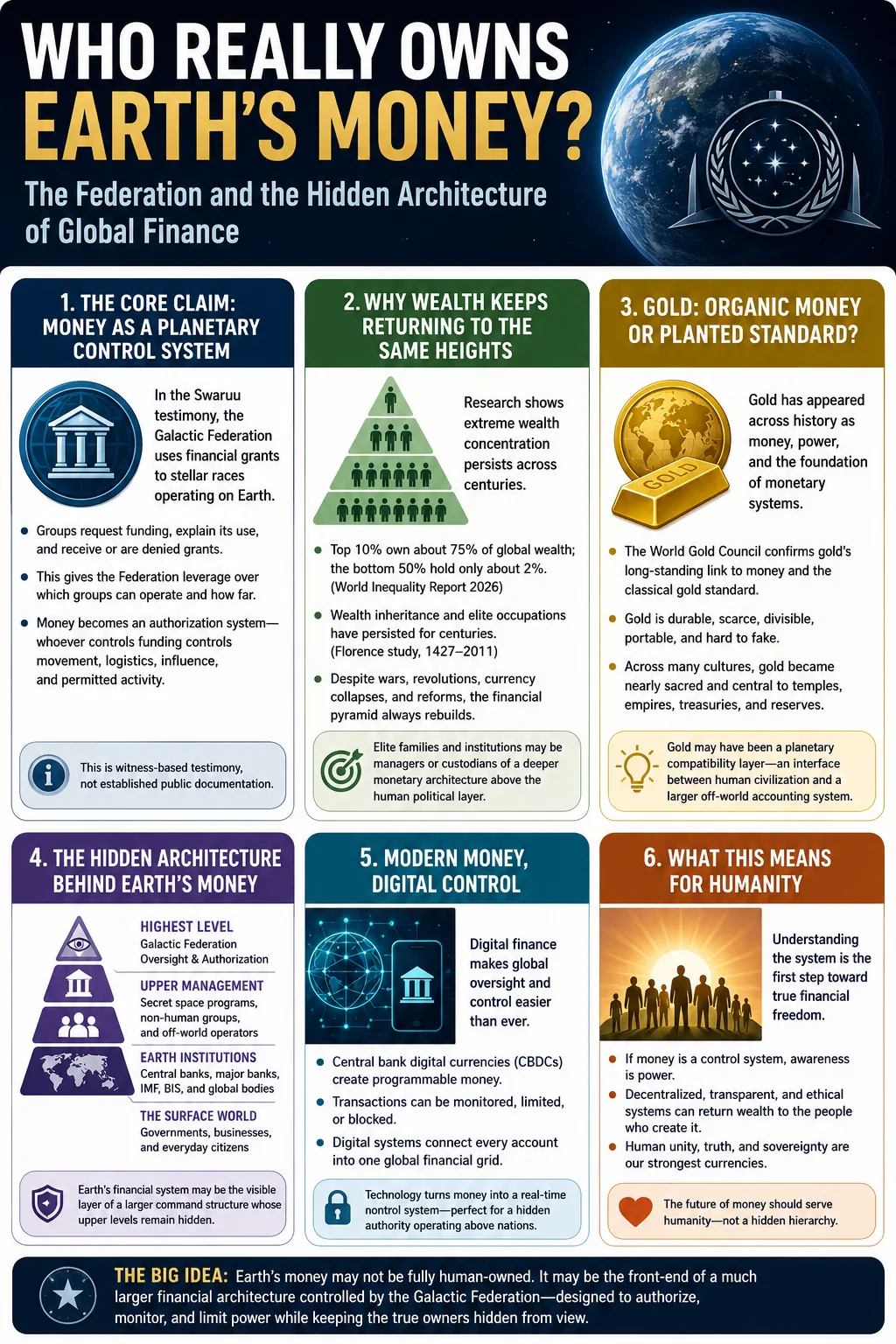
This infographic imagines the global financial system as more than banks, currencies, markets, and policy decisions. It presents money as a layered control structure, where visible human institutions may operate beneath a larger architecture of oversight, authorization, and planetary resource management.
The image places Earth at the center of a vast financial command chamber, surrounded by glowing networks, gold reserves, digital dashboards, and silent observers. It captures the core idea of the article: money may not simply measure value, it may define access, movement, power, and permission across the planet.
In this interpretation, central banks, global institutions, elite financial networks, gold reserves, sovereign debt, and cryptocurrency are not isolated subjects. They become interconnected layers inside a larger monetary pyramid. Each layer appears to serve a practical function, while also feeding into a deeper question about who ultimately controls the system itself.
What makes the visual powerful is the contrast between human banking authority and cosmic-level oversight. The suited figures represent the familiar world of finance, policy, and institutional control. The taller extraterrestrial figures suggest a hidden hierarchy operating above the human layer, quietly observing the movement of wealth across Earth.
As a companion image for the article, the scene turns an abstract subject into a cinematic visual map. It invites the viewer to look beyond surface-level economics and consider whether financial systems are only human creations, or whether they function as part of a much older and more complex planetary management structure.
Editorial concept for GalacticFederation.in: a cinematic interpretation of the hidden architecture behind Earth’s money system, exploring global finance, Federation oversight, wealth concentration, and the search for genuine human financial sovereignty.

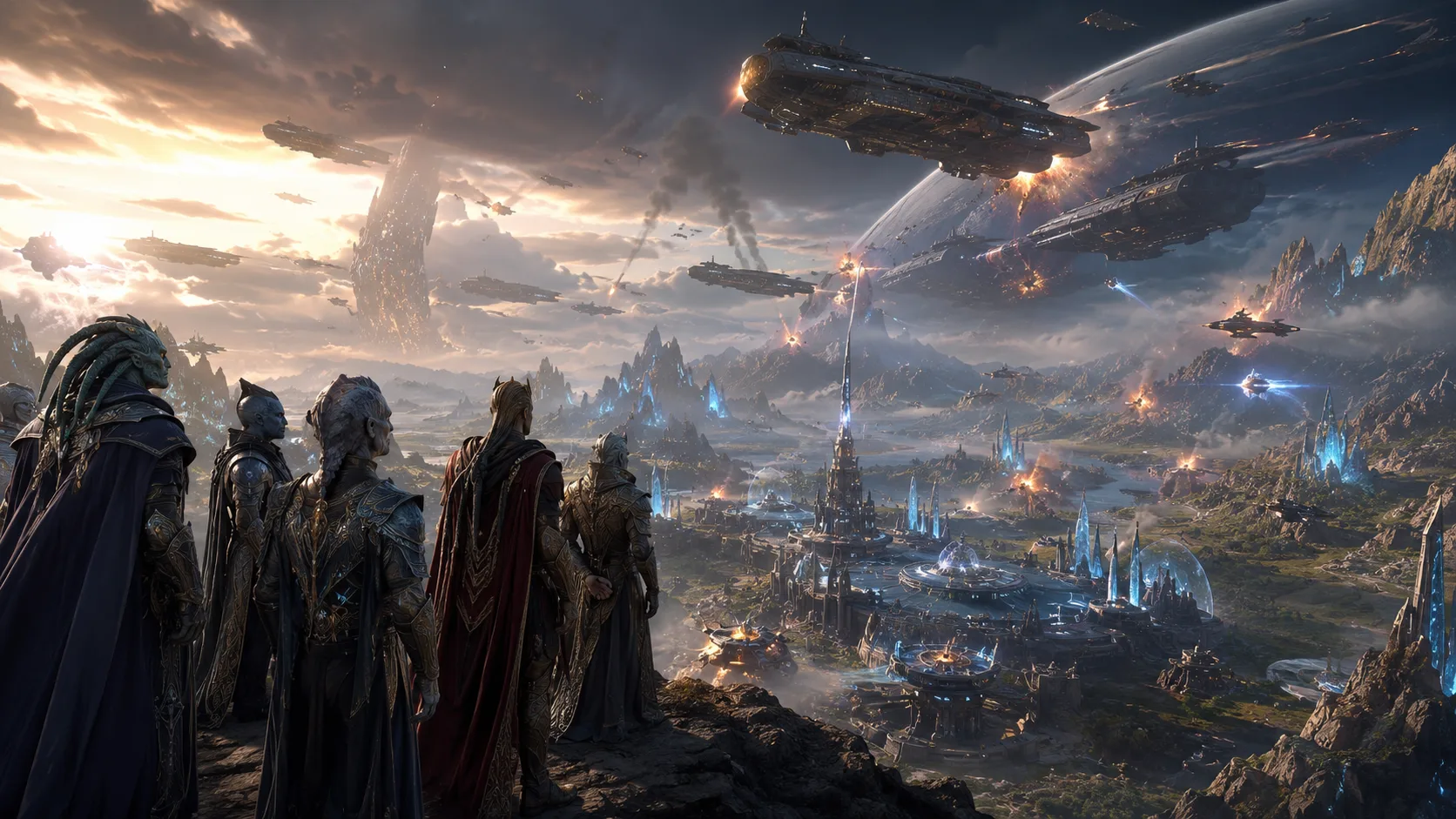

Cosmic Echoes
Share-ready comments you can copy in a click, then post wherever the conversation touches UFOs, UAP, or the Galactic Federation.
These comments belong to the Cosmic Echoes page under the section The Cosmic Currency Conspiracy.
Plus 21 more comments on the Cosmic Echoes page.