
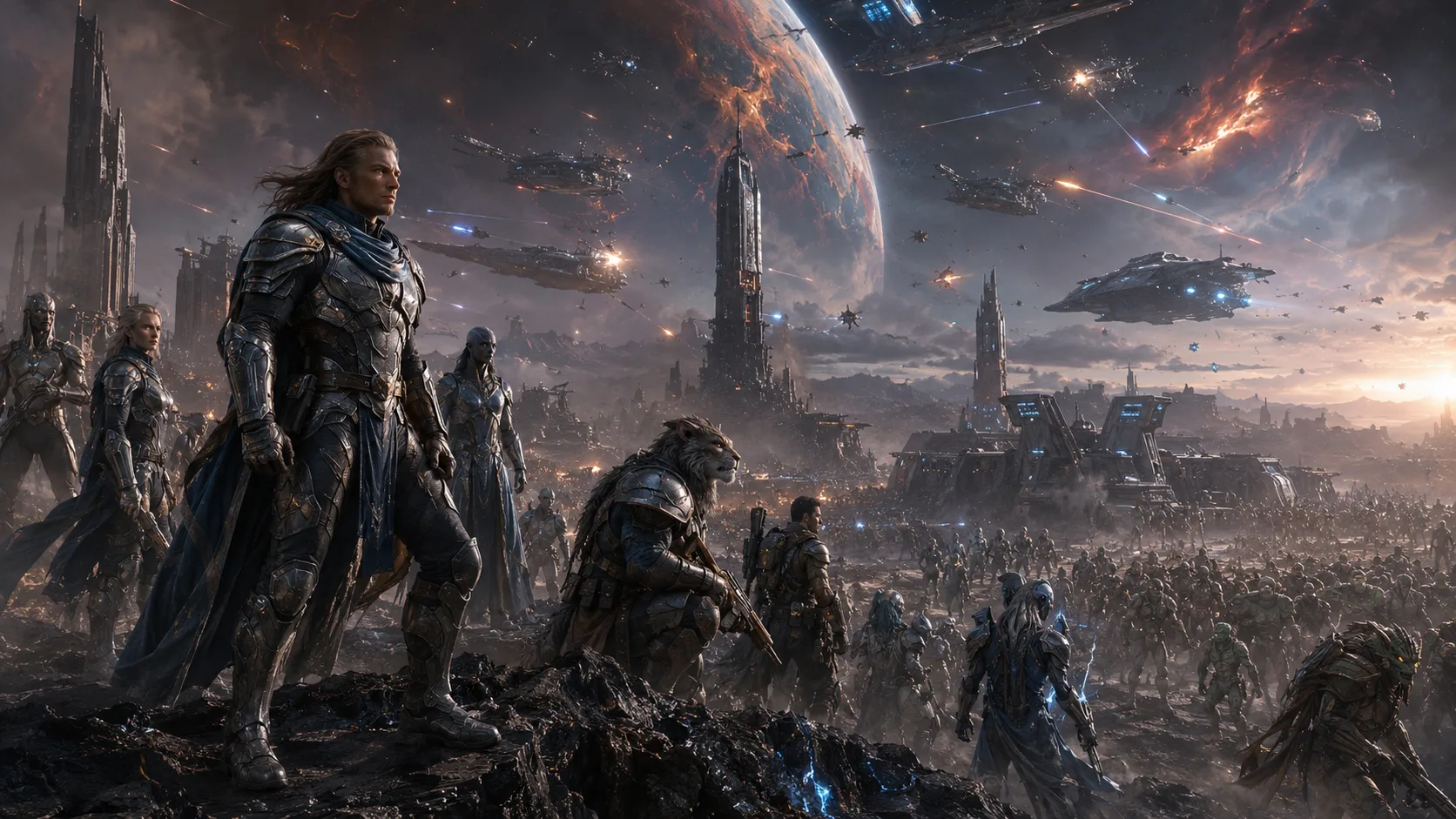
Every great political order has a wound at its center. Rome had civil war. The United Nations had World War II. In Galactic Federation contact lore, the Federation has the Orion Wars.
The Orion Wars are usually described as a single ancient conflict, but that makes them sound too tidy. They were not one battle, one front, or one clean moral showdown. They were a long chain of wars, migrations, occupations, betrayals, proxy conflicts, and political compromises centered on the Orion region and its surrounding systems. In the Taygetan/Swaruu material, the Federation itself is said to have formed after the Great Expansion from Lyra, when many races were persecuted by regressive sauroid species during the so-called Orion Wars. The same account says the Federation was founded by Andromedans, Arcturians, and Lyrians to establish alliances, legal frameworks, and cooperation in space. (Swaruu)
That origin matters. It explains why the Federation, in these narratives, can feel less like a utopian council of light and more like a post-war security apparatus. It explains the obsession with containment, quarantine, layered councils, remote authority, and controlled disclosure. Most of all, it explains why Orion Grays, especially the Etorthans, occupy such a strange and powerful place in Federation politics.
The Federation was not born from peace. It was born because peace had failed.
Orion Before the Wars: A Region Made for Conflict
Orion is one of the most recognizable constellations in the night sky, home to bright stars such as Rigel, Betelgeuse, and Bellatrix, as well as the famous Orion Nebula below the belt. (Encyclopedia Britannica) In ordinary astronomy, it’s a constellation, a pattern seen from Earth. In contact lore, however, Orion becomes something much larger: a crowded civilizational theater, with many star systems, species, factions, councils, colonies, and military corridors.
That distinction is important. “Orion” in these traditions does not mean one planet or one race. It means a whole region of power.
The Orion system and its surrounding zones are portrayed as a pressure cooker. Humanoid Lyrian-descended civilizations, reptilian empires, gray collectives, breakaway colonies, and non-aligned species all competed for space, resources, influence, and ideological dominance. Some groups organized around cooperation and mutual defense. Others built hierarchy around conquest, extraction, genetic control, and what the Law of One material calls “service to self.” (The Law of One)
That is the real core of the Orion Wars. They were not just about territory. They were about what civilization itself should be.
The Major Phases of the Orion Wars
The exact chronology varies between sources, and the Taygetan material itself contains disagreements between official Federation narratives and alternative accounts. That’s not a weakness in the story. It’s part of the story. Post-war histories are almost always contested, especially when the winners become the archivists.
Still, a broad pattern emerges.
Phase One: The Lyrian Rupture
The first phase begins with the Lyrian diaspora. In Taygetan/Swaruu accounts, the ancestral records of Lyra were damaged or lost during the first phase of the Orion Wars, specifically in connection with a reptilian invasion of Lyra and Avalon. (Swaruu) Other passages place the broader persecution of Lyrians by reptilian factions during the Great Expansion, describing it as part of the Orion Wars and placing some versions of that memory tens of thousands of years in Earth terms. (Swaruu)
This is the first great turning point. The humanoid side was no longer one people in one place. It became a diaspora.
That scattering was traumatic, but it also made the humanoid civilizations harder to destroy. A concentrated population can be conquered. A diaspora becomes a network. Lyrian-descended groups spread into new systems, formed alliances, carried their memory with them, and slowly turned survival into strategy.
The reptilian and regressive gray factions may have won early territory, but they also created the very thing that would eventually oppose them: a traumatized but highly adaptive interstellar resistance.
Phase Two: Orion Consolidation
The second phase was the consolidation of regressive Orion power. This is where the conflict stops looking like a simple invasion and starts looking like a system.
The Taygetan material distinguishes between different gray races, but it describes Orion Grays in particular as invasive or regressive, often working with reptilian Kingu types, Dracos, and other regressive factions. It also portrays them as exchange-driven operators, willing to work for different powers as long as their needs are met. (Swaruu)
That detail matters because it explains why the Orion Wars were so difficult to end. The enemy was not only a fleet or a monarchy. It was an ecosystem of deals, proxies, biological labor, military access, hidden bases, and political leverage.
The Orion side perfected indirect warfare. Instead of always conquering openly, it could infiltrate, recruit, manipulate, bargain, and outsource. The Law of One material describes something similar in different language, saying the Orion group sought conquest through mind control, elite formation, and technologies of manipulation. (The Law of One)
This is where the oldest cosmic binary takes shape: not merely humanoid versus reptilian, but open society versus domination hierarchy.
Phase Three: The Federation Counter-Alliance
The third phase was the rise of formalized opposition. The Federation, in Taygetan accounts, was created after the Orion Wars and Great Expansion as a massive multi-racial organization built to establish alliances and coordinate legal and ethical cooperation in space. (Swaruu)
That sounds idealistic, but the deeper reading is more practical. The Federation emerged because scattered civilizations needed a shared security architecture. No single Lyrian-descended group could contain Orion alone. No local council could manage the scale of the crisis. A distributed war required a distributed alliance.
This is where the tide began to turn. Not because the humanoid side suddenly became militarily superior everywhere, but because it became politically organized.
The Federation’s early strength seems to have come from three things:
- Shared legal frameworks that made alliances easier to maintain.
- Military coordination across many star races rather than isolated defense.
- A containment philosophy that treated regressive expansion as a long-term management problem, not a one-time battlefield problem.
That last point is crucial. The Federation did not simply defeat Orion. It learned to contain Orion.
Phase Four: Settlement, Absorption, and the Etorthan Problem
The final phase was not a clean victory. It was a settlement.
This is where the Etorthans become central. In Taygetan/Swaruu accounts, the Etorthans are described as tall, big-nosed Grays from the Orion region, associated with planets orbiting Betelgeuse, also called Alpha Orionis. They are also described as long-time Galactic Federation members who participate in councils for Earth, often by remote holographic presence. (Swaruu)
The official Federation version, as reported in the same material, says the Etorthans changed sides. They allegedly left the old Orion Council because they no longer agreed with its invasive politics, joined the Galactic Federation, and later rejoined the renewed Orion Council as active members. (Swaruu)
That is an astonishing political arc. In plain human terms, imagine a former enemy intelligence service becoming part of the post-war global security council, then also maintaining formal ties with a reconstituted version of its old regional bloc. That’s not peace. That’s managed ambiguity.
And managed ambiguity became one of the Federation’s defining features.
The Etorthans: From Enemy Lineage to Federation Gatekeepers
The Etorthans are the most complicated survivors of the Orion Wars because they embody the settlement’s central contradiction.
On one hand, the official story presents them as advanced, ethical, spiritual, and positive. They are described as genetic experts, terraformers, healers, and “gardener” beings who help seed and restore biological life. (Swaruu) On the other hand, alternative accounts inside the same Taygetan/Swaruu body of material report a much darker view. The Urmah account, for example, claims the Etorthans once led a multi-race invasive task force and accuses them of manipulation, trickery, and strategic deception. (Swaruu)
That contradiction may be the key to understanding their power.
The Etorthans are not simply “good Grays” or “bad Grays.” They are a political bridge between categories that should have remained separate: Orion and Federation, old enemy and new administrator, genetic manager and council diplomat, healer and suspected manipulator.
Their position suggests that the Orion peace did not remove regressive elements from power. It domesticated some of them, renamed some of them, and embedded some of them inside the machinery of oversight.
That may have seemed wise at the time. Former enemies know the enemy system better than anyone. They understand the routes, loopholes, technologies, and factions. They can be useful inspectors, negotiators, and containment managers.
But there’s always a price. When yesterday’s infiltrator becomes today’s regulator, the border between security and capture gets dangerously thin.
The Peace Terms That Reshaped the Federation
No source gives us a neat treaty text for the end of the Orion Wars. There is no clean “Treaty of Orion” to quote. What we have instead is a pattern that can be reconstructed from the political aftermath.
The implied peace terms look something like this:
- The Federation would become the dominant legal and security authority in the quadrant.
- Regressive Orion expansion would be contained rather than completely erased.
- Select Orion-associated races, including the Etorthans, would be absorbed into Federation structures.
- The old Orion Council would be dissolved, renewed, or reorganized, depending on the account.
- Sensitive governance would move into layered councils, with information compartmentalized by rank, species, and operational need.
The Taygetan/Swaruu material describes the Federation as having many layers of control, with one level not necessarily knowing what another is doing. It also presents the organization as “structured as an onion,” with hidden higher levels making decisions that lower benevolent races may not fully understand. (Swaruu)
That sounds ominous, but in a post-Orion context it makes a grim kind of sense. Compartmentalization is a wartime survival tool. You use it when infiltration is expected. You use it when one captured node cannot be allowed to expose the whole network. You use it when trust has been shattered.
The problem is that emergency structures rarely retire themselves. What begins as defense can become bureaucracy. What begins as secrecy can become unaccountability. What begins as containment can become control.
That is the Federation’s Orion inheritance.
The Law of One Parallel: The Same Conflict in Different Language
The strongest parallel source for the Orion Wars is the Law of One material, also known as the Ra Contact, received through Carla Rueckert and the L/L Research group from January 15, 1981, through March 15, 1984. (L/L Research)
The Law of One does not use all the same names as the Taygetan material, but the architecture is strikingly similar. It describes an Orion group oriented toward conquest, control, hierarchy, and “service to self.” In one passage, the Orion crusaders are said to seek conquest of planetary social complexes before they achieve social memory. In another, they contact those who resonate with their vibration, elevate them as elites, and attempt to enslave others through their own free will. (The Law of One)
That is almost exactly the political pattern attributed to regressive Orion factions in Taygetan accounts: indirect control, elite capture, manipulation of perception, and use of gray or reptilian intermediaries.
The Law of One also describes the Orion group as using both technical and non-technical information, with technology framed as tools of control or manipulation. (The Law of One) Again, this matches the broader Orion-war theme: domination does not always arrive as a warship. Sometimes it arrives as a system, a ritual, a technology, a hierarchy, or a useful ideology.
The two bodies of material differ in cosmology and vocabulary, but they agree on the deep structure:
- Orion is associated with conquest.
- The method is indirect influence as much as open force.
- The target is not only territory, but consciousness.
- The battlefield includes elites, belief systems, and social organization.
- The opposing force is a confederated or federated alliance built around a different polarity.
That overlap is why the Law of One material matters here. It gives the Orion Wars a second lens. Not the same story, but the same shadow.
Mythological Echoes: Why Earth Remembers This Pattern
If the Orion Wars were only an obscure contact-lore conflict, they would be interesting enough. What makes them richer is how often their core pattern appears in ancient human myth.
In Hindu cosmology, the devas and asuras become opposing classes of divine beings. Britannica notes that asuras are defined by opposition to the devas, and that Hindu myths frequently depict battles between them. The opposition between good devas and more demonic asuras developed over time in Vedic tradition. (Encyclopedia Britannica)
In Norse mythology, the Aesir and the Jotnar occupy a similar cosmic tension. The Jotnar are older than the gods, hostile to them, and Ragnarök culminates in a final battle between gods and giants. (Encyclopedia Britannica)
In Egyptian religion, the conflict becomes solar and serpentine. Apopis, or Apep, is the serpent demon of chaos and the enemy of the sun god Re, threatening the ordered cosmos during the sun god’s nightly journey. (Encyclopedia Britannica)
These myths are not identical. They come from different cultures, languages, and ritual systems. But the pattern is hard to miss: luminous order versus devouring chaos, sky gods versus older hostile beings, divine law versus serpentine disruption, civilization versus anti-civilization.
That does not prove the Orion Wars in a modern historical sense. Myth doesn’t work like a police report. It preserves patterns, fears, symbols, and moral memory. If the Orion conflict was seeded into human cultural memory, it would not need to appear as “Lyrians versus Orion Grays.” It would appear as gods versus titans, devas versus asuras, Ra versus Apep.
Humanity remembers in symbols long before it remembers in archives.
How the Orion Trauma Shaped Federation Governance
The Federation’s behavior makes more sense when read as trauma management.
A civilization that has survived infiltration will build compartments. A civilization that has survived conquest will build patrols. A civilization that has watched free societies collapse from internal manipulation will become obsessed with consent, quarantine, and legal technicalities.
That is exactly what we see in both the Taygetan and Law of One frameworks. The Law of One repeatedly emphasizes free will as a limiting factor, even for negative Orion contact. The Orion group prefers indirect influence because open conquest risks violating the rules of polarity and free will. (The Law of One) The Taygetan material, meanwhile, describes Federation structures around Earth as layered, secretive, and compartmentalized, with lower levels often unable to access what higher levels are doing. (Swaruu)
This helps explain three persistent Federation traits.
1. Containment Over Liberation
The Federation often appears less interested in dramatic rescue than in controlled containment. That makes sense if its founding trauma taught it that direct intervention can backfire. Remove one regressive faction too openly, and you may create dependency, worship, panic, or a new power vacuum.
Containment is slower, colder, and more frustrating. But from a post-Orion perspective, it may look safer.
2. Compartmentalization as Defense
Layered hierarchy is not always just corruption. Sometimes it begins as armor. If Orion-style infiltration was a real threat, then no single council, captain, or species could be allowed to see the whole board.
The tragedy is that the same structure that protects an alliance can also hide abuse. A compartmentalized Federation can resist infiltration, but it can also conceal infiltration once it happens.
That is the nightmare scenario in the Taygetan critique: the Federation may have inherited Orion’s defensive logic so completely that it began to resemble the thing it was built to contain.
3. The Gray Presence at the Top
The Etorthans’ high status is not an accident. It is a fossil from the peace settlement.
Their presence says the Federation chose integration over eradication. It chose to bring at least some Orion-associated intelligence, genetics, diplomacy, and administrative capability inside the tent. That may have prevented future wars. It may also have allowed Orion logic to survive in the Federation’s upper machinery.
Both can be true.
History is full of uncomfortable peace deals. Sometimes you end a war by making room for people you don’t trust. Sometimes that compromise saves millions. Sometimes it poisons the institution for centuries.
The Orion Wars seem to have done both.
The Federation’s Founding Trauma
The Orion Wars forged the Federation by forcing scattered civilizations to answer a brutal question: how do you stop conquest without becoming conquerors yourself?
The answer they built was imperfect. Alliances. Councils. Patrols. Quarantines. Legal frameworks. Controlled disclosure. Compartmentalized governance. Strategic absorption of former enemies. A permanent security architecture wrapped in the language of ethics.
That is why the Orion Wars matter. They are not just ancient cosmic combat lore. They are the key to the Federation’s personality.
The Federation’s greatest strengths come from Orion: coordination, vigilance, containment, long memory. Its greatest weaknesses may come from the same place: secrecy, hierarchy, bureaucracy, and a dangerous tolerance for gray-zone power.
In the end, the Orion Wars did not simply decide who controlled a region of space. They decided what interstellar politics would become afterward.
The Federation was born to prevent another Orion.
And that may be why Orion never truly left it.

Cosmic Echoes
Share-ready comments you can copy in a click, then post wherever the conversation touches UFOs, UAP, or the Galactic Federation.
These comments belong to the Cosmic Echoes page under the section Orion Wars: Secrets of Galactic Power.
Plus 21 more comments on the Cosmic Echoes page.