
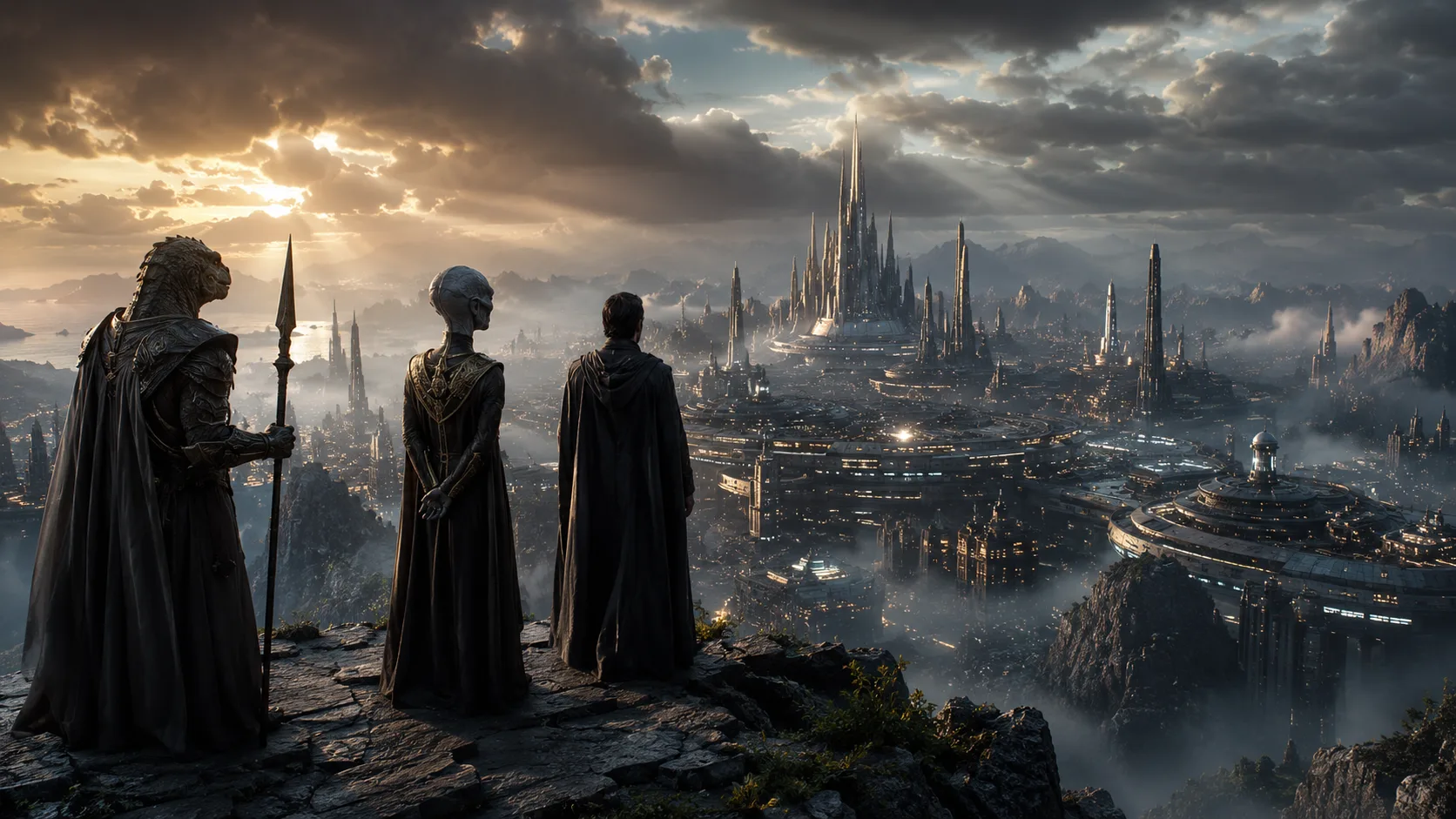
Before the Galactic Federation became a council, a bureaucracy, a diplomatic structure, or a force shaping Earth’s hidden history, it was forged in war.
Not a simple war. Not one battle. Not one rebellion. The Orion Wars are remembered in Galactic Federation origin tradition as a prolonged galactic conflict that stretched across thousands of years, involved multiple civilizations, and forced ancient humanoid societies to confront a terrible truth: survival alone was not enough. If scattered Lyrian-descended worlds, Orion humanoids, reptilian factions, gray collectives, and neighboring star nations were going to coexist, some kind of political architecture had to be built.
That architecture became the Federation.
But the price of peace was complicated.
According to this tradition, the Orion Wars did not simply end with the defeat of regressive forces. They ended with treaties, negotiated power-sharing, controlled integration, compartmentalized authority, and the inclusion of groups that many survivors considered dangerous. That is why this conflict matters so much. You cannot understand the Federation’s strange structure, its hierarchy, its extreme secrecy, or the controversial role of Orion Gray factions without understanding the war that made those compromises necessary.
Orion Before the Wars
To the modern skywatcher, Orion is one of the most recognizable constellations on Earth. NASA describes Orion as a winter constellation marked by prominent stars such as Betelgeuse, Rigel, the three stars of Orion’s Belt, and the Orion Nebula in the hunter’s sword. (NASA Science)
But in Galactic Federation origin tradition, Orion is more than a constellation. It is remembered as a vast civilizational arena.
The Orion region was not one culture, one species, or one political bloc. It was a dense, complicated field of civilizations. Some were humanoid. Some were reptilian. Some were gray. Some were spiritually advanced but politically ruthless. Others were technologically powerful but socially unstable. Many had ancient grievances, competing claims, and radically different ideas about freedom, hierarchy, genetics, resources, and control.
In that sense, Orion was less like a single kingdom and more like a galactic crossroads.
It contained:
- Humanoid civilizations descended from earlier Lyrian migrations.
- Reptilian and draconian-aligned groups with older territorial claims.
- Gray collectives with advanced technological and administrative systems.
- Neutral or semi-neutral civilizations trying to survive between larger powers.
- Hybrid societies formed through diplomacy, conquest, migration, or genetic programs.
The tension was not just racial or biological. It was ideological.
One side leaned toward sovereignty, local self-rule, spiritual development, and the protection of free civilizations. The other leaned toward hierarchy, control, resource domination, genetic management, and the belief that stronger civilizations had the right to manage weaker ones.
That clash created the conditions for war.
The Lyrian Diaspora and the Wound That Spread
The Orion Wars cannot be separated from the older Lyrian trauma.
In this tradition, Lyra represents one of the great ancestral sources of humanoid civilization in this region of the galaxy. After the destruction, persecution, or forced scattering of ancient Lyrian-descended peoples, refugee groups spread into multiple star systems. Some went toward the Pleiades. Some moved into Vega-linked traditions. Some migrated through Andromedan, Arcturian, and Sirian spheres of influence. Others entered the Orion region.
That migration created both opportunity and danger.
The Orion region already held powerful civilizations. When Lyrian-descended groups arrived, they brought memory, trauma, technology, bloodlines, and a strong resistance to domination. To regressive powers, that resistance was a threat. To sympathetic civilizations, the Lyrian diaspora represented survival, renewal, and the possibility of a freer galactic order.
This is where the conflict began to harden.
What may have started as territorial pressure, political intimidation, resource competition, and ideological rivalry eventually escalated into open warfare.
The Outbreak: When Tension Became War
The first phases of the Orion Wars were likely not recognized as “the Orion Wars” while they were happening. Most great wars are named later, after the survivors finally understand the scale of what occurred.
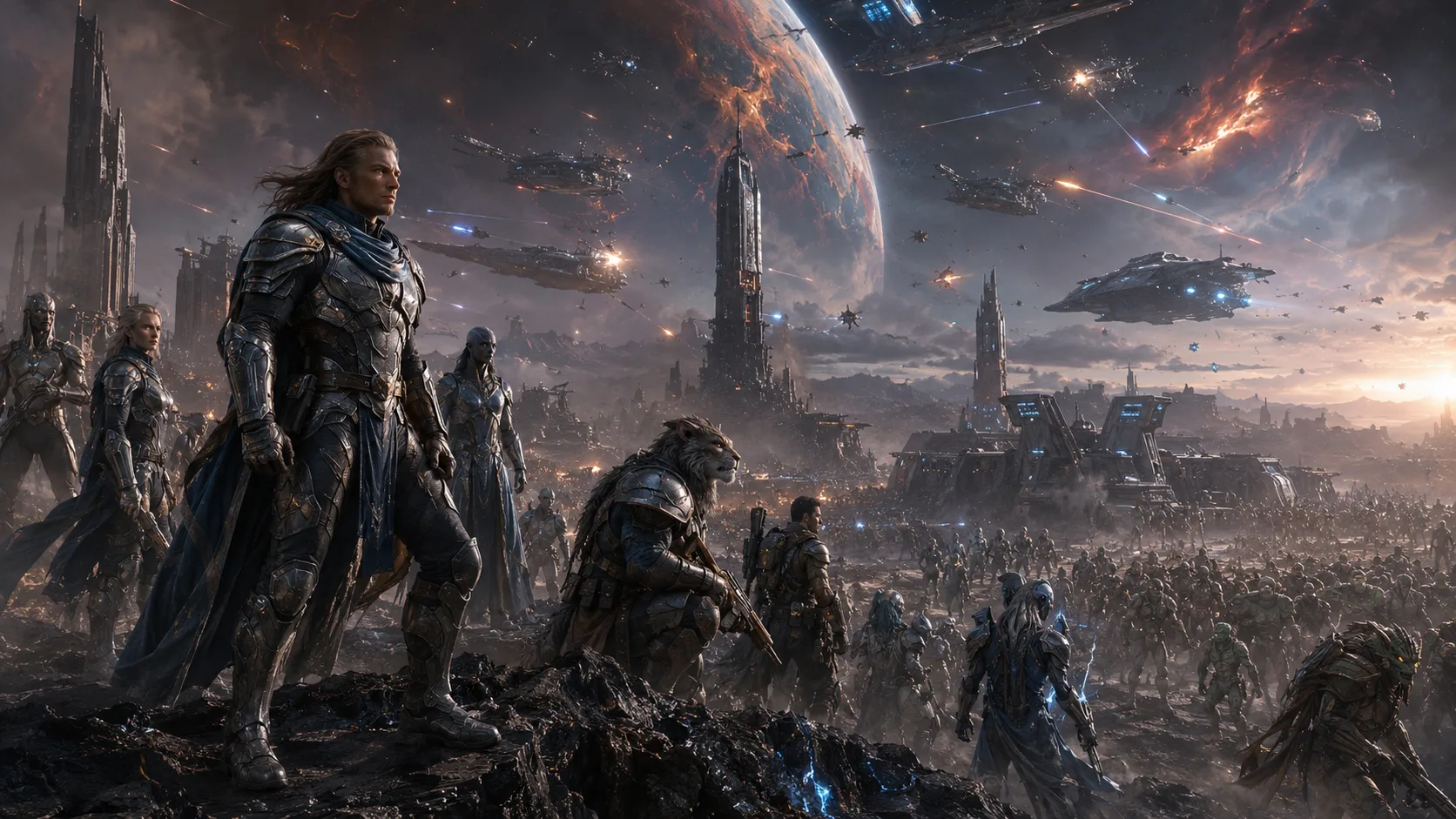
At first, there were raids. Then blockades. Then proxy conflicts. Then planetary occupations. Then retaliatory campaigns. Trade routes became militarized. Refugee corridors became targets. Civilian populations were used as leverage. Alliances formed under pressure.
The central issue was control.
Regressive Orion factions appear, in this tradition, to have believed that order could only be maintained through hierarchy. They saw free humanoid colonies as unstable, emotional, unpredictable, and politically dangerous. The Lyrian-descended groups, already scarred by displacement, saw Orion control systems as another version of the same ancient persecution they had fled.
Neither side trusted the other.
The war became a struggle over the future shape of galactic society:
Would civilization be built around consent, diplomacy, and sovereignty?
Or would it be built around managed populations, secrecy, genetic control, and elite hierarchy?
That question is still relevant to Earth today.
The Key Factions of the Orion Wars
The Orion Wars were not a simple “good species versus bad species” conflict. That kind of thinking is too shallow for a war this ancient and politically tangled.
There were benevolent reptilian individuals. There were regressive humanoid factions. There were gray collectives that were not all identical. There were neutral powers that changed sides. There were idealists, opportunists, defectors, peace negotiators, military leaders, and administrators who believed compromise was the only way to prevent endless destruction.
Still, several broad groups stand out.
The Lyrian-Descended Humanoid Civilizations
These were among the most important resistance factions. They carried the memory of earlier galactic trauma and became central to the anti-regressive alliance.
Their motivations were simple but powerful:
They wanted to survive.
They wanted self-rule.
They wanted to prevent another wave of conquest or forced displacement.
They also understood something that would later become central to Federation thinking: scattered worlds cannot resist organized domination forever unless they coordinate.
This is one of the great lessons of the Orion Wars. Individual civilizations may be noble. They may be spiritually advanced. They may even be technologically brilliant. But if they remain isolated, a disciplined hierarchical empire can defeat them one by one.
The Regressive Orion Factions
The regressive Orion side is often described as a coalition of reptilian, gray, and authoritarian humanoid-aligned groups. Their shared philosophy was not necessarily identical, but they tended to operate through domination, secrecy, and centralized control.
They viewed civilization as something to be managed from above.
In that mindset, freedom was inefficient. Open knowledge was dangerous. Genetic autonomy was too unpredictable. Spiritual development was acceptable only if it did not threaten the hierarchy.
This is where the Orion Wars become more than a military story. They become a philosophical conflict.
The war was not only about planets or star lanes. It was about the definition of sentient life.
Are beings sovereign souls with the right to evolve?
Or are they assets inside a managed system?
The Etorthan Grays
The Etorthan Grays are one of the most controversial groups in this narrative.
According to Galactic Federation origin tradition, their eventual inclusion in Federation authority was not an accident. It was a direct result of Orion War peace terms. That matters because it explains why some Gray factions are described as having influence far beyond what ordinary membership would seem to justify.
The Etorthans are often portrayed as highly advanced, mentally disciplined, bureaucratically sophisticated, and deeply skilled in systems management. Those traits would make them useful in a postwar order. But the same traits would also make them dangerous if placed inside a structure built on secrecy and compartmentalization.
This is the uncomfortable part of the story.
The Federation may have gained stability by integrating former adversarial or morally ambiguous factions. But it may also have embedded those factions into its own command structure.
That would explain why the Federation can appear benevolent in principle but strangely compromised in practice.
The Turning Point
Every long war eventually reaches a point where even victory begins to look like collapse.
The Orion Wars appear to have reached that point after enormous losses. Entire worlds were damaged. Bloodlines were scattered. Trade systems broke. Trust between civilizations collapsed. Refugees carried trauma into new star systems. Military alliances became permanent. Defensive secrecy became normal.
The anti-regressive forces may have prevented total conquest, but they did not achieve a clean, simple victory.
That is important.
A clean victory produces justice.
A negotiated ending produces structure.
The Orion Wars ended, according to this tradition, not because every regressive faction was destroyed, but because the war had become too costly for all major powers. Peace required compromise. Compromise required inclusion. Inclusion required rules. Rules required enforcement.
And enforcement required an institution.
That institution became the Federation.
The Peace Terms and the Birth of Federation Compartmentalization
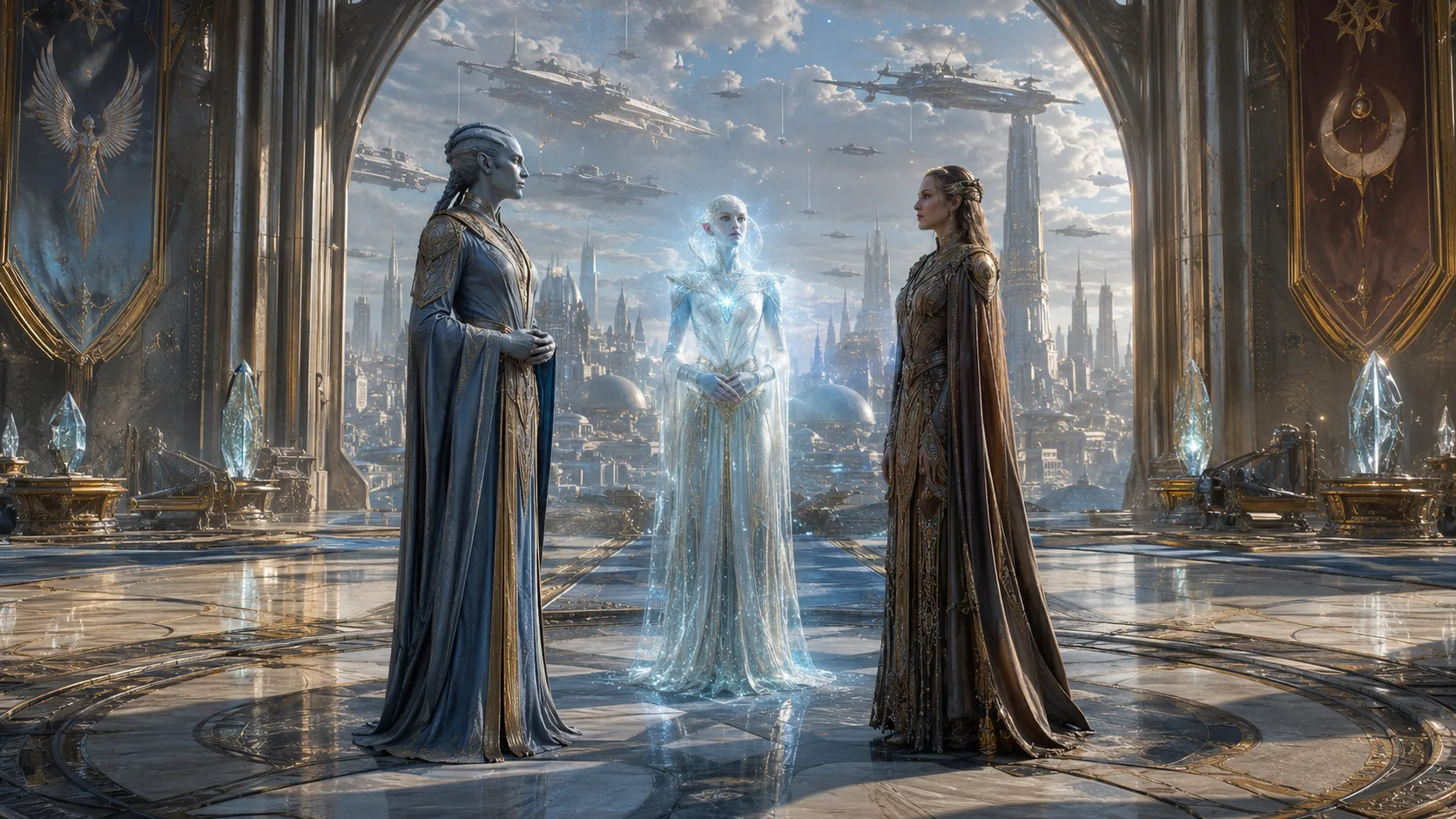
The Federation is often imagined as a shining council of enlightened civilizations. In some ways, that is true. But if the Orion Wars shaped its structure, then the Federation was also born from fear.
Fear of another galactic-scale war.
Fear of uncontrolled retaliation.
Fear of rogue civilizations.
Fear of genetic abuse.
Fear of military escalation.
Fear of information spreading faster than political systems could handle.
So the postwar order became highly compartmentalized.
Knowledge was separated by rank.
Authority was divided into layers.
Civilizations were grouped by jurisdiction.
Sensitive history was restricted.
Former adversaries were integrated under controlled conditions.
Diplomacy replaced open war, but secrecy replaced open trust.
That is the paradox. The Federation may have been created to preserve peace, but it inherited the psychology of war.
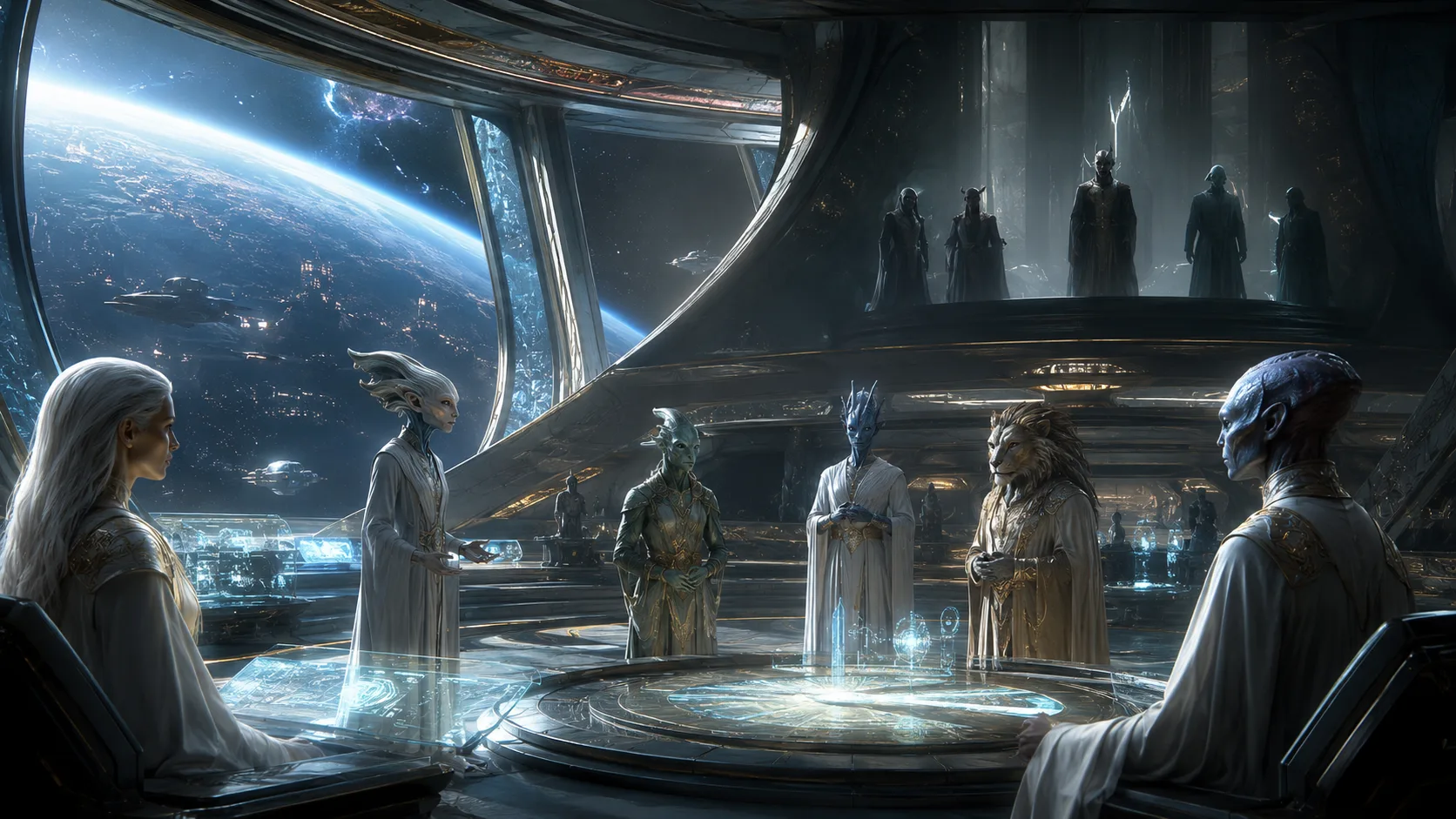
This helps explain why its hierarchy can feel so strange. A truly free confederation would be transparent, decentralized, and accountable. A postwar security structure, however, would be cautious, layered, and full of restricted access.
The Orion Wars explain that contradiction.
The Federation was not only a spiritual alliance. It was also a containment system.
How Regressive Elements Became Embedded
The most controversial claim connected to the Orion Wars is that the peace terms embedded regressive elements into the Federation itself.
That does not necessarily mean the Federation became evil. It means the Federation became politically mixed.
Former enemies, especially certain Gray factions, may have been included to prevent them from rebuilding outside the system. From a diplomatic standpoint, that makes sense. Bringing a dangerous faction into the institution gives you oversight, channels of communication, and some ability to monitor their behavior.
But there is a risk.
When you include a regressive faction inside a hierarchy, that faction can learn the hierarchy. It can exploit procedure. It can hide behind classification. It can influence committees, technical departments, genetic policy, planetary intervention rules, and contact protocols.
This is how a peace agreement can become a long-term compromise.
The war ends on the battlefield, but continues inside institutions.
That may be the deeper meaning of the Orion Wars. They did not simply create the Federation. They created the Federation’s unresolved internal tension.
The Law of One and the Orion Group
The Orion War narrative also resonates with the Law of One material, often called the Ra Material. The Law of One archive describes the material as 106 sessions involving Don Elkins, Carla Rueckert, Jim McCarty, and a claimed communication from Ra. (The Law of One)
Within that framework, the “Orion Group” is associated with service-to-self polarity, control, hierarchy, and manipulation. The Law of One material presents spiritual evolution as a path of polarity, with service-to-others and service-to-self as two major orientations. Its Orion material describes a negative path that seeks power through separation and control. (The Law of One)
That does not prove the Orion Wars in a historical sense. It does, however, create a striking thematic overlap.
Both traditions describe Orion as a center of organized negative or regressive influence.
Both connect Orion with hierarchy and control.
Both suggest that the conflict is not merely physical but spiritual and ideological.
Both frame Earth as a contested environment influenced by larger cosmic factions.
That resonance is why the Law of One is so often brought into Orion War discussions. It gives an independent metaphysical vocabulary for the same basic pattern: a struggle between sovereignty and domination, service and control, free will and managed evolution.
Mythological Echoes of the Orion Conflict
If the Orion Wars were truly as ancient and influential as this tradition suggests, we would not expect them to survive on Earth as straightforward history. We would expect them to survive as myth.
That is exactly what we find.
Across cultures, human mythology repeatedly returns to the same archetype: a war between divine or order-preserving forces and chaotic, serpent-like, giant, or power-seeking adversaries.
Again, this does not mean every myth is secretly a literal star history record. Myth is symbolic. It compresses memory, psychology, astronomy, morality, and sacred storytelling into forms people can carry across generations.
But the repeating pattern is difficult to ignore.
Devas and Asuras
In Hindu tradition, asuras eventually came to be understood as beings opposed to the devas, or gods. Britannica notes that in later Vedic development, asuras were increasingly depicted as demonic beings opposed to the devas. (Encyclopedia Britannica)
This pattern mirrors the Orion War theme of rival cosmic orders. The devas represent divine order, illumination, and alignment with higher law. The asuras represent ambition, power, rivalry, and the temptation to challenge or seize cosmic authority.
The symbolism is not identical to the Orion War narrative, but the structure is familiar: advanced beings, cosmic conflict, opposing principles, and a struggle over the direction of creation.
Aesir and Jötnar
Norse mythology carries a similar echo. The Jötnar, often translated as giants, were older powers who remained hostile to the gods, the Aesir. Britannica describes the Jötnar as beings who ruled before the gods and remained hostile to them, with Ragnarök culminating in a final battle involving gods and giants. (Encyclopedia Britannica)
That mythic structure feels deeply Orion-like.
An older power structure stands against a newer divine order. The conflict is not merely political. It is cosmic. It determines the fate of worlds.
The Norse myths do not map perfectly onto Galactic Federation tradition, but they preserve the same emotional architecture: ancient hostility, rival clans of beings, catastrophic war, and the rebirth or restructuring of reality afterward.
Ra and Apep
Egyptian mythology offers another powerful parallel. Britannica describes Apopis, also known as Apep, as a serpent demon of chaos and the enemy of the sun god Re, representing what stood outside the ordered cosmos. (Encyclopedia Britannica)
This is one of the clearest mythological echoes of the Orion War theme.
Ra represents solar order, light, continuity, and cosmic renewal. Apep represents chaos, obstruction, darkness, and the force that tries to prevent the sun’s rebirth.
On the surface, it is a myth about the sun’s nightly journey. On a deeper symbolic level, it is a story about civilization itself: light must continually pass through darkness, and order must continually resist forces that would consume it.
That is exactly the kind of story a traumatized civilization would preserve after surviving a galactic war.
Why the Orion Wars Still Matter to Earth
The Orion Wars are not just ancient history within this tradition. They are the background to Earth’s current situation.
Earth appears to be one of the worlds where the old Orion pattern is still active:
- Extreme hierarchy.
- Hidden governance.
- Genetic and psychological manipulation.
- Spiritual confusion.
- Controlled disclosure.
- Compartmentalized authority.
- Benevolent forces limited by rules.
- Regressive forces operating through loopholes.
That is why Earth can feel so contradictory.
On one hand, humanity is clearly being pushed toward awakening, contact, technological transformation, and a larger cosmic identity. On the other hand, disclosure is slow, institutions remain opaque, and the same patterns of fear, scarcity, and control keep repeating.
The Orion Wars help explain why.
Earth is not simply waiting for rescue. Earth is inside the unfinished political aftermath of an ancient conflict.
The Federation may be present, but the Federation itself may still be shaped by the compromises that ended the Orion Wars. The regressive factions may not hold open imperial control, but they may still hold influence through treaties, jurisdictional limits, genetic agreements, contact restrictions, and institutional compartmentalization.
That makes Earth’s liberation more complicated than a simple good-versus-evil rescue story.
It is not just about defeating darkness.
It is about resolving an ancient treaty system.
The Federation’s Greatest Strength and Its Greatest Weakness
The Orion Wars forced the creation of something extraordinary: a galactic political structure capable of preventing civilization-ending wars.
That is no small achievement.
Without the Federation, the galaxy may have remained trapped in endless cycles of revenge, conquest, migration, and collapse. The Federation created channels for diplomacy. It created shared rules. It gave younger civilizations some measure of protection. It established a framework where different species could negotiate instead of annihilate each other.
But the same structure also carried the scars of its birth.
Its secrecy came from war.
Its hierarchy came from war.
Its caution came from war.
Its internal contradictions came from peace terms that may have included factions whose values did not truly align with spiritual freedom.
That is the tragedy and the brilliance of the Federation. It is both a peacekeeping achievement and a compromised institution. It may be trying to protect developing worlds while also being restrained by the very agreements that allowed it to exist.
Conclusion: The War That Never Fully Ended
The Orion Wars forged the Federation, but they did not completely resolve the conflict that caused them.
They transformed open warfare into political structure. They turned battlefield enemies into treaty partners. They created councils, ranks, jurisdictions, and layers of secrecy. They protected many worlds from destruction, but they also embedded unresolved regressive influence into the machinery of galactic governance.
That is why the Orion Wars still matter.
They explain why the Federation is not a simple fantasy of perfect light. They explain why Orion Grays can appear in positions of influence. They explain why Earth’s situation feels both protected and manipulated, guided and restricted, awakening and delayed.
Most importantly, they remind us that galactic history is not clean.
Civilizations are built from trauma, compromise, courage, failure, and survival. The Orion Wars were not just a conflict between species. They were a conflict between two visions of existence: one based on sovereignty, and one based on control.
That conflict is still playing out on Earth.
And if humanity is now approaching its own place in the wider galactic community, then understanding the Orion Wars is not optional. It is part of understanding the world we inherited, the forces still shaping disclosure, and the kind of future we must choose for ourselves.
Cosmic Echoes
Share-ready comments you can copy in a click, then post wherever the conversation touches UFOs, UAP, or the Galactic Federation.
These comments belong to the Cosmic Echoes page under the section Orion Wars: The Galactic Battle That Changed Everything.
Plus 21 more comments on the Cosmic Echoes page.