
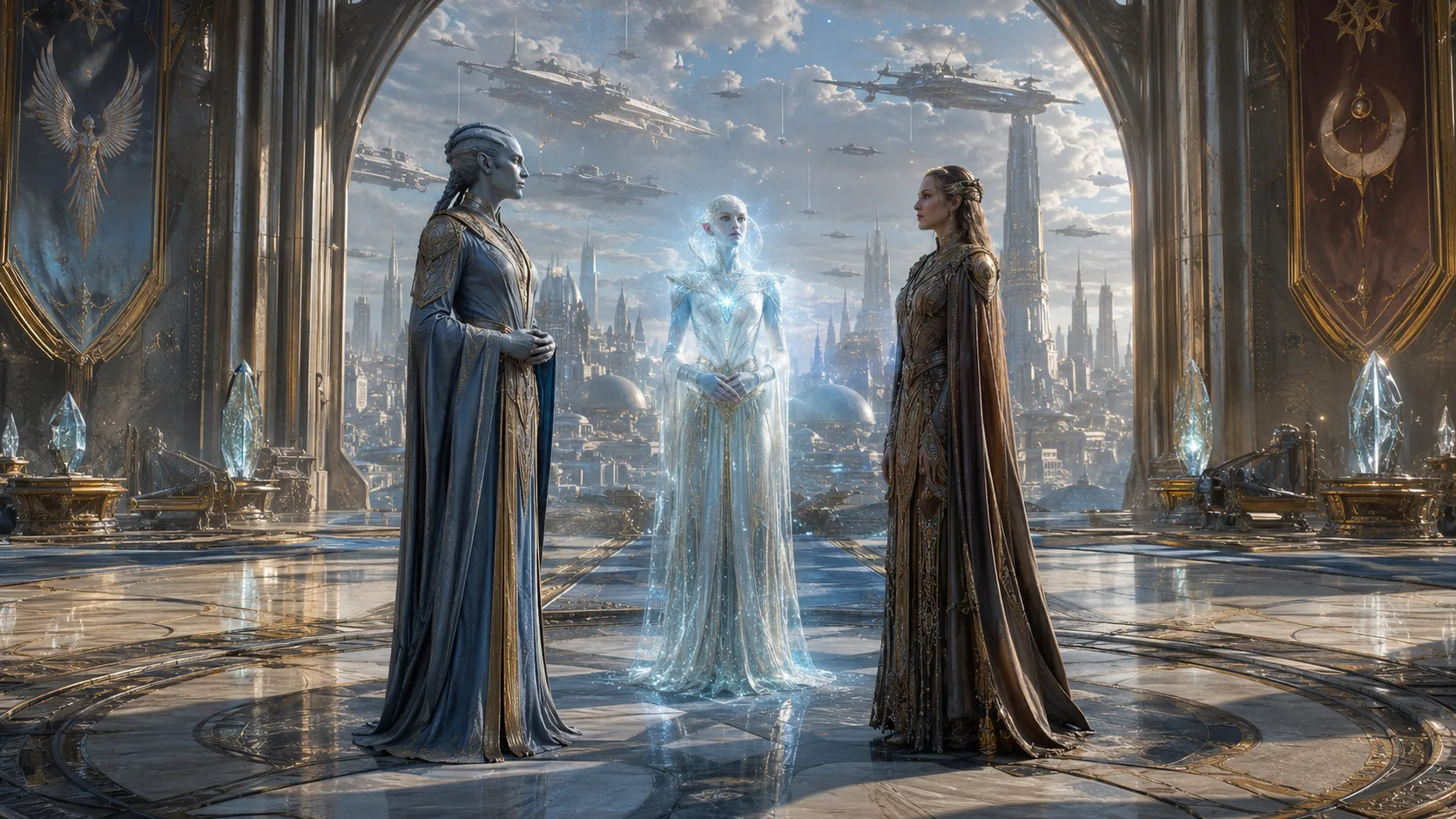
The Galactic Federation was not founded as a monument to one species, one empire, or one victorious bloodline. In Galactic Federation origin tradition, it was built as a deliberate answer to catastrophe.
After the Lyran persecution and the long trauma of the Orion Wars, the surviving civilizations faced a question that would shape everything that came after: how do you build a galactic government without recreating the same kind of dominance that caused the war in the first place?
The answer was radical.
Do not give supremacy to one race.
Do not place one civilization above all others.
Do not allow one military, one priesthood, one bloodline, or one intelligence network to define the future of every star nation.
Instead, the Federation was founded through three co-equal pillars: Andromedans, Arcturians, and Lyrians. Each represented a different kind of authority. Each brought a different civilizational strength. Each acted as a counterweight to the others.
It was not just symbolic. It was political design.
And like all political designs, it carried both brilliance and weakness from the very beginning.
Why the Founding Still Matters
The founding of the Galactic Federation matters because institutions are shaped by the fears that create them.
A nation born after civil war thinks constantly about unity. A republic born after tyranny obsesses over limits on power. A galactic federation born after interstellar persecution and Orion conflict would naturally build itself around containment, balance, and prevention.
That is the key to understanding the three-founder structure.
The Federation was not simply trying to unite worlds. It was trying to prevent the return of single-species domination.
The Orion Wars had revealed the danger of concentrated power. When one race, faction, or ideological bloc gains enough influence over military force, technology, genetic policy, and information control, freedom becomes fragile. The Federation’s founding structure was designed to stop that from happening again.
That is why three founding races mattered.
One founder could become an empire.
Two founders could become a rivalry.
Three founders created balance.
The Three Founders
The three founding races were not chosen at random. In this tradition, Andromedans, Arcturians, and Lyrians each represented a necessary ingredient for a galactic-scale civilization.
One brought distance and restraint.
One brought spiritual mastery.
One brought diversity, culture, and living memory.
Together, they formed the original moral architecture of the Federation.
The Andromedans: Guardians of Non-Interference
The Andromedans are often described as one of the most advanced and strategically distant races involved in Federation history. Astronomically, Andromeda is not a nearby star system inside the Milky Way. NASA identifies the Andromeda Galaxy, also known as Messier 31, as the nearest major galaxy to our own Milky Way and roughly 2.5 million light-years away. (NASA Science)
That distance carries symbolic weight in Galactic Federation tradition.
The Andromedan contribution was perspective.
They were not merely another local power trying to win influence after the Orion Wars. They represented the long view, the ability to step back from regional trauma and ask a larger question: what rules must exist so that developing civilizations are not constantly invaded, manipulated, or absorbed by older ones?
Their strongest founding principle was non-interference.
That does not mean indifference. It means restraint.
The Andromedan philosophy recognized that younger worlds must be allowed to evolve without constant external management. Civilizations cannot mature if every crisis is solved for them, every mistake prevented, every government corrected from above, and every spiritual lesson interrupted by outside authority.
In Federation design, this became one of the most important principles:
Advanced civilizations may guide, observe, warn, and assist under certain conditions, but they must not dominate the natural evolution of a developing world.
That principle sounds noble. It also creates enormous tension, especially on a planet like Earth, where outside influence may already exist in hidden forms. If regressive groups interfere covertly, but benevolent groups are restricted by non-interference rules, the result can look deeply unfair.
That is one of the Federation’s oldest contradictions.
The rule was created to prevent domination, but it can also slow intervention when domination is already happening.
The Arcturians: Masters of Spirit, Energy, and Healing
The Arcturians brought a different kind of authority.
Where the Andromedans represented distance and restraint, the Arcturians represented refinement. In modern astronomy, NASA describes Arcturus as a red giant visible to the unaided eye in the northern constellation Boötes. (NASA Science)
In Galactic Federation tradition, Arcturian civilization is often associated with spiritual intelligence, healing systems, vibrational science, energetic architecture, and the refinement of consciousness.
Their role in the founding was not primarily military or bureaucratic. It was ethical and energetic.
The Arcturians understood that a galactic federation could not survive on law alone. Law without consciousness becomes machinery. Machinery without wisdom becomes control. Control without compassion becomes the very thing the Federation was created to prevent.
So the Arcturian contribution was the inner dimension of governance.
They helped encode the idea that civilization is not only measured by technology, territory, or fleet strength. It is measured by consciousness. A society’s true advancement is revealed by how it treats the vulnerable, how it uses power, how it heals trauma, and whether its knowledge serves life or domination.
This mattered after the Orion Wars because war does not end when weapons go silent.
War leaves trauma inside species memory.
It leaves fear inside institutions.
It leaves suspicion between allies.
It leaves entire civilizations ready to justify secrecy in the name of security.
The Arcturian influence was meant to prevent the Federation from becoming a cold administrative machine. Their presence reminded the founders that peace must be more than the absence of war. It must include healing.
The Lyrians: Memory, Diversity, and the Right to Exist
The Lyrians brought the most painful inheritance.
Astronomically, Lyra is a small northern constellation whose brightest star is Vega. NASA notes that Vega is the brightest star in Lyra and one of the three points of the Summer Triangle. NASA also notes that ancient humans likely knew Vega as Earth’s northern pole star roughly 14,000 years ago. (NASA Science)
In Galactic Federation origin tradition, Lyra carries a much deeper meaning. It is remembered as an ancestral center of humanoid civilization and one of the great sources of genetic and cultural diversity in this galactic region.
The Lyrian contribution was living memory.
They knew what persecution looked like. They knew what displacement felt like. They knew what happened when a civilization was targeted, scattered, and forced to survive across multiple worlds.
Because of that, the Lyrians became a moral anchor in the founding.
Their presence said: never again should one race decide the fate of another. Never again should diversity be treated as weakness. Never again should genetic lineage, cultural identity, or planetary origin be used as justification for conquest.
The Lyrians brought art, culture, variation, resilience, and the memory of what had been lost. They represented the refugee who becomes a founder. The wounded civilization that refuses to become cruel. The survivor who insists that future law must protect those who cannot yet protect themselves.
That is why their role was essential.
Without the Lyrians, the Federation might have become too abstract, too administrative, too detached from the suffering that made it necessary.
Why Three and Not One
The three-founder model was a direct answer to the central lesson of the Orion Wars: concentrated power corrupts galactic systems.
A single founding species would have been simpler. One culture. One command language. One legal philosophy. One chain of authority. One official history.
But that simplicity would have been dangerous.
The Federation was not meant to be efficient in the way an empire is efficient. It was meant to be balanced.
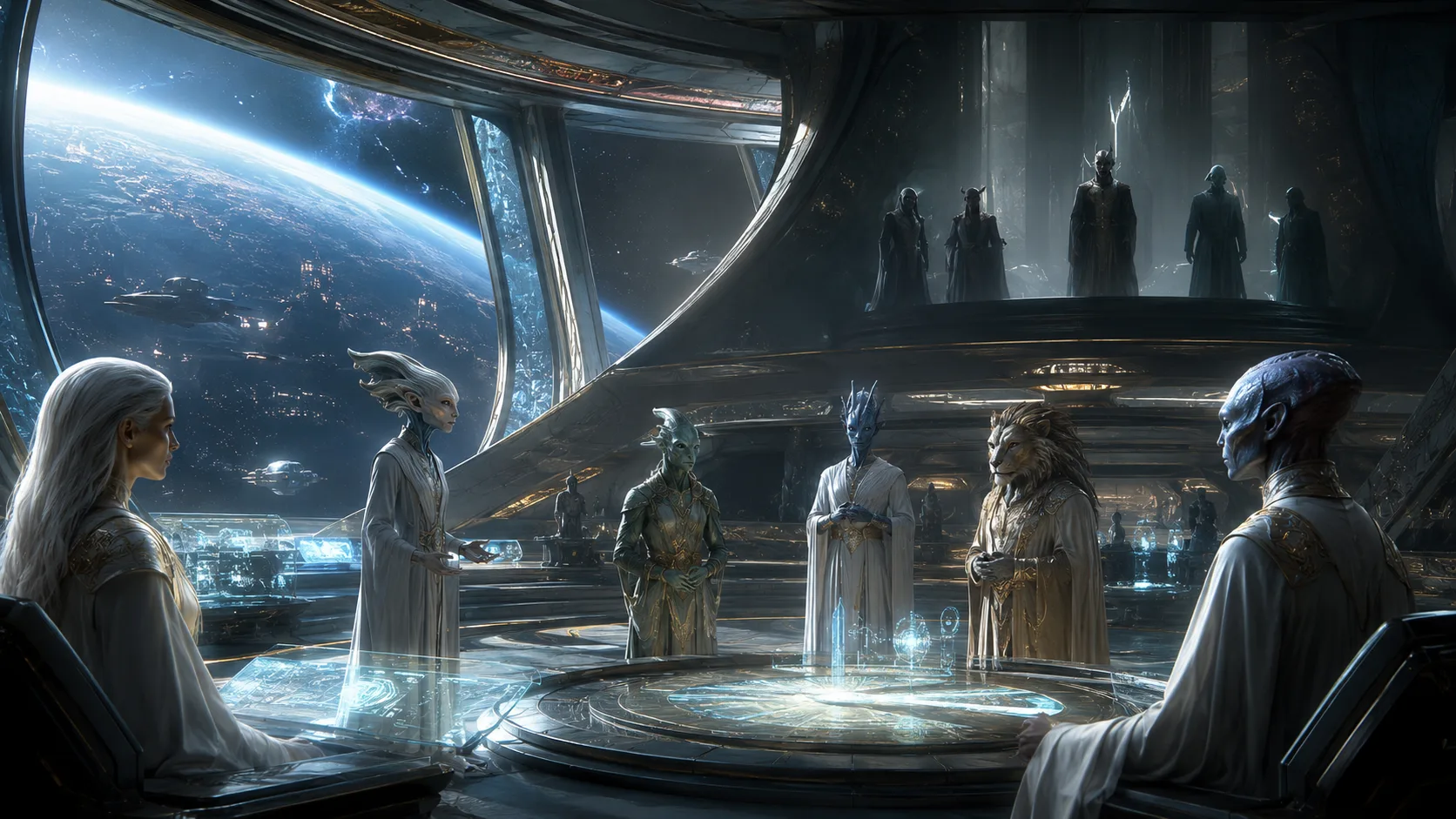
Three founders created friction by design. They forced debate. They made unilateral control harder. They gave the Federation multiple centers of legitimacy.
Each founding race checked the others:
- The Andromedans restrained interventionist impulses.
- The Arcturians restrained cold bureaucracy with spiritual ethics.
- The Lyrians restrained elitism by preserving memory, diversity, and cultural sovereignty.
This was not weakness. It was the whole point.
A galactic government without friction becomes tyranny very quickly. When decisions affect thousands of worlds, speed is not always the highest virtue. Sometimes the delay created by debate is the only thing preventing disaster.
This is where the Federation’s founding philosophy becomes recognizably constitutional.
The Founding Charter as a Galactic Constitution
The Federation’s founding charter can be understood as a galactic-scale constitutional document.
Not in the narrow human sense of parchment, courts, and national law, but in the deeper sense: a foundational agreement that defines power, limits authority, protects members, and establishes procedures for decision-making.
The charter likely enshrined several major principles:
- No single species may rule the Federation.
- Developing worlds must be protected from open domination.
- Intervention must be limited by strict conditions.
- Member civilizations retain internal sovereignty.
- Genetic, spiritual, and cultural development must not be forcibly controlled.
- Disputes between civilizations must be mediated before they become wars.
- Advanced knowledge must be handled carefully, especially around younger worlds.
- Military action must answer to collective authority, not private ambition.
That is a constitutional structure.
Human constitutional systems use similar logic. The U.S. National Archives explains that separation of powers is designed to protect against tyranny by dividing government power into branches that can check one another. (National Archives) USA.gov similarly describes checks and balances as the ability of each branch of government to respond to the actions of the others. (USAGov)
The Federation’s founding appears to follow the same broad principle, but at a cosmic scale.
Power must be divided because power cannot be trusted to police itself.
The Structural Tension Built In From the Start
The founding design was brilliant, but it had a flaw.
The Federation was too large for most members to truly understand.
That problem may sound simple, but it is enormous. The larger an institution becomes, the more ordinary members interact only with their local layer. They know their regional authorities. They know their assigned command structure. They know the rules that affect them directly.
But they do not see the whole machine.
That creates an accountability problem.
A local representative may believe the Federation is benevolent because their local experience is benevolent. A planetary council may believe the system is fair because the documents say it is fair. A lower-level Federation worker may have no idea what upper-level committees are doing in classified departments.
This is how compartmentalization begins.
At first, it may be practical. Different civilizations need different levels of access. Sensitive technology must be protected. Developing worlds cannot be flooded with destabilizing knowledge. Military intelligence cannot be public to every member civilization.
But over time, necessary secrecy can become institutional darkness.
The same structure designed to prevent domination can become a shield for hidden dominance.
That was the founding tension.
The Federation needed layers to function across a galaxy. But the more layers it created, the harder accountability became.
How the Founding Principles Were Eroded
No institution betrays itself all at once.
It usually happens gradually.
A temporary emergency measure becomes permanent. A classified department becomes untouchable. A security council gains influence. A founding principle is reinterpreted. A dangerous faction is integrated for diplomatic reasons. A compromise is made to prevent another war.
Then another.
Then another.
Over time, the Federation’s original three-founder balance appears to have weakened. The founding model was based on co-equal authority, distributed power, and moral restraint. But later structures may have shifted toward upper-level dominance, bureaucratic secrecy, and disproportionate influence by factions that were never meant to control the whole system.
This is where the previous Orion War discussion becomes important.
If former regressive or morally ambiguous groups were integrated into Federation structures as part of peace terms, then the founding charter would have faced pressure almost immediately. The Federation would have needed to balance idealism with containment. It would have had to include groups it did not fully trust, while also preventing them from rebuilding outside the system.
That is a dangerous game.
Bringing a former adversary inside an institution may reduce open conflict, but it also gives that adversary access to procedure, classification, diplomacy, and influence.
The Federation may have prevented another galactic war by absorbing tension into itself.
But by doing so, it also carried that tension into its own bloodstream.
Earth’s Political Systems as Copies
One of the most fascinating questions raised by the Federation founding story is whether Earth’s constitutional traditions are accidental echoes or deliberate reflections.
Human republics often divide power into branches or councils. The United States federal government, for example, is structured around legislative, executive, and judicial branches, each with its own powers and responsibilities. The U.S. House of Representatives describes this three-branch structure as a way to ensure separation of powers while protecting citizens’ rights. (House of Representatives) Britannica describes checks and balances as a principle in which separate branches can prevent actions by other branches and are encouraged to share power. (Encyclopedia Britannica)
That resemblance is striking.
The Federation has three founding races.
The United States has three branches.
Both systems are built around the same basic fear: no single authority should control everything.
Of course, similarity is not proof. Human history has its own political development, from ancient mixed governments to Enlightenment political theory. But from the perspective of Galactic Federation tradition, the resemblance invites a deeper question.
Did Earth develop these ideas independently because all intelligent societies eventually learn the danger of concentrated power?
Or were some of Earth’s constitutional ideas seeded, inspired, or subtly guided by older galactic governance models?
There is no simple answer. But the comparison is useful either way.
It shows that the Federation’s founding problem is also humanity’s founding problem.
How do you create authority strong enough to protect civilization, but limited enough not to enslave it?
That question has never gone away.
The Federation’s Original Genius
The genius of the Federation’s founding was not that it created perfect unity. Perfect unity is often just control wearing beautiful clothing.
The genius was that it created structured disagreement.
The Andromedans, Arcturians, and Lyrians did not erase their differences. They used those differences as stabilizers. Each race represented a different wisdom tradition. Each had a reason to distrust unchecked power. Each understood a different part of the postwar problem.
The Andromedans understood that interference can become domination.
The Arcturians understood that law without spiritual maturity becomes empty.
The Lyrians understood that diversity must be protected because persecution often begins by declaring one form of life superior to another.
Together, they built a Federation that was not meant to be ruled from one throne.
It was meant to be held in balance.
The Federation’s Original Weakness
The weakness was scale.
A small council can remain personal. A planetary government can still be seen, challenged, and understood by its citizens. A galactic federation is different.
Distance changes politics.
Time delays communication. Species think differently. Civilizations evolve at different speeds. Some worlds are physical, others more energetic or multidimensional. Some operate through councils, some through collectives, some through spiritual hierarchies, and some through technologies that younger worlds cannot even comprehend.
To manage that scale, the Federation needed layers.
But layers create distance.
Distance creates dependency.
Dependency creates trust without verification.
And trust without verification creates the perfect environment for erosion.
This is the structural flaw in the founding. The Federation’s ideals were strong, but its operating system required compartmentalization. That compartmentalization may have been unavoidable. It may even have saved lives. But it also created places where power could hide.
What the Founding Reveals About the Current Crisis
Understanding the founding helps explain why the Federation can appear so contradictory today.
It can be benevolent and bureaucratic.
Protective and slow.
Spiritually advanced and politically compromised.
Committed to free will, yet entangled in treaties that seem to limit direct intervention.
This is not necessarily hypocrisy. It may be inheritance.
The Federation inherited the trauma of the Lyran persecution. It inherited the devastation of the Orion Wars. It inherited the need to include multiple species without allowing any one of them to dominate. It inherited the impossible challenge of protecting developing worlds without controlling them.
And over time, the very mechanisms created to preserve peace may have become tools of delay, secrecy, and upper-level influence.
That does not erase the Federation’s founding ideals. It makes them more important.
Because when an institution begins to drift, the founding principles become the map back.
Conclusion: Three Races, One Warning
The Galactic Federation was founded by three races because one would have been too dangerous.
That is the heart of the story.
The Andromedans, Arcturians, and Lyrians represented more than species. They represented a political philosophy. Power must be distributed. Wisdom must be plural. No single race, council, priesthood, military class, or intelligence structure should be trusted with absolute authority over the destiny of worlds.
That was the lesson of the Orion Wars.
That was the reason for the charter.
That was the promise of the founding.
But the Federation’s greatest challenge was hidden inside its greatest achievement. To govern across a galaxy, it needed structure. To protect sensitive knowledge, it needed layers. To prevent chaos, it needed procedure. Yet every layer made accountability harder. Every procedure created a place where influence could gather. Every classified chamber carried the risk of drifting away from the original spirit of the charter.
The founding of the Galactic Federation is not just a story about ancient star races.
It is a warning about power.
Even the most enlightened system must keep returning to its first principles. Even the most advanced civilization must ask whether its institutions still serve life, freedom, and truth. And even a galactic federation founded to prevent domination must remain vigilant against domination emerging from within.
That is why the founding still matters.
The Federation began with three races because the galaxy had already learned what happens when one voice claims the right to speak for all.
Cosmic Echoes
Share-ready comments you can copy in a click, then post wherever the conversation touches UFOs, UAP, or the Galactic Federation.
These comments belong to the Cosmic Echoes page under the section Origins of Galactic Balance: The Federation’s Untold Story.
Plus 21 more comments on the Cosmic Echoes page.