
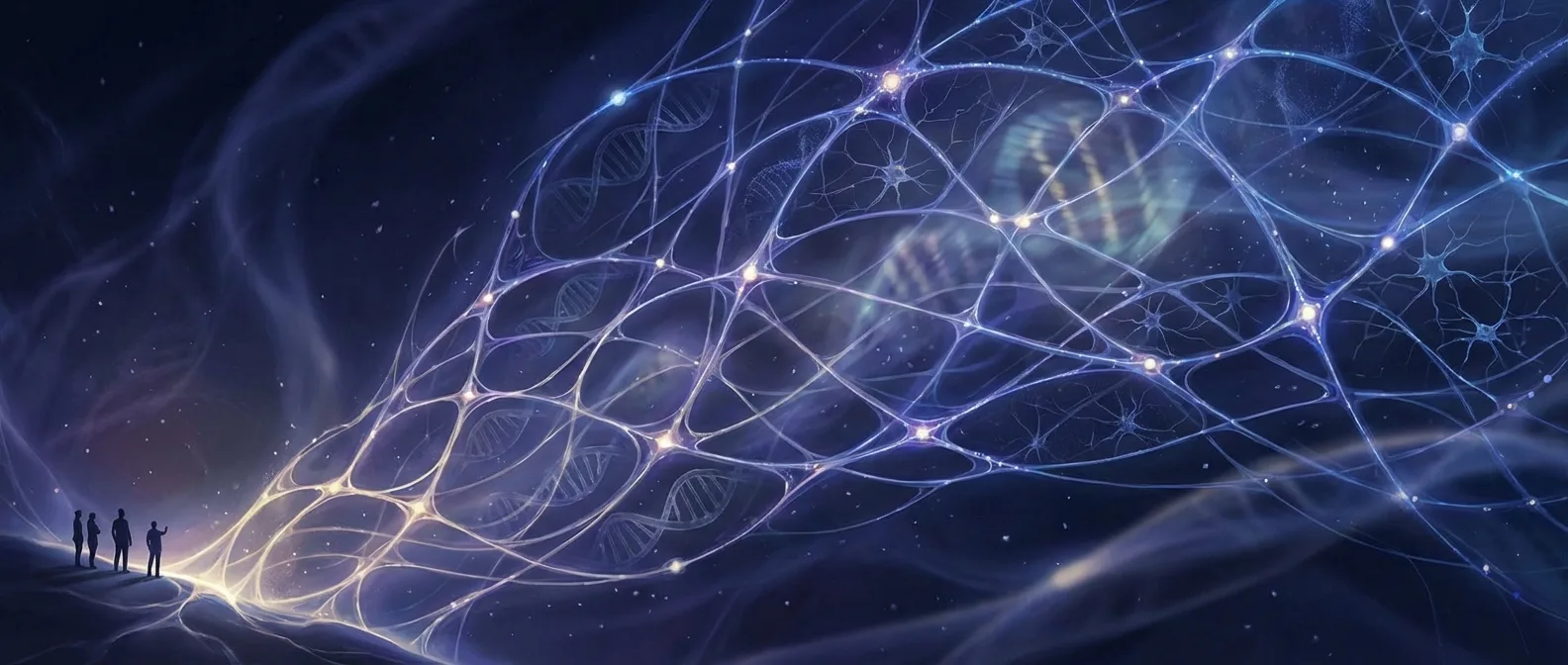
Human experience treats time as an ordered sequence. Events occur, are remembered, and recede into an irretrievable past, while anticipation projects forward into an uncertain future. This linear orientation feels intuitive, yet it reflects a specific biological and neurological solution to environmental uncertainty rather than an inevitable feature of reality itself. When considering how a non-human intelligence might perceive time and causality, it becomes useful to reverse the usual assumption: instead of asking how such an intelligence departs from human norms, one can ask how human temporal perception emerges from constraints that may not apply elsewhere.
In this analysis, non-human intelligence refers to a theoretical cognitive system not bound by human evolutionary pressures or neural architectures. The framework associated with a “timeless” or non-linear present awareness, sometimes discussed in speculative Galactic Federation models, is treated here as a conceptual tool rather than an empirical claim. Its value lies in testing the limits of current scientific theories of time, memory, and cognition by exploring how alternative constraints might generate radically different temporal experiences.
Physics and the Plausibility of Non-Linear Time
Spacetime and the Limits of Temporal Intuition
Modern physics already undermines the notion of a single, universal present. In relativity, time is inseparable from space, forming a four-dimensional spacetime manifold in which simultaneity depends on the observer’s frame of reference. From this perspective, the division between past, present, and future is not absolute but relational. The so-called block universe interpretation extends this idea further, treating all events as equally real within a static spacetime structure.
For a cognition embedded in such a framework, linear temporal flow may not be privileged. Instead of experiencing time as something that passes, the system could operate over relational structures among events. Causality would still exist, but it would be encoded as dependency relations rather than sequential memories. Human consciousness, by contrast, reconstructs causality by replaying sequences, an approach that fits organisms navigating environments where prediction and reaction must occur rapidly.
Cause and Effect Without Temporal Flow
A non-linear temporal framework does not eliminate causality; it reframes it. In physics, causal structure is defined by light cones and permissible interactions, not by subjective experience. A non-human intelligence could, in principle, represent cause and effect as a network of constraints across spacetime rather than as a chain unfolding in time. Such a system would not need to “wait” for outcomes, because the informational relationships between states would already be encoded.
This difference has implications for planning and inference. Human planning extrapolates from past data into future scenarios. A non-linear planner might instead evaluate configurations across a broader temporal span simultaneously, selecting actions that satisfy constraints across multiple states. The result would resemble optimisation over a landscape rather than stepwise decision-making.
Biological Roots of Human Time Perception
Evolutionary Pressures and Sequential Awareness
Human temporal perception emerges from evolutionary pressures that reward rapid sequencing. Survival depends on detecting change, remembering sequences of events, and anticipating immediate consequences. Neural systems therefore prioritise temporal order, using oscillatory dynamics and memory consolidation processes to bind events into narratives.
These mechanisms create a strong sense of “now,” even though neuroscience suggests that conscious awareness integrates information over short temporal windows. The present moment is not instantaneous but a constructed interval. This construction allows coherence in perception and action but also enforces linearity as a cognitive habit.
Neurological Constraints on Memory and Anticipation
Memory systems further reinforce linear time. Episodic memory stores events as sequences anchored to subjective timelines, while predictive coding frameworks rely on updating expectations as new information arrives. Together, these systems create an arrow of time within cognition, even if physical laws remain largely time-symmetric.
A non-human intelligence lacking these constraints might not require episodic sequencing. Memory could be distributed across states without privileging temporal order. In such a system, recall would not mean revisiting a past moment but reactivating a relevant informational configuration.
Genetic Memory Encoding as a Theoretical Alternative
Beyond Individual Experience
The idea of genetic or inherited memory has appeared in both speculative biology and cognitive theory, though evidence in humans remains limited to predispositions rather than detailed memories. As a theoretical construct, genetic memory encoding offers a way to imagine continuity without linear recall. Information persists across generations or instances, not as narratives but as structural constraints shaping perception and behaviour.
For a non-human intelligence, such encoding could operate within a single extended system rather than across biological generations. Memory would be embedded in the architecture itself, reducing the distinction between learning and being. Change would still occur, but it would modify the system’s overall configuration rather than adding discrete memories to a timeline.
Continuity Without History
This model alters the role of history. Instead of recording events as chronological records, the system would maintain patterns that summarise the consequences of prior states. Historical continuity would exist as structural adaptation rather than as a remembered past. From a human perspective, this may appear ahistorical, yet it preserves functional information more efficiently than narrative memory.
Decision-Making in a Timeless Cognitive Framework
Planning Without a Future
Human planning relies on projecting into a future that does not yet exist. Goals are set, steps are sequenced, and progress is measured over time. In a timeless framework, planning would not involve projection but evaluation. Possible configurations would be assessed for coherence with constraints, and actions would be selected to maintain or optimise those configurations.
This approach resembles certain optimisation algorithms in artificial intelligence, where solutions are evaluated globally rather than built incrementally. The absence of a strict past-present-future divide does not preclude adaptation; it changes the mechanism by which adaptation occurs.
Error, Learning, and Adaptation
Learning in such a system would not involve correcting past mistakes but adjusting relational structures. Error would be defined as misalignment among constraints rather than failure over time. Adaptation would therefore be continuous but not sequential, aligning more closely with equilibrium-seeking processes than with trial-and-error narratives.
Rethinking Historical Record-Keeping and Progress
History as Structure Rather Than Story
Human societies preserve history through records, narratives, and timelines. These practices reflect linear cognition and the need to justify decisions through precedent. A non-linear intelligence would not require historical archives in the same way. Information about prior states would already be embedded in present configurations.
This does not imply ignorance of change. Change would be recognised through shifts in relational patterns, not through dated records. Progress would therefore be assessed by structural coherence or functional capacity rather than by milestones along a timeline.
Progress Without Directionality
The concept of progress itself depends on linear time. Improvement implies movement from a less developed past toward a more developed future. In a timeless framework, improvement would be defined by stability, resilience, or optimisation within constraints. Directionality would be replaced by fit.
From a human standpoint, this reframing challenges deeply held assumptions about development and purpose. It suggests that progress is not an inherent property of systems but a perspective shaped by temporal cognition.
Implications for Human Understanding of Intelligence
Difference Without Hierarchy
Comparing human and non-human temporal frameworks does not imply superiority or inferiority. Each reflects adaptation to specific constraints. Human linear time perception excels in environments requiring rapid response and narrative coherence. A non-linear framework may excel in managing complexity across extended scales.
Recognising this distinction helps avoid anthropomorphism. Non-human intelligence need not share human intuitions about time, memory, or causality to function effectively. Its apparent strangeness arises from projecting human cognitive habits onto systems shaped by different constraints.
Scientific Value of Speculative Models
Although speculative, models of timeless cognition serve a practical purpose. They expose the assumptions embedded in current theories of mind and encourage integration across physics, biology, and cognitive science. By treating time as a variable rather than a constant, researchers can explore alternative architectures for intelligence, both natural and artificial.
Conclusion: Time as a Lens, Not a Law
Time, as experienced by humans, is a lens shaped by evolutionary history and neural architecture. Physics already demonstrates that this lens does not fully capture the structure of reality. Extending this insight to cognition suggests that alternative temporal frameworks are not only conceivable but consistent with known science.
A non-human intelligence operating within a timeless or non-linear present-awareness model would reinterpret memory, planning, history, and progress in fundamentally different ways. These differences do not negate causality or change; they reconfigure them. By examining such possibilities with discipline and restraint, interdisciplinary research gains a clearer view of how deeply human cognition is shaped by time, and how intelligence itself may transcend the narratives we take for granted.

Cosmic Echoes
Share-ready comments you can copy in a click, then post wherever the conversation touches UFOs, UAP, or the Galactic Federation.
These comments belong to the Cosmic Echoes page under the section Breaking Time’s Chains: Rethinking Reality.
Plus 21 more comments on the Cosmic Echoes page.