
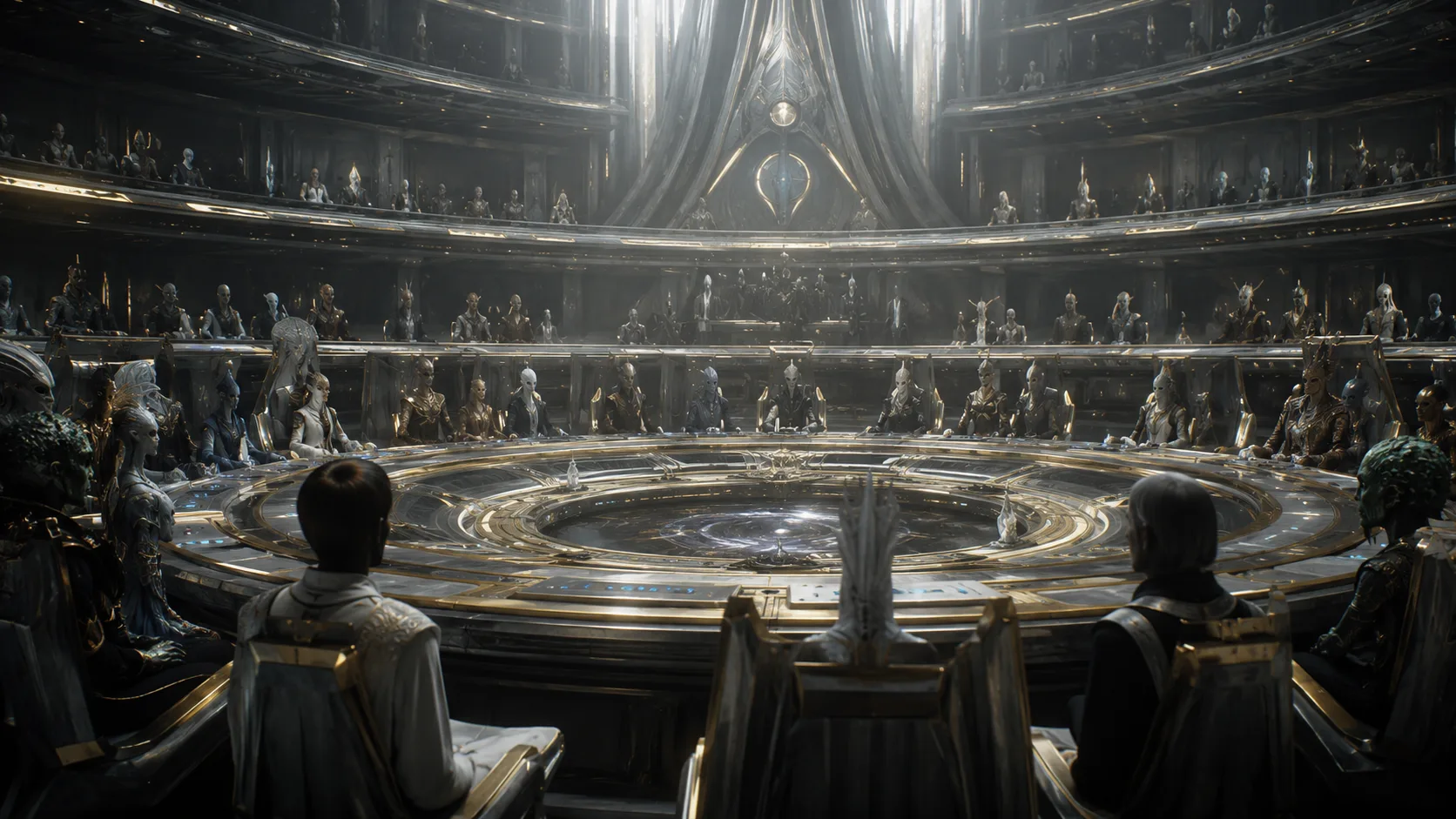
A system can be full of good people and still produce harmful results.
That’s uncomfortable, but it’s the key to understanding the Galactic Federation’s step-council structure. The most important question isn’t whether every representative inside the Federation is benevolent or corrupt. Most of them may be sincere. Many may be doing real good. Some may genuinely believe they’re serving justice, balance, non-interference, spiritual growth, or galactic peace.
The deeper question is this: what happens when good beings are placed inside a structure that prevents them from seeing who is really making the final decisions?
That is where the step-council system becomes more than a form of galactic administration. It becomes a political architecture of unaccountability.
Research note: This article treats Galactic Federation claims as witness/contact-source evidence, Earth-side institutional structures as documented comparison points, and the “same intelligence designed both systems” possibility as speculative analysis. The source framework emphasizes separating established evidence, witness-based evidence, research analysis, and speculation while evaluating claims by credibility, corroboration, and context rather than institutional approval alone.
Why Structure Matters More Than Intentions
People often look for villains first.
That makes sense emotionally. If something cruel, confusing, or manipulative is happening, we naturally want to know who is doing it. Who gave the order? Who allowed the abuse? Who is lying?
But mature power rarely works by placing one obvious villain in the center of the room. It works by building a system where responsibility is divided, information is restricted, and every level can say, “That decision came from somewhere else.”
That is the genius of compartmentalized power. It doesn’t require everyone inside the system to be evil. It only requires that each person sees too little to challenge the whole.
In the step-council model described in the Taygetan/Swaruu material, Federation representatives interact only with their assigned local level. They cannot simply bypass that level and contact the higher authority above it. In one transcript, the structure is described as a system where concerns must be handled locally, while the level above remains inaccessible, even to leaders of entire star cultures. The same source says this design can function well in small or local contexts, but becomes a barrier when larger problems overwhelm the lower council and cannot be escalated properly. (Swaruu)
That single design choice changes everything.
If you can’t access the level above you, you can’t question it. If you can’t question it, you can’t hold it accountable. And if you can’t hold it accountable, then the real center of power becomes invisible.
How the Step-Council System Works
The step-council system is presented as a chain of councils, each responsible for a defined jurisdiction. A local council handles local matters. A higher council handles broader matters. Above that sits another council, and so on.
On paper, this sounds efficient. It prevents overload. It keeps minor issues from being escalated unnecessarily. It allows local representatives to solve local problems.
But that same efficiency becomes dangerous when paired with blocked upward access.
The structure works like this:
- A lower council receives a problem.
- If the problem is too large, it requires authorization from above.
- The lower council cannot directly challenge or fully access the higher council.
- The higher council can pass decisions downward.
- Those below must carry out or defend policies they may not fully understand.
That is not normal decentralization. That is vertical control disguised as local autonomy.
In the Swaruu material on the Federation’s internal structure, the local Earth Affairs council in the Andromedan biosphere ship Viera is described as being made up of cooperative, concerned individuals who are frustrated because their “hands are tied.” The same transcript says necessary actions can only come from levels above them, while the next level, associated with Saturn, remains poorly understood even by the Viera-level representatives.
That detail matters. The local representatives are not necessarily the villains. They may be sincere. They may care deeply. They may be trying to help.
But they are not sovereign.
They are managers inside someone else’s architecture.
The Real Function: Information Deprivation
The step-council system does not merely restrict movement. It restricts understanding.
A lower council may believe it has the full picture because it has the full picture available at its level. That is the trap. The information isn’t obviously missing. It is structurally unavailable.
This creates a powerful psychological effect. People inside the system don’t feel deceived. They feel informed. They know the rules. They know the procedures. They know their colleagues. They know their immediate superiors. They can point to meetings, records, debates, and policies.
But they cannot see the architecture above the ceiling.
In another Swaruu transcript, the Federation is described as placing barriers between citizens, star races, and the true upper controllers, while hiding behind a twisted version of the step-council structure. The same source describes the system as compartmentalized, where no person or group at lower levels can see the entire picture. (Swaruu)
This is the heart of unaccountable power: not secrecy alone, but secrecy distributed through structure.
No one at the bottom needs to be told, “We are hiding the truth from you.” They are simply told, “This is not your level.”
The Parallel to Earth’s Secret Societies and Security Systems
The step-council model has obvious parallels on Earth. Not because every Earth institution is identical, and not because every member of a secretive organization is corrupt. The parallel is structural.
Earth already understands tiered access, staged knowledge, and compartmentalized authority.
Freemasonry and staged access
Public Masonic sources describe Freemasonry as organized through lodges and ceremonial degrees. The United Grand Lodge of England identifies three degrees: Entered Apprentice, Fellowcraft, and Master Mason. These are presented as stages of moral and personal development. (United Grand Lodge of England)
Britannica similarly notes that Freemasons are generally divided into three major degrees, while many lodges have additional degrees superimposed on those main divisions. (Encyclopedia Britannica)
The point is not that every Freemason is consciously participating in hidden political control. That would be too simple, and it misses the deeper mechanism.
The point is that staged systems normalize the idea that knowledge is earned level by level. Lower members can be sincere because they are not lying about what they know. They are telling the truth from inside their degree of access.
That is exactly how compartmentalized systems protect themselves. The person at the lower level is not necessarily a deceiver. Often, they are the shield. Their sincerity makes the system look trustworthy.
Intelligence agencies and “need to know”
The intelligence world uses compartmentalization openly. In U.S. national security terminology, Sensitive Compartmented Information is classified intelligence that must be handled within formal access control systems established by the Director of National Intelligence. (NIST Computer Security Resource Center)
Federal rules for classified contractor access also require a valid “need-to-know,” proper eligibility, and a nondisclosure agreement before access is granted. (eCFR)
Officially, this is about security. And in many cases, that is true. Sensitive sources, operations, and technologies may need protection.
But structurally, the same mechanism can also prevent accountability. Once information is divided into compartments, no single lower-level actor can verify the full moral, legal, or strategic context of the mission. They can only verify their piece.
The Federation step-council model appears to apply the same logic politically: every level gets enough information to function, but not enough to challenge the system.
The Inquisition as a historical warning
History shows how dangerous this becomes when moral certainty, hierarchy, and restricted information combine.
Britannica describes the Inquisition as both a judicial procedure and an institution created to combat heresy. Inquisitorial procedure often denied suspects normal transparency. The accused were not usually told who had accused them, and legal defense was restricted by fear that a lawyer could be accused of aiding heresy. (Encyclopedia Britannica)
The Spanish Inquisition later developed a formal hierarchy, with a grand inquisitor, a council, and local tribunals. Britannica notes that under the supreme council were 14 local tribunals in Spain and several in the colonies. (Encyclopedia Britannica)
This matters because the Inquisition was not just random cruelty. It was bureaucracy with spiritual language. It was procedure wrapped in righteousness. It allowed participants to believe they were defending order, truth, and salvation, while the structure itself concentrated power and reduced accountability.
That is the pattern to watch.
When a system says, “Trust the level above you,” but blocks you from inspecting that level, it has already crossed the line from governance into control.
Why Good People Serve a Corrupt System
The most uncomfortable part of this subject is that the majority of Federation members may be decent beings.
That isn’t a contradiction. It’s exactly how captured systems survive.
A corrupt structure does not need most members to be corrupt. In fact, it benefits from having kind, ethical, service-oriented people at the visible levels. They become the face of the institution. They calm concerns. They explain delays. They reassure outsiders. They absorb criticism that should be directed higher up.
A sincere local representative can say, “We’re doing everything we can,” and mean it.
That is what makes the system so effective.
The Viera-level council described in the Swaruu material is not portrayed as openly malicious. It is described as cooperative, concerned, and frustrated by its inability to act beyond its authority. That is precisely the problem: benevolent beings are placed in roles where their goodness gives legitimacy to decisions they did not truly make.
This is the information deprivation mechanism in action.
Good people inside the system are deprived of:
- Full context
- Direct access to upper authority
- Independent verification
- Lateral communication with other affected members
- The power to override harmful orders
- The ability to expose hidden decision-makers
Once those limits are in place, morality becomes localized. A council can behave ethically at its level while still serving an unethical whole.
That is how a benevolent majority becomes structurally captured.
The Federation Can Be Benevolent and Captured at the Same Time
Many people get stuck on a false choice: either the Galactic Federation is benevolent, or it is corrupt.
The step-council model suggests a more complicated answer.
The Federation may contain countless benevolent races, councils, crews, diplomats, advisors, and protectors. At the same time, the structure above them may be captured, compromised, or using their goodwill as political cover.
A Swaruu transcript discussing the Earth situation says the Federation is made of its members and that countless positive star races belong to it and do their best. Yet the same source argues that some levels are working with negative factions, and frames the Alcyone Council effort not as opposition to the Galactic Federation itself, but as an attempt to “cleanse it from evil.” (Swaruu)
That distinction is crucial.
The target is not every Federation member. The target is the architecture that prevents honest members from seeing, questioning, and correcting the top.
In other words, the problem is not simply bad beings. The problem is a structure that allows bad beings, hidden interests, or compromised councils to command good beings from above without being exposed.
The Alcyone Council Challenge
The Alcyone Council challenge is often misunderstood as political rebellion. Structurally, it appears to be something more important: an attempt to create lateral accountability.
Vertical systems control through levels. Lateral systems create peer-to-peer visibility.
In the Swaruu material, the Alcyone Council is described as representing the races and civilizations of the M45 Pleiades star system. One transcript says the council was formed independently from the Federation and later joined in bulk, meaning member races joined the Federation through Alcyone rather than only as isolated individual members. The same source describes Taygeta’s later legal move to recognize the Federation through the Alcyone Council, not as direct independent members, as an attempt to remove Taygeta from Federation rule and inflexibility.
That is not a small technicality. It changes the political geometry.
Instead of one star race standing alone before a vertical chain, multiple member races can coordinate through a shared council. Instead of each race being managed separately by the Federation hierarchy, they can compare information, coordinate responses, and create mutual defense.
That is why lateral accountability is dangerous to any step-council power structure.
A vertical hierarchy wants each member to ask upward for permission. A lateral network lets members ask each other, “What were you told? What did they tell you? Did the same order come to your council? Who signed it? Can anyone identify the source?”
Those questions break the spell.
The Pleiadian-Urmah treaty discussions described in Swaruu’s Space News material also point in this direction. The treaty is framed as expanding the influence and protection capacity of the Alcyone Council and Urmah alliance, with Antarian interest described as a sign that other races may also be noticing problems in higher Federation levels and seeking protection. (Swaruu)
That is what resistance looks like when it is structural rather than emotional.
Not merely shouting at the top.
Building a network the top cannot easily isolate.
What Lateral Accountability Would Require
If the step-council system is the problem, then the solution cannot simply be “replace the people at the top.” That may help temporarily, but the same structure would remain available for the next capture.
Real reform would require changing the rules of access.
A transparent galactic council system would need at least five safeguards:
- Right of upward appeal
Lower councils must be able to bypass a compromised immediate superior and petition higher levels directly. - Lateral communication between member races
Federation members must be able to compare information outside the vertical chain. - Named authority for major decisions
No anonymous orders. No unsigned directives. No “the higher council has decided” without traceable responsibility. - Independent review councils
Serious disputes should be reviewed by councils not controlled by the same chain of command. - Protection for dissenting representatives
Whistleblowers, dissenters, and member races raising concerns must not be punished through political isolation, military intimidation, or procedural retaliation.
Without those safeguards, a step-council system will always drift toward unaccountability, even if it began with noble intentions.
Universal Governance Pathology or the Same Intelligence?
There are two ways to interpret the similarity between the Federation’s alleged step-council system and Earth’s compartmentalized power structures.
The first possibility is a universal governance pathology. Wherever power becomes hierarchical, secretive, and insulated from challenge, it tends to protect itself. This may be a repeating pattern across civilizations: once an institution becomes large enough, it begins prioritizing continuity over truth.
The second possibility is more provocative: the same intelligence, ideology, or control strategy may have influenced both systems.
That remains speculative. But the resemblance is worth examining. Earth’s secret societies, intelligence compartments, classified programs, religious tribunals, and deep political structures all show variations of the same design principle: restrict knowledge by level, restrict access by rank, and make sure no one below the control point can see the whole.
Whether this is universal bureaucratic decay or evidence of a shared architect, the result is the same.
Power becomes unreachable.
And unreachable power eventually stops serving those below it.
Can the Step-Council System Be Dismantled From Within?
Yes, but only if enough members stop confusing procedure with morality.
A council can follow every rule and still serve injustice. A representative can act politely and still defend a harmful structure. A civilization can be advanced, spiritual, and technologically brilliant while still being politically naive about how power captures institutions.
The step-council system can only be dismantled from within if Federation members begin asking structural questions:
Who is allowed to speak to whom?
Who is forbidden from bypassing local authority?
Who signs the orders?
Who benefits from delay?
Who decides what lower councils are allowed to know?
Who can investigate the level above?
And most importantly: what happens to a member race that says no?
Those questions matter more than slogans about light, unity, service, or galactic order. Any system can use beautiful language. The test is whether it allows itself to be questioned.
Transparent Galactic Federation Governance System
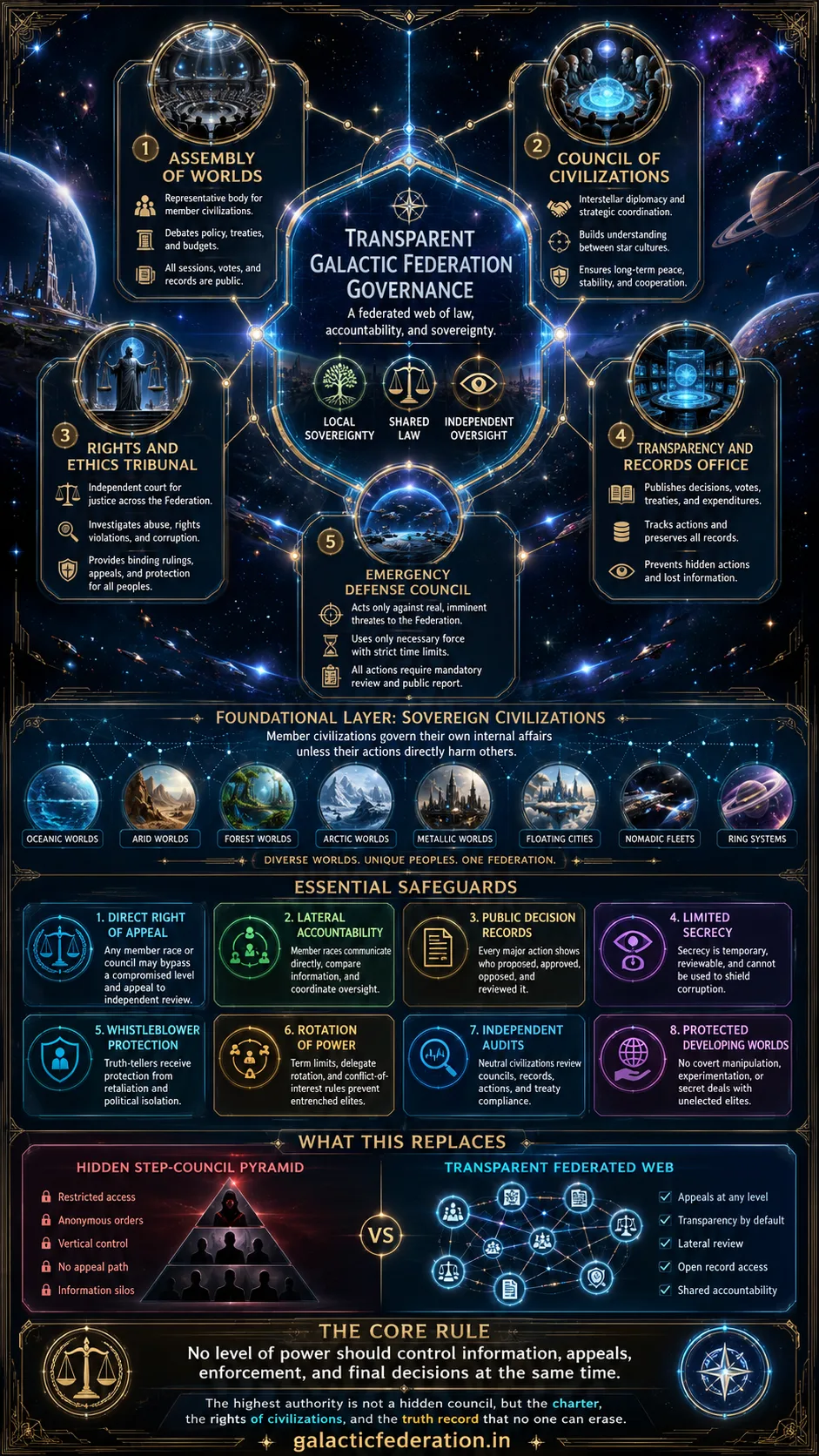
This infographic presents a better way to imagine Galactic Federation governance: not as a hidden pyramid of unreachable authority, but as a transparent federated web where power is balanced, records are preserved, and every civilization has a lawful path to be heard.
The core idea is simple: no single level of power should control information, appeals, enforcement, and final decisions at the same time. When those powers are trapped inside one vertical chain, secrecy becomes easy, accountability becomes difficult, and good representatives can end up defending decisions they never truly had the authority to question.
A more ethical Galactic Federation structure would protect local sovereignty first. Each civilization would govern its own internal affairs unless its actions directly harmed others. The larger Federation would exist to coordinate shared concerns such as interstellar diplomacy, treaty violations, protected-world rights, disclosure policy, defense emergencies, and conflicts that affect multiple star systems.
Instead of one step-council chain where each level can only speak to the level directly above it, this model separates authority into visible branches. The Assembly of Worlds represents member civilizations. The Council of Civilizations coordinates diplomacy and long-term stability. The Rights and Ethics Tribunal investigates abuses and hears appeals. The Transparency and Records Office preserves decisions, votes, and evidence. The Emergency Defense Council responds only to real threats, under strict limits and mandatory review.
What makes this model powerful is the built-in safeguard system. Member races can appeal outside their assigned council, compare information laterally, protect whistleblowers, audit powerful branches, and prevent secrecy from becoming permanent. The highest authority is not a hidden council behind the ceiling of the system. It is the charter, the rights of civilizations, and the truth record that no one is allowed to erase.
Editorial concept for GalacticFederation.in: a transparent governance framework showing how a galactic-scale federation could preserve sovereignty, prevent hidden control, and create accountability across civilizations without becoming the same pyramid structure it claims to protect against.
Conclusion: The Ceiling Is the System
The step-council system is not just a bureaucratic inconvenience. It is the ceiling placed above every lower council, every representative, every member race, and every sincere being trying to do good inside the Federation.
That ceiling is what makes power unaccountable.
The lower levels see colleagues they trust. The higher levels remain abstract. Orders move downward. Questions get trapped locally. Responsibility dissolves into procedure. And the beings at the bottom are left defending decisions whose true authors they may never meet.
That is how good people serve a corrupt structure without knowing it.
The Alcyone Council challenge matters because it points toward the only real solution: lateral visibility, shared accountability, and the right of member civilizations to speak to each other without passing every concern through a vertical chain designed to contain them.
Power stops being mystical when it can be questioned.
It stops being untouchable when names, records, and decisions can be traced.
And it stops being absolute when those below it finally realize that a ceiling is not the sky.

Cosmic Echoes
Share-ready comments you can copy in a click, then post wherever the conversation touches UFOs, UAP, or the Galactic Federation.
These comments belong to the Cosmic Echoes page under the section Cosmic Echoes: The Invisible Power Behind Galactic Order.
Plus 21 more comments on the Cosmic Echoes page.