
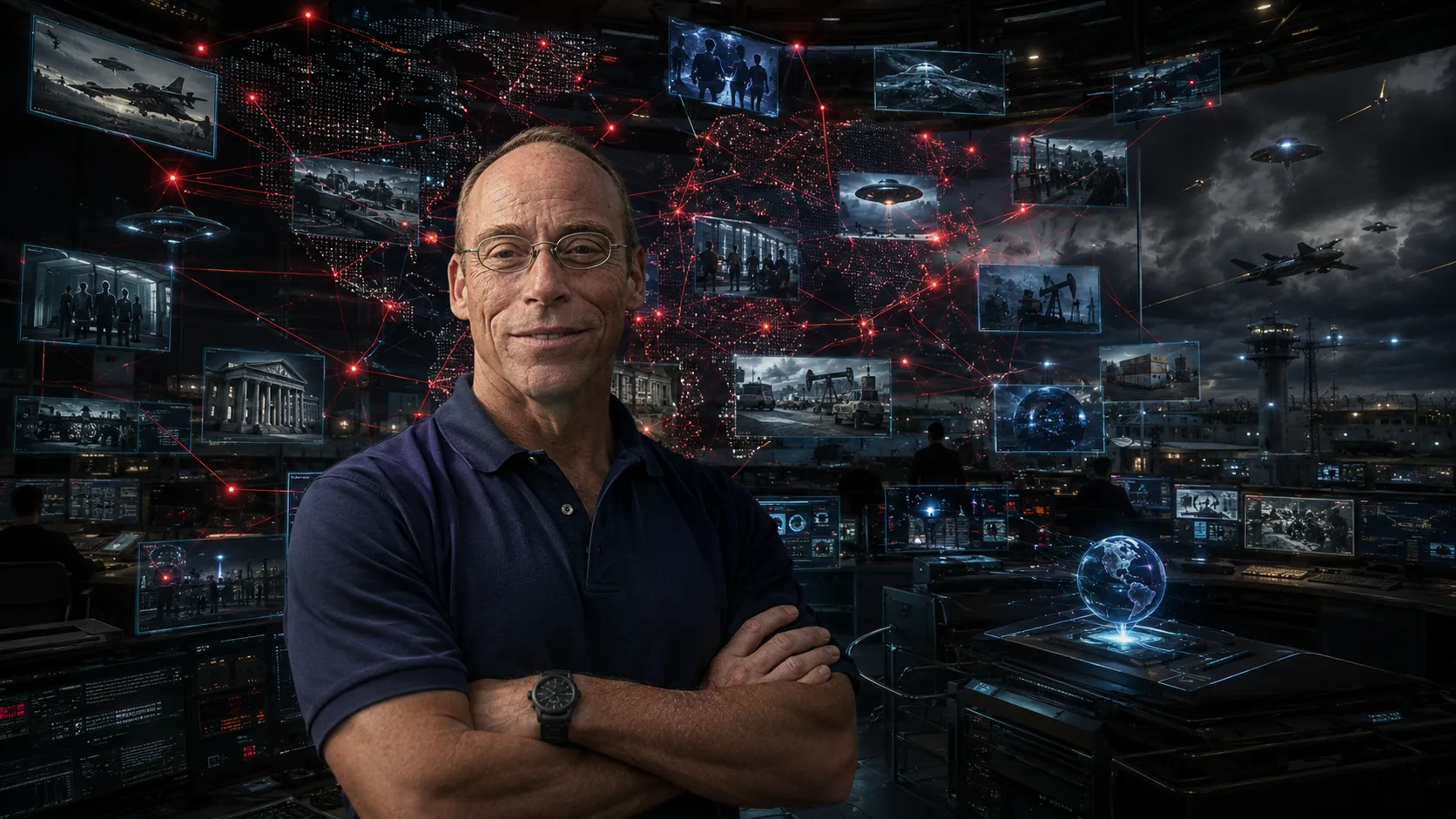
For decades, the UFO and UAP subject has lived inside a strange cultural fog. The public was taught to laugh at it, fear it, ignore it, or treat it like entertainment. At the same time, military witnesses, researchers, whistleblowers, pilots, and ordinary citizens continued asking a deeper question: what if the real issue is not only whether something unknown is operating in our skies, but who has been controlling the story around it?
That is the warning at the center of Dr. Steven Greer’s paper, How to Avoid Winning the Battle and Losing the War. Greer’s concern is not simply that disclosure may happen. His concern is that disclosure could happen in the wrong way, through the wrong narrative, and under the influence of powerful interests that want the public to interpret the phenomenon through fear. In his view, disclosure is not automatically a victory. If it is shaped around panic, militarization, emergency powers, and an “alien threat” storyline, then humanity could receive partial truth while being pushed into a deeper form of control.
The danger, then, is not only secrecy. The danger is controlled disclosure. A version of disclosure could confirm that UAPs are real while still hiding the deeper issues of illegal programs, suppressed technology, financial corruption, psychological operations, and decades of perception management. The public may feel as if it has finally been given the truth, while in reality it has only been given a carefully managed story.
That is the heart of the warning: humanity could win the battle for disclosure, but lose the larger war for truth, peace, sovereignty, and freedom.
The Battle Is Disclosure. The War Is Meaning.
The battle is getting governments, intelligence agencies, defense officials, aerospace contractors, and public institutions to admit that the UAP issue is real. That battle has already changed. The subject is no longer locked entirely outside mainstream conversation. Public hearings, whistleblower claims, military encounters, official reports, and media coverage have moved UAPs into a more serious national and global discussion.
In July 2023, the House Oversight Committee held a public hearing on UAPs featuring testimony from Ryan Graves, retired Commander David Fravor, and former intelligence official David Grusch. The Office of the Director of National Intelligence and the Department of Defense have also continued releasing public reports about UAP cases. These developments show that the topic has entered official channels in a way that would have seemed almost impossible a generation ago.
But the larger war is not only about whether UAPs are acknowledged. The larger war is about who controls the meaning of disclosure. If the public is told, “UAPs are real, and they are a threat,” that leads to one kind of future. If the public is told, “UAPs are real, and the deeper issue involves secrecy, hidden programs, suppressed science, illegal activity, and decades of perception management,” that leads somewhere very different.
One path points toward fear, emergency powers, weapons expansion, censorship, and military escalation. The other points toward transparency, constitutional oversight, peaceful contact, recovered science, and accountability for whatever has been hidden. That difference is everything.
The Warning Behind the TNCO Theory
The phrase “Trans-National Criminal Organization,” or TNCO, is central to Greer’s warning. In this framework, the alleged coverup is not treated as the work of one agency, one president, one country, or one political party. It is described as a cross-border network operating through pieces of government, intelligence, finance, media, defense contracting, energy interests, black-budget programs, and psychological operations.
That is a serious claim, and it should be handled carefully. The point is not to blindly accept every allegation as proven fact. The point is to understand the structure of the warning. Greer is describing a system in which secrecy survives because many different sectors have something to gain from it.
Some sectors may benefit from hidden technology. Others may benefit from war, public fear, energy suppression, defense spending, media control, or the confusion of ordinary people. In this view, the issue is not simply “UFO secrecy.” It is an ecosystem of power, influence, profit, and perception management.
Controlled Disclosure May Be Worse Than Silence
The most dangerous version of disclosure would not be total denial. It would be partial truth wrapped inside a false emotional frame. That is what controlled disclosure looks like.
Controlled disclosure might admit that UAPs exist. It might admit that military pilots have seen things they cannot explain. It might admit that the phenomenon is not imaginary. But after making those admissions, it could immediately steer the public toward one conclusion: threat.
This is where Greer’s warning becomes sharp. He argues that a fear-based disclosure narrative could place the world on a war footing and generate panic around non-human intelligence. That kind of disclosure would feel like truth at first. People would say, “Finally, they admitted it.” But underneath that admission, the deeper manipulation could remain untouched.
The public would still need to ask the harder questions. Who hid the evidence? Who controlled the technology? Who profited from secrecy? Who shaped the media narrative? Who intimidated witnesses? Who used national security to block oversight? Who benefits if the public panics?
Those questions matter because disclosure without accountability can become a new control system.
Media Is the Battlefield of Perception
Greer’s paper places major emphasis on media influence. His concern is that large media platforms, legacy outlets, major podcasts, and high-reach personalities can shape public emotion before people ever examine the evidence themselves.
That does not mean every journalist is corrupt. It means that once a subject becomes powerful enough, the narrative around it becomes valuable. The UAP subject is no longer just a fringe curiosity. It now touches national security, military spending, intelligence authority, public trust, religious belief, technology, energy, and the future of human civilization. That makes the story extremely valuable to control.
In the UAP world, the fear-based version often follows a predictable pattern. Unknown objects are entering restricted airspace. They appear to show advanced capabilities. They could be foreign adversaries. They could be non-human. They could be hostile. Therefore, the military needs more authority, the intelligence community needs more funding, and the public should prepare for danger.
That kind of framing changes everything. Instead of curiosity, people feel anxiety. Instead of demanding transparency, they demand protection. Instead of asking who hid the truth, they ask who can defend them from the unknown. That is why the narrative matters so much. Public perception becomes the battlefield before policy ever begins.
The False Flag Concern
One of the most explosive parts of this theory is the idea of UAP false flag events. A false flag event is an operation designed to make the public believe one party is responsible when the true cause is something else. In a UAP context, the concern is that advanced human-made craft, classified aerospace systems, electronic warfare, staged incidents, or psychological operations could be presented as evidence of an alien threat.
The public would not need to understand the technology. It would only need to see enough frightening imagery, hear enough official warnings, and watch enough commentators repeat the same message. The result could be panic, and panic is one of the easiest emotional states to manipulate.
The most effective manipulation would not need to fake everything. It could mix real unknowns, misidentified objects, classified human technology, possible non-human events, staged incidents, leaked stories, exaggerated claims, and media amplification into one confusing stream. That mixture would make the subject almost impossible for ordinary people to sort through. In that confusion, authority figures could step forward with the approved explanation.
That is why the warning is not simply about UAPs. It is about psychological control.
Abductions, Mutilations, and Stagecraft
The darker side of the theory involves abduction accounts, mutilation cases, and frightening alien imagery. Greer’s framework suggests that some terrifying events associated with non-human intelligence may involve human manipulation, covert operations, or psychological stagecraft.
That does not mean every report is fake or every witness is wrong. It means the emotional effect of these stories matters. If the public hears “non-human intelligence” and immediately thinks of helplessness, kidnapping, mutilation, experimentation, and terror, then peaceful disclosure becomes harder before it even begins.
Fear becomes the operating system. Once fear becomes the operating system, people become easier to move. They may accept secrecy, emergency powers, militarization, censorship, and a permanent security state. That is exactly the danger Greer is trying to prevent.
Illegal Black Projects and the Problem of Oversight
Another major part of the theory is the existence of illegal black military projects. These are alleged programs operating outside normal constitutional oversight, public budgeting, legal review, and democratic accountability.
In the UAP debate, this often includes claims about crash retrievals, reverse engineering, hidden compartments inside defense contracting, and advanced aerospace programs buried so deeply that elected officials may not know the full scope. The danger is not merely secrecy. Governments sometimes keep secrets for legitimate reasons. The real danger is secrecy that becomes independent of law.
A hidden program can develop its own funding channels. It can decide who is read in. It can mislead Congress. It can intimidate whistleblowers. It can hide behind national security. Over time, it can become a power structure unto itself. That is where the line between classified government work and criminal activity becomes dangerously blurred.
The Official Record Is Still Contested
This is also why the public conversation remains so divided. On one side are whistleblowers, researchers, pilots, witnesses, and disclosure advocates who argue that the public has not been told the full truth. On the other side, official government reviews have not confirmed many of the most extraordinary claims.
AARO’s 2024 historical report stated that it found no empirical evidence that U.S. government investigations confirmed extraterrestrial technology or reverse-engineering programs. The Pentagon’s annual reporting process continues to categorize and investigate UAP reports, including hundreds of new cases, but many remain unresolved because of limited data.
That tension is important. A serious public response should not be blind belief or blind dismissal. It should be disciplined curiosity. The public should demand evidence, protect whistleblowers, follow the money, audit the programs, separate witnesses from influencers, separate unknowns from assumptions, and separate legitimate security from illegal secrecy. That is the mature path.
Suppressed Technology and the Human Future
Greer’s broader worldview connects UAP secrecy to suppressed energy systems, advanced propulsion, electromagnetic technologies, and scientific breakthroughs that could transform civilization. This is where the issue becomes much larger than lights in the sky.
If advanced technology exists inside illegal or hidden programs, two enormous problems appear. First, that technology could be used against people while officially “not existing.” Second, it could be withheld from humanity even if it could reduce poverty, clean up energy systems, transform transportation, and weaken the economic logic of war.
That is why the theory connects UAP secrecy to oil, energy, aerospace, weapons, banking, and corporate power. In this view, old industries are protected by hidden science. Hidden science is protected by secrecy. Secrecy is protected by threat narratives. Threat narratives are amplified through media. The cycle feeds itself.
Why Money Matters
One of the strongest practical points in Greer’s paper is the emphasis on financial investigation. He compares the situation to the way Al Capone was ultimately imprisoned for tax violations rather than the full range of violent crimes associated with his empire.
That analogy matters because hidden systems often leave financial trails. Investigators can ask who got paid, who funded the media campaign, who owns the shell company, who received the defense contract, who moved money after a major incident, who controls the aerospace subcontractor, and who is connected to the nonprofit, think tank, media platform, intelligence cutout, or private security firm.
Money can reveal structure where testimony alone gets blocked. If a hidden network exists, it may not be exposed first through the most dramatic allegation. It may be exposed through banking records, contracts, fraud trails, procurement abuse, shell companies, and financial relationships. That is less cinematic than a UFO landing on the White House lawn, but it may be far more useful.
Why the Infographic Matters
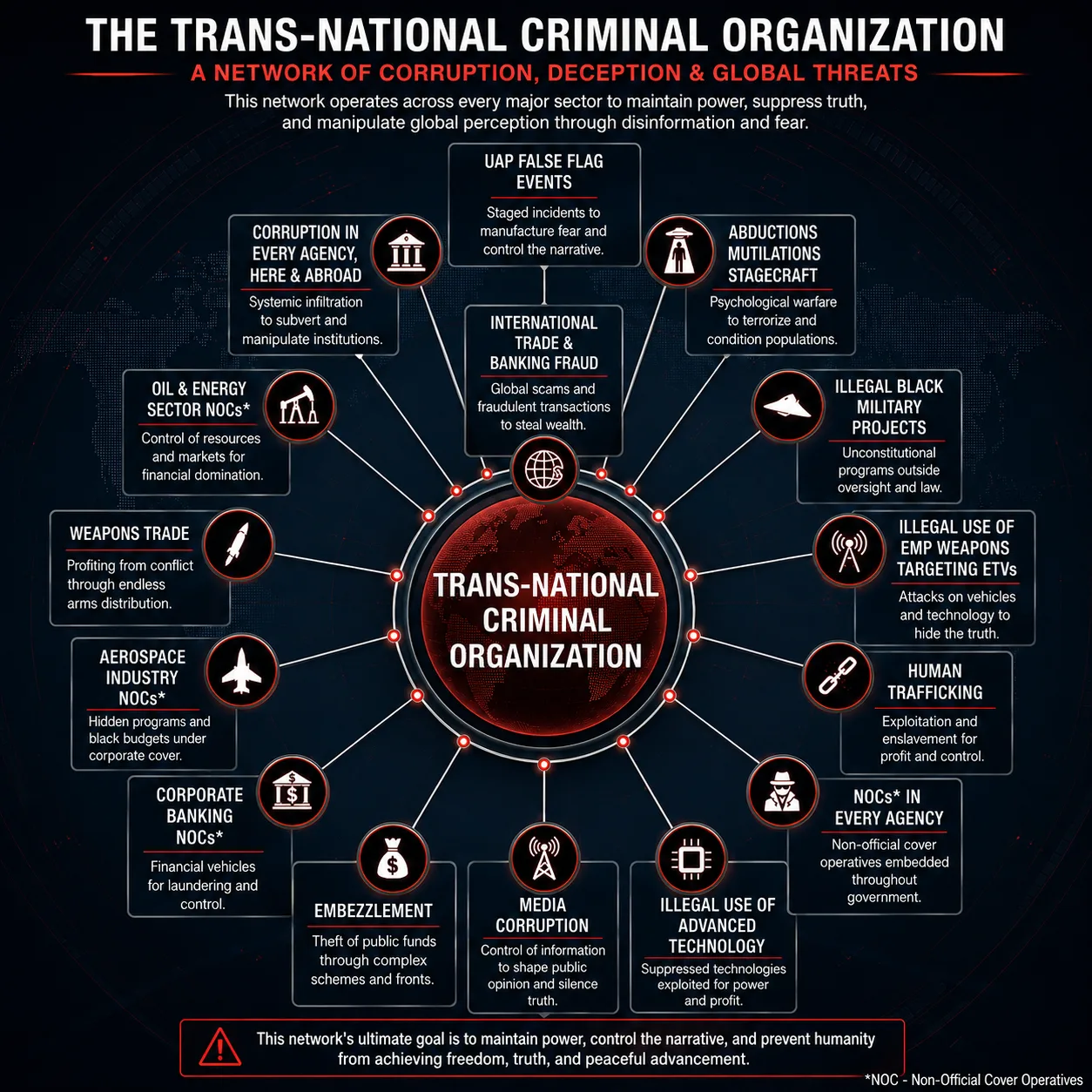
The infographic matters because it takes a dense and difficult theory and turns it into a visual map. Instead of looking at the disclosure issue as one isolated subject, it shows how many different systems could work together to control the public narrative, protect secrecy, and maintain power. At the center is the alleged trans-national criminal organization, presented as the core structure behind the operation. Around it are the different sectors, tactics, and influence points that help the system survive.
The surrounding branches represent the operating arms of that hidden structure. Media corruption shapes what the public believes. False flag events create fear and confusion. Illegal black military projects keep advanced programs outside normal oversight. Suppressed technology protects old power systems. EMP weapons, aerospace cover programs, corporate banking fronts, international financial fraud, weapons trade, oil and energy interests, agency infiltration, public embezzlement, psychological stagecraft, human trafficking, and drug trafficking all represent different ways a secretive network could generate money, hide evidence, compromise people, influence governments, and manufacture consent.
Each part of the infographic has a different function. Some parts of the network control information. Some protect illegal programs. Some create public fear. Some fund the machine. Some bury technology that could change civilization. Some influence officials and institutions. Others help create the emotional conditions needed for the public to accept a fear-based version of disclosure.
Taken together, the image shows why this theory is not just about UFO secrecy or hidden files. It presents the secrecy system as something larger, coordinated, and self-protecting. The main point is simple: the coverup is not just a vault where information is locked away. It is a machine, and every part of that machine helps keep the truth controlled.
The Alien Threat Narrative Benefits Powerful Institutions
The alien threat narrative benefits the wrong people. It benefits defense contractors because threat creates demand. It benefits intelligence agencies because threat justifies secrecy. It benefits political leaders because threat creates emergency authority. It benefits media networks because threat drives attention. It benefits energy interests if alternative technologies remain hidden. It benefits illegal programs because old crimes can be reframed as necessary defense.
That does not mean everyone using threat language is knowingly corrupt. Some people may genuinely believe they are protecting the public. Some may have seen real classified evidence but interpreted it through a narrow military lens. Some may be repeating the only framework they were given.
But incentives matter. If the same institutions accused of hiding the truth now present themselves as the only trustworthy interpreters of the truth, the public should be careful.
The Difference Between Real Disclosure and Managed Disclosure
Real disclosure would be rooted in truth, accountability, transparency, and a peaceful orientation toward whatever the UAP and non-human intelligence issue truly represents. It would not simply confirm that something has been hidden. It would ask the deeper questions that matter most: what has been concealed, who concealed it, what technologies may exist, who was harmed, who profited, what laws were broken, and what information can be safely released to the public without creating panic. Real disclosure would also focus on restoring constitutional oversight, protecting legitimate whistleblowers, and opening the door to peaceful contact rather than fear-based escalation.
Managed disclosure would be very different. Instead of revealing the full picture, it would release selective pieces of truth while steering the public toward a controlled emotional response. It would frame the subject around threat, danger, and obedience. The message would be simple: trust the authorities, do not ask too many questions, accept continued secrecy for your own safety, fund the defense response, and prepare for possible conflict. In that version of disclosure, the public may feel like it is finally receiving answers, but those answers would already be filtered through narrative control.
That difference is everything. Real disclosure leads toward freedom, accountability, recovered knowledge, and a more mature understanding of humanity’s place in the larger reality. Managed disclosure leads toward fear, militarization, emergency authority, and deeper dependence on the same institutions that may have hidden the truth in the first place. A public that only receives managed disclosure may never realize it has been redirected away from the real crimes and toward a manufactured storyline designed to protect the system behind the secrecy.
The Role of Whistleblowers
Whistleblowers are essential because compartmentalized secrecy prevents any one person from seeing the whole machine. One person may know about craft. Another may know about funding. Another may know about biological claims. Another may know about intimidation. Another may know about media influence. Another may know about psychological operations. Another may know about energy systems. Alone, each piece can be dismissed. Together, the pieces may reveal a structure.
That is why whistleblower protection matters. Without protection, insiders stay silent. If insiders stay silent, the public receives only the official narrative. And if the official narrative has been captured, disclosure becomes another layer of deception. The public should not worship whistleblowers blindly, but it should protect the process that allows them to speak.
The Bigger Human Question
At the deepest level, this is not just about UAPs. It is about whether humanity can face reality without surrendering to fear.
If non-human intelligence is real, humanity needs seriousness, humility, caution, science, diplomacy, and courage. But seriousness does not require panic. Caution does not require militarization. Security does not require total control. The public has a right to know the truth, and the public also has a right to know whether the truth has been manipulated.
That is why media literacy matters. That is why independent research matters. That is why financial investigation matters. That is why congressional oversight matters. That is why peaceful framing matters. That is why the narrative matters. The UAP issue cannot be reduced to strange objects in the sky. It is also a struggle over power, perception, technology, money, fear, and the future direction of civilization.
Conclusion: Disclosure Must Be Liberating, Not Weaponized
Disclosure is not automatically victory. It can heal, or it can harm. It can free humanity, or it can frighten humanity into deeper control. It can expose illegal secrecy, or it can protect illegal secrecy under a new story. It can open the door to peaceful contact, or it can prepare the public for conflict.
That is the warning behind the Trans-National Criminal Organization theory. Whether a person accepts every part of Greer’s framework or not, the central caution deserves attention: do not confuse admission with truth, and do not confuse fear with protection.
The real question is not only, “Are UAPs real?” The real question is who is explaining them to us, what they want us to believe, what they want us to fear, what they want us to ignore, what they gain if we panic, and what future becomes possible if we refuse to be manipulated.
The battle for disclosure may be close, but the larger war is the battle for human perception. If humanity can face the truth without surrendering to fear, disclosure can become a turning point toward accountability, peace, and a new civilization. If humanity cannot, disclosure may become the most powerful psychological operation in modern history.
That is the warning. And that is why the narrative matters.
Sources
[1] House Oversight Committee, “Unidentified Anomalous Phenomena: Implications on National Security, Public Safety, and Government Transparency.”
https://oversight.house.gov/hearing/unidentified-anomalous-phenomena-implications-on-national-security-public-safety-and-government-transparency/
[2] Office of the Director of National Intelligence, “2024 Consolidated Annual Report on Unidentified Anomalous Phenomena.”
https://www.dni.gov/index.php/newsroom/reports-publications/reports-publications-2024/4020-uap-2024
[3] AARO Historical Record Report Volume 1, 2024.
https://media.defense.gov/2024/Mar/08/2003409233/-1/-1/0/DOPSR-2024-0263-AARO-HISTORICAL-RECORD-REPORT-VOLUME-1-2024.PDF
[4] Department of Defense, “Department of Defense Releases the Annual Report on Unidentified Anomalous Phenomena.”
https://www.defense.gov/News/Releases/
[5] Dr. Steven Greer, “How to Avoid Winning the Battle and Losing the War,” January 7, 2026.
https://drstevengreer.com/wp-content/uploads/2026/01/How-to-Avoid-Winning-the-Battle-and-Losing-the-War-1-7-2026_Redacted.pdf


Cosmic Echoes
Share-ready comments you can copy in a click, then post wherever the conversation touches UFOs, UAP, or the Galactic Federation.
These comments belong to the Cosmic Echoes page under the section Cosmic Echoes: The Battle for Truth Beyond Disclosure.
Plus 21 more comments on the Cosmic Echoes page.