
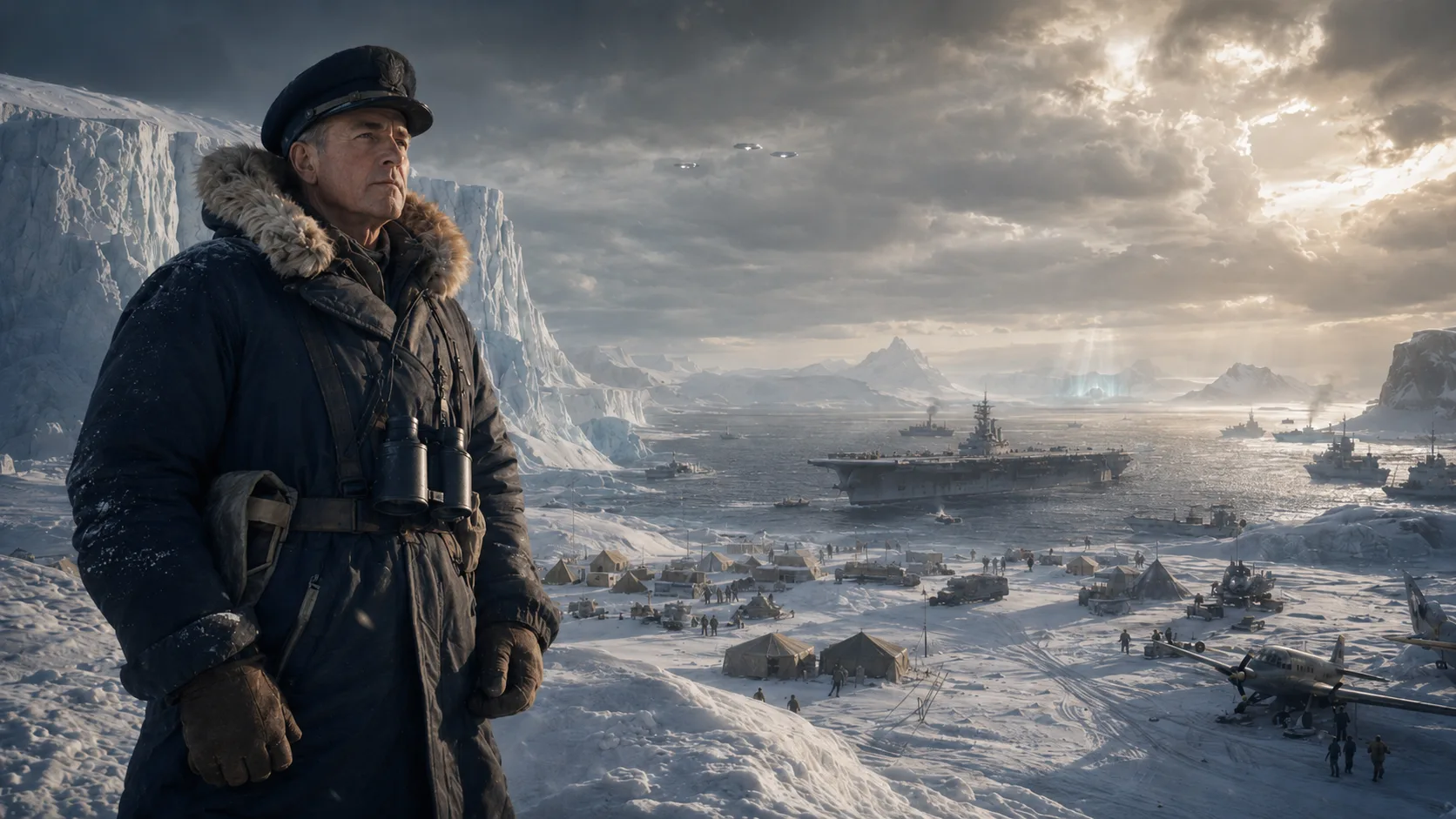
There are stories that become legends because they’re mysterious. Operation Highjump became legendary because the real story was already enormous, and the myths that grew around it were even bigger.
At the center stands Rear Admiral Richard E. Byrd, the polar explorer, naval officer, aviator, and national hero whose name had already become tied to the farthest edges of the map. Then came Antarctica, a continent so hostile and remote that it seemed almost designed to breed rumors. Add a massive U.S. Navy task force, Nazi escape stories, strange aircraft, secret bases, and an alleged hidden civilization beneath the ice, and you have one of the most irresistible modern legends ever attached to the polar world.
The video’s version of the story frames Operation Highjump as a dramatic mission involving Admiral Byrd, a hidden Nazi base, flying saucers, Hollow Earth, and a mysterious figure known as “the Master.” The truth is more complicated, and in some ways, more interesting. The verified history gives us a huge military expedition into Antarctica at the dawn of the Cold War. The legend gives us a mythic underworld full of ancient races, forbidden technology, and warnings about humanity’s future.
Both deserve to be understood, but they shouldn’t be confused.
This must-watch video takes one of the most fascinating Antarctic stories ever told and turns it into a full-scale journey through history, secrecy, and legend. It explores Admiral Richard E. Byrd, the massive 1946 Operation Highjump naval expedition, the real SS Schwabenland mission, the rumors of Nazi Base 211, strange flying objects, Hollow Earth claims, the alleged Ariani encounter, and the mysterious figure known as the Master. What makes the video so compelling is that it does not just tell the wild version of the story, it also pulls back and separates what can be documented from what belongs to postwar myth, Cold War fear, UFO folklore, and Antarctic mystery.
The Real Operation Highjump Was Already Epic
Operation Highjump was the public name for the U.S. Navy’s Antarctic Developments Program of 1946–1947. In August 1946, the Navy mounted the operation, with Rear Admiral Richard E. Byrd involved in organizing it and Rear Admiral Richard H. Cruzen commanding the task force. Its official goals were practical but ambitious: establish the Antarctic research base Little America IV, train personnel in extreme cold, test equipment, study the feasibility of Antarctic bases, and conduct extensive aerial mapping and observation. (The Unwritten Record)
The scale was staggering. Operation Highjump sent 13 ships, including an aircraft carrier and seaplane tenders, along with roughly two dozen aircraft and thousands of men into one of the most dangerous environments on Earth. Britannica describes it as the most massive sea and air operation in Antarctica up to that time, with ship-based aircraft returning with tens of thousands of aerial photographs. (Encyclopedia Britannica)
This was not a casual scientific field trip. It was a floating city of steel moving into a frozen continent that still held vast blank spaces on the map. The expedition included aviation, logistics, survival testing, photography, weather observation, transport experiments, and cold-weather naval operations. The Arctic Institute notes that Task Force 68 departed Norfolk on December 2, 1946, with 13 ships, helicopters, aircraft, and more than 4,000 men, making it the largest Antarctic expedition ever assembled at that point. (Arctic Institute)
That alone is cinematic. You don’t need UFOs to make Operation Highjump feel enormous. Imagine aircraft launching into polar weather before modern satellite navigation. Imagine ships pushing through pack ice with limited knowledge of what waited ahead. Imagine sailors and pilots trying to build and operate a base in a landscape where a mistake could kill you quickly and rescue might be days away.
Why Antarctica Mattered After World War II
To understand why the United States cared so much about Antarctica in 1946, you have to remember the timing.
World War II had just ended. The atomic age had begun. The United States and the Soviet Union were sliding into the Cold War. Long-range aircraft, polar routes, and remote bases were no longer abstract possibilities. Military planners were thinking seriously about how future wars might be fought over the top or bottom of the world. (Arctic Institute)
The official story emphasized research, training, mapping, and equipment testing. That was true, but it wasn’t the whole atmosphere surrounding the mission. Smithsonian’s Air & Space Magazine notes that the Navy also had classified political instructions connected to establishing a possible basis for a land claim in Antarctica, even though that aspect was not public at the time. (Smithsonian Magazine)
So the “cover story” idea in the video isn’t completely invented out of thin air, but it stretches the truth. Operation Highjump did have military and geopolitical layers beyond simple science. That does not mean it was secretly a war against Nazi UFOs. It means Antarctica had strategic value in a world suddenly obsessed with air power, polar routes, and global reach.
The real mission was not small, innocent, or ordinary. It was a serious projection of American power into the most remote continent on Earth.
Admiral Byrd: The Man Who Made the Legend Believable
Richard E. Byrd was not some fringe character pulled into a conspiracy tale at random. He was one of the most famous polar explorers of the twentieth century. He was a naval officer, aviation pioneer, and expedition leader whose career was built around pushing aircraft into places aircraft had barely been before. (Encyclopedia Britannica)
Byrd had already established Little America during earlier Antarctic work and became famous for polar aviation, including the first flight over the South Pole in 1929. He was promoted to rear admiral and became strongly associated with the heroic age of modern polar exploration. (Encyclopedia Britannica)
That reputation matters because it explains why the legends stick. If a random sailor had supposedly seen a hidden world beneath the ice, the story might have faded. But attach that story to Byrd, a decorated explorer with a real record in Antarctica, and suddenly the myth feels heavier. His name gives the legend a kind of borrowed authority.
This is a common pattern in folklore. A real hero becomes the anchor for an unreal story. The more impressive the real person, the easier it becomes for later storytellers to build impossible events around him.
The Cost of the Mission: George One and the Human Danger
Operation Highjump wasn’t just big. It was dangerous.
One of the most tragic episodes involved the PBM Mariner aircraft known as George One. During the mission, the aircraft took off in deteriorating weather and crashed in brutal conditions. Three Navy men died, while six survivors endured the wreck and cold before rescue. (Smithsonian Magazine)
That tragedy is important because it grounds the entire story. Antarctica didn’t need hidden weapons to be deadly. The weather, terrain, distance, darkness, ice, and mechanical risk were already enough. Every flight carried danger. Every landing was uncertain. Every route had to be treated with respect.
The mythic version of Highjump imagines sailors battling unknown craft. The documented version shows men fighting something just as terrifying: the indifference of the Antarctic environment.
The Nazi Antarctica Story: Where Fact Ends and Legend Begins
The Nazi thread is one of the most famous parts of the Operation Highjump legend. According to the conspiracy version, Germany sent the SS Schwabenland to Antarctica before World War II to locate a hidden region, establish a secret base called Base 211, and possibly make contact with an underground race or acquire advanced flying technology.
There is a real historical seed here. Germany did send an expedition to Antarctica in 1938–1939 aboard the Schwabenland. Its purpose was tied to whaling, economic planning, and Germany’s desire to secure whale oil, which was important for products such as margarine and other fat-based goods. The expedition conducted aerial reconnaissance and photographed territory that Germany claimed as Neu-Schwabenland, or New Swabia. (HISTORY)
That part is real. The underground Nazi city is where the evidence collapses.
A scholarly study in Polar Record examined the myth of Hitler’s Antarctic base and found no evidence for a secret wartime German base in Dronning Maud Land. The authors argue that the legend developed by mixing several real events: the German Antarctic expedition, wartime U-boat rumors, British and American Antarctic operations, and later nuclear and UFO anxieties. They also conclude that Operation Highjump was designed to train the U.S. Navy for polar operations, especially in the context of possible Arctic conflict, not to attack a German base under the ice. (Cambridge University Press & Assessment)
That distinction matters. The Nazis did go to Antarctica. They did claim territory. They did conduct aerial surveys. But a verified underground Antarctic base full of advanced craft, surviving SS scientists, and secret weapons has not been demonstrated by credible evidence.
The legend works because it fuses real history with nightmare logic. Nazi fugitives did escape to South America after the war. The Cold War did create secrecy. Antarctica was remote and poorly understood. UFO reports did explode in the late 1940s. Put those elements together, and the imagination does the rest.
The Ice-Free Oasis That Fed the Mystery
One of the most fascinating real discoveries tied to Operation Highjump was an ice-free Antarctic region known as the Bunger Hills.
During Highjump, Lieutenant Commander David E. Bunger spotted a mysterious ice-free area in 1947. Later research confirmed that the Bunger Hills are a real Antarctic oasis, with exposed rock, lakes, meltwater ponds, and unusual summer conditions compared with the surrounding ice. (Cambridge University Press & Assessment)
This is exactly the kind of detail that makes the legend feel plausible. An ice-free region in Antarctica sounds impossible at first. Lakes, exposed land, algae, and warmer-looking terrain seem like something out of a hidden-world story. But the explanation does not require Hollow Earth. Antarctica has dry valleys, exposed rock zones, geothermal features, unusual microclimates, and ice-free coastal oases shaped by wind, geology, and local conditions.
The real Bunger Hills are amazing. They just aren’t proof of mammoths, underground cities, or flying saucers.
The “Secret Diary” and Byrd’s Alleged Journey Beyond the Pole
The most dramatic part of the legend centers on an alleged secret diary attributed to Admiral Byrd. In that story, Byrd flies beyond the pole, his instruments fail, the ice gives way to green land, he sees a mammoth-like animal, and strange disc-shaped aircraft take control of his plane. He is then brought into a hidden civilization and meets a figure called “the Master,” who warns him that humanity is too immature for atomic power.
It’s a powerful piece of storytelling. It has everything: lost time, impossible geography, advanced craft, ancient wisdom, nuclear anxiety, and a chosen messenger returning from a forbidden realm.
But the alleged diary is not accepted as an authentic Byrd document by credible historians. It circulates in Hollow Earth and UFO communities, not in the established archival record of Byrd’s expeditions. Fact-checking and archival discussions of Byrd’s papers have found no evidence that he discovered a secret inner civilization. (Reuters)
That does not make the story worthless. It makes it folklore. And folklore can reveal a lot about what people fear and hope for.
The alleged diary appeared in a world haunted by atomic weapons, Nazi science, secret military projects, and the possibility that human civilization might destroy itself. The “Master” becomes a symbolic judge, a being from a superior realm who looks at humanity and says, in effect: you have power, but not wisdom.
That is why the scene resonates. It turns Cold War dread into myth.
The Master and the “Ariani”: What This Race Really Represents
In the legend, the Master is described as the leader or spokesman of an advanced people sometimes called the Ariani or Arianni. They are usually portrayed as tall, fair, highly intelligent, technologically superior, and morally concerned about humanity’s misuse of atomic energy. In some versions, they live inside the Earth. In others, they are connected to ancient Aryan myths, lost civilizations, or “Nordic” UFO beings.
There is no verified evidence that such a race exists beneath Antarctica. Researching the “Ariani” therefore means researching the ideas that inspired the legend, especially the older and extremely dangerous myth of the “Aryan” master race.
The word “Aryan” did not begin as a Nazi invention. It originated as a term connected to ancient Indo-Iranian peoples and language history. Over time, European racial theorists twisted it into a racial category. The Nazis then made “Aryan” identity central to their racist worldview, using it to define who supposedly belonged at the top of a racial hierarchy. (Holocaust Encyclopedia)
Nazi ideology portrayed so-called Aryans as a superior “master race,” often idealized in propaganda through traits like blond hair, blue eyes, and northern European appearance. The United States Holocaust Memorial Museum explains that these racial theories were false, pseudoscientific, and used to justify persecution, exclusion, forced sterilization, conquest, and genocide. (Holocaust Encyclopedia)
That history is essential because the “Ariani” of the Byrd legend are not just random fantasy beings. They are a cleaned-up, science-fiction version of an older racial fantasy. The story removes the brutality of Nazi racial politics and replaces it with glowing cities, ancient wisdom, and anti-nuclear warnings. But the imagery still echoes the same obsession with a hidden superior people, a purified bloodline, and a chosen race standing above ordinary humanity.
That makes the legend fascinating, but also uncomfortable.
The Master is usually presented as peaceful and wise, not as a Nazi villain. He warns humanity against nuclear destruction. He says his people have watched us for a long time. He suggests that human beings are reckless children playing with cosmic fire. On the surface, that sounds noble. But underneath it is the same old temptation: the dream that somewhere there is a perfect race, older and wiser than us, waiting to correct the failures of ordinary people.
That dream has a dark history.
Modern scholarship has repeatedly shown that the Nazi racial hierarchy was not science. Human beings cannot be cleanly divided into superior and inferior biological races in the way Nazi ideology claimed. The “master race” concept was political mythology dressed up as science. (Holocaust Encyclopedia)
So, in a serious article, the Master and the Ariani should be treated as mythic figures, not historical ones. They belong to the world of Hollow Earth lore, occult speculation, postwar UFO culture, and racial fantasy. They are important because they show how older myths can survive by changing costumes. In one decade, the “Aryan” is a racial slogan. In another, the Ariani become glowing underground guardians with flying discs.
The costume changes. The myth survives.
The Nazi Occult Angle: Why It Keeps Coming Back
The video also leans into the Thule Society, ancient artifacts, hidden knowledge, and Nazi occultism. This is another area where fact and fiction blur easily.
There were occult and pseudo-historical currents in early twentieth-century German nationalist circles, and the Nazis did exploit mythology, symbolism, archaeology, and racial pseudoscience. But popular culture often exaggerates this into a fantasy where Nazism itself becomes a supernatural project powered by ancient relics and hidden masters. Historians have warned that this can distort the real causes of Nazism by making it seem otherworldly instead of human, political, and ideological. (Aeon)
That warning matters. The occult Nazi myth is entertaining because it feels like a movie. Secret orders. Hidden bases. Lost civilizations. Super-weapons. But the danger is that it can make real historical evil look mysterious and glamorous, instead of showing it as a human system built on racism, violence, bureaucracy, propaganda, and power.
Operation Highjump gets pulled into that mythology because it happened at the perfect moment: right after the fall of Nazi Germany, right before the modern UFO age, and right at the start of the Cold War.
Hollow Earth: The Ancient Dream Beneath the Ice
The Hollow Earth idea is much older than Operation Highjump. For centuries, writers, mystics, and speculative thinkers imagined inner worlds beneath the surface. Some versions described underground kingdoms. Others imagined polar openings. Later versions connected Hollow Earth to Agartha, Shambhala, hidden masters, ancient survivors, or advanced beings who withdrew from the surface world.
The Byrd legend borrows heavily from that tradition. Antarctica becomes the doorway. The polar flight becomes the initiation. The Master becomes the hidden king. The Ariani become the secret race. The warning about atomic weapons becomes the moral lesson.
Scientifically, though, Earth is not hollow. Modern geology and seismology show that Earth has a crust, mantle, outer core, and inner core. Seismic waves moving through the planet reveal its internal structure, including the liquid outer core and solid inner core. (U.S. Geological Survey)
That doesn’t kill the symbolic power of the story. It just moves it from science into myth.
The Hollow Earth version of Byrd’s journey is not really about geology. It’s about the fear that the surface world has gone mad. It imagines that wisdom has retreated underground, away from war, greed, and nuclear weapons. It asks a haunting question: what if the most advanced civilization on Earth decided we were too dangerous to contact?
That’s good mythology. It just isn’t documented history.
The Antarctic Treaty: Not a Cover-Up, but Still Intriguing
One of the most repeated claims in the Operation Highjump legend is that the Antarctic Treaty was created to keep people away from the truth. In this version, governments supposedly locked down the continent after Byrd’s discovery.
The actual Antarctic Treaty was signed in Washington on December 1, 1959, by 12 countries active in Antarctic science during the International Geophysical Year, and it entered into force in 1961. Its purpose was to reserve Antarctica for peaceful purposes, protect freedom of scientific investigation, and prevent the continent from becoming a military battleground. (Antarctic Treaty System)
It also does not ban all human access to Antarctica. Scientists work there. Tourists visit. Expeditions operate under strict environmental and safety rules. Certain protected areas require permits, and activities that disturb wildlife, introduce invasive species, or damage protected sites are restricted. (IAATO)
So the treaty is not proof of a hidden civilization. But it does add to Antarctica’s aura. Few places on Earth are governed so unusually. No single nation owns it. Military activity is restricted. Scientific cooperation is central. The continent is open, but regulated. That combination makes Antarctica feel both international and forbidden, which is perfect fuel for mystery.
What Operation Highjump Really Achieved
Strip away the saucers and secret cities, and Operation Highjump remains one of the boldest polar missions of the twentieth century.
It tested how ships, aircraft, machines, and men performed in extreme cold. It expanded aerial photography of Antarctica. It helped planners understand the challenges of building and supplying bases. It exposed the limits of equipment and logistics in a polar environment. It showed that Antarctica could be entered at scale, but never casually. (The Unwritten Record)
It also helped push the United States deeper into the age of polar strategy. The expedition belonged to a world where the poles were no longer just blank spaces for explorers. They were becoming military corridors, scientific laboratories, geopolitical symbols, and technological proving grounds.
That is the real epic core of Highjump. It was a bridge between the old age of exploration and the new age of global military science.
Byrd represented the old heroic explorer: fur-lined gear, dangerous flights, frozen camps, and the romance of the unknown. The Navy task force represented the new world: aircraft carriers, helicopters, mapping cameras, classified objectives, and Cold War strategy.
Put those together in Antarctica, and legend was almost inevitable.
Why the Myth Refuses to Die
The Operation Highjump legend survives because it satisfies several powerful instincts at once.
It gives us a hidden enemy: surviving Nazis beneath the ice.
It gives us forbidden technology: flying saucers and energy weapons.
It gives us a lost world: green valleys, mammoths, and underground cities.
It gives us a wise authority: the Master warning humanity about atomic destruction.
It gives us a cover-up: governments hiding the truth behind treaties and classified files.
Most importantly, it gives Antarctica a secret worthy of its appearance. The continent looks like the end of the world. It feels natural to imagine that something impossible is buried there.
But the verified story has its own power. Real men did sail south. Real aircraft did fly into unknown weather. Real lives were lost. Real maps were made. Real military planners were thinking about how the poles could shape the next war. Real geopolitical ambitions were hidden behind public language about research and training.
The myth is spectacular. The history is formidable.
Conclusion: The Truth Beneath the Ice
Operation Highjump is one of those rare stories where the facts and the legends both feel huge.
The facts tell us that Admiral Byrd and the U.S. Navy helped launch the largest Antarctic expedition of its time, a mission packed with ships, aircraft, scientific goals, military training, strategic ambition, danger, and tragedy. The myths tell us that something deeper was waiting under the ice: Nazi bases, UFOs, ancient beings, and a mysterious Master warning humanity not to destroy itself.
The responsible way to tell the story is not to flatten it into either pure conspiracy or dry history. The best version holds both layers in view. Operation Highjump was real. Byrd was real. The German Antarctic expedition was real. Ice-free Antarctic oases are real. Cold War secrecy was real. The fear of atomic destruction was real.
But the hidden Ariani race, the underground Master, the Nazi saucer base, and the Hollow Earth civilization belong to legend, not verified history.
And maybe that’s why the story still works.
Antarctica remains one of the few places on Earth that can still make modern people feel small. Operation Highjump sent a fleet into that silence, and what came back was more than maps and photographs. It came back with a mythology, one that still asks the same question every great polar story asks:
What if the edge of the world isn’t the end of the map, but the beginning of something we were never meant to understand?



Cosmic Echoes
Share-ready comments you can copy in a click, then post wherever the conversation touches UFOs, UAP, or the Galactic Federation.
These comments belong to the Cosmic Echoes page under the section Frozen Legends: Operation Highjump Uncovered.
Plus 21 more comments on the Cosmic Echoes page.