
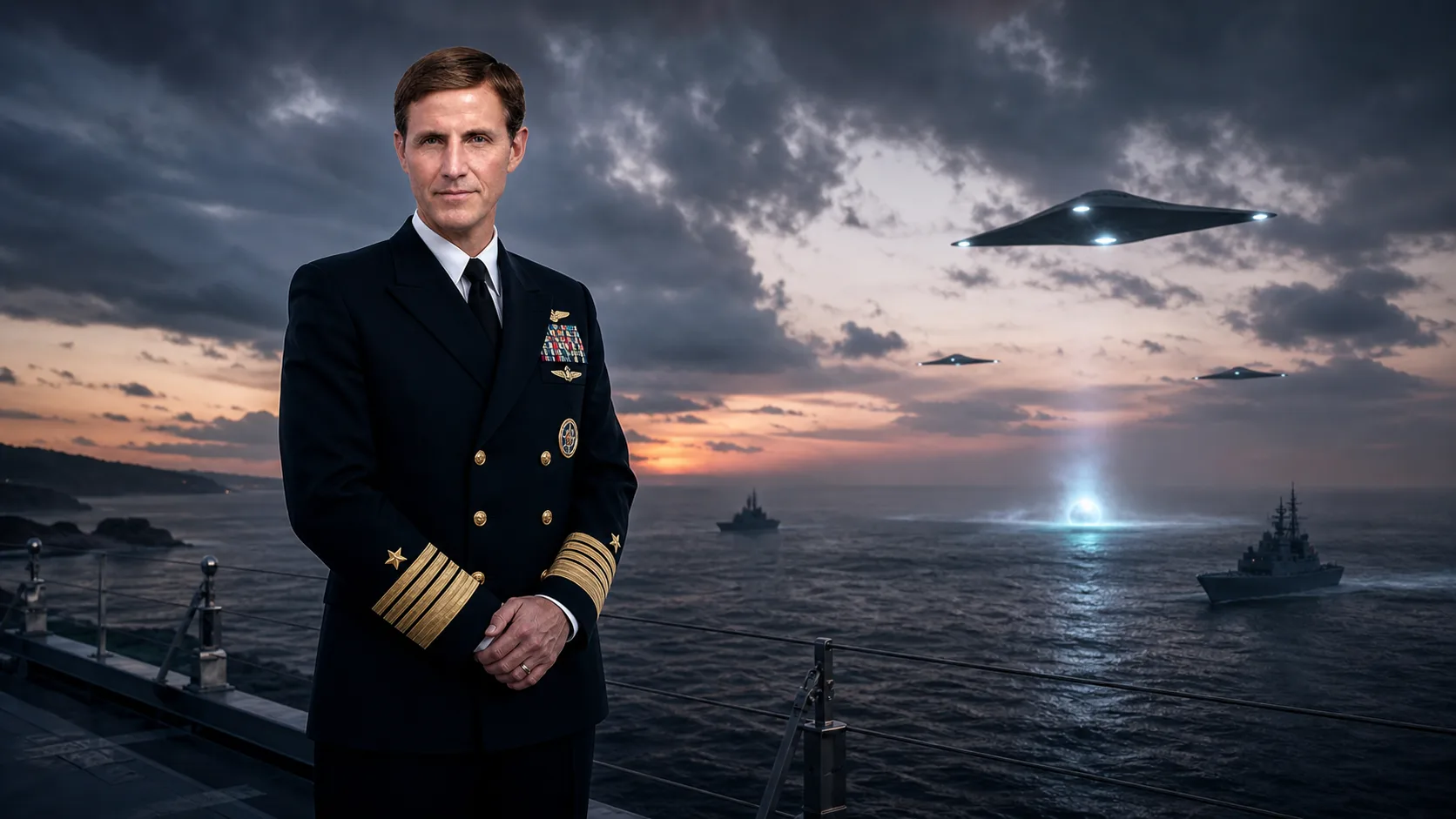
For years, unidentified aerial phenomena were treated as a subject people discussed quietly, often with a raised eyebrow and a quick change of topic. That has changed. Today, UAP are being discussed in congressional hearings, military reports, scientific panels, and serious national security conversations.
One of the more notable voices pushing that conversation forward is Timothy Gallaudet, a retired U.S. Navy Rear Admiral and former Oceanographer of the Navy. His background matters. Gallaudet isn’t simply commenting from the sidelines. He spent decades inside the military’s operational and scientific infrastructure, working with ocean data, naval intelligence, environmental monitoring, and maritime security.
That’s why his warnings have drawn attention. He has argued that unexplained activity is not limited to the skies. Some of the most puzzling reports, he says, may involve objects moving between air and water, a possibility that raises serious questions about what we know, what we don’t know, and what may be happening in one of the least understood environments on the planet.
Why Gallaudet’s Perspective Stands Out
Many people have opinions about UAP. Far fewer have spent a career working at the intersection of naval operations, oceanography, and national security.
Gallaudet served in roles where understanding the ocean was not an academic exercise. It was a mission-critical responsibility. The Navy depends on accurate knowledge of weather, sea conditions, underwater terrain, currents, and environmental data. These factors affect everything from submarine movement to aircraft carrier operations.
So when someone with that background says unexplained phenomena deserve serious investigation, it carries a different weight.
His concern is not built around sensational claims. It is built around a practical question: if trained military personnel and advanced sensors are detecting objects that appear to behave in ways we cannot explain, shouldn’t we investigate them carefully?
That question sounds simple. But for decades, stigma made it difficult to ask out loud.
A Pattern That Is Harder to Ignore
The modern UAP conversation is no longer based only on blurry photographs or secondhand stories. Some of the most discussed incidents involve trained pilots, naval operators, radar systems, infrared cameras, and other forms of sensor data.
According to Gallaudet and others who have spoken publicly, these encounters are not always isolated events. In some cases, personnel have reported repeated observations in restricted training areas, places where unknown objects should not be operating at all.
The reported behavior often includes objects that seem to:
- Move at extraordinary speeds
- Accelerate without visible engines or exhaust
- Hover or maneuver in unusual ways
- Appear in sensitive military operating zones
- Transition between air and sea
- Avoid easy classification as conventional aircraft, drones, or balloons
That does not automatically mean the explanation is exotic. It does mean the reports should not be dismissed casually.
In any other context, unknown objects entering military training ranges would trigger concern. Whether the explanation is foreign technology, sensor error, experimental systems, natural phenomena, or something stranger, the security implications are real enough to warrant attention.
The Ocean May Be the Missing Piece
Most public discussion of UAP focuses on what happens in the air. That makes sense. The term itself points people upward. Fighter pilots see objects in the sky. Videos show objects moving across radar screens or infrared displays. News coverage tends to frame the issue around airspace.
Gallaudet’s contribution is different because he keeps bringing the conversation back to the ocean.
That matters because the ocean is vast, difficult to monitor, and still deeply mysterious. More than 70% of Earth’s surface is covered by water, and much of it remains poorly explored compared with land or near-Earth space. Even today, the deep ocean is a challenging environment for science, navigation, and surveillance.
If some unexplained objects are entering or exiting the water, as certain accounts suggest, then the UAP issue becomes more complicated. It is no longer just an aviation question. It becomes a maritime question, an oceanographic question, and potentially a defense question.
The USO Question
Objects reported beneath the surface are sometimes referred to as unidentified submerged objects, or USOs. The term is less familiar than UAP, but it points to a related mystery.
The idea is not simply that something was seen in the water. The more puzzling reports involve objects that appear to move through water in ways that do not match known submarines, torpedoes, drones, or marine life. Some accounts describe objects moving from air to water without the kind of splash, drag, or disruption one would expect.
That is the part that catches attention.
Water is not air. It is dense, resistant, and unforgiving. A craft designed to fly at high speed through the atmosphere would face very different engineering challenges underwater. Something that could operate smoothly in both environments would represent an extraordinary technological achievement.
Again, that does not prove what these objects are. But it does make the reports worth studying with better data and fewer assumptions.
Why Serious Investigation Matters
One of the most important things about Gallaudet’s position is that he does not present speculation as certainty. He has not claimed to know exactly what these phenomena are. He has not declared that they are extraterrestrial. He has not offered a neat answer wrapped in a dramatic headline.
Instead, he has called for a more disciplined approach.
That includes:
- More transparency from government agencies
- Better systems for reporting unusual encounters
- Less stigma for pilots, sailors, and service members
- Stronger cooperation between military and academic researchers
- A scientific framework for studying unexplained data
That last point is especially important. Science does not begin with certainty. It begins with observation, measurement, and the willingness to ask uncomfortable questions.
If there are credible reports supported by sensor data, then the next step is not ridicule. It is investigation.
The Stigma Problem
For a long time, one of the biggest obstacles to understanding UAP was not technology. It was embarrassment.
Pilots and service members risked being mocked, ignored, or professionally sidelined if they reported something unusual. That creates a dangerous incentive to stay quiet. In military settings, silence can lead to blind spots.
Imagine a pilot repeatedly seeing unknown objects in a training area but choosing not to report them because the subject feels too strange. That is not just a cultural problem. It is a safety problem.
This is one reason the tone around UAP has changed so much in recent years. The issue has moved away from late-night speculation and closer to a practical question of reporting, data collection, and risk assessment.
No military wants unknown objects operating near aircraft. No navy wants unexplained activity in or around sensitive waters. Whatever the final explanation may be, the first step is making sure people can report what they see without fear of ridicule.
Not the Only Credible Voice Speaking Up
Gallaudet is part of a broader group of military and government-linked figures who have helped bring UAP into mainstream discussion.
David Fravor, a former Navy pilot, became widely known for his account of the “Tic Tac” encounter off the coast of California. Ryan Graves, another former Navy pilot, has spoken about repeated encounters reported by aviators. David Grusch, a former intelligence official, has made more controversial claims involving alleged classified programs.
These individuals do not all say the same thing. Their claims vary in scope, evidence, and level of certainty. But together, they have contributed to a major shift: UAP are no longer being treated only as a fringe curiosity.
The conversation gained even more momentum after the 2017 New York Times reporting that revealed the U.S. government had funded efforts to study unexplained aerial incidents. Since then, the issue has moved into congressional hearings, official reports, and public debate.
That does not mean the mystery has been solved. It means the question has become harder to ignore.
What Could These Objects Be?
The honest answer is that no single explanation covers every case.
Some sightings may turn out to be drones, balloons, aircraft, satellites, sensor glitches, weather effects, or misidentified objects. That is expected. Any serious investigation would likely explain many cases in ordinary ways.
But the most difficult cases are the ones that remain unresolved after review, especially when multiple trained observers and sensor systems are involved.
Possible explanations include:
- Advanced foreign surveillance technology
- Classified U.S. experimental systems
- Unknown atmospheric or oceanic phenomena
- Sensor errors or data interpretation problems
- Highly advanced drones or autonomous platforms
- Something not yet understood by current science
Non-human intelligence is sometimes discussed as a possibility, but possibility is not the same as proof. A careful approach leaves room for unusual explanations without jumping to conclusions.
That balance is important. Dismissing everything is lazy. Believing everything is just as flawed. The better path is disciplined curiosity.
The Government’s Role and AARO
As public pressure grew, the U.S. Department of Defense established the All-domain Anomaly Resolution Office, known as AARO, to examine unidentified objects across different environments, including air, sea, space, and other domains.
The creation of AARO reflects a key point: the government now acknowledges that unidentified phenomena deserve a formal review process.
Official reports have stated that many sightings can be explained, while others remain unresolved because of limited data. That is not the same as confirming extraordinary origins. But it is also not nothing.
For many people, the frustration is that the public still sees only a small part of the picture. Members of Congress, researchers, and transparency advocates have continued to push for clearer answers, especially when taxpayer-funded agencies may hold relevant data.
If these objects are a security concern, the public has a legitimate interest in knowing how seriously the issue is being handled.
Why the Ocean Angle Changes the Conversation
The ocean adds a layer of complexity that the public conversation often misses.
Airspace can be monitored with radar, satellites, aircraft, and ground-based systems. It is not perfect, but there is a large infrastructure built around tracking things in the sky.
The ocean is different.
It is deep, dark, loud, pressurized, and difficult to observe continuously. Subsurface monitoring is possible, especially for military purposes, but it is not complete. There are enormous gaps in what we can detect, map, and understand.
That makes the ocean a natural hiding place for uncertainty. Not necessarily for “aliens” or anything dramatic, but for unknown activity in general. Advanced drones, secret submarines, unusual natural phenomena, or something genuinely unexpected could all be harder to identify beneath the surface.
Gallaudet’s point is not that the ocean solves the UAP mystery. It is that ignoring the ocean may prevent us from understanding the full picture.
The Bigger Question
At the heart of this issue is a question that is both simple and enormous:
What are we dealing with?
That question has followed the UAP topic for decades, but it feels different now. The people asking it are not only hobbyists or believers. They include pilots, military officers, scientists, lawmakers, and intelligence professionals.
Gallaudet’s role in the conversation is not to provide a final answer. It is to argue that the question itself is valid.
That matters. Once a question becomes valid, it can be studied. Once it can be studied, it can be measured. Once it can be measured, it can move out of the realm of rumor and into the realm of evidence.
That is where this subject needs to go.
Conclusion: The Mystery Is Bigger Than the Sky
Timothy Gallaudet’s warning is not about panic. It is about paying attention.
If unexplained objects are operating in military airspace, that matters. If some of them are also interacting with the ocean, that may matter even more. The sea is one of Earth’s greatest blind spots, and it may hold clues that have been overlooked because the public conversation has focused so heavily on the sky.
None of this proves that the most dramatic theories are true. But it does suggest that dismissing the subject outright is no longer reasonable.
The right response is not fear. It is curiosity, transparency, and serious investigation.
Whatever these phenomena turn out to be, advanced technology, natural anomalies, classified systems, or something entirely unknown, the search for answers is no longer a fringe pursuit. It is becoming a serious conversation about security, science, and the limits of what we think we know.
And if Gallaudet is right, the next major breakthrough in the UAP mystery may not come from looking higher into the sky.
It may come from looking deeper into the ocean.



Cosmic Echoes
Share-ready comments you can copy in a click, then post wherever the conversation touches UFOs, UAP, or the Galactic Federation.
These comments belong to the Cosmic Echoes page under the section Ocean Depths: The Next Frontier in UAP Mysteries.
Plus 21 more comments on the Cosmic Echoes page.