
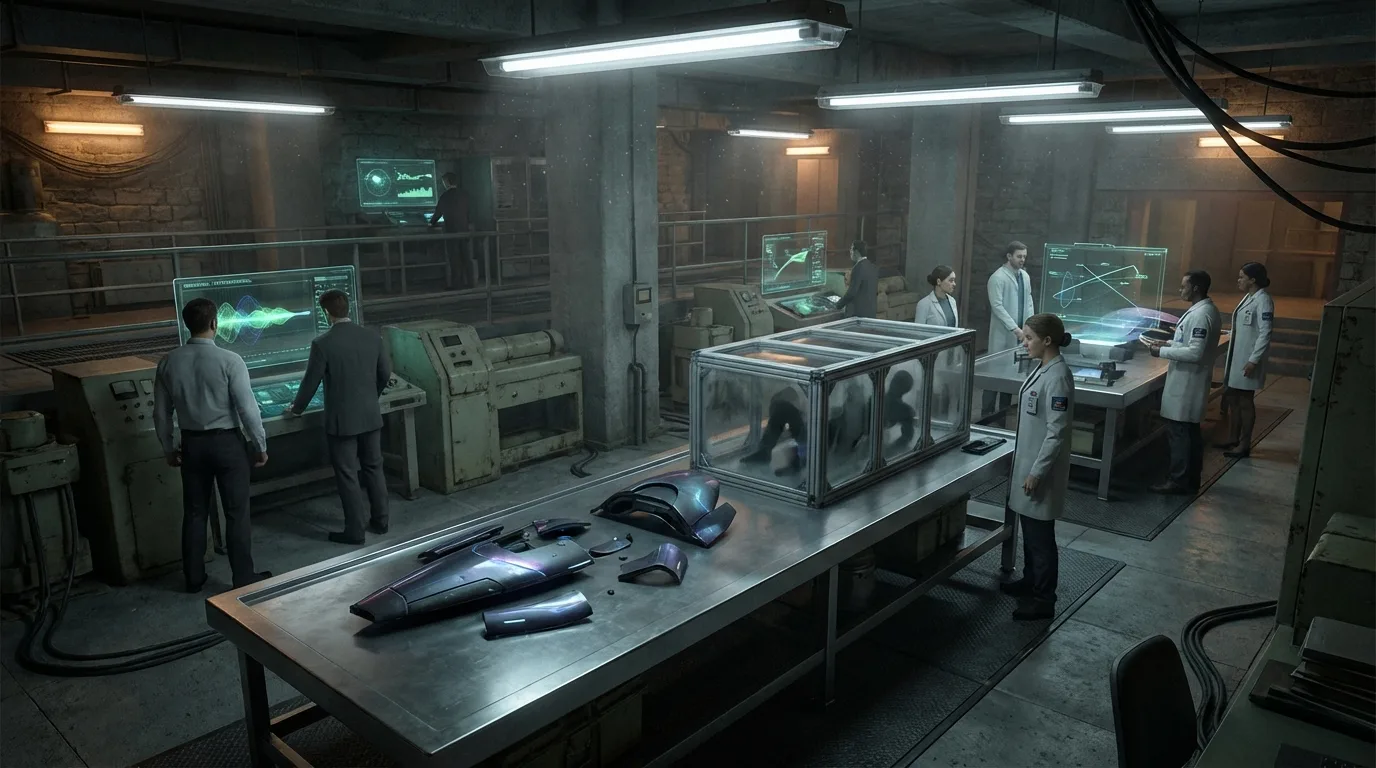
Project Red Dawn is described, by those who claim knowledge of it, as a long-running multinational research effort tied loosely to NATO structures and intelligence-sharing frameworks. According to these accounts, the initiative emerges in the post–Cold War period, when geopolitical rivalry gives way to quieter forms of strategic cooperation and secrecy. Rather than a public-facing program or a formally acknowledged treaty effort, Project Red Dawn is framed as an internal designation, a compartmentalized research umbrella under which unexplained aerial phenomena are studied beyond conventional aerospace or defense analysis.
The central claim is not simply that unidentified aerial phenomena exist, a position now cautiously acknowledged by several governments, but that a coordinated effort has operated for decades to move from passive observation to direct technical and biological analysis. Proponents argue that this shift reflects a growing internal consensus that some UAPs represent technologies or entities not attributable to known human development.
What follows is an examination of these claims as they are presented, with attention to structure, internal logic, and why the narrative continues to resonate.
Alleged Origins and Strategic Context
NATO After the Cold War
Accounts of Project Red Dawn place its beginnings in the early to mid-1990s, a period marked by institutional recalibration across NATO states. Intelligence agencies, no longer singularly focused on nuclear standoffs, expand their remit to include emerging, ambiguous threats. In this framing, unexplained aerial encounters, once dismissed or siloed within national programs, become a shared concern.
Rather than a single centralized laboratory, Project Red Dawn is described as a coordination framework. Participating states allegedly contribute data, recovered materials, or personnel under strict compartmentalization. The rationale, according to the narrative, is practical. No single nation possesses the expertise or political insulation required to investigate phenomena that challenge existing scientific and strategic assumptions.
The alleged NATO connection is therefore procedural rather than declarative, rooted in shared intelligence mechanisms rather than overt policy.
From Observation to Direct Analysis
Early Monitoring and Data Aggregation
The first phase of the project is consistently described as observational. Military radar anomalies, pilot encounters, and satellite data are catalogued and cross-referenced. The emphasis is on pattern recognition rather than interpretation. Advocates of the narrative stress that this phase mirrors known intelligence practices and does not require extraordinary assumptions.
The turning point, they claim, comes when certain incidents cannot be reconciled with sensor error, adversarial technology, or atmospheric phenomena. At this stage, the program allegedly transitions from analysis of events to analysis of objects.
Recovery and Examination Claims
By the late 1990s or early 2000s, Project Red Dawn is said to focus increasingly on recovered materials. These recoveries are described cautiously, often framed as partial debris rather than intact vehicles. Still, proponents argue that even fragmentary samples exhibit properties inconsistent with known alloys or manufacturing processes.
This shift from observation to hands-on analysis is portrayed as gradual and reluctant, driven by accumulated anomalies rather than sudden discovery.
Reported Craft Characteristics
Absence of Conventional Propulsion
One of the most frequently cited features of alleged Red Dawn–associated craft is the lack of observable propulsion systems. Accounts describe vehicles without exhaust, control surfaces, or heat signatures consistent with jet or rocket engines. Movement is characterized by abrupt acceleration, right-angle turns, and silent hovering.
Analysts within the narrative interpret these features as evidence of propulsion methods that manipulate gravity or inertia, though such interpretations are presented as working hypotheses rather than established conclusions. The key claim is not that these systems are understood, but that they do not align with current aerospace engineering paradigms.
Materials and Structural Anomalies
Recovered materials are described as lightweight yet exceptionally durable, sometimes exhibiting layered or isotopic structures that challenge conventional metallurgy. Some accounts claim these materials resist cutting or deformation, while others emphasize their responsiveness to electromagnetic fields.
Skeptics note that exotic material claims have historically proven difficult to verify, and the Red Dawn narrative generally acknowledges this, framing material analysis as ongoing and inconclusive.
Claims of Non-Human Biological Entities
Biological Findings and Containment
More controversial elements of the Project Red Dawn narrative involve alleged non-human biological entities. These are typically described as associated with recovered craft rather than independent lifeforms. Proponents stress that descriptions vary widely, suggesting either multiple origins or significant interpretive uncertainty.
Containment efforts, according to these claims, prioritize biological isolation and environmental control. Facilities are described as operating under protocols similar to high-level biosecurity labs, emphasizing risk mitigation over experimentation.
Analytical Uncertainty
Importantly, the narrative does not consistently assert that these entities are extraterrestrial in the traditional sense. Some interpretations frame them as engineered biological systems, probes, or even artificial constructs designed for specific functions. The lack of consensus is presented as evidence of analytical restraint rather than confusion.
Consciousness as a Technological Interface
Human Interaction Experiments
A distinctive feature of Project Red Dawn claims is the alleged role of human consciousness in interacting with non-human systems. According to proponents, certain technologies respond unpredictably or not at all to mechanical input, yet show measurable changes when exposed to trained human operators.
These experiments are described cautiously, often invoking neuroscience and cognitive science rather than mysticism. Consciousness is framed as an emergent biological phenomenon that may interact with advanced systems in ways not yet fully understood.
Interpretive Risks
Critics point out that such claims risk conflating subjective experience with technical function. Supporters counter that early research into human–machine interfaces, including neural implants and brain–computer interfaces, once faced similar skepticism. Within the Red Dawn narrative, consciousness-based interaction remains speculative and contested, not a settled conclusion.
Dual Classification of UAP Origins
Extraterrestrial and Terrestrial Categories
One of the more structured elements of the narrative is the proposed two-category classification system. According to this framework, UAPs are divided into those of likely extraterrestrial origin and those of terrestrial but non-human origin.
The extraterrestrial category aligns with conventional expectations, technologies or entities originating beyond Earth. The terrestrial category, however, encompasses hypotheses involving ancient civilizations, non-human intelligences native to Earth, or technologies predating modern humanity.
Implications of the Framework
This dual classification is presented as an analytical tool rather than a definitive claim. Proponents argue that it allows researchers to account for variability in observed behavior, design, and interaction without forcing all phenomena into a single explanatory model.
The framework’s appeal lies partly in its flexibility, though critics argue it risks expanding uncertainty rather than resolving it.
Underground Facilities and Historical Implications
Alleged Research Sites
Project Red Dawn is frequently associated with underground facilities, described as deep, hardened complexes designed to conceal sensitive research and contain potential hazards. These sites are said to be distributed across multiple countries, often repurposing Cold War infrastructure.
Supporters argue that such facilities are consistent with known military practices for classified research. Detractors note the absence of verifiable evidence linking these sites to UAP studies.
Reframing Human History
The most far-reaching implications of the narrative emerge when underground research is linked to alternative interpretations of human history. If non-human intelligences have operated on Earth for extended periods, the argument goes, archaeological and historical records may be incomplete or misinterpreted.
Notably, Project Red Dawn narratives tend to stop short of asserting definitive historical revision. Instead, they frame these ideas as unresolved questions raised by anomalous data.
Why the Narrative Persists
The enduring interest in Project Red Dawn reflects broader cultural and institutional dynamics. Governments now acknowledge that unexplained aerial phenomena warrant investigation, lending partial legitimacy to earlier speculative claims. Advances in neuroscience, materials science, and aerospace engineering make once-fringe ideas seem marginally less implausible.
At the same time, the narrative’s careful avoidance of absolutes, at least in its more sober forms, allows it to coexist with skepticism. It does not demand belief so much as attention.
A Cautious Assessment
Project Red Dawn, as described in alleged accounts, occupies a liminal space between intelligence analysis, speculative science, and alternative history. Its internal structure, timelines, and classifications give it a coherence that many conspiracy narratives lack. Yet coherence is not confirmation.
The claims surrounding recovered craft, biological entities, and consciousness-based technologies remain unverified and, in many cases, unverifiable with publicly available information. Their value lies less in what they prove than in what they reveal about contemporary anxieties and curiosities surrounding technology, secrecy, and humanity’s place in a potentially crowded universe.
Viewed this way, Project Red Dawn functions as both a hypothesis and a mirror, reflecting the limits of current knowledge and the enduring human impulse to look beyond them.
Unexplained drones, UFOs and the state of the Navy



Cosmic Echoes
Share-ready comments you can copy in a click, then post wherever the conversation touches UFOs, UAP, or the Galactic Federation.
These comments belong to the Cosmic Echoes page under the section Veil of Secrets: The NATO UAP Enigma.
Plus 21 more comments on the Cosmic Echoes page.