
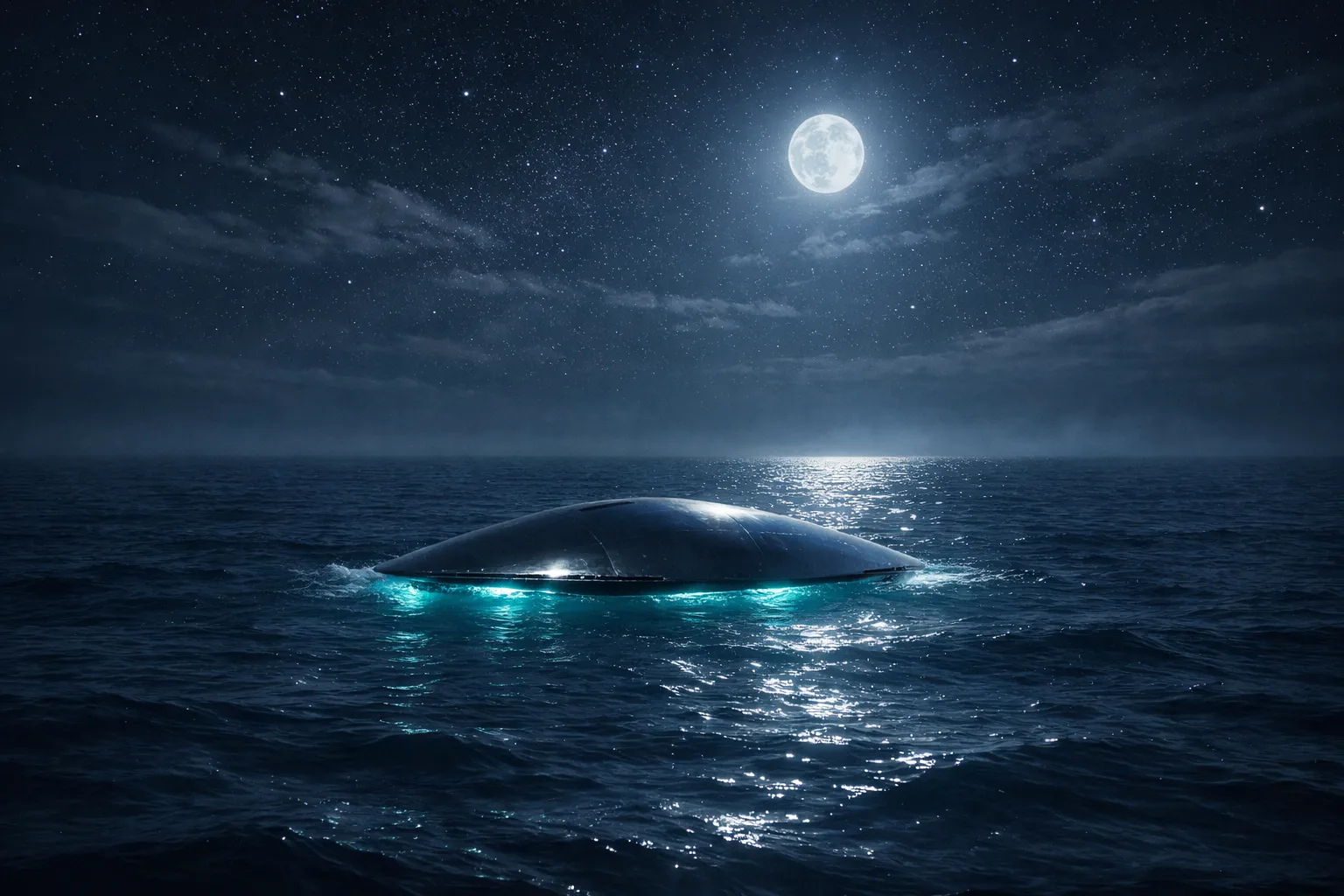
The idea that “something” might be operating under the waves is suddenly everywhere, from podcasts and cable segments to social feeds and interactive sighting maps. The phrase changes depending on who’s talking, “USOs,” “underwater UFOs,” “transmedium craft,” but the hook is the same: objects that allegedly move between air and water, sometimes at high speed, sometimes without obvious signatures like splashes, wakes, or acoustic noise.
What’s driving the surge isn’t just one dramatic clip or a single whistleblower. It’s the overlap of three forces that have been building for years: a steady rise in UAP reporting, a more formal push inside government to catalog and resolve cases, and a growing awareness that the maritime domain is a huge blind spot for public-facing data. If you want to believe a big claim, “the ocean is hiding it” is a very convenient place to put it. It’s also, annoyingly, not a crazy place to look for any poorly understood phenomenon.
That’s the tension this topic deserves: skeptical, open-minded, evidence-first.
Why the Ocean Keeps Getting Pulled Into the UAP Conversation
Myth: The ocean angle is just sci-fi cosplay with a wetsuit
In the popular imagination, “aliens in the ocean” sounds like a mashup of Atlantis, secret bases, and creepy glowing trenches. It’s easy to dismiss the whole thing as an internet myth wearing a Navy cap.
Reality: The ocean is the biggest data gap on the map, literally
Rear Admiral (ret.) Tim Gallaudet’s Sol Foundation white paper makes a straightforward argument: if the UAP topic is treated as a measurement problem rather than a conclusion, the ocean is an under-instrumented arena where unusual activity could be missed or misinterpreted. The paper explicitly cautions against jumping to “alien craft” conclusions, but it pushes the idea that maritime research is the logical next frontier for better data.
The document’s most grounding point is almost boring, and that’s why it matters. It notes that less than 25% of the seabed has been mapped to modern standards, and only about 5% of the ocean’s volume has been explored. In other words, “we haven’t looked” is not a fringe claim, it’s the baseline context.
“Prosaic explanations for phenomena should always be considered to avoid jumping to conclusions about alien craft.”
If you’re trying to understand why the ocean shows up in UAP discussions so often, start there. Unknowns thrive where measurement is expensive, incomplete, or classified.
The Data Trend People Are Pointing To: Crowdsourced Reports Near Coastlines
Myth: Thousands of coastal reports prove there are underwater craft
When people share maps of “clusters” along the coasts, it’s usually framed like evidence of something lurking offshore.
Reality: Crowd reports are a lead generator, not a verdict
A widely circulated datapoint comes from Marine Technology News, which reported that as of August 2025 the Enigma app logged over 9,000 U.S. sightings within 10 miles of shorelines and major waterways. The same report says around 1,500 of those mention water-related terms (about 17%), and roughly 500 occurred within 5 miles of a coastline, with more than 150 describing objects interacting with water (hovering above, entering, or exiting). (marinetechnologynews.com)
That’s interesting. It’s also not the same thing as confirmation.
Crowdsourced reporting has real strengths:
- It captures “soft signals” that might never reach official channels.
- It can identify geographic and temporal clustering worth studying.
- It builds a dataset that can be filtered, queried, and compared over time.
It also has major limitations:
- Reports are uncalibrated and often lack sensor metadata.
- Coastlines have more observers, more aircraft, more drones, and more light pollution.
- Viral narratives can change what people notice and how they describe it.
- Misidentifications are common, especially at night or over water.
So the right way to read crowdsourced maps is not “proof,” but “where should we point better instruments?”
What the U.S. Government Is Actually Saying Right Now
Myth: The Pentagon has admitted “they’re here,” and the rest is cover-up
If you live online long enough, you’ll see the claim that official offices exist only to manage disclosure, not to investigate.
Reality: The official framing is unresolved cases plus a lot of ordinary explanations
AARO’s Historical Record Report (Volume I) describes its review of U.S. government involvement with UAP going back to 1945. It outlines methodology that includes reviewing classified and unclassified archives, conducting interviews, and coordinating with oversight officials. It also states that past investigations were motivated by flight safety, foreign tech concerns, and the possibility of off-world technology “under intelligent control,” but that “unknown” doesn’t automatically mean exotic. (U.S. Department of War)
One of the report’s most important lines for the broader conversation is its blunt assessment that many cases remain unsolved primarily because the available data is not good enough, and that with additional quality data, many unresolved cases could likely be identified as ordinary objects or phenomena. (U.S. Department of War)
Meanwhile, public reporting on the Pentagon’s annual UAP updates repeatedly emphasizes two themes: hundreds of new cases, and no evidence that any of it is extraterrestrial. The Guardian’s coverage of the November 2024 report highlights both the volume of sightings and the lack of indication of alien origin, while noting that some cases remain unexplained due to limited information. (The Guardian)
AARO has also been publishing more public-facing material, including an “Official UAP Imagery” page with case writeups, some resolved (like balloons or birds), some unresolved, and some still under analysis. This isn’t full transparency, but it’s a concrete shift from “trust us” to “here’s at least a slice of the artifacts.” (aaro.mil)
The “Transmedium” Hook: Why Water-Adjacent Incidents Get So Much Attention
Myth: If something enters the ocean without a splash, it must be nonhuman tech
The “no splash” detail gets repeated because it feels like a physics-breaking tell.
Reality: The claim is meaningful only if the sensors and context hold up
The ocean is a messy environment for perception. Darkness, horizon effects, glare, ship motion, thermal layers, and sensor artifacts can all distort what a viewer thinks they’re seeing. Even when you have military systems involved, the public almost never gets the full dataset: calibration info, angles, wind conditions, range to target, sensor modes, and correlated tracks from independent systems.
That’s why “transmedium” is more of a hypothesis category than a conclusion. It’s a pointer to the kind of event that, if real, should be measurable across different sensing modalities:
- radar and electro-optical tracking above water
- infrared signatures
- sonar or acoustic anomalies below the surface
- surface disturbance patterns
- timing and geometry consistent across platforms
When those pieces line up, you have something worth serious analysis. When they don’t, you have a story that can’t be resolved, and unresolved stories are the fuel of mythology.
Academic and “Academic-ish” Efforts: Pattern Cataloging Without Overclaiming
Myth: A paper with charts means the science is settled
A PDF can look authoritative while being speculative, low-quality, or simply outside the scientific mainstream.
Reality: Some researchers are trying to move from anecdotes to taxonomies
A 2025 paper circulating via ResearchGate, “Mapping Boundary-layer Features in Unidentified Anomalous Phenomena (UAP),” attempts to categorize recurring observational signatures and themes across reports. Whatever you think of its conclusions, it reflects a real trend: people trying to turn narrative accounts into structured variables that can be tested and compared. (ResearchGate)
This approach can be useful if it stays humble. Taxonomies can help investigators ask better questions:
- Are there repeated “behaviors” across independent reports?
- Do certain descriptions cluster near particular environments (coasts, military ranges, shipping lanes)?
- Are some signatures more associated with sensor artifacts than with physical objects?
But it’s not a substitute for calibrated measurement. It’s a map of claims, not a confirmation of causes.
Catalina Island and the Hotspot Economy: How Media Shapes the Story
Myth: A “hotspot” segment means there’s a hotspot in the scientific sense
Media hotspots can be real, but they can also be the product of selective attention, storytelling incentives, and repeat amplification.
Reality: Hotspots often reflect where cameras, interest, and lore collide
NewsNation’s “Reality Check” segment featuring Ross Coulthart pushes the “underwater UFO highway” narrative and ties it to a Catalina Island hotspot framing. It’s compelling television, and it undeniably drives public attention toward USO interpretations. (YouTube)
The important move for readers is to separate:
- “a place where people report things” from
- “a place where validated anomalies recur under controlled observation”
Sometimes those overlap. Often they don’t. Hotspots are a starting line, not a finish line.
The Core Confusion: “Unidentified” Is Not “Nonhuman”
This is the crux of the entire debate, and it’s worth saying plainly.
“Unidentified” means the available information is insufficient to confidently classify what was observed. It does not mean:
- extraterrestrial
- interdimensional
- secret base
- advanced civilization
In practice, “unidentified” often means one of three things:
- the object is ordinary but the data is too poor to resolve it
- the object is unusual but still within human technology or environmental phenomena
- the object is genuinely anomalous and merits deeper study
Only after sustained, high-quality measurement would anyone be justified in entertaining “nonhuman intelligence” as more than a narrative possibility.
What Scientific-Grade Evidence Would Need to Look Like
If the claim is extraordinary, the proof has to be boringly strong. Not one spectacular clip. Not a single eyewitness. Not a map of pins. What would actually move this conversation forward?
Multi-sensor correlation with released metadata
At minimum, you’d want the same event captured by independent systems, with enough technical context to analyze it:
- sensor type and mode
- calibration details
- time synchronization
- range estimates and uncertainty bounds
- environmental conditions (weather, sea state, visibility)
The difference between “we saw something weird” and “we measured something weird” is metadata.
Repeatability in a defined time and place
A credible “ocean anomaly” claim should generate a testable prediction:
- a window of recurrence (dates, times, conditions)
- a location bounded tightly enough to deploy instruments
- a measurable signature expected to appear again
Repeatability is what turns mystery into science.
Physical traces, if interaction with water is claimed
If objects are entering or leaving the ocean, you’d look for:
- disturbances consistent with mass and velocity
- acoustic signatures (or a credible explanation for their absence)
- correlated radar/IR tracks showing continuity across the boundary layer
“Transmedium” should be measurable as a continuity problem, not just a vibe.
Transparent chain of custody for the data
Even good data becomes useless if it can’t be trusted. That means:
- documentation of who collected it and how
- protection against tampering
- access for independent analysis, at least in a controlled form
Without this, every debate collapses into “trust me.”
Why This Trend Isn’t Going Away
Even if every single case ultimately turns out to be ordinary, the topic has structural momentum:
- UAP reporting is now normalized enough to keep generating new cases. (The Guardian)
- Government offices are under pressure to show work, which means more public artifacts over time. (aaro.mil)
- The ocean remains, by its nature, an enormous measurement challenge.
- Media incentives reward the most dramatic interpretation, especially when data is incomplete. (YouTube)
So the question isn’t “will the narrative continue?” It will. The better question is whether the conversation shifts from storytelling to instrumentation.
What a Serious “Oceans First” Investigation Could Look Like
Gallaudet’s argument, stripped of headlines, is essentially a roadmap for how to be rational about a weird topic: collaborate across government, academia, and private stakeholders to expand maritime domain awareness and treat anomalous reports as a research and security problem, not a punchline.
A serious program would look like this:
- Use civilian data to propose candidate hotspots, but don’t treat it as proof. (marinetechnologynews.com)
- Deploy passive and active sensor arrays (optical, IR, radar, acoustic) near those locations.
- Standardize reporting formats so new incidents produce analyzable data.
- Publish enough of the results for independent review, even if some details remain classified.
That’s how you turn “aliens in the ocean” from a cultural meme into a measurable question. And if the answer ends up being drones, balloons, sensor glitches, and human pattern-seeking? Fine. That’s still progress. Science doesn’t exist to protect our favorite stories. It exists to replace them with better ones.
Sources and references
- Sol Foundation, “Beneath the Surface: We May Learn More about UAP by Looking in the Ocean” (Rear Admiral Tim Gallaudet, March 2024).
- Marine Technology News, “UFO App Logs Mysterious Underwater Sightings” (Oct 2025; reporting stats as of Aug 2025). (marinetechnologynews.com)
- U.S. Department of Defense, AARO, “Historical Record Report, Volume I” (published March 2024; report dated February 2024). (U.S. Department of War)
- AARO, “Official UAP Imagery” (case summaries, resolved and unresolved). (aaro.mil)
- The Guardian, “Latest Pentagon report reveals hundreds of new UFO…” (Nov 15, 2024). (The Guardian)
- ResearchGate, “Mapping Boundary-layer Features in Unidentified Anomalous Phenomena (UAP)” (posted Nov 2025). (ResearchGate)
- NewsNation / YouTube, “Reality Check with Ross Coulthart: Underwater UFOs” (Catalina-related framing). (YouTube)


Cosmic Echoes
Share-ready comments you can copy in a click, then post wherever the conversation touches UFOs, UAP, or the Galactic Federation.
These comments belong to the Cosmic Echoes page under the section Oceanic Mysteries: Aliens Beneath the Waves.
Plus 21 more comments on the Cosmic Echoes page.