

For decades, the idea that extraterrestrial intelligence exists has hovered at the edge of public consciousness. Sometimes it appears as science fiction, sometimes as whispered rumor, and sometimes as serious inquiry from scientists, military officials, and intelligence agencies. In recent years, renewed attention to unidentified aerial phenomena, declassified documents, and whistleblower testimony has reignited an old question with new urgency. What if non-human intelligences are real, present, and willing to be known, but something on our side is preventing that moment from happening?
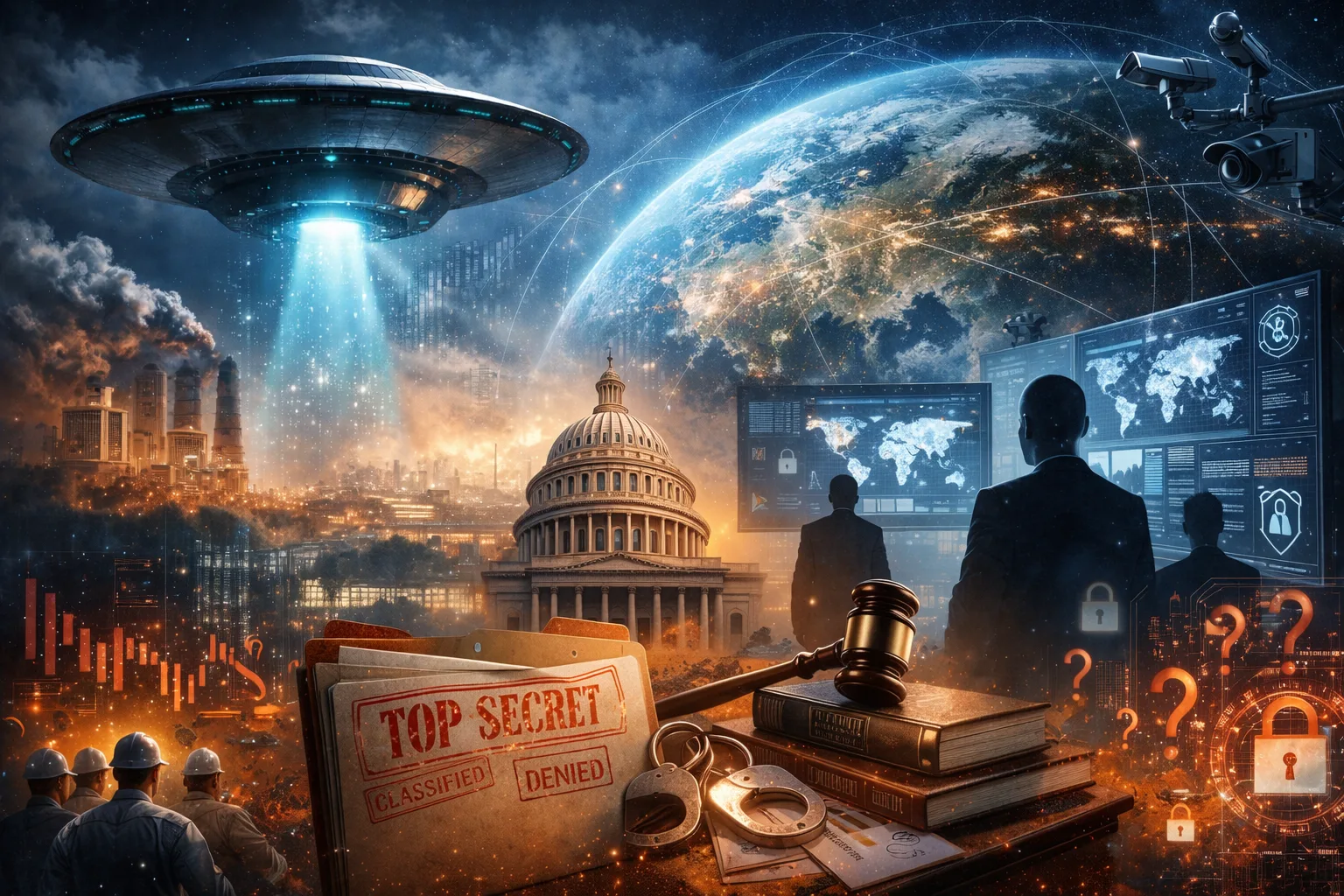
This article explores a speculative but persistent theory: that advanced non-human intelligences want open contact with humanity, and that human governments, for a complex mix of reasons, are acting as a barrier between the public and that disclosure. This is not a claim of fact, but a lens through which to examine power, fear, secrecy, and humanity’s readiness for a larger cosmic context.
The Long Shadow of Secrecy
Modern governments are built on information control. National security, military advantage, economic stability, and political legitimacy all depend on managing what the public knows and when it knows it. Throughout history, governments have withheld information they believed could destabilize societies, from military technologies to intelligence failures to public health risks.
Against that backdrop, the idea of extraterrestrial contact represents the ultimate disruptive information. Confirmation of non-human intelligence would instantly reshape religion, philosophy, science, economics, and geopolitics. It would collapse old hierarchies of power and replace them with uncomfortable questions. Who are we in the universe? Who has authority now? Who was lying before?
From a purely bureaucratic perspective, secrecy becomes almost inevitable. If officials believe disclosure could cause panic, economic collapse, or loss of control, delay becomes policy. Over time, delay hardens into doctrine.
The Alleged Intent of Non-Human Intelligence
In speculative models of alien contact, advanced civilizations are often imagined as either conquerors or observers. But another possibility is less dramatic and more unsettling: that they are educators.
In this framework, non-human intelligences are not here to invade, but to observe and gradually influence. Their interest is not territory, but consciousness. They may view humanity as a developing civilization capable of growth, but constrained by internal systems of fear, conflict, and misinformation.
If such beings exist and possess technology far beyond ours, open contact would be trivial for them. The fact that it has not occurred openly leads some theorists to conclude that restraint is intentional. Contact may be conditional, dependent on humanity reaching a certain level of psychological, ethical, or social maturity.
This is where the idea of “waking up the population” enters the narrative.
Awakening Versus Control
An awakening, in this context, does not necessarily mean mass enlightenment or mystical revelation. It could be something far more grounded: a realization that humanity is not alone, that our conflicts are small in a cosmic sense, and that cooperation is more adaptive than competition.
Such a realization would threaten many existing power structures. Nations justify militaries through fear of other nations. Corporations justify exploitation through scarcity. Political systems justify authority through managed narratives of threat and protection.
If an external intelligence exists that does not participate in human tribalism, those narratives weaken.
From this perspective, governments are not villains in a science fiction plot, but institutions trapped by their own incentives. Disclosure would not merely inform the public. It would fundamentally alter the basis on which authority operates.
The Cold War Legacy
Many modern secrecy practices trace their origins to the Cold War. During that period, unidentified objects in the sky were treated primarily as potential foreign weapons. Any unknown craft was assumed to be a technological threat until proven otherwise.
This mindset created a feedback loop. Reports were classified. Analysis was restricted. Public discussion was discouraged or ridiculed. Over time, stigma replaced curiosity. Serious investigation moved behind closed doors, while the public narrative drifted toward caricature and dismissal.
If early encounters with unexplained phenomena occurred during this era, they would have been framed through paranoia rather than wonder. Once secrecy was established, reversing it would require admitting decades of deception or misinterpretation. Institutions are rarely eager to confess either.
The Problem of Gradual Truth
One of the most difficult challenges with disclosure is not the truth itself, but the timeline. If governments have known something for generations and the public learns it all at once, trust collapses. Every other statement from authority becomes suspect.
To avoid that, institutions may attempt gradual disclosure. Small admissions. Ambiguous language. Carefully worded reports. The hope is to acclimate the public slowly, reducing shock and preserving legitimacy.
Critics argue that this approach backfires. Partial truth breeds speculation. Ambiguity invites conspiracy. Silence creates a vacuum filled by rumor and fear. If non-human intelligences truly want open contact, incremental half-truths may look less like caution and more like obstruction.
The Ethics of Gatekeeping Humanity
A central moral question emerges from this speculative framework. Who gets to decide when humanity is ready for cosmic truth?
If governments act as gatekeepers, they assume a paternal role, positioning themselves as guardians of psychological stability. But this assumes that the public cannot handle uncertainty or transformation, an assumption that may no longer hold in an age of global communication and scientific literacy.
On the other hand, if disclosure is mishandled, the consequences could be real. Religious extremism could intensify. Markets could panic. Misinformation could spiral faster than clarification. The responsibility is enormous.
The ethical tension lies between protection and autonomy. Is it better to shield people from destabilizing truth, or to trust them with it and allow society to adapt organically?
Technology as a Catalyst
One reason the disclosure debate has intensified in recent years is technology. High-resolution cameras, global satellite coverage, civilian radar, and instant information sharing have eroded the monopoly governments once held over observation.
The sky is no longer watched by militaries alone. It is watched by pilots, astronomers, hobbyists, and automated systems. Data leaks. Videos surface. Analysis crowdsources itself.
If non-human intelligences exist and operate within our environment, hiding them becomes exponentially harder over time. This technological pressure may be forcing institutions toward disclosure, whether they want it or not.
In this scenario, governments are not blocking contact indefinitely, but slowing it, trying to control the narrative as long as possible before it escapes their grasp.
The Alien Perspective, Hypothetically
If we attempt to imagine the perspective of an advanced non-human intelligence, the picture becomes even more complex. Such beings might view humanity not as a unified species, but as a fragmented one, divided by borders, ideologies, and power struggles.
Direct contact with a single government could be interpreted as endorsement of that government. Contact with all governments simultaneously could amplify competition. Contact with the public directly could destabilize existing systems overnight.
From that perspective, restraint may be strategic. If the goal is long-term integration rather than short-term shock, waiting until humanity resolves certain internal contradictions might be logical.
In this view, governments are not the sole obstacle. Humanity itself is.
Psychological Preparedness
Another element often overlooked is psychological preparedness. The discovery that we are not alone challenges deeply held assumptions about meaning, uniqueness, and destiny.
For some, this would be liberating. For others, terrifying. The same information can expand or collapse a worldview depending on context and support structures.
If non-human intelligences exist and are aware of this variability, they may be cautious about exposure. Governments, likewise, may fear social fragmentation if large segments of the population interpret contact through apocalyptic or conspiratorial lenses.
The question becomes whether preparation should happen through secrecy or through education.
Disclosure as a Process, Not an Event
One useful way to reframe the entire debate is to abandon the idea of disclosure as a single moment. No dramatic landing. No universal broadcast. Instead, disclosure becomes a process, unfolding over decades through science, culture, and gradual normalization.
In this model, aliens are not waiting for permission, and governments are not holding a single switch. Reality seeps out through many channels: academic research, unexplained observations, philosophical shifts, and cultural narratives that slowly expand the range of the acceptable.
From that perspective, the population is already waking up, not through revelation, but through curiosity and skepticism.
Power, Fear, and the Unknown
At its core, the theory that governments are blocking alien disclosure is less about aliens and more about power. It reflects a deep mistrust of institutions and a belief that truth is managed rather than shared.
Whether or not non-human intelligences exist, that mistrust is real and historically grounded. Governments have lied. Information has been suppressed. Narratives have been engineered.
The alien disclosure narrative becomes a symbolic container for broader anxieties about control, autonomy, and who gets to define reality.
The Role of the Public
If humanity is ever to engage openly with non-human intelligence, the responsibility will not belong solely to governments or aliens. It will belong to the public.
Curiosity without hysteria. Skepticism without cynicism. Openness without gullibility. These traits matter regardless of the truth behind the speculation.
A population that can hold uncertainty without collapsing into fear is a population more likely to be trusted with transformative knowledge.
Conclusion: Between Silence and Revelation
The idea that aliens want to go public while governments stand in the way is a powerful narrative because it sits at the intersection of hope and frustration. Hope that we are not alone. Frustration that truth feels perpetually out of reach.
Whether this scenario is literal, symbolic, or somewhere in between remains unknown. But the questions it raises are valuable regardless. Who controls knowledge? How much truth can societies handle? What does readiness really mean?
If non-human intelligences exist and are observing us, the most important signal we may send is not technological, but ethical. How we treat each other. How we respond to uncertainty. How willing we are to outgrow systems built on fear.
Disclosure, if it ever comes, will not just reveal them. It will reveal us.


Cosmic Echoes
Share-ready comments you can copy in a click, then post wherever the conversation touches UFOs, UAP, or the Galactic Federation.
These comments belong to the Cosmic Echoes page under the section Cosmic Echoes: The Hidden Truth Behind Alien Disclosure.
Plus 21 more comments on the Cosmic Echoes page.