
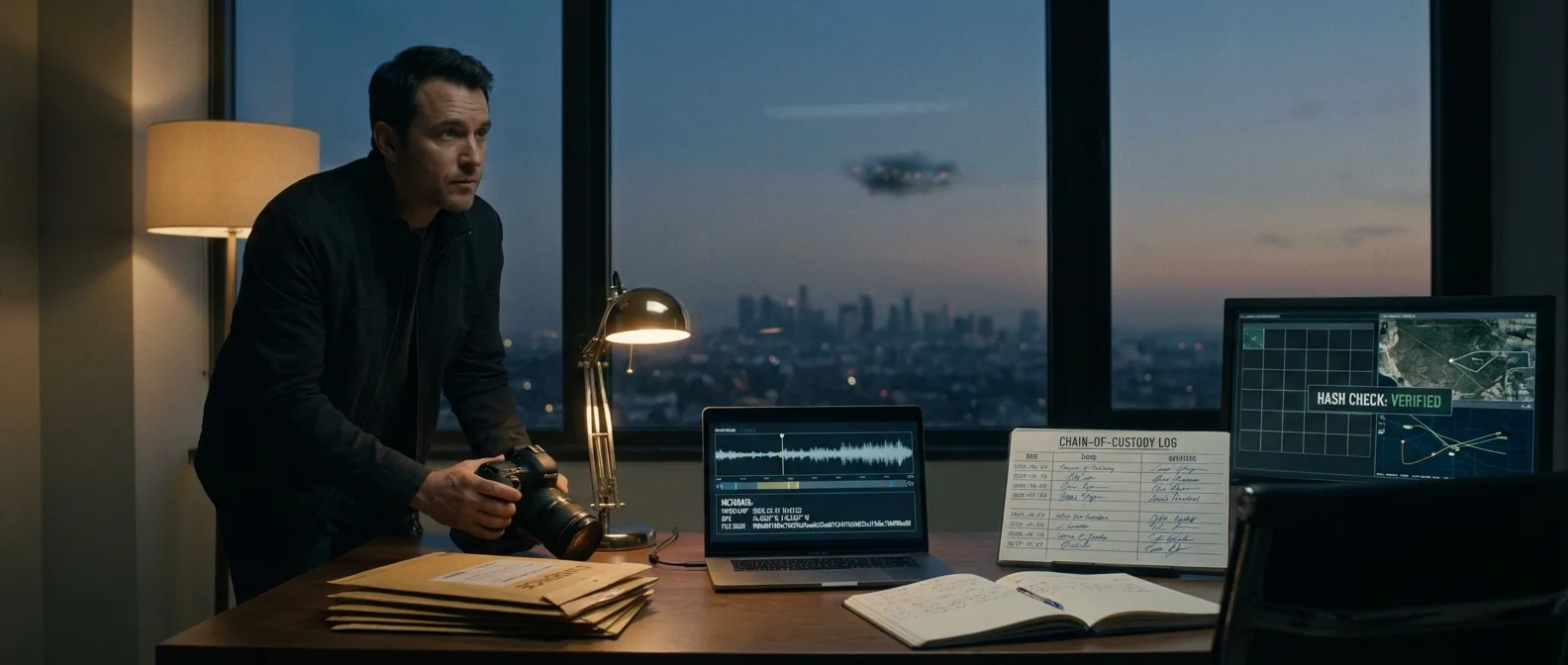
Imagine a private citizen captures something genuinely anomalous. The footage is clear. The event is strange. Nothing about it feels staged. A decade ago, releasing that material might have sparked curiosity. Today, it triggers something else entirely.
The modern disclosure problem is not a shortage of evidence. It is a shortage of trust.
In an information environment saturated with synthetic media, institutional skepticism, and social fragmentation, even high-quality material struggles to find stable ground. The question is no longer “Is this real?” but “Who decides what real even means anymore?”
This article examines what actually happens when extraordinary evidence enters public circulation, why it so often fails to produce consensus, and what conditions allow truth to survive contact with platforms, institutions, and human psychology.
Why Trust, Not Evidence, Is the Bottleneck
Clear photos and high-resolution video no longer carry the weight they once did. Advances in image manipulation and artificial intelligence have flattened the credibility curve. Authentic material is routinely dismissed as fabricated, while fabricated material often travels faster than facts.
This inversion creates a paradox. The clearer the evidence appears, the more aggressively it is attacked. High clarity raises the stakes, and high stakes activate defensive skepticism. People do not merely evaluate the data. They evaluate the implications.
Trust used to be scaffolded by institutions: newsrooms, courts, scientific bodies. Today, those scaffolds are contested. Audiences fragment into parallel realities, each with its own standards of proof. In that environment, extraordinary claims are judged less on their content than on their perceived origin and motive.
What Happens When Evidence Is Released Without Preparation
When anomalous material is published impulsively, the sequence of events is surprisingly consistent.
First comes immediate attribution to known fabrication pathways: computer-generated imagery, artificial intelligence generation, compositing, or misidentification. This happens regardless of the evidence’s actual quality.
Next, attention shifts from the data to the individual. Their background, beliefs, employment, and online history become the story. Motive replaces method.
Then platforms intervene. Content moderation systems, designed to handle misinformation at scale, struggle with edge cases. Material may be downranked, flagged, removed, or placed behind warning screens. None of this requires coordination. It is a byproduct of risk management.
Finally, the original evidence degrades. Files are reuploaded, compressed, stripped of metadata, or edited for commentary. The chain of custody dissolves. What began as potential evidence becomes content.
None of these outcomes require a conspiracy. They are emergent properties of modern media systems operating under uncertainty.
Legal Reality Is Less Dramatic, and More Procedural
Popular imagination often jumps to immediate seizure or intimidation. The legal reality is more mundane.
In the United States and comparable democratic systems, physical seizure of property requires legal justification and process. Publicly released digital material is difficult to retroactively contain. There is no automatic mechanism by which anomalous footage triggers state intervention.
That does not mean there is no risk. Pressure, when it appears, is more likely to be procedural or reputational. Requests for clarification. Scrutiny from employers. Social consequences that encourage silence without explicit force.
The most realistic danger is not confiscation. It is loss of credibility through unmanaged exposure.
Why Evidence Must Be Treated Like Evidence
Material intended to withstand scrutiny cannot be handled like social media content. It must be treated as a forensic artifact.
Basic principles of digital evidence handling are well established across journalism, law, and forensic science:
- Preserve the original file untouched.
- Generate cryptographic hashes to demonstrate that the file has not changed.
- Document capture conditions, including device, time, location, and settings.
- Maintain a simple chain-of-custody log.
- Work only from verified copies, never the original.
Once these steps are skipped, doubt becomes permanent. No later explanation can fully restore confidence, because the question shifts from “What does this show?” to “What might have happened to it?”
Why Corroboration Beats Spectacle
A single dramatic clip, no matter how striking, is inherently fragile. It concentrates risk into one data point.
By contrast, modest evidence supported by independent corroboration is far harder to dismiss. Convergence matters more than clarity.
Stronger cases involve:
- Independent recordings from different devices or vantage points.
- Witnesses who did not coordinate with one another.
- Consistent time and location data across sources.
- Aviation, radar, or air traffic control correlations.
Extraordinary claims gain durability through alignment, not intensity.
The Role of Independent Verification
Public trust increases when analysis is conducted by parties who do not benefit from the claim.
Digital forensics laboratories can assess file integrity and manipulation. Imaging and signal processing experts can examine artifacts and noise patterns. Investigative journalists can vet sources while protecting identities. Academics can publish methods and limitations without declaring conclusions.
The goal is not persuasion. It is reproducibility.
When verification focuses on how conclusions are reached rather than what those conclusions are, skepticism becomes constructive rather than corrosive.
The Limits of Official Channels
Government disclosure pathways exist, but they are fragmented and often misunderstood.
Some offices focus primarily on internal or classified reporting. Civilian intake mechanisms are narrow or indirect. Aviation safety reporting remains one of the most normalized channels for anomalous encounters, but its scope is limited to airspace safety, not public explanation.
This leaves civilians in a gap. Evidence exists, but there is no universally trusted intake mechanism designed for public-facing validation.
Freedom of Information laws offer partial relief. They allow citizens to request government records, establish historical patterns, and confirm prior awareness. They do not authenticate new evidence, and they are slow by design. FOIA is a contextual tool, not a proof engine.
What History Quietly Teaches
History provides examples of credible individuals reporting anomalous sightings without producing resolution or consensus. In one well-documented case, a future U.S. president publicly described an unexplained aerial sighting earlier in his life. The report was straightforward and sincere. It changed nothing.
The lesson is not that the event was insignificant. It is that credibility alone does not substitute for verifiable, corroborated evidence.
When institutions do not supply clear processes for evaluation, narratives emerge to fill the gap. Over time, rumors attach themselves to historical figures, not because they are true, but because they satisfy unresolved curiosity.
The Psychological Dimension of Disclosure
The most destabilizing aspect of anomalous evidence is not the possibility of non-human intelligence. It is the erosion of shared standards for truth.
When people cannot agree on how claims should be evaluated, every claim becomes a referendum on identity, ideology, or trust in authority. Signal and noise collapse into each other.
In that environment, uncertainty feels threatening. Stories rush in to provide emotional resolution where process is absent.
This is not a failure of intelligence. It is a predictable human response to ambiguity without structure.
A Responsible Civilian Path Forward
Disclosure, if it is to be meaningful, must be treated as a process rather than an event.
A responsible approach prioritizes durability over virality:
- Secure and preserve originals.
- Establish provenance before publication.
- Seek independent verification quietly.
- Release evidence with context, not commentary.
- Expect skepticism and design for it.
This approach does not guarantee acceptance. It does something more important. It keeps the question open without poisoning it.
Why This Matters Beyond Any Single Claim
If humanity struggles with disclosure, it is not because the truth is too terrifying. It is because the systems we rely on to validate reality are under strain.
Attention moves faster than verification. Trust has become scarcer than information. Platforms reward engagement, not accuracy. Institutions move slowly, and silence is interpreted as evasion.
In that environment, truth does not vanish. It fragments.
Disclosure is no longer a moment when a curtain is pulled back. It is an ongoing negotiation between evidence, systems, and human behavior.
When that negotiation lacks structure, myths take its place.
When it has structure, uncertainty becomes manageable, and reality, however strange, remains discussable.



Cosmic Echoes
Share-ready comments you can copy in a click, then post wherever the conversation touches UFOs, UAP, or the Galactic Federation.
These comments belong to the Cosmic Echoes page under the section Trust in the Age of Anomalies.
Plus 21 more comments on the Cosmic Echoes page.