
For most of his professional life, Jim Semivan worked in a world defined by compartmentalization, deniability, and silence. He spent roughly twenty-five years with the Central Intelligence Agency’s National Clandestine Service, completing multiple overseas and domestic tours and holding senior management roles at headquarters. He retired in 2007 as a member of the CIA Senior Intelligence Service, later receiving the agency’s Career Intelligence Medal. After formal retirement, he continued working for more than a decade as an independent intelligence consultant.
None of that background suggests a public-facing role. Yet beginning in the late 2010s, Semivan began speaking openly—carefully, selectively—about a set of experiences and observations that he says unfolded over decades. His comments, most notably in interviews such as Engaging the Phenomenon, have drawn attention not because they claim definitive answers, but because they illustrate how an intelligence professional parses uncertainty, attribution, and institutional limits when discussing unidentified aerial phenomena, or UAP.
This article treats Semivan’s statements as a documentation problem rather than a revelation. What does he say he experienced directly? What does he say he was told by others with clearances? And what does he infer—explicitly labeling inference as inference—about how secrecy, authority, and information flow operate inside the U.S. government?
Building a Timeline Before Drawing Conclusions
Semivan repeatedly emphasizes chronology. His account unfolds in discrete phases, each separated by long stretches of professional life in which, by his telling, the topic of anomalous phenomena receded rather than intensified.
The core phases are:
- His intelligence career prior to the early 1990s
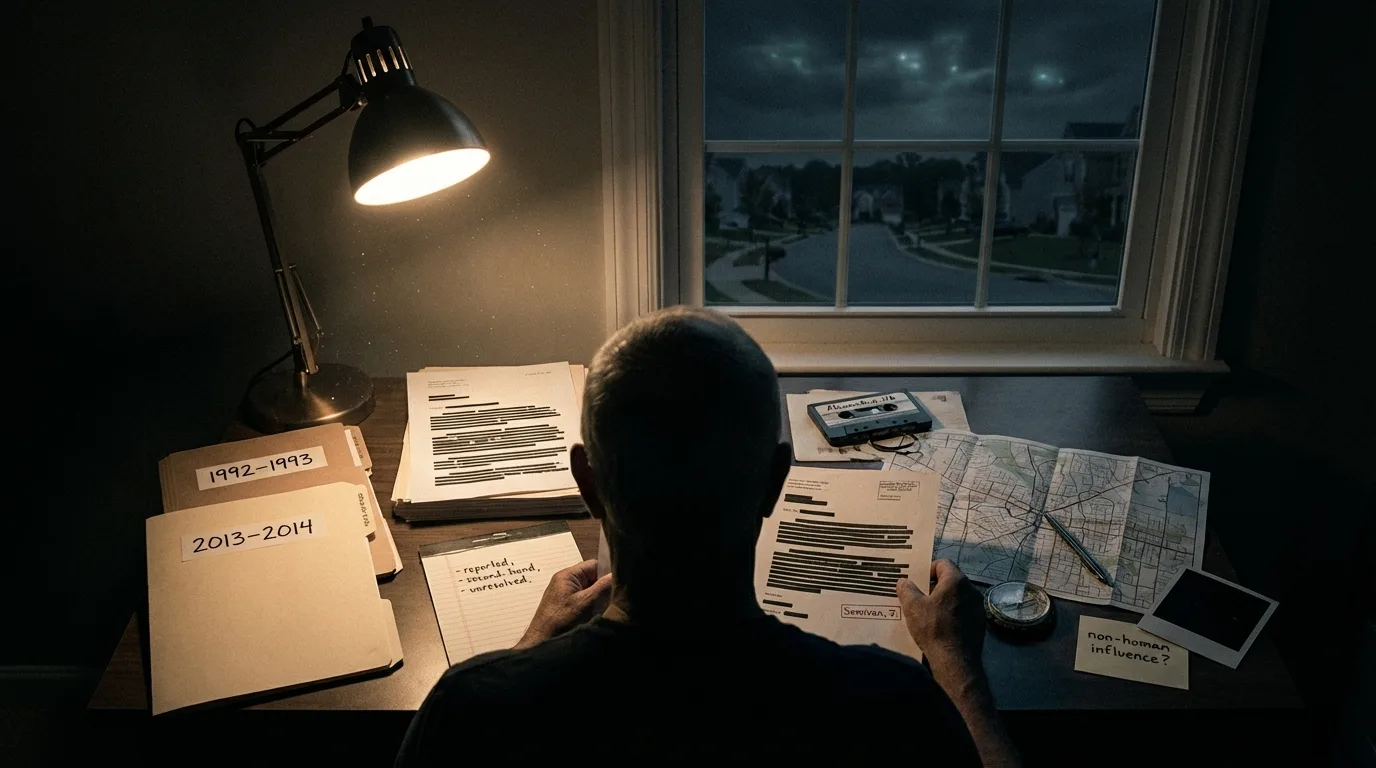
- A reported anomalous event involving his wife in Alexandria, Virginia, during 1992–1993
- Subsequent personal and environmental aftereffects
- A long period of relative disengagement
- Re-engagement with researchers and officials around 2013–2014
- Public commentary on secrecy, authority, and disclosure constraints in later years
Treating these phases separately is essential. Semivan himself insists on that separation, often cautioning listeners against collapsing personal experience, second-hand reporting, and structural analysis into a single narrative.
Before the Experience: An Intelligence Officer, Not a Researcher
Prior to the early 1990s, Semivan does not describe himself as someone engaged with the UAP topic in any sustained way. His work focused on traditional intelligence functions: foreign operations, management, and analysis within established national security frameworks. He has said publicly that, like many in the intelligence community, he was aware of UFO reports as cultural artifacts but did not consider them central to his professional responsibilities.
This matters because Semivan frames what follows not as the culmination of long-standing interest, but as an intrusion into an otherwise conventional career trajectory.
The 1992–1993 Alexandria Event
What Semivan Says Happened
According to Semivan, an anomalous event occurred in the early 1990s—typically dated to 1992 or 1993—at his home in Alexandria, Virginia. He has described the incident as primarily involving his wife, though he was present in the home at the time.
He deliberately avoids the term “abduction,” preferring language that reflects uncertainty rather than conclusion. In interviews, he has stated that something occurred that neither he nor his wife could readily explain, involving an apparent interaction with an unknown presence or process. He has been consistent in emphasizing that his account reflects perception and aftermath rather than a clear visual narrative.
“I don’t like to label it,” Semivan has said in interviews, stressing that naming the phenomenon risks importing assumptions that cannot be verified.
Boundaries of the Claim
Semivan does not claim to know what the phenomenon was, who or what caused it, or how it should be categorized. He does not present physical evidence, nor does he describe the event as proof of extraterrestrial activity. His framing remains cautious: something unusual occurred, it had lasting effects, and it resisted easy explanation.
Aftereffects and Follow-On Activity
Psychological and Environmental Changes
In the period following the Alexandria incident, Semivan reports a series of aftereffects. These included psychological stress, changes in perception, and what he characterizes as ongoing anomalous activity in and around their living environment. He has been careful to say that these reports reflect subjective experience rather than independently verified measurements.
What distinguishes his account is not the specificity of the phenomena, but the way he describes their persistence. Rather than a single disruptive night, he portrays the event as initiating a prolonged period of instability that affected both him and his wife.
Seeking Understanding Without Publicity
During this time, Semivan did not go public, nor did he seek to attach his experience to broader explanatory frameworks. He has said that his priority was managing personal and family well-being, not building a theory. Importantly, he does not claim that the CIA or other government bodies intervened or managed his experience in any direct way.
Years of Distance and Silence
For roughly two decades after the early 1990s, Semivan describes a period of relative disengagement from the phenomenon. He continued his intelligence career, retired, and worked as a consultant. The anomalous experience remained part of his private history but did not define his public identity or professional focus.
This long gap complicates simplistic narratives. If Semivan were seeking attention or validation, the timeline does not obviously support that motive. Instead, the record shows extended silence punctuated by a later, more reflective re-engagement.
Re-Engagement Around 2013–2014
Conversations With Researchers and Officials
Around 2013 or 2014, Semivan says he reconnected with individuals studying anomalous phenomena. This period included discussions with figures such as John Alexander, a retired U.S. Army colonel known for his interest in non-lethal weapons and anomalous topics.
Semivan frames these interactions not as enrollment in a program, but as conversations—information exchanges among people with overlapping curiosities and professional backgrounds. He has not claimed that these discussions produced definitive findings or official conclusions.
Joining a Broader Conversation
This re-engagement eventually led to Semivan’s association with To The Stars Academy, where he served as Vice President of Operations. Even there, his public statements remained restrained. He positioned himself as someone contributing operational and analytical experience rather than making scientific claims.
Parsing Secrecy and Authority
Executive Branch Control
One of Semivan’s most consistent assertions concerns the structure of secrecy itself. He has stated that, in his view, UAP-related information—if it exists in classified form—is controlled at the executive branch level rather than dispersed evenly across agencies. This is not presented as insider revelation but as inference based on decades of observing how sensitive programs are managed.
He distinguishes between formal oversight mechanisms and practical control, noting that access often depends on need-to-know rather than rank.
Contractors and Legal Risk
Semivan has also spoken about contractors, suggesting that individuals working in private industry may face different legal and professional risks when discussing classified or sensitive material. He stops short of claiming that contractors possess secret knowledge en masse, but he acknowledges structural incentives for silence.
These comments align with broader debates about whistleblower protections and the uneven application of classification law, though Semivan does not cite specific statutes or cases in his public remarks.
Disclosure as a Risk Management Problem
Potential Societal Impact
Rather than framing disclosure as a moral imperative, Semivan often frames it as a risk calculation. He has suggested that abrupt or poorly contextualized disclosure could have destabilizing effects, not because the public cannot handle uncertainty, but because institutions themselves may be unprepared for the consequences.
This framing echoes ideas long discussed by researchers such as Jacques Vallée, whom Semivan has referenced for his work on the complexity and ambiguity of anomalous phenomena.
Information Flow and Influence
Semivan has cautiously entertained the possibility that non-human intelligence—if it exists—could influence information flow indirectly, by shaping perception or interpretation rather than issuing commands. He emphasizes that this is speculative, a conceptual tool rather than an assertion of fact.
He is explicit about this boundary. Speculation, in his telling, is a way to explore hypotheses, not to declare conclusions.
What Remains Unresolved
Clear Claims vs. Open Questions
Attribution remains the organizing principle of Semivan’s account:
- Personally experienced: an anomalous event involving his wife in the early 1990s and subsequent aftereffects
- Second-hand information: conversations with researchers and officials in later years
- Inference: structural analysis of secrecy, authority, and disclosure constraints
He does not claim possession of hidden documents, recovered materials, or definitive explanations. The value of his testimony lies less in what it proves than in how it models restraint.
A Case Study in Uncertainty
For hobbyists and enthusiasts, Semivan’s story offers neither confirmation nor debunking. Instead, it provides a case study in how an intelligence professional documents ambiguity. Dates are marked, roles are specified, and speculation is labeled as such.
In an area often dominated by certainty—both affirmative and dismissive—Semivan’s contribution may be methodological rather than evidentiary. He shows how to speak about the unknown without pretending it has already been solved.
Closing Notes on Trust and Framing
Semivan’s public remarks invite careful reading, not belief. They ask the audience to track sources, timelines, and degrees of certainty. In that sense, his story functions less as a disclosure narrative and more as a reminder: in intelligence work, and perhaps in the study of anomalous phenomena, knowing what you do not know is often the most accurate position available.
The UFO Program, Interactions with Nonhuman Intelligences, u0026 Experiencers w/ Jim Semivan
We are joined by former CIA Officer Jim Semivan of To The Stars*. We discuss everything from The UFO Program, Interactions with Nonhuman Intelligences, and Experiencers.

Cosmic Echoes
Share-ready comments you can copy in a click, then post wherever the conversation touches UFOs, UAP, or the Galactic Federation.
These comments belong to the Cosmic Echoes page under the section Shadow Ops to Spotlight: Secrets Unveiled.
Plus 21 more comments on the Cosmic Echoes page.