
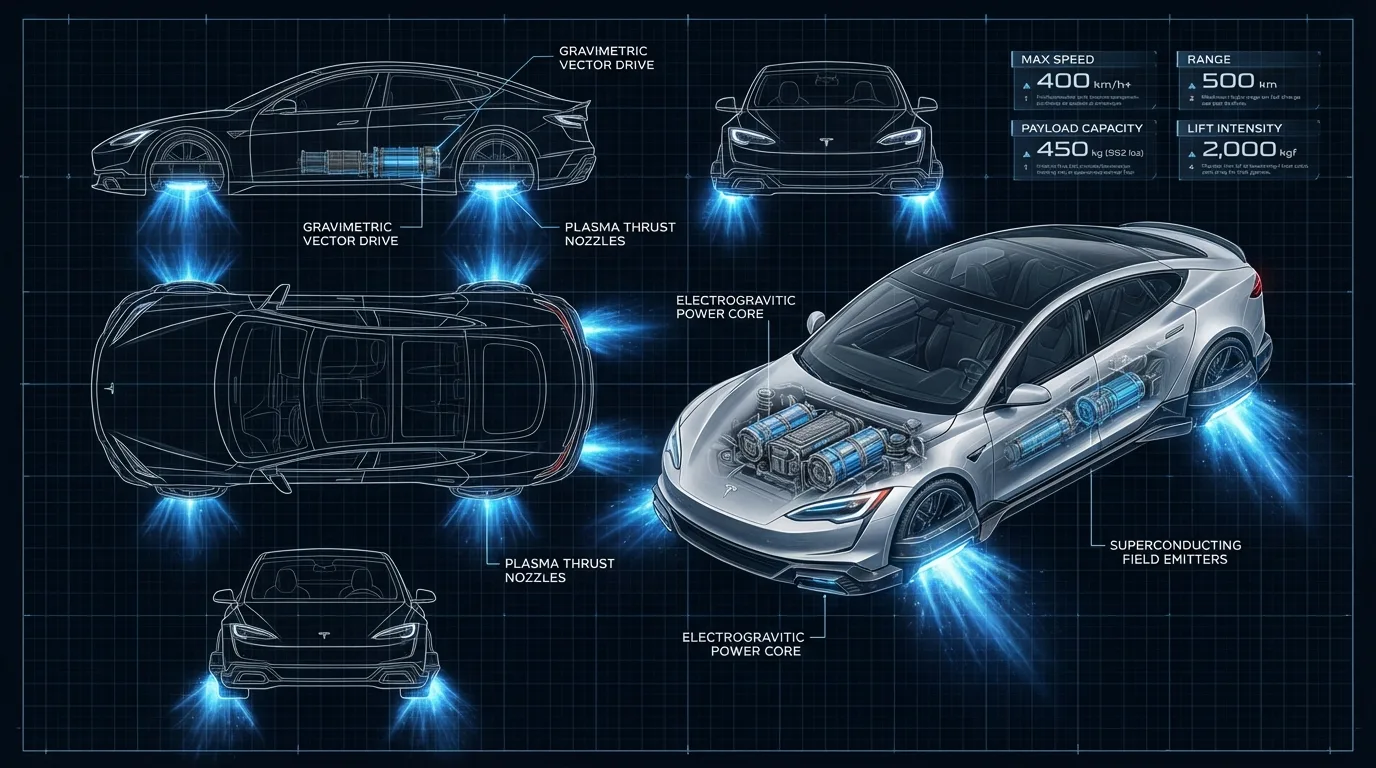
When Elon Musk sat down on the Joe Rogan Experience in late 2025, the moment that set the internet buzzing was not a whiteboard breakdown or a technical demo. It was a sentence. Or rather, a cluster of sentences. Musk described technology tied to the next-generation Tesla Roadster as “alien,” hinted that a coming demo would be “unforgettable,” and joked—half-seriously—that the future is supposed to have flying cars. The clip spread quickly, often stripped of its surrounding context, and quickly metastasized into claims that Tesla was secretly building a flying vehicle.
What matters for credibility is not the excitement the clip generated, but what was actually said, and just as importantly, what was not.
This article draws a hard line between verifiable statements and speculation. It treats the Rogan appearance as what it was: a cultural tease and a strategic moment of anticipation, not a technical disclosure. From there, it explores a grounded question that many readers are already asking anyway. If a consumer flying car ever matched the movie-era promise of silent, stable hover—without rotors, rockets, or wings—what kinds of physics would it have to rely on?
What Elon Musk Actually Said on Joe Rogan
The relevant conversation occurs during Musk’s discussion of the long-delayed Tesla Roadster. In that context, he describes a future prototype demonstration as something that will “stun” people and uses the phrase “alien technology” in a characteristically playful way. He also makes a passing remark that the future is supposed to include flying cars.
That is the extent of the disclosure.
There is no explanation of propulsion. There is no description of lift, thrust, stabilization, or control. There is no claim that Tesla has solved flight, nor any statement that a flying Roadster exists as a finished product. When pressed for details, Musk deflects, noting that he does not want to reveal specifics before a formal unveiling.
Crucially, there is video proof of Musk saying these words. Viewers can watch him use the phrase “alien technology” and tease that people will be stunned. What the video does not provide is proof of alien technology as an engineering discipline, or evidence of a working flying car. The clip documents rhetoric, not hardware.
Mainstream technology outlets that covered the appearance framed it the same way: an intriguing tease tied to the Roadster, paired with an absence of technical explanation. No reputable reporting claims Tesla demonstrated flight or disclosed a propulsion system during or after the podcast.
What He Did Not Say, and Why That Matters
The gap between what was said and what many headlines implied is where confusion creeps in.
Musk did not say Tesla has built a production-ready flying car.
He did not say the Roadster will launch with flight capability.
He did not describe rotors, wings, rockets, or any other lift mechanism.
He did not provide a timeline for a flying vehicle entering consumer use.
These omissions are not accidental. Musk often uses exaggerated language to frame ambition and spark curiosity, especially in informal settings. Treating that language as a literal technical claim is a category error.
For readers trying to stay grounded, this distinction matters. The excitement is real. The disclosure is not.
Why the Usual Flying Car Ideas Fall Apart
Part of the reason Musk’s comments resonated is that many people already feel dissatisfied with existing “flying car” concepts. Most of what exists today falls into three buckets, all of which clash with the Jetsons-era fantasy that still shapes public imagination.
Rotors and Multicopters: Loud, Fragile, and Unromantic
Drone-style vehicles rely on exposed rotors. They work, but they are loud, aerodynamically inefficient at scale, and visually indistinguishable from oversized quadcopters. They also raise safety concerns in dense urban environments, where spinning blades and redundancy failures are not theoretical issues.
This approach delivers lift, but not the feeling people associate with futuristic personal flight.
Rockets and Jets: Powerful but Impractical
Rocket-based or jet-assisted concepts generate dramatic visuals but introduce extreme heat, noise, and fuel constraints. They also fail the basic test of consumer viability. No city is going to accommodate thousands of rocket-assisted commutes per day.
Wings and Runways: Aviation, Not Cars
Winged designs drift into the territory of small aircraft. They require runways or long takeoff zones and fundamentally change how a vehicle is used. That may be useful for aviation startups, but it does not satisfy the cultural idea of a car that simply lifts and goes.
When Musk jokes about flying cars, he is tapping into a very specific nostalgia: silent, stable hover; smooth lateral motion; and intuitive control in three-dimensional space. None of the conventional solutions deliver that experience.
Myth Versus Reality: Separating Fantasy From Physics
The myth is that someone, somewhere, has already cracked antigravity and is hiding it behind a curtain. The reality is that no publicly demonstrated, peer-reviewed technology allows a car-sized object to hover silently without aerodynamic lift or reaction mass.
However, that does not mean the idea is meaningless. It means it belongs in the realm of thought experiments rather than product claims.
If a future consumer vehicle ever achieved movie-style flight, it would likely rely on field-based interactions rather than pushing air or expelling mass. Below are several speculative categories that are often discussed in scientific and science-fiction contexts, presented here with explicit reality checks.
Field-Based Lift as a Narrative Thought Experiment
Gravimetric Vector Control
In fiction, gravimetric systems manipulate gravity itself, allowing a vehicle to “fall” in any direction it chooses. This produces effortless hover and smooth translation, exactly matching cinematic depictions of flying cars.
Reality check: gravity is the weakest fundamental force, and no known technology allows localized manipulation of gravitational fields. Gravimetric control remains speculative and unsupported by experimental engineering.
As a narrative device, however, it explains why such vehicles appear silent, stable, and immune to turbulence.
Inertial Mass Reduction
Another common concept involves reducing a vehicle’s effective inertia, making small forces sufficient to move it in any direction. With inertia lowered, electric propulsion systems could, in theory, achieve dramatic motion without visible thrust.
Reality check: inertia is a fundamental property of mass, and there is no experimental evidence that it can be altered independently. This idea lives firmly in speculative physics.
Its appeal lies in how neatly it bridges electric power with extraordinary motion.
Tesla Electric Flying Car — Concept Image Gallery
This visual gallery presents a speculative yet grounded exploration of Tesla’s advanced electric flying car concept. Through a series of cinematic renders, technical mockups, and real-world use-case scenarios, the images explore how field-based propulsion, gravimetric lift systems, and next-generation electric power could redefine personal transportation. Together, these scenes trace the evolution from controlled prototype testing and engineering visualization to everyday urban flight, offering a cohesive look at a future where silent, stable flying vehicles integrate seamlessly into modern city life.
Electromagnetic or Plasma Field Interaction
Some researchers have explored whether ionized air or plasma fields could be shaped and controlled using electromagnetic forces. In theory, such systems could provide lift and stabilization without traditional rotors.
Reality check: while plasma physics is real and actively studied, no known configuration provides efficient, stable, car-scale hover suitable for urban environments. Energy requirements and control challenges remain prohibitive.
This category is often invoked because it sounds plausibly scientific while remaining visually clean and futuristic.
Magnetic Flux Locking and Environmental Fields
Superconductors can “lock” into magnetic fields, creating remarkably stable levitation effects in laboratory settings. This principle underlies maglev trains.
Reality check: this requires strong external magnetic fields and cryogenic systems. It does not enable free-flight and would depend heavily on infrastructure.
As a city-scale future vision, it is intriguing. As a standalone flying car solution, it is limited.
Why None of This Is a Claim About Tesla
It is essential to say this plainly. Tesla has not demonstrated any of the above systems. Elon Musk has not claimed that Tesla possesses them. There is no verified evidence that “alien technology” refers to a literal breakthrough in physics.
The value of discussing these ideas lies elsewhere.
They help explain why the public imagination keeps returning to flying cars, and why incremental solutions like drones feel unsatisfying. They also provide a vocabulary for discussing what would actually be required to deliver the experience people think they want.
The Role of Rhetoric and Cultural Timing
Musk’s genius, for better or worse, often lies in timing. He understands how to deploy language that feels provocative without being precise. On a long-form podcast like the Joe Rogan Experience, that language lands especially well.
The phrase “alien technology” does not function as a technical description. It functions as a signal: whatever this is, it is not incremental, and it will not feel familiar.
That is enough to spark discussion without committing to specifics.
A Measured Way to Read the Moment
For readers trying to stay informed rather than swept up, the most reasonable interpretation is also the least sensational.
There is video proof that Elon Musk teased extraordinary technology and suggested a future that includes flying cars. There is no proof that such technology exists today in consumer-ready form. There is no disclosed mechanism, no timeline, and no confirmation of flight capability.
What exists is a conversation starter.
In that sense, the enduring appeal of flying cars says more about us than about Tesla. We are still drawn to the idea that technology might someday feel magical again. Silent hover, smooth motion, and effortless control remain powerful symbols of progress, even if the physics to achieve them remains out of reach.
Understanding that difference—between aspiration and achievement—is the key to enjoying the idea without being misled by it.
Flying Cars, Field Propulsion, and the Question We Never Get to Ask
If a civilian flying vehicle ever debuts using field propulsion—silent, stable, body-safe, and capable of hovering without rotors or exhaust—it would represent more than a transportation breakthrough. It would quietly redraw the boundary of what the public is allowed to know.
Field-based lift is not just “another engine.” It implies control over forces that conventional physics treats as fixed constraints. If that technology becomes visible in a consumer product, it raises an unavoidable question: where has this line of research actually been explored before, and by whom?
This is where the conversation shifts from engineering into disclosure—not in a sensational way, but in a civic one.
For decades, governments have framed unidentified aerial phenomena as either misidentification or classified human technology. But if stable, non-aerodynamic flight suddenly enters public life, the explanation “nothing to see here” stops working. The public would naturally want to know:
- Has this class of propulsion existed in classified programs before now?
- If so, why is it only becoming visible at the consumer level?
- What does this mean for institutions like Space Force, whose mandate already assumes operations beyond Earth?
- Does “space defense” quietly include off-world capabilities the public has never been briefed on?
These questions don’t require belief in aliens to be reasonable. They arise simply from continuity. Technologies do not appear fully formed. They mature somewhere, under someone’s oversight, before they reach daylight.
There is also a deeper, more human tension underneath it all.
If field propulsion is real, safe, and scalable, it doesn’t just change transportation—it changes borders, logistics, energy assumptions, and even the idea of distance itself. It forces a reckoning with how much of our shared future has been planned in private, while the public was told to look elsewhere.
Maybe there is no grand revelation waiting. Maybe there is no hidden fleet or interstellar roadmap. But the moment everyday people can look up and see vehicles hovering effortlessly—no noise, no wings, no visible thrust—the era of passive acceptance ends.
At that point, the most powerful force won’t be gravity or electromagnetism.
It will be curiosity.
And once curiosity becomes widespread, disclosure stops being a choice and starts becoming a responsibility.



Cosmic Echoes
Share-ready comments you can copy in a click, then post wherever the conversation touches UFOs, UAP, or the Galactic Federation.
These comments belong to the Cosmic Echoes page under the section Alien Tech or Just Hype? Unlocking Musk’s Cosmic Tease.
Plus 21 more comments on the Cosmic Echoes page.