
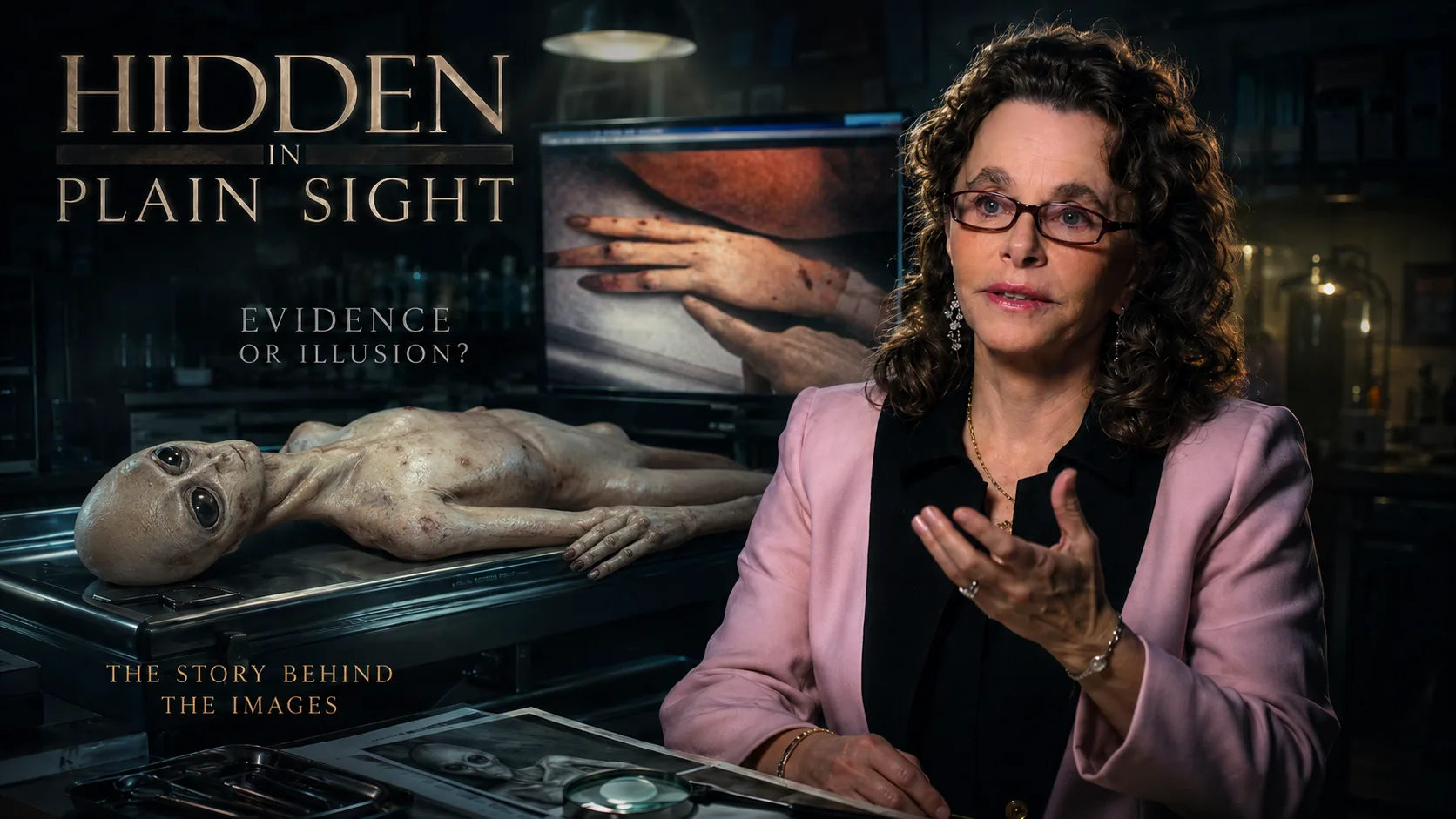
Some UFO cases are easy to place into a clean category.
A sighting is either witnessed by multiple people or it isn’t. A document is either traceable or it isn’t. A video either has a chain of custody or it doesn’t.
But every now and then, a case appears that refuses to sit neatly in one box.
The Brazilian “Relato de um MIB” case is one of those cases.
At first glance, it looks like a strange internet-era UFO mystery involving disturbing alien imagery, autopsy-style photographs, laboratory settings, industrial environments, computer-screen evidence, and claims that the material may have been connected to classified military or intelligence circles.
Then the story takes another turn.
The man connected to the original source trail, Brazilian artist and writer Philipe Kling David, says the images were part of a fictional project he created years ago. According to him, the alien body, the laboratory-style scenes, the UFO object, and the disturbing autopsy imagery were created for a fictional story called “Relato de um MIB,” or “Account of an MIB.”
For skeptics, that settles it.
For many UFO researchers and experiencers, it raises a much more uncomfortable question.
What if fiction is sometimes the safest way to release something real?
A Case Built for Plausible Deniability
The phrase “plausible deniability” gets used a lot in UFO research, but this case is almost a perfect example of why the idea matters.
If the images are fake, then the creator’s explanation makes sense. He made them as part of an art-driven UFO story, the images escaped their original context, and later researchers misread them as leaked alien evidence.
But if the images were connected to something real, then calling them fiction would also make sense.
That is what makes the case so interesting.
A person who released sensitive material could protect himself by placing it inside a fictional story. If questioned, he could say, “It was only art.” If the images spread too far, he could point back to the fictional project. If powerful people became concerned, the creator would have a built-in escape route.
That does not prove the images are real.
But it does explain why some UFO circles continue to discuss the case instead of dismissing it outright.
What the Official Source Trail Says
The source trail points back to Philipe Kling David and his long-running Brazilian fiction project “Relato de um MIB.”
According to David, the project began around 2008 after he created illustrations of a dead alien. He later built a story around those images involving Brazilian MIB-style agents, recovered extraterrestrial material, a hidden alien entity, secret operations, and a larger conspiracy connected to UFO retrievals.
He says the project included writing, videos, 3D artwork, edited images, digital paintings, social media interactions, and fictional characters who interacted with readers online.
In other words, it was not simply a single image. It was closer to an early internet transmedia UFO story, the kind of project that today might be compared to an ARG, or alternate reality game.
That is important because “Relato de um MIB” was designed to blur the line between story and reality.
And when UFO material is designed to look real, it can eventually become detached from its original context.
That appears to be exactly what happened.
Why the Images Still Disturb People
Even after hearing the creator’s explanation, it is easy to understand why people react strongly to these images.
They do not look like polished modern CGI. They do not look like clean AI-generated fantasy art. They look old, rough, low-resolution, badly photographed, and strangely physical.
That actually makes them feel more believable.
The alien body appears in lab-style environments. Some images appear on a computer monitor, while others seem to show physical surroundings outside the screen. The lighting is imperfect. The angles are awkward. The quality is degraded. There are industrial settings, equipment, people in work environments, and a body that many viewers find disturbingly realistic.
To a skeptic, those flaws are exactly what you would expect from an old fictional art project.
To a believer, those same flaws can feel like authenticity.
That is the tension at the heart of the case.
Review the Images and Decide for Yourself
The images connected to this case sit at the center of the controversy. Some viewers see them as fictional artwork from an early internet UFO project. Others believe the realism, lab setting, body details, screen captures, and strange presentation leave the door open to something more complicated.
The Photo Gallery: Fiction, Cover Story, or Hidden Disclosure?
Below is the image gallery connected to the “Relato de um MIB” controversy. Review the photos carefully, study the environment, compare the screen-based images with the images that appear to show physical surroundings, and decide where you think the evidence points.
Relato de um MIB Alien Autopsy and Laboratory Image Gallery
Four-Fingered Hand on Monitor
A screen-based image that became central to the debate over whether this was staged fiction or something more carefully hidden.
Alien Body Close-Up
A disturbing autopsy-style image showing the alleged alien body, head shape, eyes, skin texture, and clinical presentation.
Public Dispute and Source Context
A context image showing the controversy around whether the material was fictional artwork, misidentified evidence, or a possible cover story.
Alien Body Displayed on Workstation
A monitor-based view of the alleged alien body, surrounded by ordinary workspace details that make the image feel strangely grounded.
The Linda Moulton Howe Controversy
The case gained renewed attention when well-known American ufologist Linda Moulton Howe discussed the alien images in connection with alleged military sources.
According to David, Howe presented the material as if it had been provided by a source connected to Wright-Patterson Air Force Base and described it as imagery related to an “orange alien.”
David strongly rejected that interpretation and said the images came from his fictional work.
The controversy escalated when, according to David, he attempted to explain that the images were fictional, while some people continued to argue that the material was real. He also claimed that he was accused of being connected to the CIA or participating in a disinformation effort.
This is where the case becomes especially strange.
If the images are fake, then the situation shows how UFO researchers can be misled by old internet material when the original context is lost.
If the images are real, then the situation becomes a possible example of how real material can be neutralized by attaching it to a fictional creator and calling it art.
Again, neither side can be proven by appearance alone.
Why “It Looks Real” Is Not Enough
One of the biggest mistakes in UFO research is assuming that realism equals authenticity.
A convincing image is not automatically evidence. A disturbing image is not automatically disclosure. A lab setting is not automatically proof of a classified program.
To take a case like this seriously, researchers would need more than visual impact.
They would need things like:
- A verifiable chain of custody
- Original camera files or source files
- Metadata from the earliest versions of the images
- Proof that the images existed before the art project
- Independent witnesses connected to the location
- Confirmation of the facility shown in the photos
- A military, laboratory, or institutional link that can be verified
- Consistent testimony from people with direct involvement
- Evidence that does not rely only on anonymous-source claims
Without that, the case remains fascinating, but not confirmed.
That distinction matters.
A case can be worth investigating without being proven.
A case can be culturally important without being verified.
A case can raise serious questions without being treated as established fact.
The Fiction Problem in UFO Disclosure
The UFO subject has always had a complicated relationship with fiction.
Science fiction has shaped the way people imagine alien contact. Movies have influenced how witnesses describe craft. Government secrecy has created room for both legitimate whistleblowers and opportunists. At the same time, some researchers have argued that real information may occasionally be released through fiction, entertainment, or controlled leaks.
That makes cases like “Relato de um MIB” difficult.
If something is presented as fiction, should researchers automatically ignore it?
Not necessarily.
But they also should not automatically treat it as real.
The better approach is to ask careful questions.
Where did the material first appear? Who controlled it? Did the creator have the skills to make it? Are there earlier versions? Are there independent witnesses? Did anyone else preserve the files? Do the images contain details that can be verified? Does the story become stronger when separated from belief and examined piece by piece?
That kind of analysis is more valuable than simply saying “real” or “fake.”
Could Fiction Be Used as a Cover Story?
This is the question that keeps the case alive.
If someone had access to sensitive alien-related material, one way to release it would be to hide it in plain sight.
Make it part of a fictional story. Mix real images with created ones. Add humor. Add exaggeration. Add absurd details. Make the entire thing deniable.
Then, if the material attracts attention, the creator can say it was all fake.
That idea sounds far-fetched to some people, but in UFO culture it is not an unfamiliar theory. Researchers have long debated whether certain films, books, television shows, and “fictional” leaks contain fragments of real information.
The problem is that this theory is almost impossible to prove unless stronger evidence appears.
It can explain the case, but it cannot confirm the case.
That is why the “Relato de um MIB” material should be treated as a mystery, not a conclusion.
A Better Way to Look at This Case
The most honest position is not to declare the images real.
It is also not to mock the people who still find them suspicious.
The better position is this:
The known source trail supports the claim that these images came from a fictional Brazilian UFO project. At the same time, the case remains interesting because it demonstrates how alleged evidence can survive inside the gray zone between art, folklore, anonymous sources, disinformation claims, and possible disclosure.
That gray zone is where much of UFO history lives.
Some cases are solved.
Some are misidentified.
Some are hoaxes.
Some are folklore.
Some may be something else entirely.
The challenge is knowing which is which.
Final Thoughts: Fiction, Cover Story, or Hidden Disclosure?
The Brazilian alien autopsy case is not strong enough to be presented as confirmed alien evidence.
But it is far too interesting to ignore.
It shows how a fictional UFO project can become a modern controversy. It shows how old images can gain new power when stripped from their original source. It shows how anonymous military-source claims can turn internet art into alleged disclosure. And it shows why UFO researchers must be both open-minded and careful.
Maybe “Relato de um MIB” is simply an impressive early internet fiction project that fooled people years later.
Maybe it is a case study in how UFO mythology spreads.
Or maybe, as some continue to wonder, fiction was the safest place to hide something real.
For now, the viewer has to decide.
Look at the images. Follow the source trail. Study the claims. Weigh the evidence.
Because in the UFO world, the most interesting cases are not always the ones that give us easy answers.
Sometimes they are the ones that force us to ask better questions.



Cosmic Echoes
Share-ready comments you can copy in a click, then post wherever the conversation touches UFOs, UAP, or the Galactic Federation.
These comments belong to the Cosmic Echoes page under the section Cosmic Echoes: The Blurred Lines of Alien Truth.
Plus 21 more comments on the Cosmic Echoes page.