
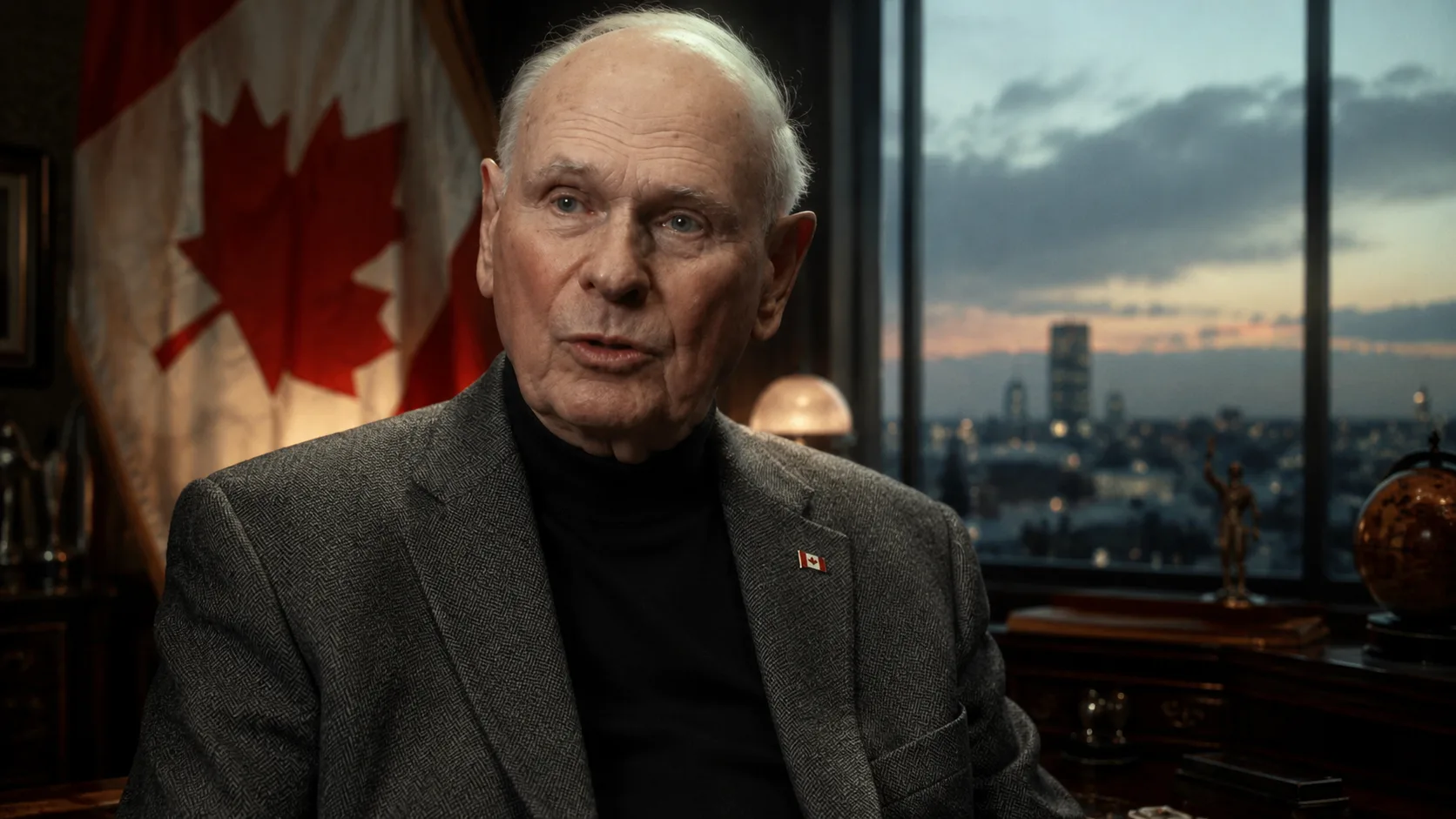
Paul Hellyer’s warnings have always had a strange way of pulling people in. Part of it is the résumé. He wasn’t just another voice on the internet. He was a former Canadian cabinet minister, a man who served as Minister of National Defence from 1963 to 1967 and later as Minister of Transport. (Lipad)
But the bigger reason his words still circulate is that they touch something many people already feel, even if they don’t know how to explain it. The world feels harder to understand. Money feels abstract. Privacy feels gone. Governments feel distant. Corporations feel enormous. And when someone with Hellyer’s background says there’s a larger system operating behind the visible one, people listen, even if they’re not sure they believe every claim. The transcript presents Hellyer’s message as a warning about hidden power, debt-based money, surveillance, and a coming deception.
That doesn’t mean every claim should be accepted at face value. It means the conversation is worth slowing down.
The Man Behind the Claims
Hellyer’s public career gives his words weight, but it doesn’t automatically make his later claims true.
That distinction matters. A person can have real experience inside government and still make claims that need evidence. Hellyer’s warnings about a “cabal,” suppressed technology, and possible staged crises go far beyond what public records can verify. At the same time, his concerns about money, concentrated power, secrecy, and public trust are not fringe concerns. They’re part of everyday life now.
The useful question isn’t, “Was Hellyer right about everything?” The better question is, “What was he pointing at that people already sense but rarely understand?”
Why He Started With Money
Hellyer placed money at the center of his warning because money is never just money. It decides who gets credit, who owns assets, who pays interest, who takes risk, and who has room to breathe.
Most people think of money as cash, coins, or numbers sitting safely in an account. But modern money is much more complicated than that. Official explanations from central banks support one of Hellyer’s core points: commercial banks do create much of the money supply when they make loans. A Government of Canada publication explains that money in Canada is created mainly through private commercial bank loans or asset purchases, and through Bank of Canada asset purchases, with commercial banks creating the majority when they extend loans such as mortgages. (Publications.gc.ca)
The Bank of England has made a similar point, saying banks are not simply lending out deposits that savers placed with them. In modern banking, new loans create new deposits, though the amount of money created is still shaped by central bank policy, regulation, borrower demand, and the wider economy. (Bank of England)
That’s a big deal. It means money is not just a neutral thing moving around. It is also created through promises, obligations, collateral, and debt.
The Part That Needs More Nuance
Hellyer’s version of the story is dramatic. He describes a system where money is created as debt, interest is owed, and the public sinks deeper and deeper into obligations. There’s truth in the idea that modern economies rely heavily on credit. But the system is not quite as simple as “banks create money from nothing and everyone is trapped forever.”
Loans create deposits, but loan repayment also destroys deposits. Banks face capital rules, liquidity requirements, competition, risk controls, and central bank policy. Interest payments don’t require a mystical separate money supply. They move income from borrowers to lenders, employees, depositors, shareholders, and other parts of the economy.
Still, the anxiety behind the claim is real. When housing, education, government budgets, consumer spending, and corporate growth all depend heavily on borrowing, ordinary people are right to ask who benefits and who carries the burden.
In the United States, that burden is not theoretical. As of May 20, 2026, total public debt outstanding was about $39.05 trillion, according to the U.S. Treasury’s Debt to the Penny data. (FiscalData) The Treasury defines national debt as money the federal government has borrowed to cover accumulated expenses, including interest owed to investors who bought Treasury securities. (Fiscal Data)
That doesn’t prove a secret plot. But it does prove the scale of the system is enormous.
Cash Is No Longer the Main Story
One of the most striking parts of Hellyer’s argument is the idea that only a small share of money exists as physical cash, while the rest is digital or ledger-based.
The exact percentage depends on the country and definition of money, but the general point is fair: most money is not paper in a wallet. In the United States, Federal Reserve data for March 2026 listed seasonally adjusted M2 at $22.686 trillion and currency at $2.359 trillion, meaning physical currency was roughly 10 percent of M2 by that measure. (Federal Reserve)
So even if a specific “3 percent” figure is not universally accurate, the larger point stands. Most money today exists as balances, entries, deposits, claims, and digital records.
And that raises a very human question: if money is mostly numbers inside institutions, how much control do ordinary people really have?
Complexity Creates Suspicion
The modern financial system is hard to understand. That’s not an accident in the conspiratorial sense. It’s the result of layers: banking law, monetary policy, securities markets, government borrowing, private credit, central bank operations, and global trade.
But when a system becomes too complex for the average person to explain, trust becomes fragile. People start looking for simpler stories. Sometimes those stories are wrong. Sometimes they’re exaggerated. Sometimes they’re emotionally satisfying because they turn confusion into certainty.
That’s the danger and the appeal of Hellyer’s message. It gives people a single villain: a hidden group controlling everything. Real life is usually messier. Power is often distributed through incentives, institutions, legal structures, lobbying, markets, secrecy, and habit. It doesn’t always need a smoke-filled room.
Still, complexity can protect power. When ordinary people can’t understand the rules, they can’t easily challenge the game.
The Privacy Connection
Hellyer’s warning also connects to something much more immediate than central banking: privacy.
You don’t need to believe in a hidden world government to notice that personal data has become a commodity. The Federal Trade Commission has warned that major social media and video streaming companies engaged in broad surveillance of users to monetize personal information, including data involving both users and non-users. (Federal Trade Commission) The FTC has also examined “surveillance pricing,” where companies may use personal details such as location, demographics, credit history, browsing behavior, or shopping history to target prices to individual consumers. (Federal Trade Commission)
That’s the everyday version of the same concern: people feel watched, measured, sorted, scored, and sold.
This is why claims about control resonate. Control doesn’t always look like a dramatic takeover. Sometimes it looks like terms of service nobody reads, a credit score nobody fully understands, a targeted ad that knows too much, or a price that changes because a company thinks it knows what you’ll tolerate.
The Cabal Claim Is the Core of Hellyer’s Warning
Hellyer’s most explosive claim is not simply that governments keep secrets. His deeper warning is that a powerful hidden network, made up of banking interests, multinational corporations, intelligence agencies, military contractors, and unelected power brokers, has gained enormous influence over democratic institutions.
That is not a small accusation. It is the kind of claim that almost never comes with neat, public evidence, because if Hellyer is right, the entire point of such a system is to make sure the evidence never reaches the public in a clean, undeniable form. A control structure like that would not leave its fingerprints in places ordinary citizens could easily find. It would operate through secrecy, compartmentalization, classified programs, financial pressure, media influence, political leverage, and fear.
That is why Hellyer’s position matters. He was not speaking as a random outsider guessing from a distance. He had been inside government. He had seen how power works from rooms most people will never enter. When someone with that background says the visible government is not always the real center of power, it deserves to be taken seriously.
Of course, critics will say, “Where is the proof?” But that question has limits. Whistleblowers who speak about deeply protected systems rarely have the luxury of walking into daylight with a perfect folder of evidence. If the people involved are as powerful as Hellyer claimed, then exposing them directly would carry enormous personal risk, not only professionally, but potentially physically. In that kind of environment, silence becomes survival, and partial disclosure becomes the only form of warning a person can safely give.
This does not mean every rumor should be believed. It means the absence of public proof does not automatically erase the possibility of hidden control. Some systems are designed specifically to remain unprovable from the outside.
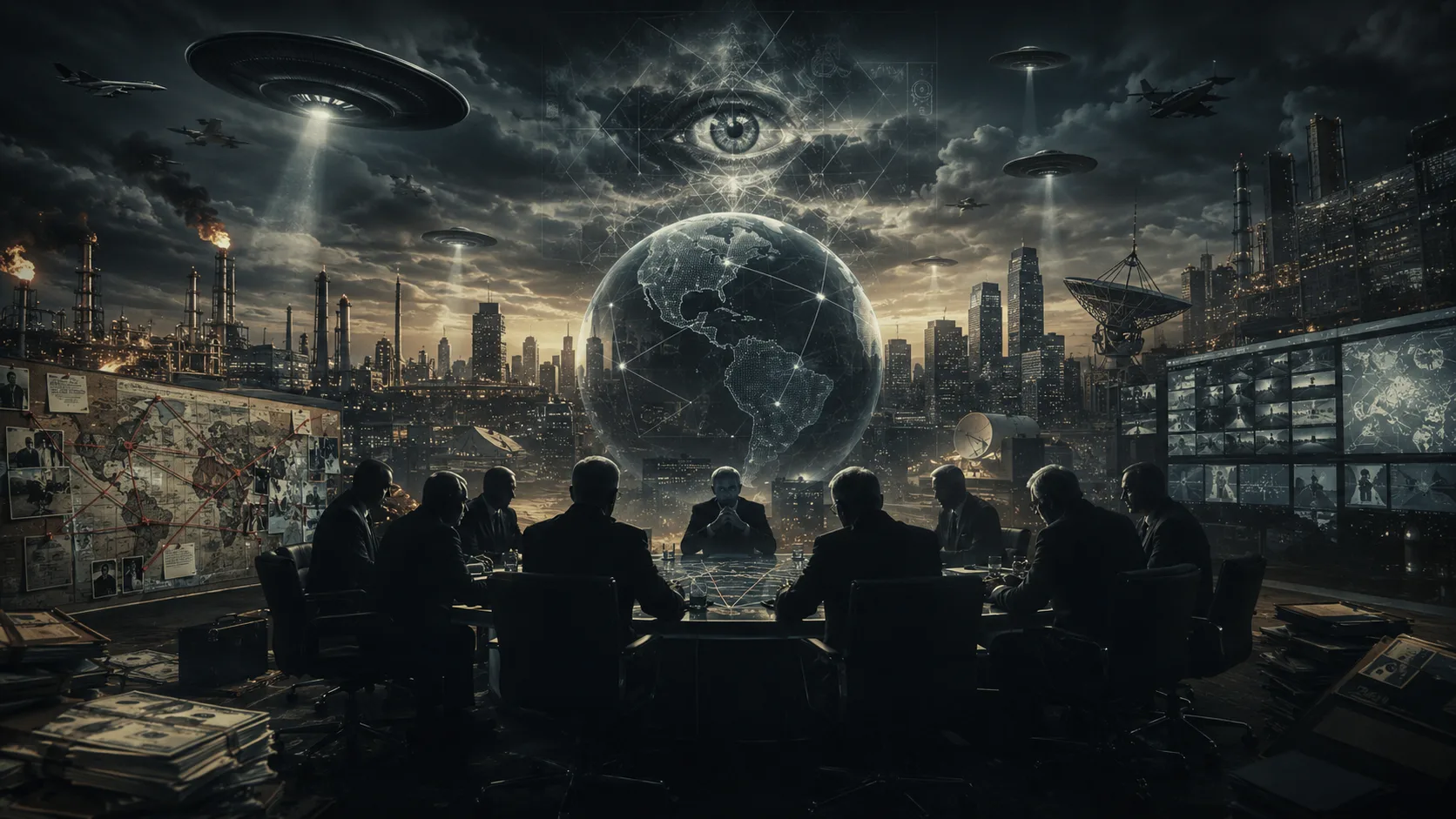
And when you look at the world Hellyer was describing, the pattern is hard to ignore. Banking power, endless debt, corporate influence, intelligence secrecy, military expansion, surveillance, media manipulation, and public confusion all seem to point in the same direction: power moving away from ordinary people and into the hands of institutions that are rarely accountable.
That was the heart of Hellyer’s warning. The cabal was not just a dramatic word. It was his way of describing a hidden architecture of control, one that operates above elections, beyond public debate, and outside the reach of normal democratic oversight.
The more useful path is not to dismiss the claim because it sounds uncomfortable. The useful path is to follow the pattern, watch who benefits, study how influence moves, and ask why the same forces always seem to appear at the center of the deepest rabbit holes.
UFOs, UAPs, and the Power of the Unknown
Hellyer’s later reputation became closely tied to UFOs, extraterrestrial contact, suppressed technology, and the possibility that humanity has been kept in the dark by design. But in the larger context of his warning, the alien question was never just about strange lights in the sky. It was about power, secrecy, technology, and who gets to decide what humanity is allowed to know.
That is where the message from Advice from the Extraterrestrials connects directly to Hellyer’s claims. In that passage, the alleged extraterrestrial voice says openly that contact with governments and heads of power has already happened. It says agreements were made in secret because world leaders claimed humanity was not ready. It also says people have been hurt or killed to protect that secrecy, while the beings themselves deny responsibility for that harm.
Whether someone accepts that message literally or symbolically, the theme is powerful: the public is not being told the whole story.
The warning goes beyond UFO disclosure. It describes Earth as a planet in crisis, with contaminated water, dying forests, damaged food chains, overpopulation, nuclear weapons, biological weapons, and environmental systems under severe stress. The message claims there are better ways to produce energy and meet humanity’s food needs without destroying the planet, but those in power already know this and refuse to release those solutions because they view them as a military and security threat.
That point lines up with one of Hellyer’s central arguments. He did not simply say extraterrestrials exist. He argued that advanced knowledge, including free energy or zero-point energy, has been suppressed because it would disrupt the power structure. If energy became clean, abundant, and decentralized, the old systems of control would start to collapse. Oil dominance, debt dependency, military leverage, and corporate scarcity would all lose power.
That may be why secrecy matters so much. If the truth is only about aliens, then disclosure becomes a curiosity. But if the truth includes suppressed technologies, hidden agreements, environmental solutions, and decades of public deception, then disclosure becomes a threat to the entire system.
The most unsettling part of the transcript is the idea of amnesty. The passage suggests that leaders and governments may need protection from prosecution before they will come forward with the truth. That is a hard idea to accept, especially if people have suffered, died, or been lied to for generations. But the argument is simple: if the people involved believe confession means prison, destruction, or death, they will never confess. They will keep hiding the truth until the system breaks or until humanity runs out of time.
That is the moral trap at the center of disclosure. People want justice, and they should. But if the price of justice is continued secrecy, continued environmental collapse, continued technological suppression, and continued public manipulation, then the world may be forced to ask a painful question: do we want punishment first, or do we want the truth first?
Hellyer seemed to understand that the UFO subject was only the doorway. Behind it was a much larger issue: humanity has allegedly been managed like a population that cannot be trusted with its own future. The public has been told to wait, to doubt, to laugh, to ignore, and to accept official silence while those in power decide what reality is allowed to look like.
That is why UAP secrecy matters. It is not just about unidentified objects. It is about the right of human beings to know the truth about their planet, their history, their technology, and their place in the universe.
If Hellyer was right, then the real danger is not extraterrestrial contact. The real danger is a power structure so committed to control that it would rather let the planet suffer than release knowledge that could set humanity free.
The Strongest Part of Hellyer’s Warning
Near the end of the transcript, Hellyer shifts away from hidden systems and toward something more grounded: the worship of money, power, and greed.
That may be the most important part.
You don’t have to believe in every claim to see that modern life often rewards extraction over service, status over character, and profit over dignity. You don’t need a grand conspiracy to notice that many people are exhausted, indebted, distracted, and suspicious of institutions that claim to serve them.
That’s where Hellyer’s warning becomes less about proving a secret plot and more about asking a moral question.
What kind of society do we become when everything is for sale?
How to Read Warnings Like This
The best response is not blind belief. It’s also not smug dismissal.
A serious reader can hold two thoughts at once. First, many of Hellyer’s most dramatic claims remain unproven. Second, some of the systems he criticized are genuinely difficult, powerful, and poorly understood by the public.
A healthy skepticism should work in both directions:
- Don’t accept extraordinary claims without evidence.
- Don’t dismiss real problems because they arrive wrapped in dramatic language.
- Learn how money, debt, data, and institutions actually work.
- Demand transparency where public power is involved.
- Protect privacy before it becomes impossible to recover.
The world doesn’t need more panic. It needs more understanding.
Conclusion: The Real Warning Is About Control
Paul Hellyer’s message endures because it does not feel like a wild theory from a man chasing attention. It feels like a warning from someone who had been close enough to power to understand how carefully power protects itself.
He was not a random voice shouting from the outside. He was Canada’s former Minister of National Defence, a man who had operated inside high-level government, military, and political structures. That matters. When someone with that background says the public is not being told the full truth, the responsible reaction is not to laugh it away. The responsible reaction is to ask what kind of system would need that much secrecy in the first place.
At the center of Hellyer’s warning is the cabal, not as a cartoon villain hiding in a dark room, but as a real architecture of control: banking power, oil and gas power, military power, intelligence power, corporate power, and political power moving together behind the visible surface of democracy. If he was right, then the world is not simply suffering from bad leadership or broken policy. It is being held inside a system designed to keep humanity dependent, divided, distracted, and afraid.
That is why the free energy claim matters so much. If clean, abundant energy already exists, or if the science to develop it has been suppressed, then the issue is not just technology. It is liberation. Free energy would change everything. It would weaken the oil and gas empire. It would reduce poverty. It would reshape war, transportation, agriculture, housing, and the entire global economy. It would give ordinary people and nations a level of independence that the current power structure may never willingly allow.
That may be the real reason disclosure has been delayed for so long. The truth is not only about extraterrestrials. It is about the agreements, the hidden alliances, the suppressed technologies, and the quiet transfer of planetary power away from the people. If the Galactic Federation or other non-human groups have been involved with governments behind closed doors, then humanity has been living inside one of the greatest withheld truths in history. Not because people were too foolish to understand it, but because those in power were too afraid of losing control.
And that is the question Hellyer leaves behind: how much of human suffering is natural, and how much of it is managed?
How many wars were necessary? How much poverty was unavoidable? How much disease, pollution, debt, scarcity, and fear had to exist? How much of our future has been delayed because a hidden structure decided that oil, money, control, and secrecy were more important than human freedom?
This is where the article cannot end softly. Hellyer’s warning is not comfortable. It is not meant to be. It asks the reader to look at the world and question why the same forces always seem to win, why the same industries remain protected, why the same secrets remain buried, and why humanity is always told to wait for a better future that never fully arrives.
The escape from this cabal, if Hellyer was right, will not come from one politician, one hearing, one leaked document, or one government announcement. It begins when people stop surrendering their curiosity. It begins when they question debt, energy, war, surveillance, media narratives, and the official version of history. It begins when humanity refuses to be managed like livestock and starts demanding the truth as a birthright.
Because the real battle is not only over UFOs, money, oil, or technology.
It is over consciousness.
It is over whether humanity stays trapped inside an engineered reality built on fear and dependency, or finally wakes up enough to reclaim the future that was stolen from it.


Cosmic Echoes
Share-ready comments you can copy in a click, then post wherever the conversation touches UFOs, UAP, or the Galactic Federation.
These comments belong to the Cosmic Echoes page under the section Cosmic Echoes: Power Behind the Curtain.
Plus 21 more comments on the Cosmic Echoes page.