
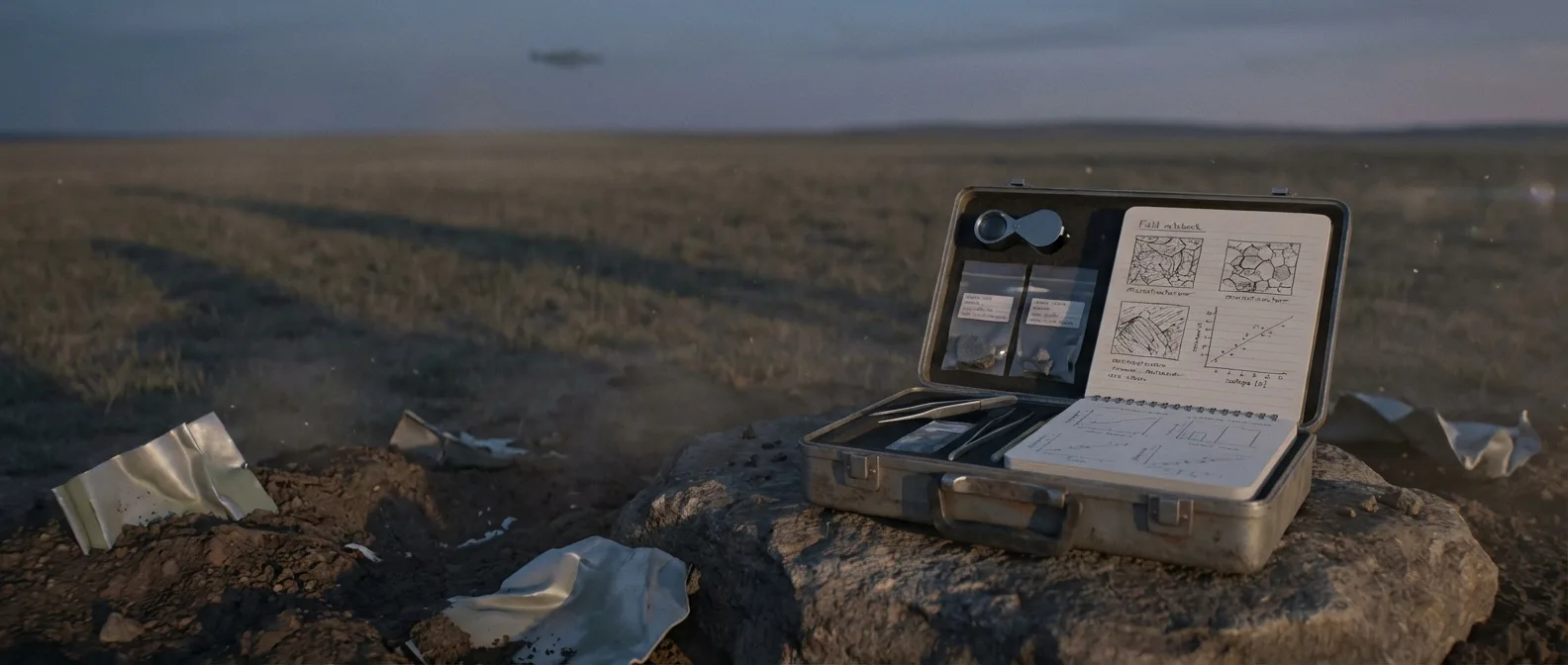
West-central New Mexico is the kind of landscape that makes stories feel older than the people telling them. The Plains of San Agustin, stretching near Horse Springs and the Datil area, sit far from major cities, wide enough to swallow a crash site, a rumor, or a secret. In UFO history, that geography becomes more than scenery. It becomes a stage.
The “San Agustin 1947” story is usually framed as a parallel thread to Roswell, not a replacement. In this telling, early July 1947 brings not just scattered debris near Roswell, but a more intact crash site on or near the plains, sometimes described as a “second site,” sometimes described as the real prize: bodies, a craft, and the kind of scene that would rewrite history if it were ever nailed down with hard documentation. The problem is that the story’s foundation is mostly testimony that surfaces decades later, plus modern claims about recovered material tested in a lab. Those are very different kinds of evidence, and they deserve to be handled differently.
That tension is the whole case in miniature: the narrative wants to be definitive, but the record doesn’t cooperate.
“The mystery isn’t just what happened in 1947. It’s how the story changes as it travels through time.”
What follows is an evidence-forward map of the claim stack, what’s asserted, where it appears in the record, and what would actually be required to move this from fascinating to verifiable.
The Geography Behind the Claim
The Plains of San Agustin region is repeatedly linked to an alleged July 1947 crash near Horse Springs, New Mexico, often associated with the Datil area. In modern summaries of the case, it’s presented as a “pre-Roswell” or “parallel-to-Roswell” crash narrative, meaning it either predates Roswell by days or unfolds during the same early-July window. Alternative Propulsion Engineering Conference (APEC) frames the story in exactly those terms: alleged craft crash near Horse Springs, followed by later-recovered materials and lab testing. [1]
Geography matters here because it affects plausibility and corroboration. Remote terrain can hide events. It can also hide the absence of events. The plains are not a vault, they’re a wide-open bowl of sky. That becomes important when the story intersects with claims involving archaeologists working in the area around the same time.
A Timeline of When the Claims Enter the Record
The biggest mistake writers make with this case is treating “1947” like a single clean block of certainty. The date is a label, not proof. A more honest approach is to track when each key claim becomes visible in publications, interviews, and official references.
Timeline table: claims vs. documentation
| Time period | What’s claimed | Where it shows up in the record | What that means |
|---|---|---|---|
| Early July 1947 (often July 2) | A craft allegedly crashes on/near the Plains of San Agustin near Horse Springs/Datil | Appears mainly in later UFO literature and modern summaries | The core event lacks a clear contemporaneous 1947 paper trail in widely cited public sources [1][2] |
| 1970s–1980 | A “second site” narrative becomes attached to the Barnett story; bodies are alleged | Discussed in later Roswell-era writing and retrospectives | This is late and secondhand, which raises contamination risk [2][3] |
| 1990s | The controversy becomes a formal internal debate within UFO research circles | The Air Force Roswell Report bibliography references a work on the “Plains of San Agustin Controversy” involving Gerald Anderson, Barnett, and archaeologists | The dispute is established enough to be cited in official-report context, but that’s not the same as validation [4] |
| 1991–1996 interviews | Witness interviews are recorded and archived, including interviews with alleged witnesses | National Archives blog describes “Sound Recordings Relating to ‘The Roswell Reports’” and associated interview materials | Primary-source interviews exist as records, but they are still testimony, not contemporaneous 1947 evidence [5] |
| July 2009–Oct 2010 | Six metal samples are reportedly provided to a researcher for analysis, with results compiled in a report | APEC summarizes Colbern’s analysis, stating samples W1–W6 were tested and interpreted as unusual | This is the pivot from story to “materials claim,” but provenance becomes everything [1] |
| 2025 | The case is recapped and amplified for a modern audience | APEC article re-summarizes the crash narrative + lab results | Useful for overview, but readers must trace each claim back to its source layer [1] |
The Witness Layer: What’s Said, When It’s Said, and Why That Matters
Eyewitness testimony is not worthless. It’s just fragile, especially when it arrives decades after the fact, in a cultural landscape already saturated with UFO narratives. With San Agustin, the witness layer is a patchwork of alleged firsthand accounts, secondhand retellings, and disputed connections to archaeology work in the area.
Gerald Anderson: a recorded witness, not a recorded event
Gerald Anderson is frequently presented in UFO literature as an alleged firsthand witness to a crash site sometimes labeled “Site 2,” associated with the plains narrative. APEC repeats a version of Anderson’s claim: a horseshoe-shaped craft, bodies, and an encounter framed as childhood memory. [1]
What can be stated with more confidence is narrower: the National Archives has described a set of interviews and sound recordings connected to “The Roswell Reports,” including interviews with alleged witnesses. That establishes that recorded testimony exists in an archival context, independent of modern blog summaries. [5]
That’s valuable, but it still leaves the central limitation intact: a recorded interview decades later is not the same as a report written in 1947.
The Barnett story: secondhand, posthumous, and controversial
The “Grady ‘Barney’ Barnett” narrative tends to function like a narrative bridge. It links Roswell-era lore to the plains and adds bodies, military presence, and a forced exit. Kevin Randle’s discussion of the plains case highlights a core problem: even major UFO researchers describe the Barnett story as initially lacking a firm date when it was first told, and the story’s framing shifts over time. [3]
Time magazine’s classic Roswell-era coverage treats “bodies” narratives as part of a broader ecosystem of claims, emphasizing how much of the lore arrives later and relies on recollection. [2]
A fair way to phrase it is this: the Barnett story is important historically because it shaped the modern “second site” idea, but it is structurally weak as evidence because it is secondhand and late.
The archaeologist angle: the best potential corroboration, and a key point of dispute
One of the more interesting features of the plains narrative is the recurring attempt to connect the alleged crash to archaeologists working in the region. In theory, that’s exactly the kind of independent corroboration a case like this needs. In practice, the connection is contested.
Randle’s skeptical analysis points out the ways in which these linkages are disputed, including claims that archaeologist Herbert Dick denied seeing anything unusual. [3] If a credible field team is nearby during the alleged time window, then the absence of corroboration is consequential, not trivial.
“The archaeologist angle is the kind of detail that could strengthen the case. It’s also the kind of detail that collapses it if it doesn’t hold.”
The Recovery Layer: When the Story Starts Claiming Physical Material
Many UFO crash narratives stall at testimony. This one doesn’t, at least not in modern retellings. APEC’s 2025 summary puts Chuck Wade at the center of the “recovery” layer: Wade reportedly provides six metallic samples to researcher Steven (S. G.) Colbern, who then performs a suite of tests and writes up a report dated 2010, with samples received in 2009. [1]
This is where the case becomes both more compelling and more demanding. Physical material can be tested. It can also be mislabeled, contaminated, or simply misattributed. Once you invoke lab instrumentation, you inherit lab standards.
The Lab Layer: What the Analysis Claims, in Plain English
Colbern’s report is circulated and summarized as a technical analysis of six samples labeled W1–W6. APEC describes the methods used as a combination of light microscopy, scanning electron microscopy (SEM), elemental mapping via energy-dispersive X-ray spectroscopy (EDX/EDS), inductively coupled plasma mass spectrometry (ICP-MS), and Raman spectroscopy. [1]
Here’s what those mean in normal language:
- Light microscopy: basic magnified imaging to observe surface features and structure.
- SEM: high-magnification imaging using electrons, good for fine surface and microstructural detail.
- EDX/EDS: identifies which elements are present in the scanned region.
- ICP-MS: measures elemental concentrations with high sensitivity, and can be used for isotopic ratios under controlled conditions.
- Raman spectroscopy: looks at molecular and lattice vibrations, sometimes used to detect carbon-based structures such as nanotube signatures.
Reported observations, as summarized in public sources
APEC states the samples appear to be an aluminum-alloy matrix with unusual elemental compositions and coatings, including notable concentrations involving silicon, titanium, and nickel in some contexts. [1] It also repeats the more unusual story beats: microstructures, pits, layered structures, nanotube indications via Raman, and isotope ratios interpreted as non–terrestrial or influenced by high neutron flux. [1]
These are extraordinary interpretations. They may be true, partially true, or the result of ordinary explanations interacting with unclear provenance. Without full lab notebooks, calibration details, controls, and independent replication, the responsible stance is “reported, not settled.”
The energy-emission claim: where caution matters most
The “pendulum deflection” or “energy emission” claim sometimes appears in summaries as an informal indicator that samples might be producing a field effect. APEC repeats this claim as part of the narrative package. [1]
From a journalistic standards perspective, this should be treated as a reported demonstration, not evidence of an exotic phenomenon. Such tests are extremely sensitive to setup, bias, environmental factors, and expectation effects. If the effect is real, it should be measurable with instruments designed for magnetic, electric, or electrostatic fields, using blinded protocols.
The Scientific Hinge: Provenance, Controls, and Replication
If you strip away the UFO context, the scientific question becomes simple: do these samples show anomalies that survive the kind of scrutiny applied to any contested material?
Here’s the checklist that matters, written in practical terms.
What would set scientific confidence, not just curiosity?
- Chain of custody
- Who collected the samples, on what date, at what coordinates?
- How were they stored, packaged, and transported?
- Who handled them, and when?
- Site controls and blanks
- Was soil from the same site tested?
- Were field blanks run (containers opened at the site and sealed without samples)?
- Were lab blanks run to detect contamination introduced in processing?
- Split-sample independent replication
- A portion of each sample should be sent to at least two independent labs.
- Labs should work blind to the claimed origin, using pre-registered test plans where possible.
- Transparent isotope methodology
- Which isotopes were measured, with what standards?
- What are the uncertainty ranges, instrument corrections, and mass bias adjustments?
- Are results compatible with known industrial fractionation, ore source variation, or contamination?
- Comparison against known materials
- Compare microstructure and composition with known aluminum alloys, coatings, aerospace treatments, and industrial residues.
- Compare carbon signatures against modern contamination sources, including adhesives, lab environments, and handling.
This isn’t a debunking toolset. It’s what separates a strong materials claim from a story with lab equipment.
Why Official Roswell Reporting Matters to This Case, Even If It’s “Not About Roswell”
The Air Force Roswell Report represents the government’s attempt to explain the Roswell debris narrative through programs like Project Mogul and related balloon and testing activities, and it reports that Air Force research did not disclose records of recovered extraterrestrial materials or “alien bodies.” [6]
That does not disprove a separate plains event. But it does establish a baseline: official investigations, at least as represented in those reports, reject the alien-craft framing. Any article trying to “map the claim stack” should include that contrast, because it shows where the mainstream institutional record sits relative to the lore.
Photo Gallery Placeholder: Debris, Context, and Lab Visuals
Photo Gallery
Recovered debris, documents, and close-ups. Click any image to view full size.
.webp)
.webp)
.webp)
.webp)
.webp)
.webp)
.webp)
.webp)
.webp)
.webp)
.webp)
.webp)
.webp)
.webp)
.webp)
.webp)
.webp)
.webp)
.webp)
So What Is This Case, Right Now?
Right now, the Plains of San Agustin story is best understood as two overlapping narratives that shouldn’t be blended carelessly.
Narrative A: the crash-and-bodies story
- Built primarily from later testimony and retellings, some of it disputed.
- Historically important as part of Roswell-era lore expansion.
- Evidentially fragile because the signal is late and the cultural noise is loud. [1][2][3][5]
Narrative B: the materials-analysis story
- Anchored to an analysis report described in public summaries, with named samples and named methods.
- Potentially testable, which is a major upgrade over pure testimony.
- Scientifically unresolved until provenance, controls, and independent replication are made robust and transparent. [1]
If there’s a “responsible intrigue” stance, it’s this: the case is worth discussing precisely because it invites verification. It’s either a rare situation where legend points to a reproducible anomaly, or it’s an example of how easily provenance can turn ordinary materials into extraordinary narratives.
What Would Settle This, Practically, in 2026
A serious resolution doesn’t require a government confession. It requires a modern testing protocol.
- Publish a full chain-of-custody record for any sample claimed to come from the plains site.
- Run a blinded, split-sample study across independent labs.
- Release raw instrument outputs and calibration details.
- Compare to known industrial and aerospace materials before invoking exotic hypotheses.
- If isotope anomalies remain, involve specialists in isotope geochemistry and mass spectrometry to evaluate terrestrial and industrial explanations.
And if the results survive all of that? Then the story stops being “a crash narrative with lab claims” and becomes a genuine materials-science mystery that deserves a different kind of attention.
References
[1] Alternative Propulsion Engineering Conference (APEC), “San Augustin: UFO Crash Recovery Sample Analysis.” https://www.altpropulsion.com/san-augustin-ufo-crash-recovery-sample-analysis/
[2] TIME, “Did Aliens Really Land?” (subscriber archive page). https://content.time.com/time/subscriber/article/0,33009,986565-2,00.html
[3] Kevin Randle, “The Plains of San Agustin Crash Revisited.” https://kevinrandle.blogspot.com/2015/02/the-plains-of-san-agustin-crash.html
[4] U.S. Air Force, “The Roswell Report” (AFD-100713-052 PDF), bibliography reference to “The Plains of San Agustin Controversy, July 1947.” https://www.secretsdeclassified.af.mil/Portals/67/documents/AFD-100713-052.pdf
[5] National Archives (The Unwritten Record), “The Roswell Reports: What crashed in the desert?” https://unwritten-record.blogs.archives.gov/2014/07/07/the-roswell-reports-what-crashed-in-the-desert/
[6] National Security Archive-hosted copy of U.S. Air Force Roswell research report PDF. https://www.nsa.gov/portals/75/documents/news-features/declassified-documents/ufo/report_af_roswell.pdf
Cosmic Echoes
Share-ready comments you can copy in a click, then post wherever the conversation touches UFOs, UAP, or the Galactic Federation.
These comments belong to the Cosmic Echoes page under the section Echoes from the Forgotten Crash.
Plus 21 more comments on the Cosmic Echoes page.