
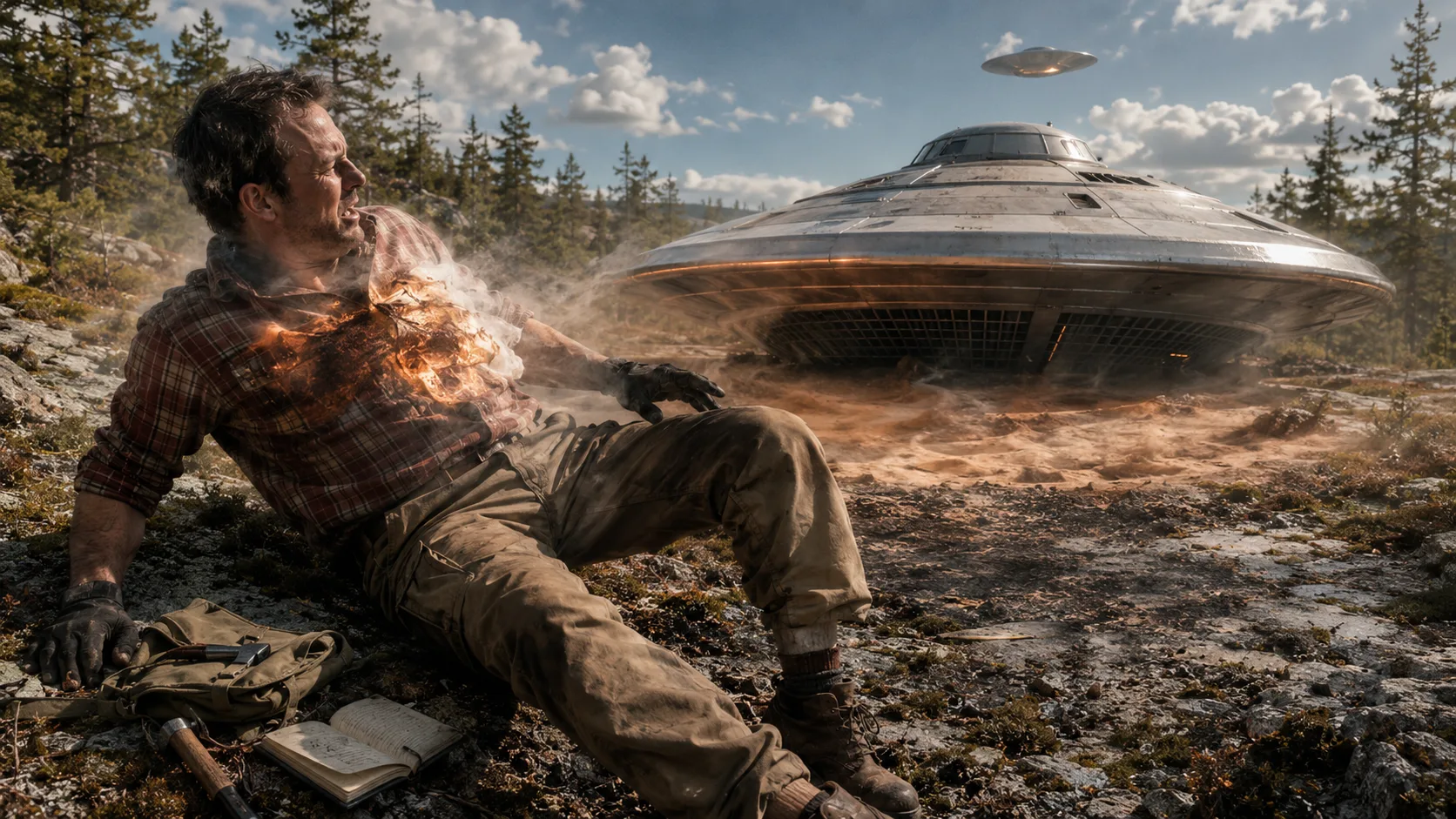
Most UFO stories live or die on testimony. Someone sees a light, a shape, a movement in the sky. Maybe there’s a photograph, maybe there isn’t. Maybe the witness is sincere, maybe mistaken. Either way, the evidence usually fades into memory.
The Falcon Lake incident is different.
On May 20, 1967, Stefan Michalak, an industrial mechanic and amateur prospector, walked into the rocky wilderness near Falcon Lake, Manitoba, looking for minerals. By the end of the day, he was sick, burned, shaken, and telling police that he had been injured by a landed, disc-shaped craft. What followed was not just a strange story, but a paper trail: police interviews, military involvement, medical notes, laboratory tests, radiation surveys, burned clothing, contaminated soil samples, and a government file that never quite found a comfortable explanation.
That doesn’t make Falcon Lake proof of alien visitation. The better point is more careful, and more interesting. It is one of the rare close-encounter cases where the physical claims were taken seriously enough to be tested, argued over, and preserved in official records. Even decades later, it remains stubbornly hard to flatten into either “obvious hoax” or “simple mistake.”
A Regular Man on a Regular Prospecting Trip
Stefan Michalak was not out hunting UFOs. He was prospecting.
According to his RCMP interview, Michalak worked as an industrial mechanic at Inland Cement in Winnipeg. He had studied geology and spent time prospecting in the field, carrying the sorts of tools a practical rockhound would bring: a hammer, compass, gloves, safety goggles, notebook, magnet, axe, lunch, and materials for testing mineral streaks. He had gone to the Falcon Lake area because the Canadian Shield there offered the kind of exposed rock that amateur geologists love.
That detail matters. Michalak wasn’t wandering around aimlessly. He was a craftsman, a mechanic, and a prospector, the kind of person used to watching surfaces, textures, heat, tools, and mechanical behavior. If something metallic, hot, loud, or structurally unusual appeared in front of him, he had at least some practical vocabulary for describing it.
It also makes the beginning of the story feel almost ordinary. He arrived near Falcon Lake, set out on foot, and spent the morning examining rock formations. He later said the weather was good, visibility was clear, and there was no storm, heavy wind, or rain to confuse the scene.
Then, sometime after lunch, he heard geese making noise overhead.
That was when the day stopped being ordinary.
The Encounter: Two Objects, One Landing
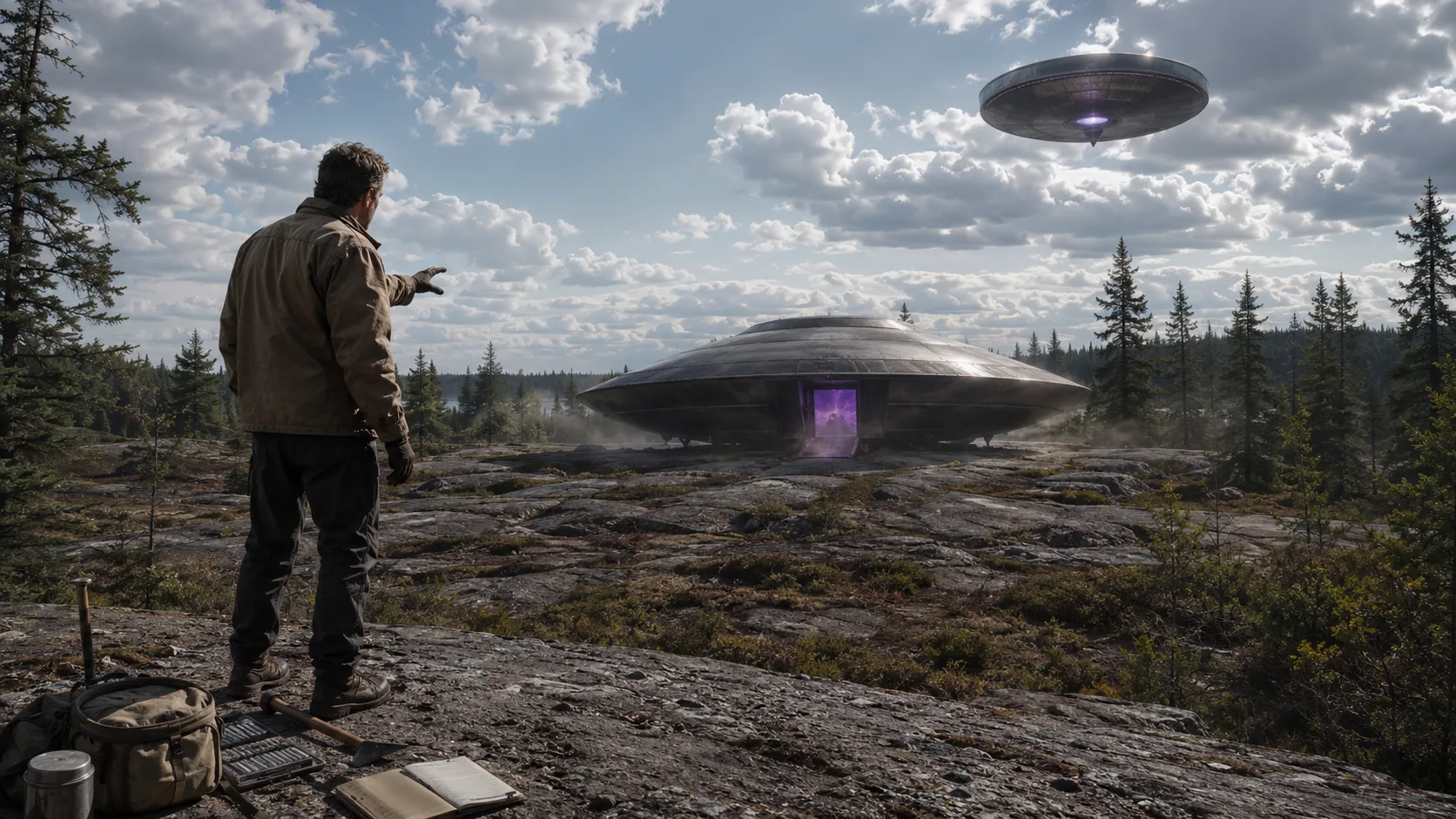
Michalak told investigators that he saw two objects descending in the sky. He described them as disc-shaped, glowing, and silent. One hovered above the ground, while the other came down and landed on exposed Precambrian rock roughly 100 feet away.
His description of the landed object was oddly specific. He said it was about 35 to 40 feet across, roughly 11 feet high with a dome, and initially glowed red before cooling to a steel-grey or silver color. It sat there for around 45 minutes. After about 10 minutes, a hatch opened, releasing a bright violet light. He heard sounds that he compared to whirring and air suction.
This is where the case becomes stranger than the usual “object in the sky” sighting. Michalak said he heard humanlike voices coming from inside the craft. Thinking it might be an experimental aircraft, possibly American, he called out in several languages. He reported using English, German, Polish, Ukrainian, and Russian. When he shouted, the voices stopped.
To a modern reader, that small moment is one of the most revealing parts of the case. Michalak didn’t immediately frame what he saw as extraterrestrial. His first instinct was practical and Cold War-era: this might be secret military hardware. That doesn’t prove his story, but it does make it feel less like a man trying to build an alien myth and more like a man trying to categorize something that didn’t fit.
The Grill, the Heat, and the Burn Pattern
Michalak said the craft’s hatch closed, the object began to rotate, and heat radiated from a grill-like structure. He reported standing within several feet of the openings and touching the craft with a gloved hand. The glove, he said, began to melt or soften. Then, as the object lifted off, a blast of hot air or gas struck him. His shirt caught fire, and he tore it off.
The burn pattern is one of the reasons Falcon Lake has remained so compelling. Michalak’s chest reportedly bore a grid or checkerboard-like pattern, consistent with his claim that the blast came through a vent or grill. An RCMP follow-up report later listed “burns to his chest in a checked pattern” among the facts investigators could not easily dismiss.
That pattern is important because it suggests more than simple exposure to heat. A campfire, electrical burn, or accidental scald usually produces irregular damage. A repeating grid pattern implies a shaped source, something like a vent, exhaust baffle, or perforated surface. If Michalak’s account is taken at face value, the injury sounds less like mystical radiation and more like an engineering problem: heat forced through a patterned opening.
That doesn’t tell us what the object was. It does, however, give the case its peculiar mechanical texture. The story is full of practical details: cooling metal, a hatch, ribs or grates, air suction, a rotating body, a grill, hot exhaust, melting gloves. It reads less like a dream and more like a bad accident involving an unfamiliar machine.
The Immediate Aftermath
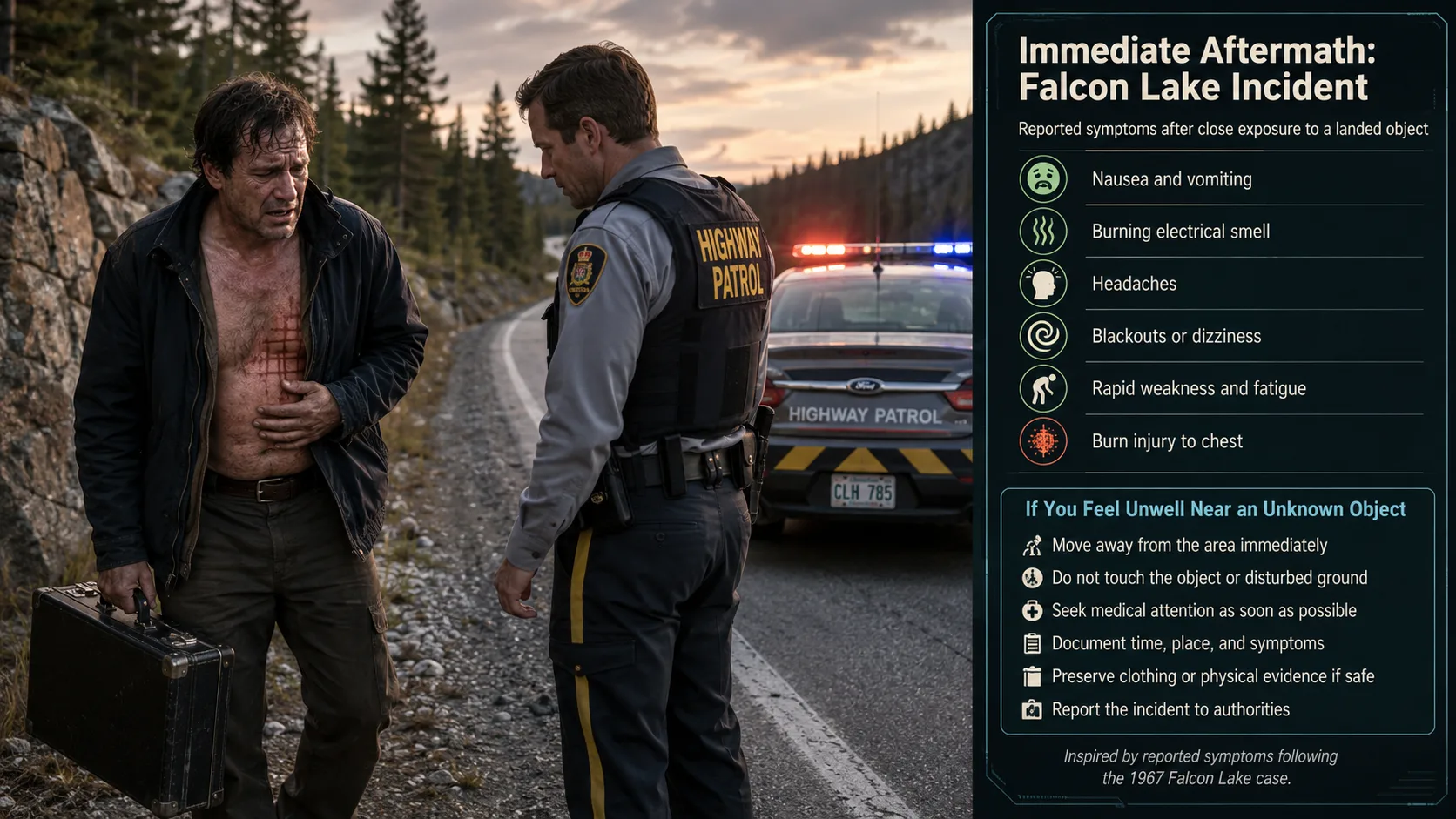
After the object left, Michalak said he became violently ill. He reported vomiting, a burning electrical smell, headaches, blackouts, and rapid weight loss over the next several days.
A highway patrol report from the same day gives the story an uncomfortable sense of reality. Constable G. A. Solotki encountered Michalak on the Trans-Canada Highway west of Falcon Beach. The officer noted that Michalak was wearing a jacket but no shirt, carrying a briefcase, and claiming he had been burned by hot exhaust from “two spaceships.” Solotki reported that Michalak appeared distressed and possibly dazed, but he did not smell alcohol on him.
Michalak did not seem eager for attention. He reportedly resisted going into the police office, asked where he could find a doctor, said he did not want publicity, and planned to catch a bus back to Winnipeg.
That reluctance cuts both ways. Skeptics can point to his uneven cooperation as suspicious. Supporters can point out that a man staging a sensational UFO story usually does not begin by trying to avoid publicity. Either way, the early police record captures someone in obvious distress, not someone cheerfully selling a tale.
He was later treated at Misericordia Hospital in Winnipeg for first-degree burns and released. The case then moved from a strange police contact into something larger: an official investigation involving Canadian law enforcement, military personnel, health officials, and outside researchers. (Canada)
Why Falcon Lake Became a Serious Investigation
The Falcon Lake case drew attention because it had three things many UFO cases lack: a named witness, visible injury, and a specific alleged landing site.
The RCMP and Royal Canadian Air Force both investigated. Library and Archives Canada identifies the main investigators as RCMP Corporal J. Davis and RCAF Squadron Leader Paul Bissky, with police interviews conducted at Michalak’s home shortly after the incident. (Canada)
The Canadian government’s files also drew interest beyond Canada. The case was reviewed in connection with U.S. Air Force Project Blue Book and the University of Colorado UFO study led by Edward Condon, both of which were part of the broader official effort to assess UFO reports during the Cold War. Project Blue Book itself collected 12,618 sighting reports between 1947 and 1969, leaving 701 categorized as unidentified. (National Archives)
Falcon Lake stood apart because it was not just a light in the sky. There was a place to inspect. There were clothes to examine. There were medical complaints to document. There was soil to test.
That made it a physical trace case, one where the question wasn’t simply, “What did the witness see?” It became, “What, if anything, happened to the ground, the clothing, and the body?”
The Landing Site and the Radioactive Soil
The alleged landing site became one of the most debated parts of the case.
When investigators later returned to the area, they found a circular or semi-circular area where moss and vegetation appeared to have been removed from rock. One RCMP report described a roughly 15-foot diameter semi-circle at the site, while also noting that the surrounding terrain was smaller and less open than expected from earlier descriptions.
The radiation findings were even more complicated.
In July 1967, officials from Canada’s Department of Health and Welfare examined soil, burned shirt material, and a steel tape connected to the case. Their report found radioactive contamination in some samples, including material associated with radium-226 or an equivalent source. Investigators later surveyed the alleged landing site and found a small contaminated area along a crack in the rock, including contaminated lichen and vegetation.
This is where the popular version of Falcon Lake often gets too dramatic. The official health report did not conclude that the site was dangerously radioactive overall, nor did it declare the radiation to be alien in origin. In fact, it stated that the contamination level did not create a serious public health hazard because the site was remote and most of the contaminated material had been removed for sampling.
But the report also did not neatly solve the problem. It concluded that radioactive contamination of rock and lichen had been found at the alleged landing site, and that the origin of the contamination was not determined.
That “not determined” is doing a lot of work.
The RCMP report noted that preliminary laboratory work suggested the material might be related to radium luminous paint, a substance once used commercially on instrument dials and watch faces. But investigators also noted the absence of obvious radium sources in the homes or offices of people connected to the case, and they did not reduce the matter to a clean explanation.
In other words, the radiation evidence is not the simple smoking gun believers sometimes want it to be. It is also not nothing.
The Medical Evidence: Burns, Illness, and the Limits of Certainty
The medical side of Falcon Lake is just as frustrating.
Michalak’s burns were real enough to be treated. A physician, Dr. Helmuth, examined the injuries and considered them thermal burns, according to the federal health report. The same report noted that no ingested radioactivity had been found in testing at Pinawa, as officials understood it.
That matters because it separates two different questions. One question is whether Michalak was burned. The answer appears to be yes. Another question is whether he was exposed to radiation from the object he described. The record is much less clear.
The RCMP follow-up report listed several hard-to-explain facts: Michalak’s illness, his bewildered appearance after the alleged sighting, blood-cell count fluctuations, chest burns in a checked pattern, and the near-perfect circle where soil and moss had disappeared from the rock face.
Still, medicine could not turn the case into a verdict. Thermal burns do not identify a craft. Nausea and headaches can have many causes. Blood-count changes are significant, but they do not automatically prove an exotic energy source. The strongest medical point is narrower: something happened to Michalak that left visible injuries and prompted serious follow-up.
That’s less cinematic than “the UFO poisoned him,” but it is more defensible.
What the Grid Pattern Implies About the Craft
If Michalak’s description is accurate, the grid-burn pattern may be the most interesting design clue in the entire case.
A grid-shaped burn implies that heat passed through a patterned barrier. That could mean a vent, exhaust screen, intake, heat exchanger, or some kind of protective grill. Michalak described exactly that: a grill-like opening from which heat emerged as the object rotated and lifted away.
The implication is oddly down-to-earth. The injury does not suggest a smooth, silent miracle machine. It suggests a vehicle with heat-management problems. Something had to vent. Something got hot enough to burn fabric and skin. Something produced an effect directional enough to stamp a pattern across his chest.
That detail also keeps the case connected to Cold War engineering. Library and Archives Canada’s discussion of the incident notes that some researchers have considered whether the object could have been a terrestrial experimental craft, including comparisons to unconventional aircraft concepts such as the Avrocar. None of those theories has closed the case, but they show why the Falcon Lake incident does not fit neatly into a simple “aliens or hoax” box. (Canada)
If the object existed as described, it behaved like a machine. The mystery is what kind.
The Problems Skeptics Point To
No serious article on Falcon Lake should pretend the case is flawless.
Investigators noted discrepancies. Michalak was not always easy to interview. He removed items from the site despite being asked not to disturb evidence. The RCMP report stated that some of his actions were inconsistent with his earlier cooperation and that parts of the investigation could not be resolved.
There were also practical issues with the physical evidence. The site was not immediately secured. Some samples were handled by civilians before official testing. The radioactive material could have had a mundane source. The circular ground mark, while intriguing, was not impossible to fake or misinterpret. The RCMP report itself acknowledged that moss removal by brushing or raking could not be completely ruled out.
Those are not minor objections. They are exactly the kinds of problems that keep Falcon Lake from becoming a clean proof case.
But here’s the thing: the investigators knew that too. The official record is not naïve. It contains doubt, caution, conflicting impressions, and unanswered questions. That is part of what makes the case so compelling. It was not accepted uncritically, yet it was not dismissed easily either.
The Human Cost Behind the Case File
It is easy to treat Falcon Lake as a puzzle: radiation, burns, landing marks, witness reliability. But there was also a family behind the file.
Stefan Michalak’s son Stan later co-authored When They Appeared: Falcon Lake 1967: The Inside Story of a Close Encounter with researcher Chris Rutkowski, offering a family perspective on what happened after the incident. Library and Archives Canada has featured both Rutkowski and members of the Michalak family in its public discussion of the case, emphasizing not only the records but the long shadow the event cast over the household. (Canada)
That part is often missing from sensational retellings. Whether someone believes Michalak encountered an unknown craft, suffered an accident, or became entangled in something stranger than either explanation, the aftermath was not glamorous. He dealt with medical symptoms, public suspicion, official questioning, and the permanent burden of being known for one extraordinary claim.
Close-encounter stories are usually told as moments of wonder. Falcon Lake feels more like trauma. The witness did not come away enlightened. He came away burned, sick, embarrassed, and watched.
Why the Canadian Government’s “Unexplained” Matters
One of the strongest reasons Falcon Lake continues to matter is that it did not disappear into rumor. It entered the archive.
Library and Archives Canada notes that Canadian government records on UFO sightings have been preserved and made available, and that the Department of National Defence has identified the Falcon Lake incident as unsolved to this day. (Canada)
That word, “unsolved,” should be handled carefully. It does not mean “extraterrestrial.” It does not mean “impossible.” It means the available evidence did not produce a satisfactory conventional explanation.
In a field full of exaggerated certainty, that distinction is refreshing. Falcon Lake’s power comes from its resistance to easy answers. The official documents show a witness with injuries, a site with physical traces, contaminated samples of uncertain origin, and investigators who found reasons to doubt parts of the story but could not account for all of it.
That is why the case has lasted.
Conclusion: The Case That Leaves a Mark
The Falcon Lake incident remains one of the most remarkable physical trace cases because it leaves marks in more than one place.
It leaves a mark on Stefan Michalak’s body, in the form of the grid-like burns documented after the encounter. It leaves a mark on the landscape, in the reported circular disturbance on the rock. It leaves a mark in laboratory records, through radioactive samples whose origin was never firmly settled. It leaves a mark in police and military files, where the case was investigated, challenged, and still not fully explained.
The most responsible conclusion is not the loudest one. Falcon Lake does not give us permission to declare, with certainty, that a craft from another world landed in Manitoba in 1967. But it also does not behave like an ordinary campfire accident, a simple lie, or a passing misidentification.
It sits in the uncomfortable middle, where the best mysteries usually live.
Something happened to Stefan Michalak near Falcon Lake. The records show that much. What exactly happened remains the question, and more than half a century later, the case still has the one quality every serious mystery needs.
It refuses to go away.



Cosmic Echoes
Share-ready comments you can copy in a click, then post wherever the conversation touches UFOs, UAP, or the Galactic Federation.
These comments belong to the Cosmic Echoes page under the section Falcon Lake: The UFO Encounter That Left Its Mark.
Plus 21 more comments on the Cosmic Echoes page.