
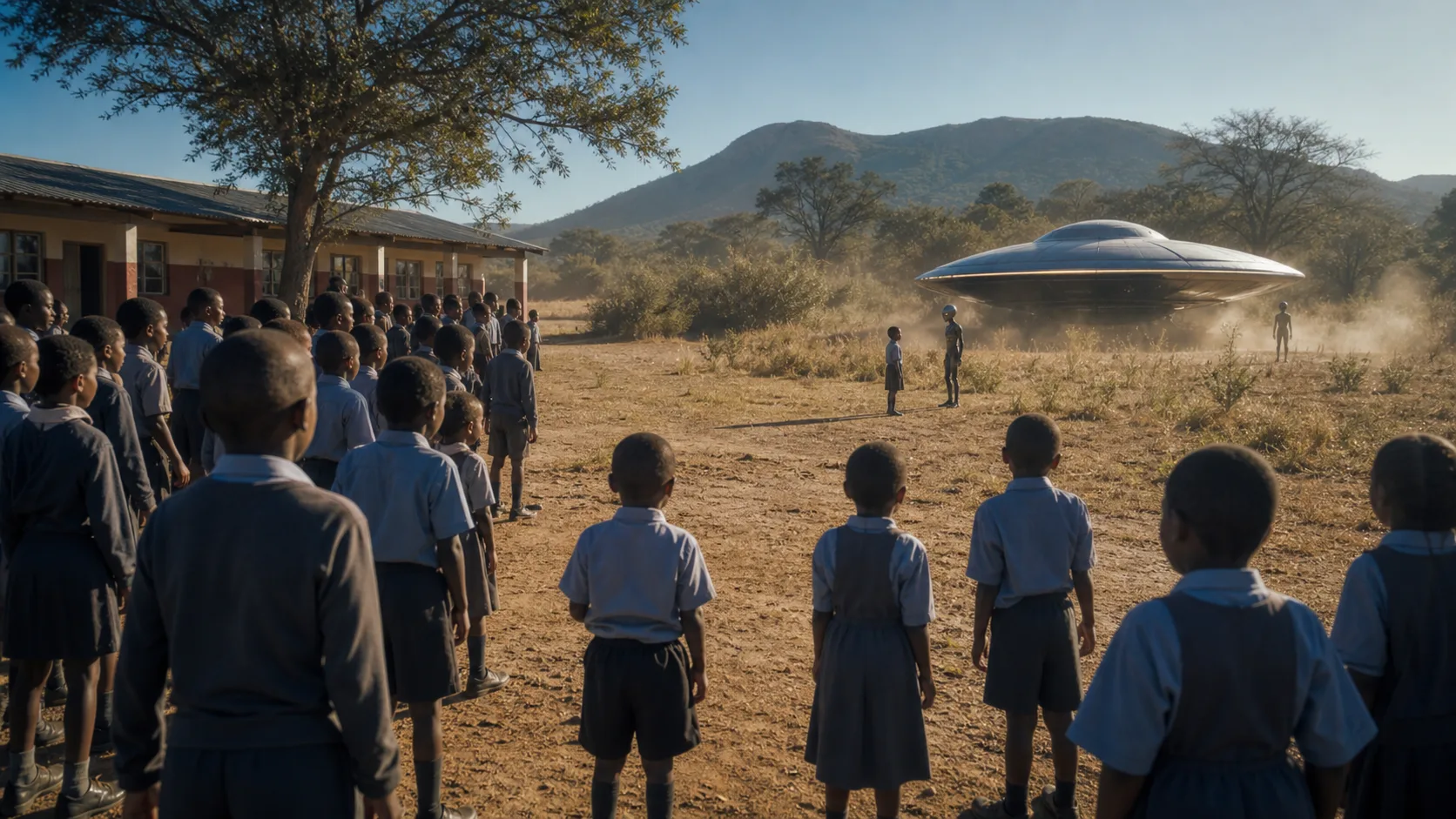
On a Friday morning in September 1994, a group of schoolchildren in rural Zimbabwe ran back from recess with a story no teacher was prepared to hear.
They said something had landed beyond the edge of their playground.
Not a plane. Not a helicopter. Not a truck kicking up dust on the road. A shining, disc-like object near the scrubland beside Ariel School in Ruwa. Near it, they said, were small beings with large dark eyes, dressed in tight black suits. Some of the children were frightened. Some cried. Some insisted the beings had looked directly into them and placed images in their minds, images of a damaged Earth, dead trees, polluted air, and a warning about what humanity was doing to the natural world.
The Ariel School encounter has endured because it doesn’t rest on one dramatic testimony. It rests on dozens of children, many between about six and twelve years old, who gave accounts that investigators found difficult to dismiss. Teachers were inside during the morning break, which meant the event unfolded without adult authority figures guiding the children’s reactions in the moment. Later, the children made drawings, told their stories to journalists and researchers, and, in many cases, repeated the same core account as adults decades later.
It’s one of the rare UFO or contact cases that feels less like a lights-in-the-sky report and more like a direct encounter with intelligence. And that is exactly why it still unsettles people.
The Morning in Ruwa
Ariel School sat outside Ruwa, a small agricultural community southeast of Harare. On September 16, 1994, the students were outside for mid-morning break while the teachers were inside holding a staff meeting. The children had the playground to themselves, the kind of unsupervised pocket of time where kids usually chase, shout, trade snacks, and invent small dramas that vanish by lunch.
But this story didn’t vanish.
According to the children, a silver object moved through the sky and came down near trees and rough scrub beyond the school grounds. Several students described it as bright, shiny, or disc-shaped. Some said there was more than one object. Then came the part that made the adults uneasy: the children said they saw beings near the craft.
The descriptions varied in small details, as eyewitness accounts usually do, but the repeated themes were striking. The beings were short, with large black eyes. They wore dark, tight-fitting suits. One stayed near the object while another seemed to move through the grass in an unnatural way, almost as if time or gravity worked differently around it. In one later adult recollection, a witness described the figure as repeatedly appearing, moving, and then reappearing in the same starting place, which frightened her more than the appearance of the beings themselves.
That detail matters because the Ariel case isn’t just remembered for “children saw aliens.” It’s remembered for the texture of their testimony. The children didn’t simply point at the sky and say “spaceship.” They described sound, movement, emotional reactions, eye contact, and a strange sense of communication without speech.
What the Children Said They Saw
In interviews later conducted by psychiatrist Dr. John Mack, several children described sounds before or during the sighting. One child compared it to a flute. Others spoke of buzzing, like bees or electricity. Then they noticed the silver object and moved closer, trying to understand what they were seeing. One girl, Candace, said they first wondered whether the shining thing could be a house reflecting sunlight, then realized there were no houses in that spot.
The children’s descriptions of the beings were even more memorable. They spoke again and again about the eyes.
Large. Black. Fixed. Impossible to look away from.
That detail has become central to the Ariel School story because the “message” some children reported seemed to come through the eyes rather than through spoken language. The beings’ mouths did not move. There was no ordinary conversation. Instead, several students said they received impressions, feelings, or images directly in their minds.
For anyone studying contact experiences, that detail places Ariel in a very particular category. This wasn’t only a sighting. It was reported as a consciousness event.
The Drawings That Made Adults Stop and Look
One reason the case gained traction was that the children were asked to draw what they had seen. The resulting pictures showed similar themes: rounded or disc-like craft, figures with oversized dark eyes, small bodies, and dark suits. In later reporting, one teacher said the drawings helped persuade her because so many of them were similar, even though the written stories were individually expressed.
Cynthia Hind, one of Africa’s best-known UFO investigators, also emphasized the children’s cultural diversity. Ariel’s students included Black African children from several backgrounds, children of mixed heritage, Asian children, and white Zimbabwean-born children whose families came from places such as South Africa or Britain. Hind found it compelling that the children interpreted the beings through different cultural lenses while still repeating many of the same core details. Some children framed the figures as aliens. Others initially understood them through local folklore, such as tokoloshe-like beings.
That’s one of the most interesting parts of the case. The interpretation changed depending on the child’s worldview. The shared description did not.
Cynthia Hind’s Early Investigation
Cynthia Hind was not a casual enthusiast wandering into a rumor. She had spent years collecting UFO reports across southern Africa and publishing them through UFO Afrinews. When the Ariel School report reached her, she recognized it as unusually significant. In her own case notes, later discussed by Mail & Guardian, Hind described the Ariel report as one of the most exciting UFO stories of that year, or any year.
There is some confusion in popular retellings about exactly how quickly Hind physically arrived at the school. The strongest available accounts place her involvement almost immediately, with contact soon after the report, and her school visit within days rather than literally within twenty-four hours. Skeptical reviews note that she spoke to some children by phone the day after the sighting and later accompanied BBC reporter Tim Leach to interview about a dozen students.
Her proximity to the event is important. She was involved before the case had years to harden into legend. She collected children’s accounts and drawings early, while emotions were still raw and before the story had become a documentary subject or internet debate.
At the same time, Hind’s methods have been criticized. Some skeptics argue that group interviews can create cross-contamination, especially when children hear one another’s answers. That doesn’t erase the testimony, but it does mean the case has to be handled carefully. The strength of Ariel lies in the number and emotional force of the witnesses. The weakness lies in the lack of a tightly controlled, modern investigative protocol at the very beginning.
Both things can be true.
John Mack Enters the Story
The Ariel case might have remained a regional mystery if Dr. John E. Mack hadn’t traveled to Zimbabwe.
Mack was not an obscure figure. He was a Harvard Medical School professor of psychiatry and a Pulitzer Prize-winning author. Harvard’s own obituary notes that he had been a professor of psychiatry at Harvard Medical School since 1972, and the Pulitzer Prize organization lists his biography of T. E. Lawrence, A Prince of Our Disorder, as the 1977 Pulitzer winner in Biography.
By the early 1990s, Mack had become controversial because of his work with people who reported alien abduction or contact experiences. He approached these accounts less as a debunker and more as a clinician interested in trauma, sincerity, memory, and worldview. That made him valuable to believers and frustrating to skeptics.
When Mack interviewed the Ariel children, he focused on whether they appeared to be fabricating, fantasizing, or reporting something that had genuinely affected them. After speaking with children, teachers, and parents, he told the parents he believed the children were describing something that had occurred in physical reality. He also argued that the consistency of their accounts and the way they spoke left little doubt in his mind that the event had happened much as they said it had.
That conclusion carried weight because of who Mack was. It also attracted criticism for the same reason.
Skeptical writers have argued that Mack’s interviews were not a neutral forensic investigation, that only portions of the interviews have been publicly available, and that the most famous “telepathic environmental message” material appears most clearly in the Mack interviews rather than in the earliest public reports.
Still, even critics generally do not argue that the children were simply lying. The deeper question is harder: were they accurately describing a nonhuman encounter, misinterpreting something ordinary under extraordinary social conditions, or participating in a shared experience that does not fit neatly into either category?
That’s where Ariel becomes more than a UFO story.
The Message: Pollution, Technology, and a Wounded Earth
The most haunting part of the Ariel School encounter is not the craft. It’s the warning.
Several children said the beings communicated without words. The message, as remembered by the witnesses, centered on environmental destruction and humanity’s relationship with technology. In Mack’s interviews, one boy spoke of being warned about something that was going to happen and associated it with pollution. Another child said people were harming the world and “mustn’t get too technologed.” A third described a vision of trees going down, no air, and people dying.
Decades later, some adult witnesses continued to describe the same theme. In coverage of Netflix’s Encounters, Emma recalled that after eye contact, “ideas” seemed to come into her, including an overwhelming feeling about the importance of the environment. Salma described receiving a message about clean air, plants, and soil. Lisil said she remembered big black eyes and a message that humans were harming the planet.
This is why Ariel resonates so strongly with people interested in contact, consciousness, and ecological awakening. The case doesn’t present the beings as conquerors or technicians. They appear, at least in the children’s reports, as messengers. The communication is visual, emotional, and direct. It bypasses language and lands in the body as fear, urgency, and grief.
Whether one interprets that as extraterrestrial contact, a visionary experience, a symbolic event, or a strange psychological episode, the content is hard to ignore. Children in 1994 described a future defined by ecological imbalance, technological overreach, and disconnection from the living world. Three decades later, that warning sounds less like science fiction and more like the evening news.
The Children as Adults
One of the strongest reasons Ariel has survived is that many of the witnesses did not quietly abandon the story once they grew up.
Filmmaker Randall Nickerson spent years making the documentary Ariel Phenomenon, eventually interviewing dozens of former students. According to WHYY’s reporting on the film, Nickerson interviewed 43 of the former students, and he said that, in his conversations, none of them recanted their original stories. Some were willing to speak on camera. Others were hesitant, largely because of ridicule and fear of not being believed.
The documentary’s own site describes the film as the first feature documentary about the Ariel School incident and says it follows former witnesses more than twenty-five years later, including Emily Trim’s return to Zimbabwe. Nickerson’s team also collected archival tapes, articles, audio, and hundreds of hours of footage while building the film.
The adult witnesses are not all identical in how they carry the memory. Some speak with conviction. Some speak with discomfort. Some seem tired of being known for the strangest day of their childhood. Emily Trim, for example, has been described as still struggling with the memories and with the way the experience affected her relationships.
There has also been dissent. One former student, Dallyn, later claimed in a Netflix documentary that he helped spark the incident by inventing a story about a shiny rock. Other former students dispute that claim, and Vice noted that the confession could not be independently verified.
That disagreement matters. A serious article shouldn’t pretend every witness story is perfectly uniform or that every question has been settled. But it’s equally important not to reduce the whole event to one later denial when multiple adult witnesses continue to describe a deeply felt encounter with the same core elements they described as children.
Why Ariel Received So Little Institutional Attention
For a case this dramatic, Ariel received surprisingly little formal institutional study.
There are a few reasons for that.
First, there was no clear physical evidence presented to the public. No recovered material. No official radar data. No adult teacher standing beside the children saying, “Yes, I saw it too.” That made the case powerful as testimony but weak as conventional evidence.
Second, UFO stigma was intense in the 1990s. Even Mack’s involvement became controversial at Harvard. WHYY reported that Harvard investigated challenges to his methods and credibility, though Mack was ultimately cleared of wrongdoing.
Third, the case sat awkwardly between categories. It was not just an aerial sighting, which could be passed to aviation experts. It was not just a psychological event, because so many children insisted they saw something physical. It was not just folklore, because the children came from varied cultural backgrounds and produced overlapping descriptions. It was not just a religious experience, because it involved a craft-like object and beings in suits.
Institutions like clean boxes. Ariel did not fit one.
Finally, the public record remains incomplete. Critics have pointed out that many retellings rely on selected interview clips and that not all raw interview material has been easily available to outside researchers. Skeptical Inquirer has argued that serious evaluation requires all the data, including testimony from children who did not see anything and the full context of Mack’s interviews.
That critique is fair. If Ariel is as important as many believe, then it deserves more transparency, not less.
Why This Case Still Matters
The Ariel School encounter remains compelling because it sits at the intersection of three powerful themes: childhood perception, nonhuman contact, and ecological warning.
Children are not perfect witnesses. They can be influenced, frightened, imaginative, and socially contagious. But children can also be startlingly direct. They often describe what they experience before they know what they are “supposed” to say. That is part of what gives the Ariel testimony its force. The witnesses were young enough to be vulnerable, but old enough to describe fear, confusion, movement, eye contact, and meaning.
For those exploring contact experiences, starseed narratives, or the idea of a new generation of children more sensitive to consciousness-based communication, Ariel holds a special place. It suggests contact may not always arrive as technology landing in front of governments. It may arrive in a schoolyard, through children, with a message adults are too busy, too skeptical, or too afraid to hear.
But the case is also valuable for skeptics, researchers, and anyone who cares about truth. It asks how we should listen when ordinary people report extraordinary events. It asks whether ridicule protects reason or simply shuts down inquiry. It asks whether testimony can be meaningful even when it is not conclusive.
Ariel doesn’t give us a tidy answer. That may be why it has lasted.
A Warning Still Echoing
The children of Ariel School said they saw something that wasn’t human. They said it looked at them. They said it showed them a wounded planet and a future shaped by pollution, dying trees, and technology moving faster than wisdom.
Maybe the encounter was exactly what the witnesses believed it was. Maybe it was something stranger than the extraterrestrial label can hold. Maybe it was a rare psychological and social event that still deserves careful study. The honest position is to leave room for mystery while refusing to flatten the witnesses into either saints or fools.
What remains undeniable is the human impact. Dozens of children carried that morning into adulthood. Some still speak of it with fear. Some speak of it with reverence. Some simply want to be believed.
And beneath all the debate about craft, beings, methods, and memory, one message keeps rising to the surface: take care of the Earth.
Whatever happened at Ariel School, that warning has only become harder to dismiss.


Cosmic Echoes
Share-ready comments you can copy in a click, then post wherever the conversation touches UFOs, UAP, or the Galactic Federation.
These comments belong to the Cosmic Echoes page under the section The Ariel School Encounter: When Children Saw Beyond Reality.
Plus 21 more comments on the Cosmic Echoes page.