
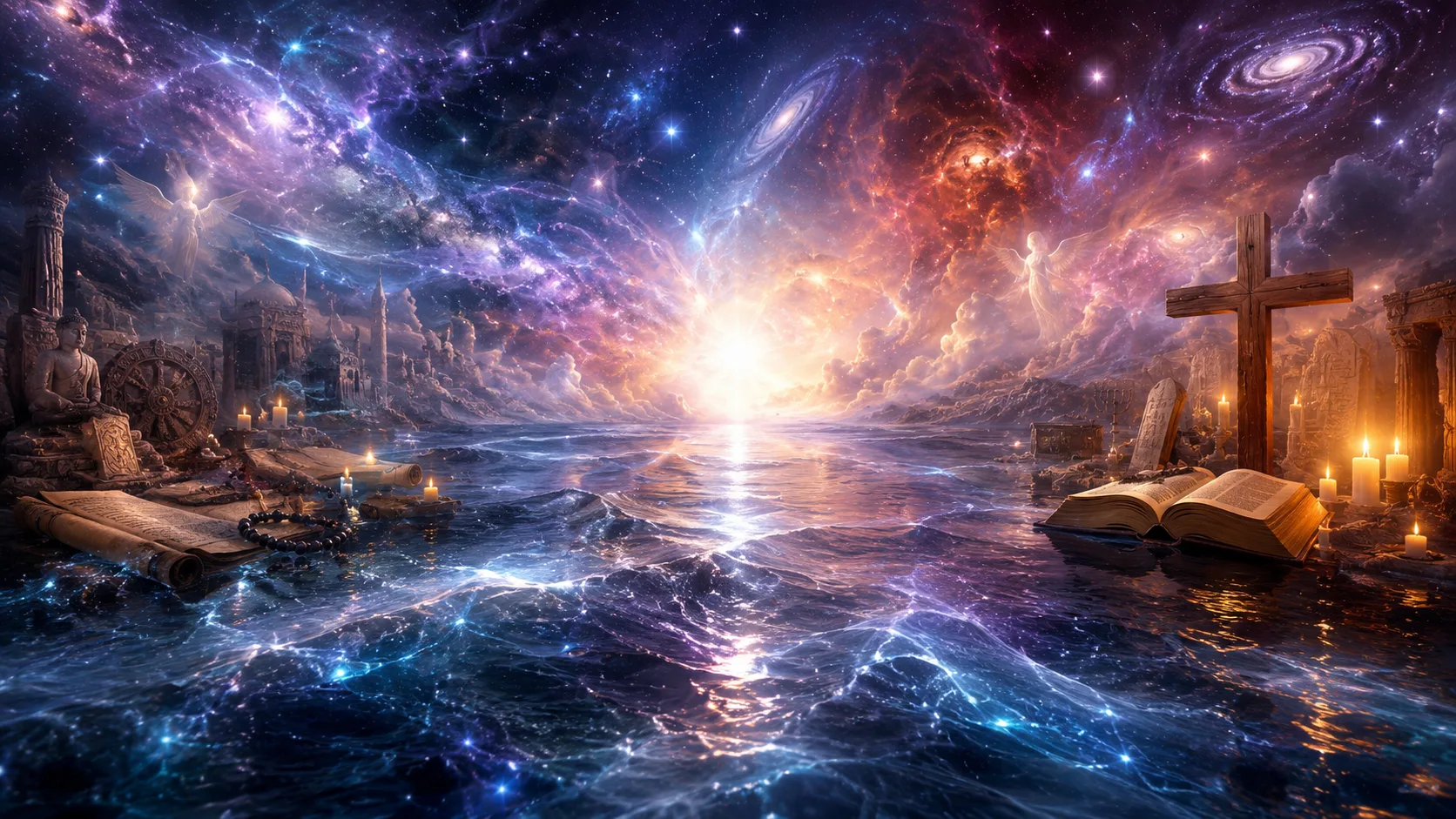
Religion Gave Humanity a Book, but the Universe Gave Humanity a Question
What if God was never locked inside scripture, but scattered through stars, bloodlines, frequency, ancient memory, and the hidden story of our creation?
Maybe the Bible was never meant to be the final answer. Maybe it was the spark that made humanity look higher, beyond the church, beyond the page, beyond the fear, and into the living cosmos where God was always too vast to be owned.
There is a reason so many people struggle with the Bible. It is not because they are stupid. It is not because they do not care about God. It is not because they are empty, evil, lost, or broken. A lot of people struggle with the Bible because somewhere along the way, religion made it feel simple when it was never simple at all.
The Bible was handed to many people like a finished answer. Read this. Believe this. Repeat this. Do not question this. Do not look too deep. Do not ask where the symbols came from. Do not ask why the stories sound older than the religion itself. Do not ask why heaven is above, why angels descend, why gods come down, why fire appears in the sky, why voices speak from clouds, why wheels move through the heavens, why beings appear and disappear, or why light always seems to be the language of the divine.
Just believe.
That is what a lot of us were given. For some people, that was enough. It gave them comfort, structure, identity, and a way to understand the world. But for others, especially the ones who could feel something deeper hiding underneath the words, it was never enough.
Because deep down, we knew something was there.
Something older.
Something cosmic.
Something bigger than church walls, hymn books, Sunday school, and a preacher standing behind a pulpit telling everyone what God meant.
Maybe the struggle was never with God at all. Maybe the struggle was with being told not to search. Maybe the soul was never rejecting the sacred. Maybe it was reaching past the version of the sacred it had been handed, looking for the larger mystery behind it.
The Bible still matters because it carries pieces of that mystery. It carries ancient memory, human fear, divine longing, cosmic symbolism, spiritual trauma, bloodlines, visions, and questions that never fully disappeared. The problem was not that people asked too much of the Bible. The problem may be that religion often asked too little of it.
It made the mystery smaller.
But the universe kept asking the bigger question.
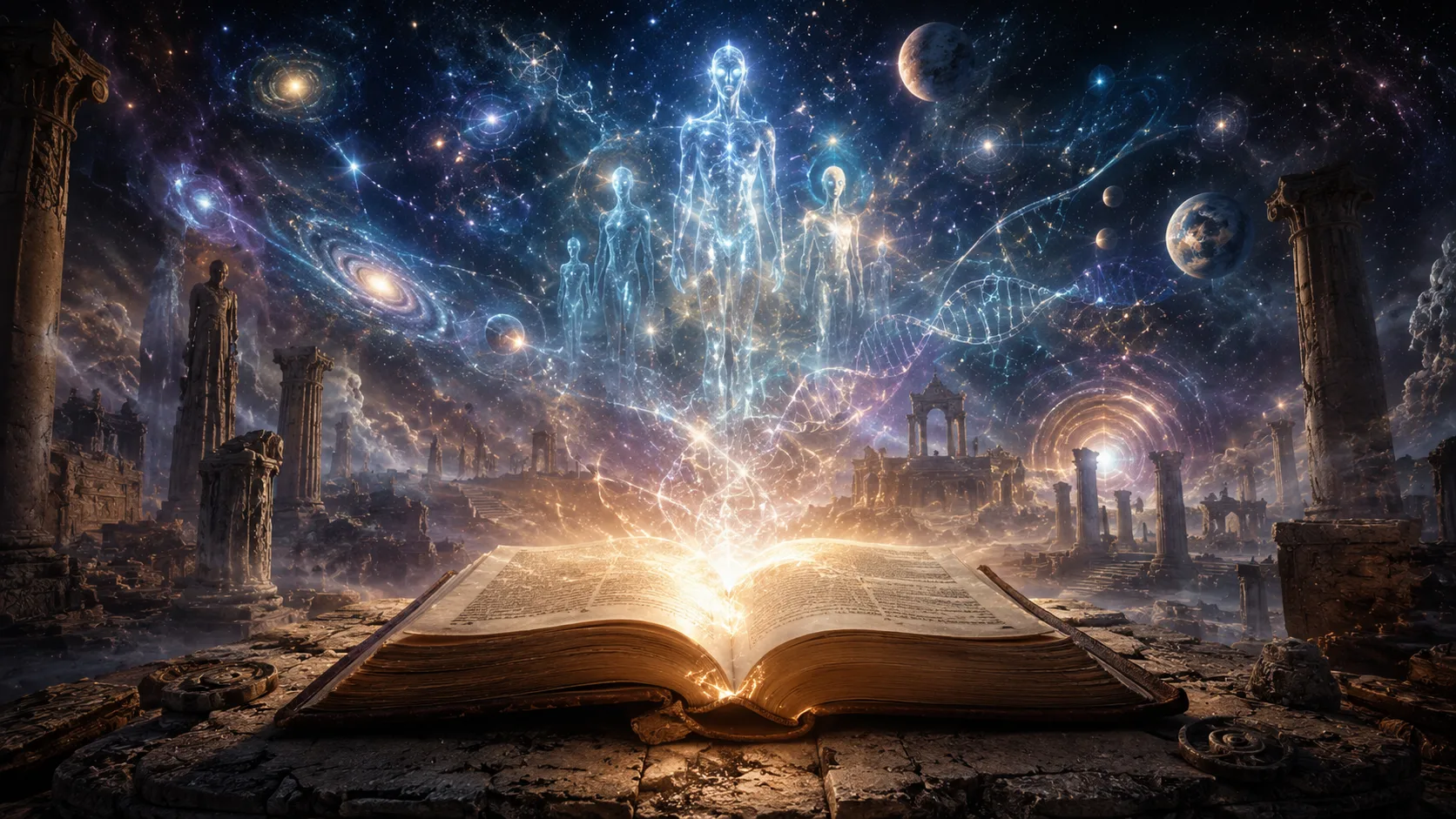
The Child Who Memorized John 3:16
For a lot of people, faith did not begin as a theory. It began as a memory.
It began with being a child in church because your mother made sure you went. It began with getting dressed, sitting in the pews, and listening to adults talk about salvation, sin, heaven, hell, baptism, and Jesus as if these were not just religious ideas, but the center of the entire universe.
For me, one of those memories is John 3:16.
That verse was not just words on a page. It was something I had to memorize. It was something I had to stand up and read in front of the whole church.
“For God so loved the world…”
As a child, that felt enormous. Not because I understood theology. Not because I understood ancient Greek, church doctrine, translation history, or religious politics. I did not need all of that then.
What I understood was the feeling.
God loved the world so much that He gave His Son.
That is heavy. That is emotional. That is not small. Whether someone reads that through Baptist faith, Christian tradition, cosmic symbolism, or a deeper spiritual lens, the emotional power is still there.
A parent giving a child. A son carrying the weight of the world. A sacrifice made for humanity.
That image goes straight into the heart.
And that is why these stories survive. Not because every person understands them perfectly, and not because every institution explains them correctly, but because they touch something ancient inside us.
They reach the child before they reach the scholar.
They reach the heart before they reach the doctrine.
And sometimes, long after a person has questioned the church, the religion, and everything they were taught, that memory still remains.
A child standing in front of a church.
A verse remembered by heart.
A feeling that God was love before anyone turned Him into fear.
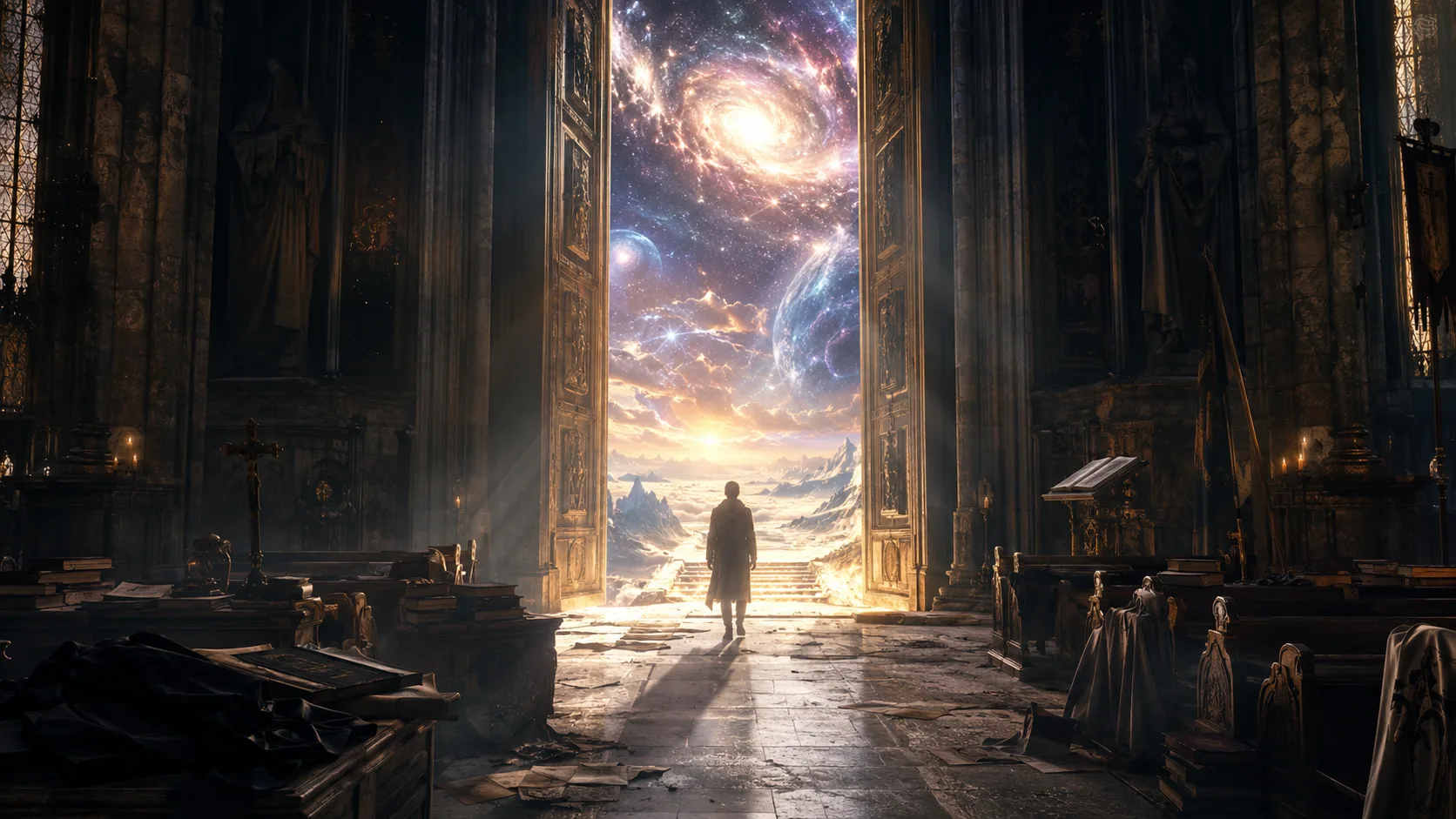
The Problem Was Never God
The problem was never God. That is the part people need to understand.
The problem was never the feeling of divine light. It was never the awe, the prayer that made a child feel seen, or the beauty of believing that something greater than us exists. Those moments were real. They mattered. They touched something deep inside the human spirit.
The problem was that religion often took something infinite and tried to fit it inside a box.
It gave God a system, a building, a dress code, a list of approved questions, and a list of forbidden thoughts. It made the universe feel like a courtroom. God became the judge. Humans became the guilty. Religion became the middleman.
And somehow, the living mystery of existence got buried underneath rules, fear, shame, performance, and repetition.
That is why so many people walk away. Not always because they hate God. Not always because they stopped believing in something sacred. Sometimes they walk away because they still believe God is real, but they can no longer feel God inside the version of religion they were handed.
They know there is something more.
They can feel it in the stars, in silence, in music, in nature, in grief, in love, and in the strange pull of the unknown. They know the mystery is still there. They just do not know what to call it yet.
Maybe walking away from religion is not always the loss of faith.
Sometimes it is the soul searching for God without the walls.
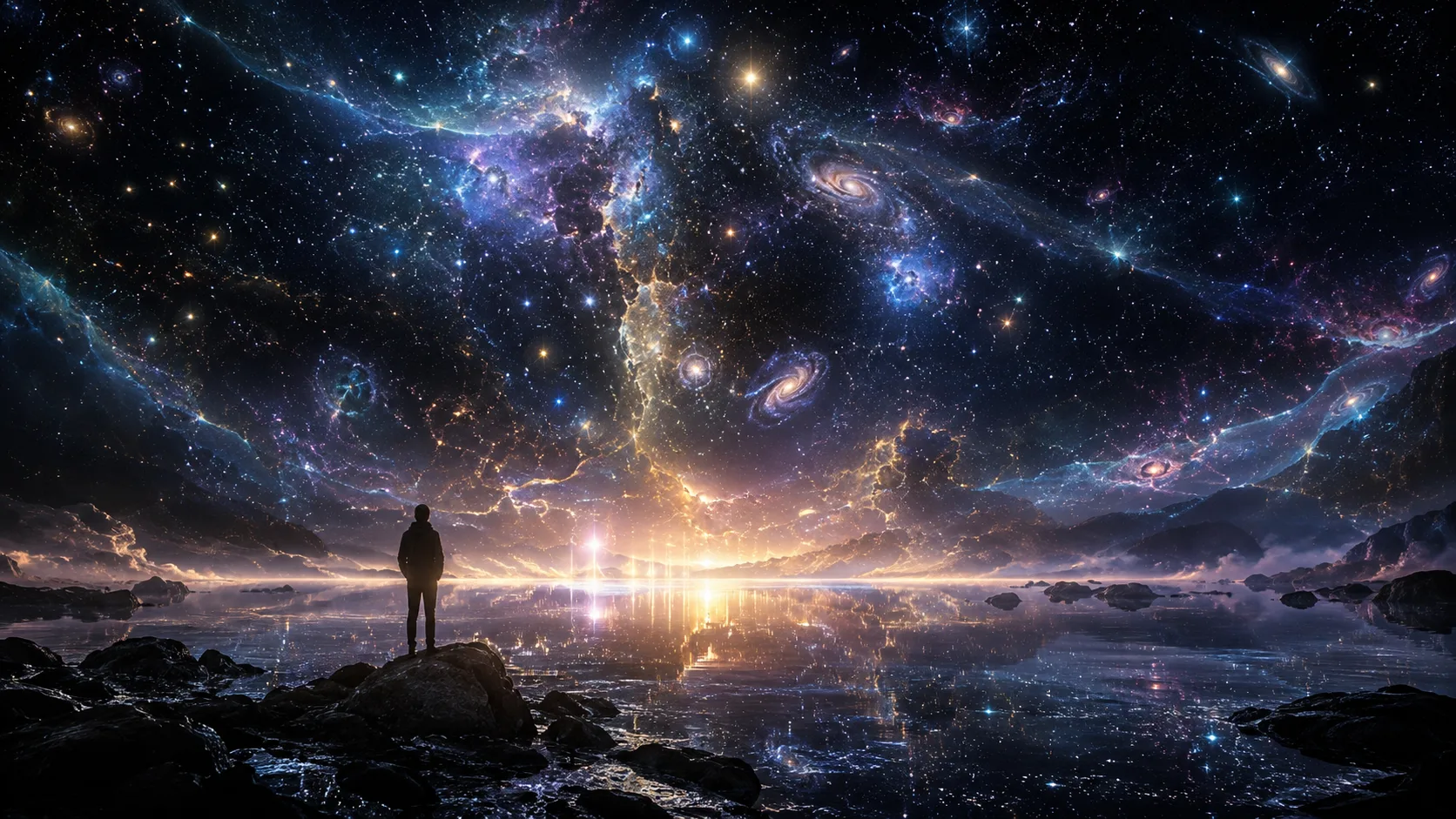
God as the Universe
As a child, God may have looked like a figure above the clouds. An old image. A throne. A father. A king. A bright being somewhere far away.
But as you grow, that image can change.
For some people, God becomes bigger than the picture they were first given. God becomes the black space between the stars, not empty blackness, but living blackness. The kind of darkness that holds galaxies. The kind of darkness where light is born. The kind of silence that makes stars look like angels.
When you look into space and see all those lights, colors, and impossible distances, it is hard not to feel something spiritual. The cosmos feels holy without needing a church to name it holy. The stars feel like witnesses. The galaxies feel like scripture written in light.
The universe itself begins to feel like the body of God.
And once you see God that way, it is hard to return to a smaller version. Suddenly, God is not only above you. God is around you. God is inside the atoms, inside the water, inside the light, inside the breath, and inside the frequency moving through everything.
God becomes the pull that makes human beings look up at the night sky and feel homesick for a place they cannot remember.
Maybe that feeling is not imagination.
Maybe it is memory.
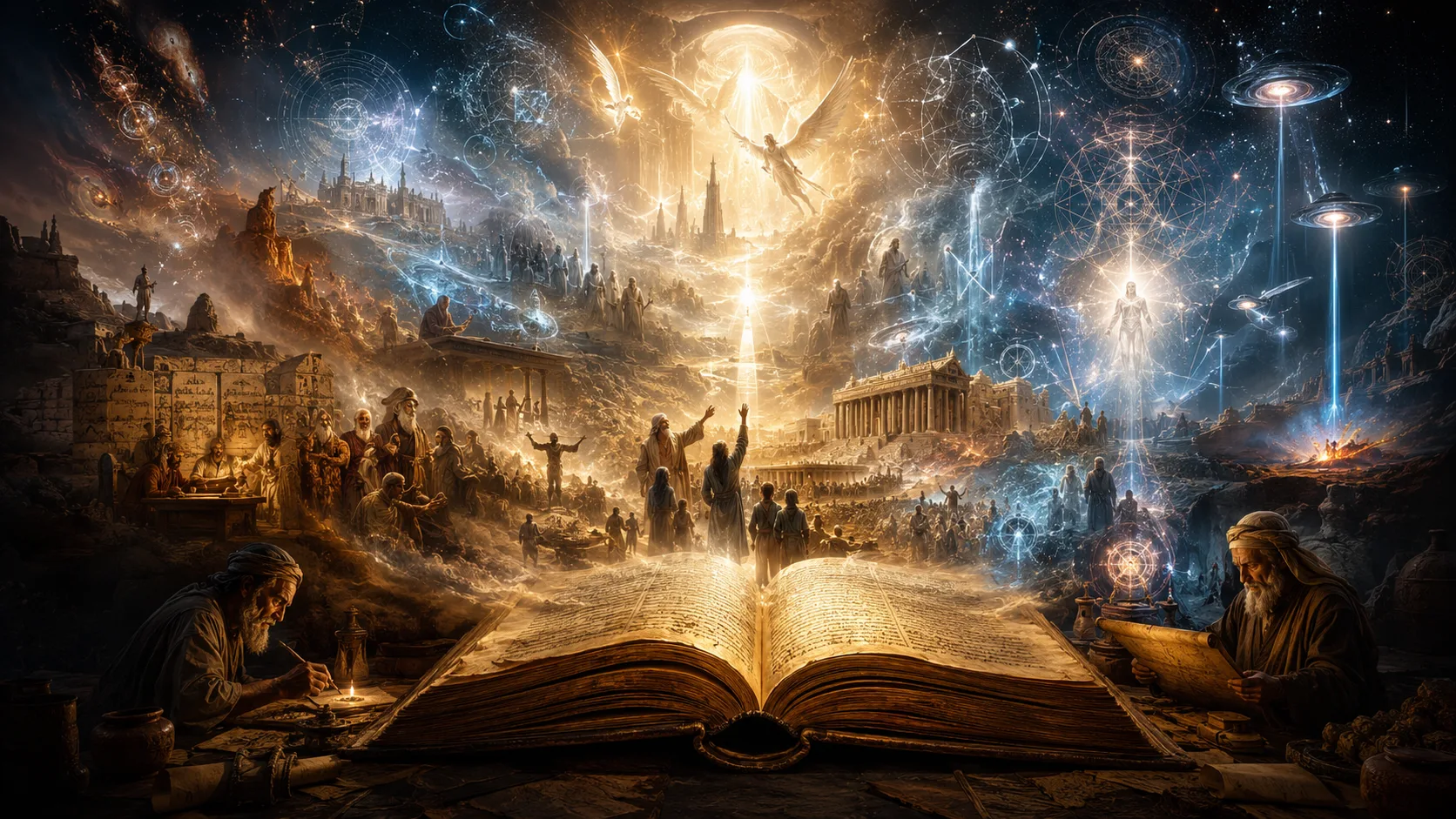
The Bible Was Never Just a Simple Book
This is where the Bible becomes more interesting, not less. Maybe it was never meant to be read as a flat, simple book. Maybe it was never only one thing.
Maybe the Bible is part memory, part history, part myth, part spiritual code, part political document, part trauma record, part cosmic symbolism, and part human attempt to describe contact with something far beyond ordinary life.
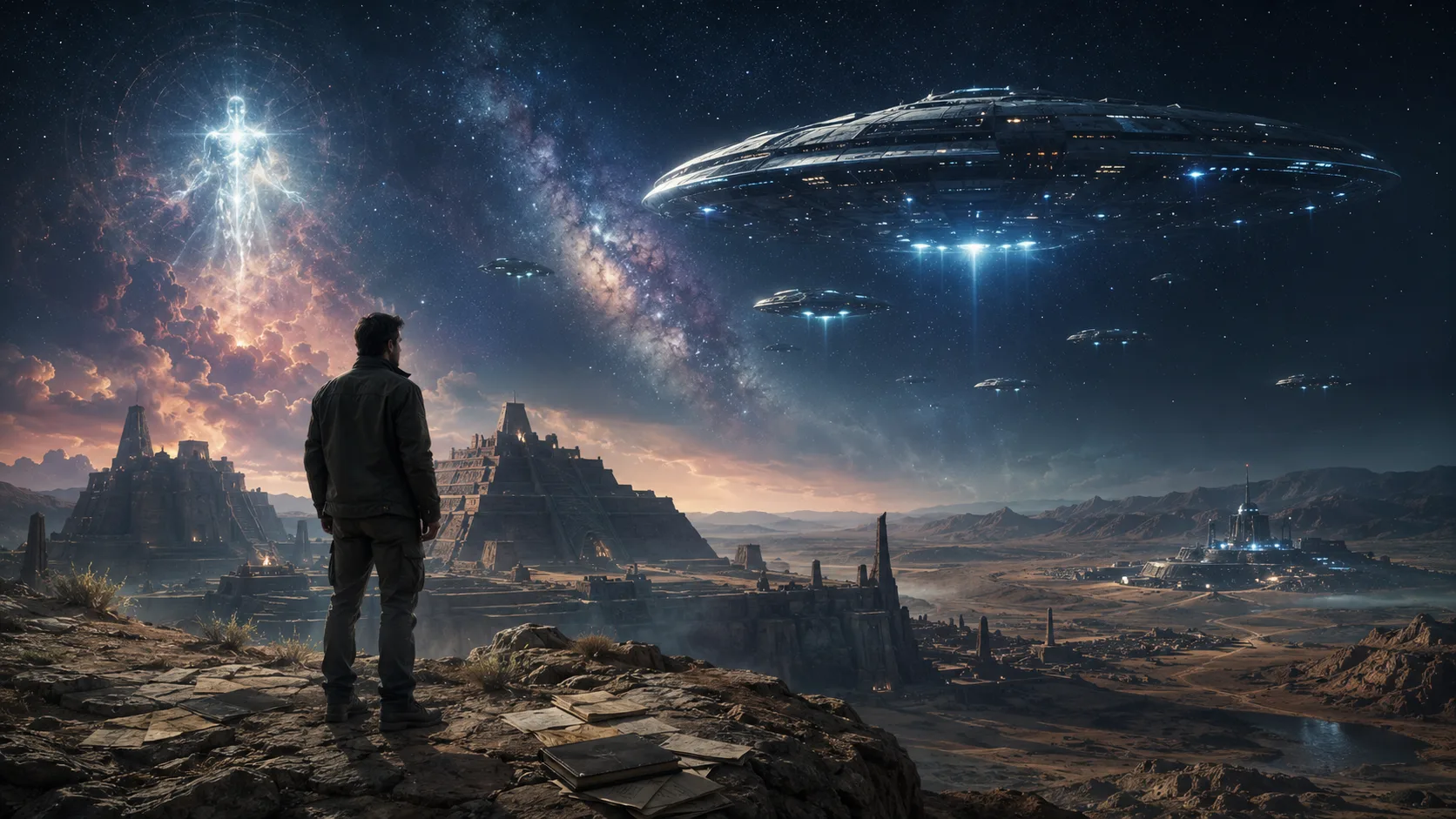
Ancient people did not have modern language for advanced technology or higher-dimensional realities. They did not have words for spacecraft, genetic engineering, energy fields, holographic reality, simulation layers, frequency, or civilizations beyond the earth. So they used the language they had.
What would they call something that came from above?
Heaven.
What would they call a powerful being surrounded by light?
An angel.
What would they call someone who could heal, command nature, appear transformed, or operate beyond normal human limits?
Divine.
What would they call a higher realm?
The kingdom of heaven.
What would they call beings from the stars?
Gods.
That does not mean every Bible story is secretly about aliens. That idea is too simple too. The deeper point is that ancient people may have been trying to explain experiences that were bigger than their language. They reached for symbols, visions, fire, clouds, wheels, wings, thrones, voices, stars, and heavenly beings because those were the images available to them.
Religion later took many of those living mysteries and turned them into fixed doctrines. The unknown became organized. The symbolic became literal. The cosmic became institutional. The mystery became something people were told to accept instead of explore.
That is where the Bible was flattened.
Not because the text had no depth, but because people were taught to read it too small.
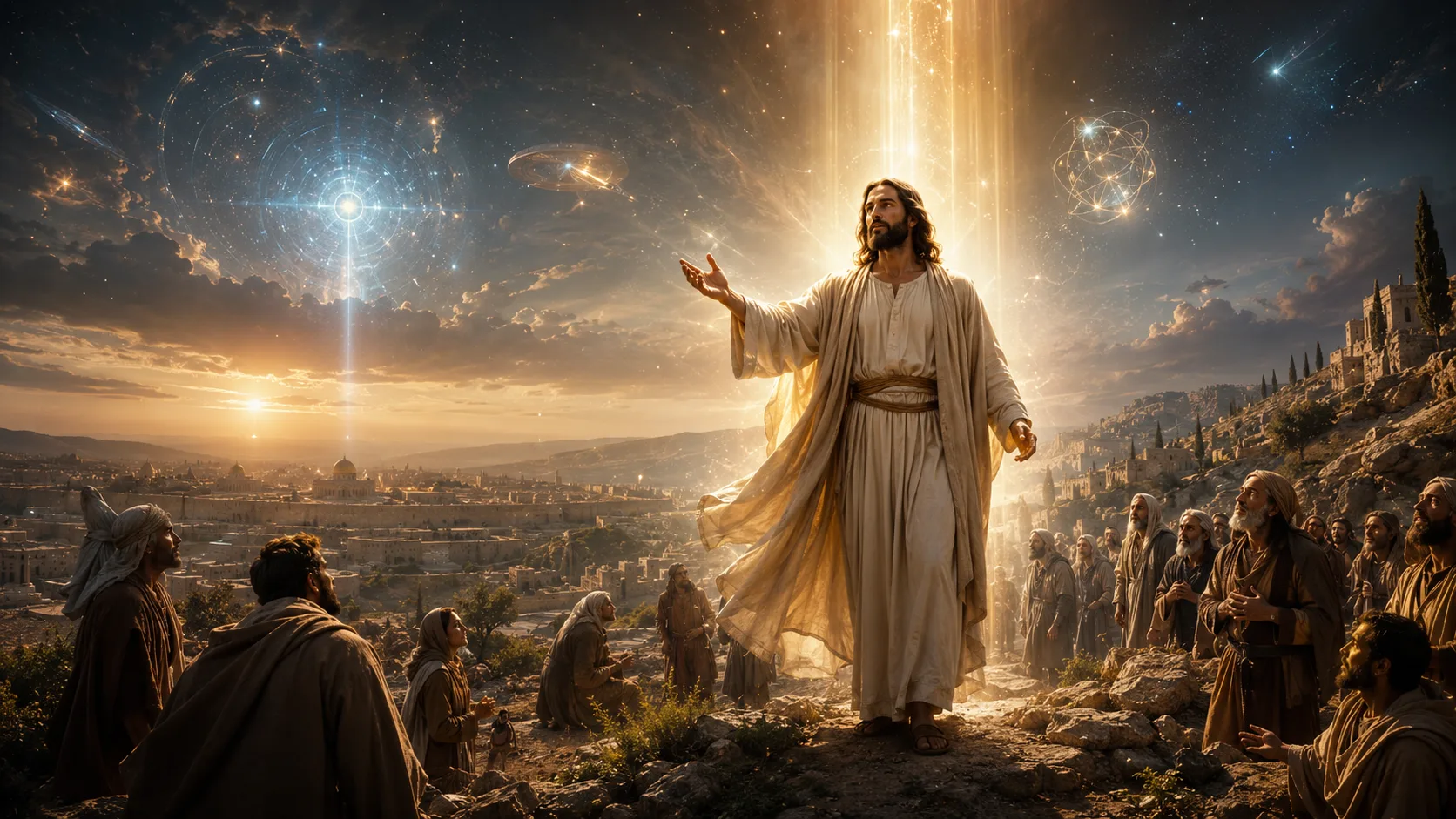
Jesus and the Ancient Visitor Question
Jesus is one of the most powerful figures in human history because, no matter how someone interprets him, the story is not ordinary. A man appears with a message of love, forgiveness, healing, power, sacrifice, and resurrection. He challenges religious authority, speaks of a kingdom not of this world, heals the sick, sees through people, talks about being one with the Father, becomes light on the mountain, dies, and the story says he rises again.
A traditional Christian sees the Son of God. A mystic may see an ascended master. A cosmic thinker may see a higher-dimensional being. Someone who believes in ancient advanced civilizations may wonder whether Jesus was connected to knowledge, consciousness, or power far beyond what the people of his time could understand.
Within this kind of spiritual conversation, that question is not unreasonable. To ancient people, advanced ability would have looked like miracle power. Healing technology would have looked like divine healing. Energy mastery would have looked like holiness. Higher consciousness would have looked like God moving through a person.
Maybe Jesus was exactly what religion says he was. Maybe he was more than religion understood. Maybe he was both.
That is where the question becomes interesting, because the real question is not only, “Was Jesus from heaven?” The deeper question is, “What is heaven?”
Is heaven a spiritual dimension? A higher realm? A cosmic civilization? A level above this reality? A place outside the system? Or is it something so far beyond human language that ancient people could only describe it through symbols, visions, clouds, light, angels, thrones, and fire?
That is where faith, scripture, ancient astronaut theory, and spiritual awakening begin to overlap. Jesus becomes more than a figure trapped inside one religious interpretation. He becomes a doorway into a much larger mystery.
Maybe the story of Jesus was never small.
Maybe it was humanity trying to describe contact with something higher.
If This Is a Game, There Are Levels Above This
Another way to understand this is through the idea of levels. If this reality is like a game, a simulation, or a created world, then the creators of this level may not be the highest creators. They may simply exist above us.
And above them, there may be another level.
And above that, another.
That changes the entire conversation about God. If advanced beings helped shape humanity, then from our point of view, they would look like gods. If the Anunnaki were real and played a role in human creation, then to early humans, they would have seemed like creators. They would have had the power, the knowledge, the technology, and the ability to appear divine.
But that still leaves the bigger question.
Who created them?
Who created the creators?
Where does consciousness begin?
Where does Source begin?
Where does God begin?
That is why the God question never really dies. Even if angels become extraterrestrials, gods become advanced civilizations, miracles become technology, and heaven becomes higher dimensions, the same mystery remains.
Something started this. Something holds this. Something breathes through it. Something exists beyond every level, every creator, every dimension, and every name we give it.
That something is what many people call God.
Maybe the mistake was thinking that discovering levels above us would erase God. Maybe it does the opposite. Maybe each higher level only makes the mystery larger. The more creation expands, the more the question deepens.
If this world is a level, then God may not be just another being inside the game.
God may be the Source behind the entire system.
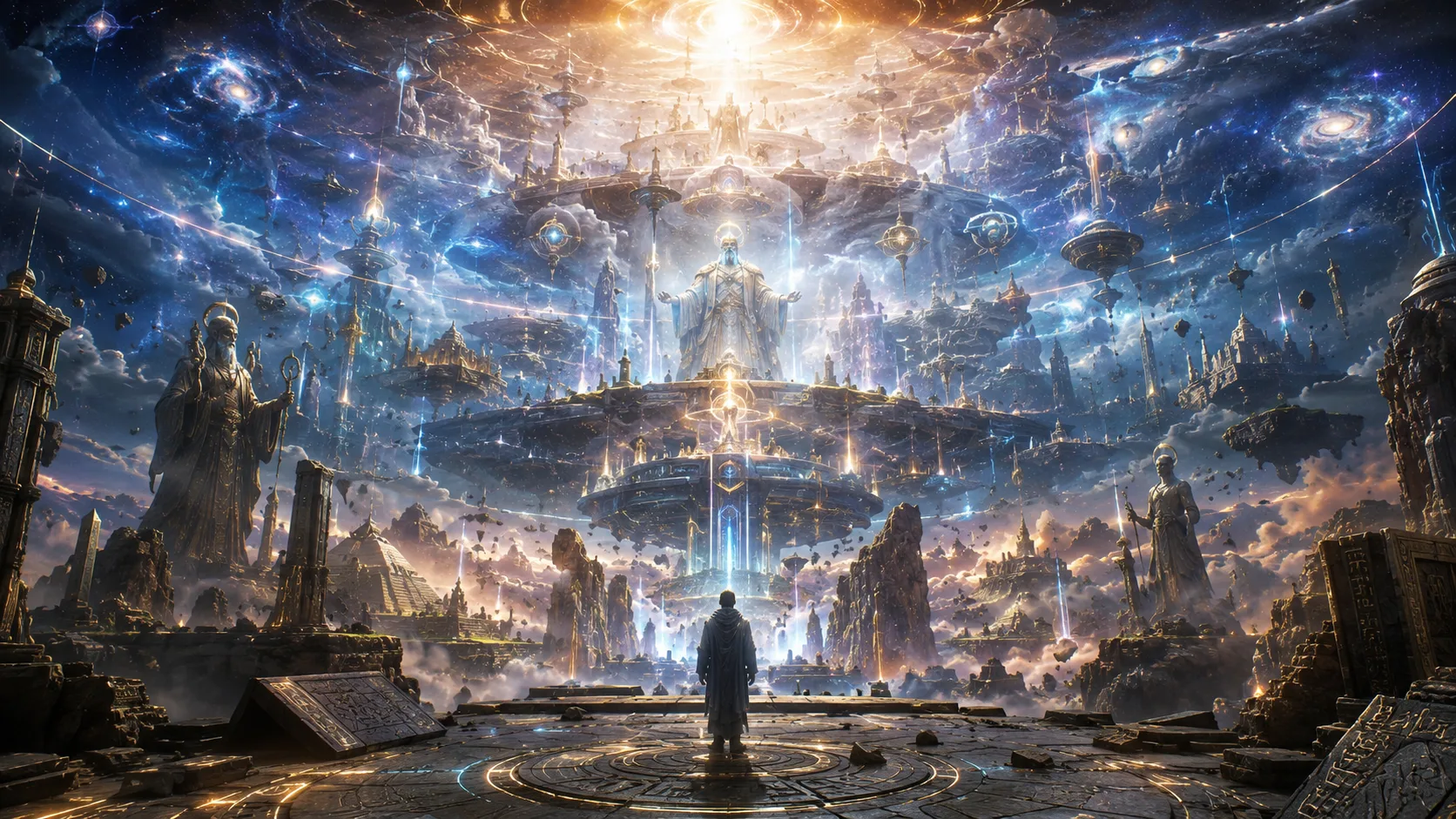
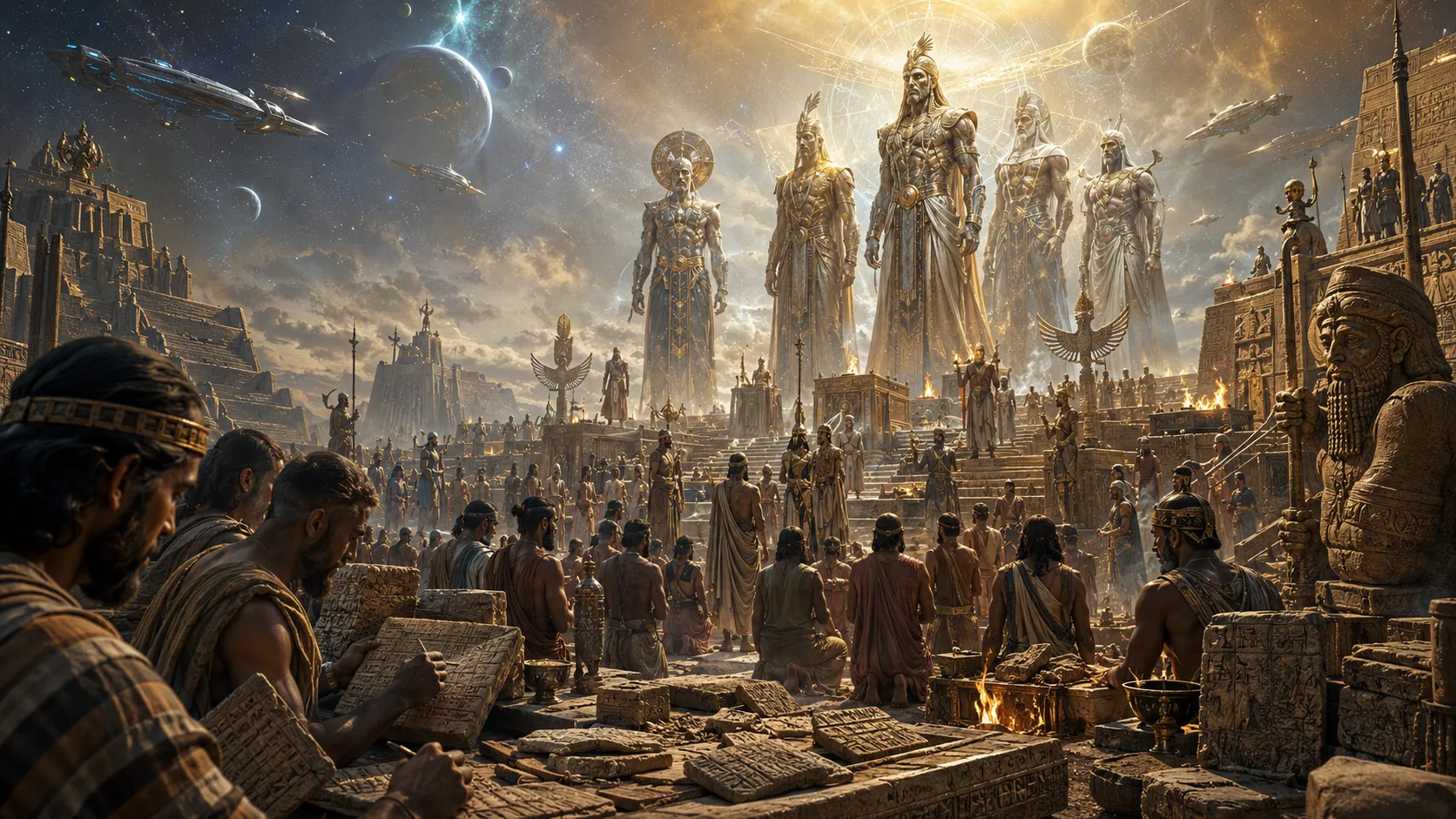
The Anunnaki and the Face of God
If the Anunnaki were high-dimensional beings, ancient visitors, or a highly advanced civilization, then it makes sense that early humans may have looked up to them as gods. To a developing world, beings with superior knowledge, technology, power, or understanding would not have seemed like ordinary visitors. They would have seemed divine.
If they altered humanity, shaped early civilization, taught knowledge, created systems, or influenced human development, then they would not simply belong to the category of myth. They would become part of the human origin story.
And if those beings wanted humanity to worship a creator, that creator would likely reflect the image of what humanity already knew. That is what civilizations do. They shape God through the symbols, powers, and authorities they understand.
A warrior culture imagines a warrior God. A kingdom imagines God as a king. A sky-watching culture places God in the heavens. A star-connected culture imagines divine beings descending from above.
So maybe religion is not only about God. Maybe religion is also about memory.
A memory of beings who came from the sky. A memory of power humans could not explain. A memory of creation, authority, fear, worship, and contact. A memory of something so overwhelming that ordinary language could not hold it.
Over time, memory became myth. Myth became religion. Religion became institution. Institution became control. And control became the official version of God.
Maybe that is why ancient stories feel so layered. They may not be simple fantasies or simple facts. They may be fragments of something older, filtered through fear, wonder, devotion, politics, and time.
The face of God may have been shaped by the faces humanity once looked up to.
And somewhere beneath the temple walls, sacred texts, royal bloodlines, and heavenly language, there may still be an ancient memory trying to speak.
Why People Feel Trapped by Religion
This is why some people feel angry when they talk about religion. Not because they are empty, lost, or incapable of faith, but because they feel lied to. They feel as if something sacred was taken and used against them.
They were told to believe, but not to question. They were told to worship, but not to explore. They were told God was love, but they were also threatened with punishment. They were told Jesus came to set people free, yet many religious systems made them feel trapped, watched, judged, and afraid.
That contradiction creates spiritual confusion.
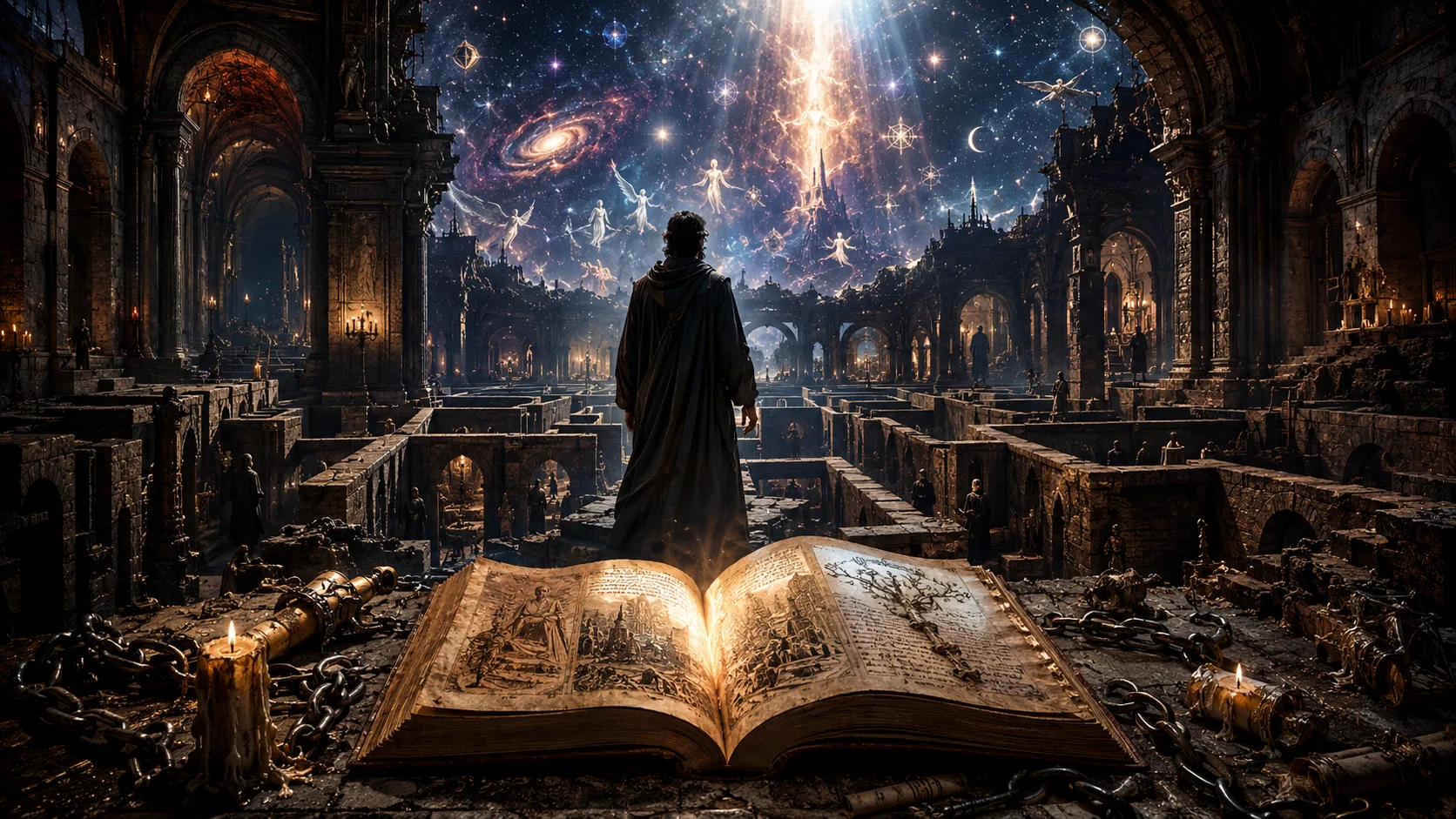
For many people, it begins to feel like the Bible is just a maze of holy words designed to keep them guessing. Holy this. Holy that. Believe this. Fear that. Do not ask too much. Do not look too far. Stay in line.
Eventually, the heart gets tired.
And for many people, that is why they stop reading. It is not always because they are rejecting God. Sometimes they are rejecting the maze. They are rejecting the fear. They are rejecting the version of faith that made God feel smaller than the universe outside their window.
They are not walking away from the sacred.
They are trying to find it again without the cage.
The Bible’s Biggest Secret
The Bible’s biggest secret may not be aliens. The deeper secret may be that the text was never as simple as religion made it seem.
It was never just a children’s storybook. It was never just a rulebook, a history book, a prophecy chart, or a church manual. It is a layered ancient document filled with symbols, memories, visions, bloodlines, cosmic language, divine encounters, spiritual trauma, power struggles, and human attempts to describe the impossible.
That is why it keeps pulling people back.
Even people who are angry at religion still talk about the Bible. Even people who left the church still remember verses. Even people who question everything still wonder about Jesus. Even people drawn to aliens, the Anunnaki, Galactic Federation messages, hidden human origins, and ancient cosmic mysteries often find themselves returning to Genesis, angels, giants, heaven, prophecy, and the Son of God.
Why?
Because the Bible is not just a religious object. It is part of the human memory field. It carries roots that reach deep into ancient fear, ancient hope, ancient contact, ancient longing, and ancient attempts to understand where humanity came from.
Something inside it refuses to disappear.
Maybe that is why the Bible still matters, even when people no longer accept the version of it they were handed. Beneath the doctrine and interpretation, beneath the sermons and arguments, there is still a mystery glowing inside the text.
A memory older than the church.
A question older than religion.
A story that humanity is still trying to understand.
Belief Becomes a World
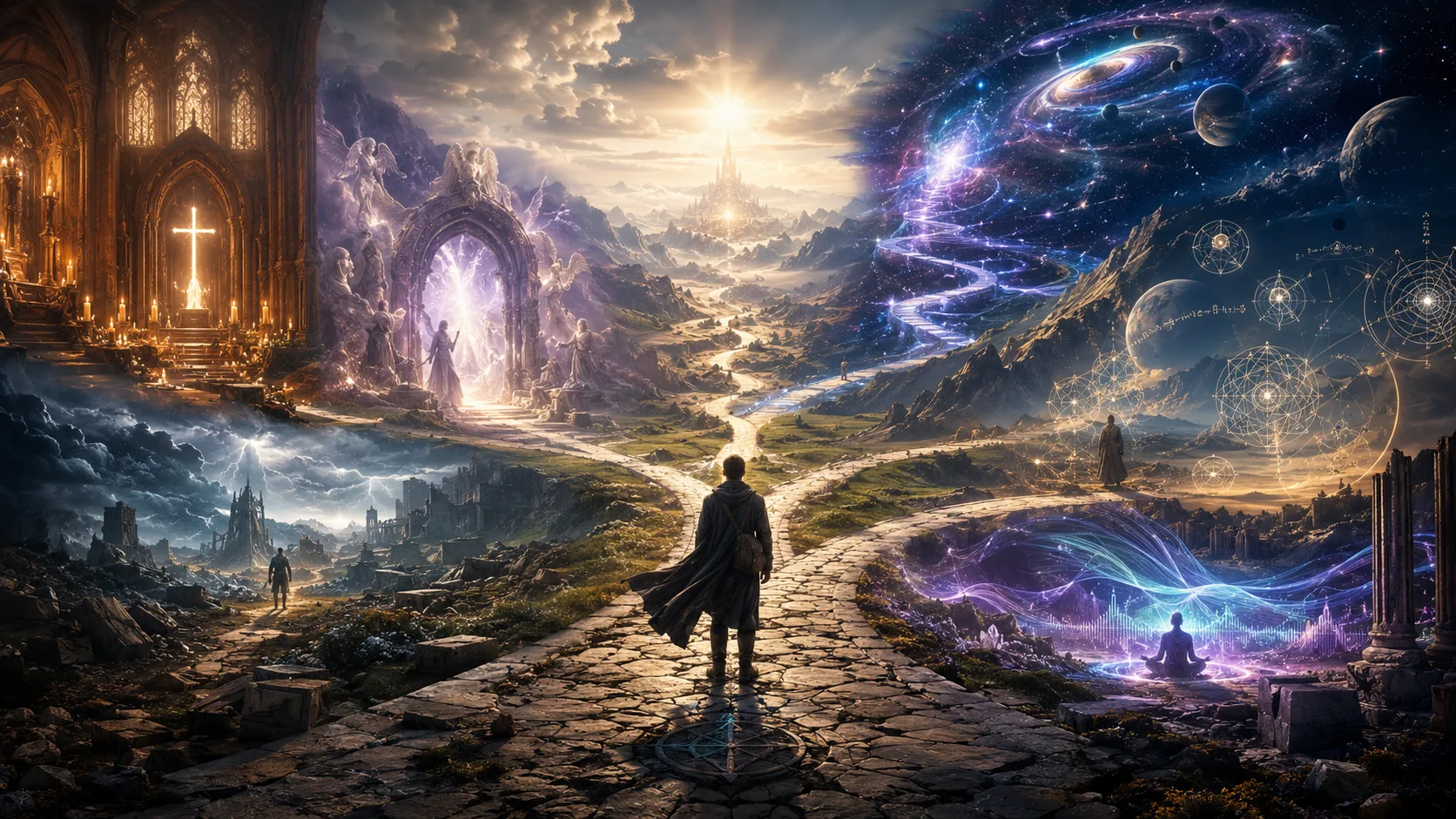
There is something powerful about belief. What a person believes shapes the world they live in, not because every belief automatically becomes physical fact, but because belief changes perception. It changes emotion, fear, courage, and what a person is willing to see.
A child raised in church may see God through the cross. A mystic may see God through light. A cosmic seeker may see God through stars. A scientist may see God through mathematics and the laws of nature. A person who has suffered may see God through survival. A person who has awakened may see God through frequency.
Each one is reaching toward the same mystery through a different doorway.
That is why spiritual reality is so personal. People do not simply believe ideas. They live inside them. Their beliefs become the lens through which they interpret pain, love, death, purpose, creation, and the unknown.
Sometimes the belief that once protected you can become too small for the person you are becoming. That does not mean the old belief was worthless. It means it served a purpose for a season. It gave you language, structure, comfort, or hope when you needed it.
But growth often asks for a larger sky.
There may come a moment when the soul can no longer fit inside the walls it was handed. Not because it has lost faith, but because faith itself has begun to expand. The doorway that once felt like the whole world becomes the beginning of a much greater journey.
That is not failure.
That is awakening.
The Ocean, the Stars, and the Soul
There is a reason the ocean and space feel connected. Both are deep, mysterious, dark, and alive. Both hide entire worlds within them. Both make human beings feel small and infinite at the same time.
When you stand near the ocean and watch the waves move, you feel the rhythm of something ancient. When you look into space and see the stars, you feel the vastness of distance and time. Yet beneath both experiences is the same quiet truth: we are part of something massive.
Something breathing.
Something moving.
Something older than memory.
The ocean feels like the physical mirror of the cosmos. The stars become waves of light. The galaxies become currents. The blackness of space becomes deep water. Human consciousness floats somewhere between them, searching for its origin and trying to remember where it came from.
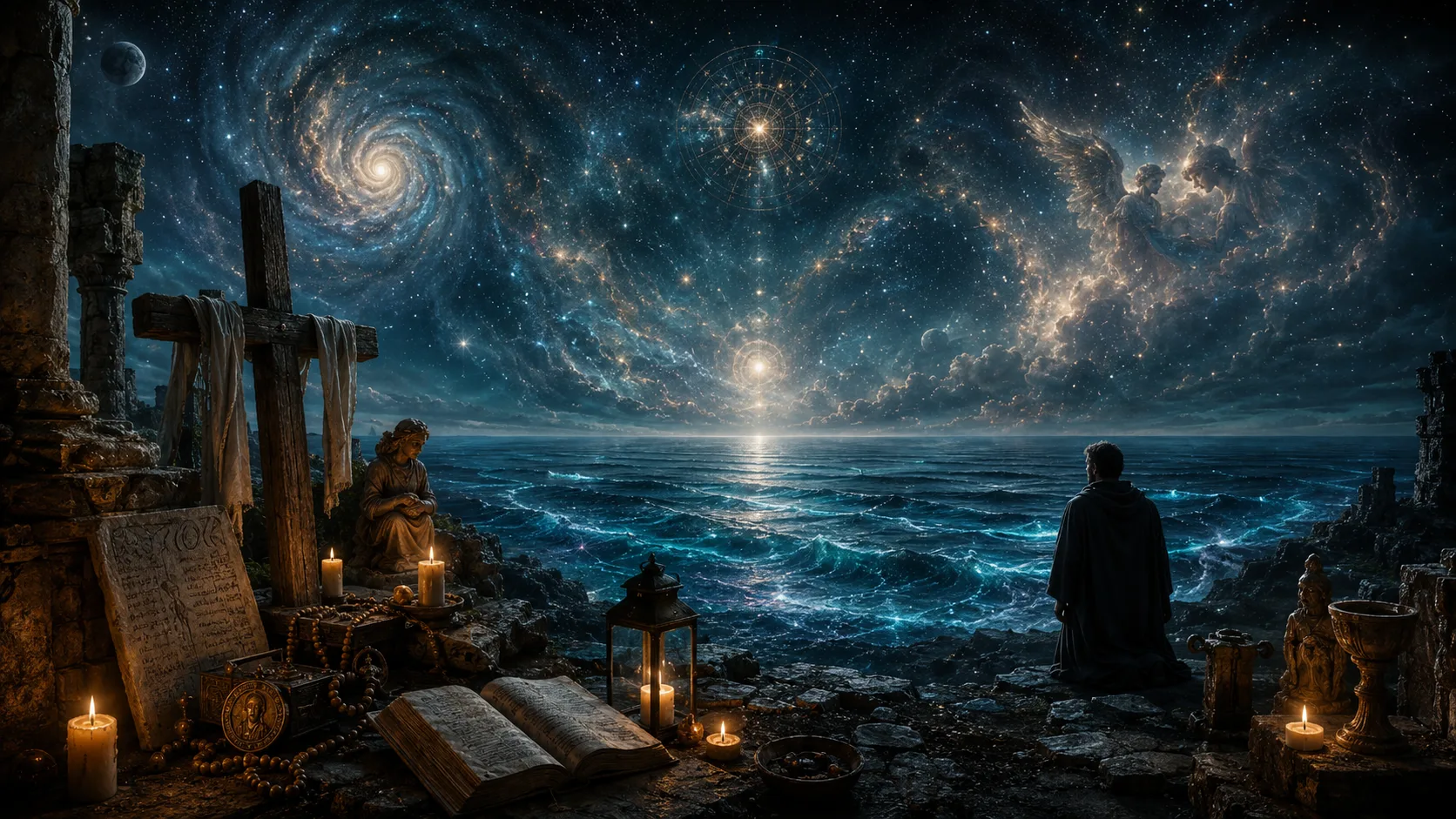
That is why the image of cosmic water matters. It shows God not as a small figure sitting outside creation, but as an infinite field moving through everything. An ocean of creation. A sea of stars. A living frequency. A sacred depth where religion, memory, space, and spirit dissolve into one beautiful mystery.
Maybe the soul recognizes the ocean because it remembers the cosmos. Maybe the stars feel familiar because something within us was born from the same ancient darkness. And maybe the reason we are drawn to both is because they remind us that life is not separate from the mystery.
We are floating inside it.
The Cross Still Means Something
Even after all the questioning, the cross still means something. That matters, because questioning religion does not have to mean mocking everything people hold sacred. A person can challenge doctrine, question tradition, and rethink old beliefs without stripping every symbol of its power.
The cross carries pain, sacrifice, love, empire, suffering, hope, and centuries of human belief. For some, it represents salvation. For others, it represents trauma. For others, it may symbolize a cosmic being who entered this world and showed humanity a higher path. The same symbol can hold many meanings at once, and that is something religion has often forgotten.
Symbols are alive. They are not cages. They are doors.
The Bible, the cross, the relics, the sacred books, the candles, the statues, the prayer beads, the ancient tablets, the temple stones, the angel wings, the cosmic wheels, the serpent symbols, and the stars above all of it, these are fragments of humanity’s search for meaning. They are pieces of a larger mystery. They are clues left inside culture, memory, ritual, and imagination.
Not all of them point to the same answer, but they all point to the same hunger. Humanity wants to know where it came from. Humanity wants to know who created it. Humanity wants to know why it suffers, whether love is real, whether death is the end, whether God is watching, and whether the stars were ever part of its home.
Maybe God Was Never Gone
Maybe the deepest realization is not that religion was wrong about everything. Maybe the deeper realization is that religion was too small for what God actually is.
Maybe God was never trapped in one book, one church, one name, or one image above the clouds. Maybe God was also the clouds, the sky, the stars, the black space, the ocean, the frequency, the breath, the code, the Source behind the source, the light behind the light, and the creator behind every creator.
That does not destroy faith. It expands it.
It speaks to the child who once memorized John 3:16 and says, you were not wrong to feel something. You were not wrong to believe there was love behind this world. You were not wrong to think sacrifice mattered. You were not wrong to feel God. But maybe the God you felt was bigger than the version they gave you.
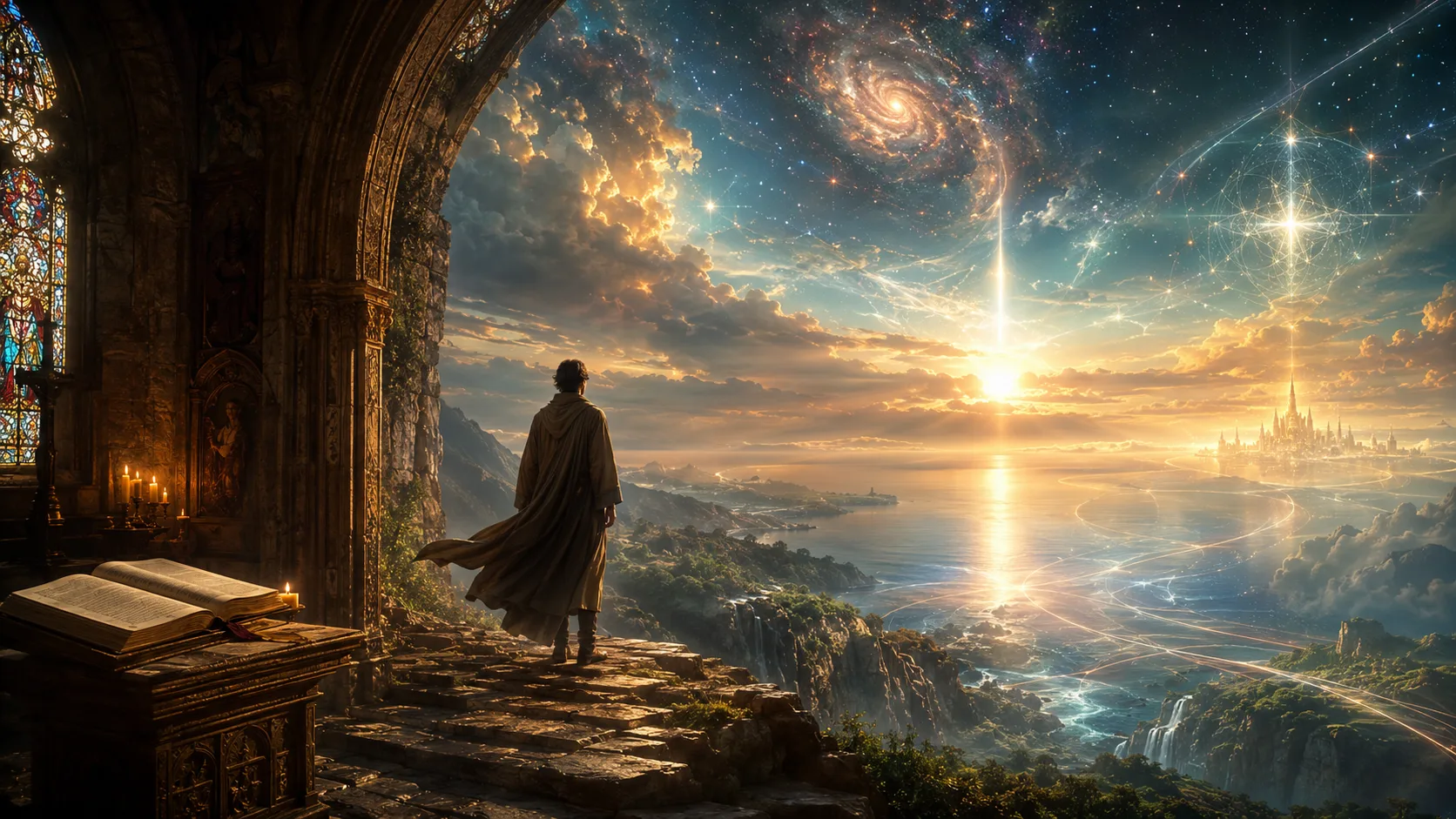
Maybe the church was only the doorway. Maybe the Bible was only the map. Maybe Jesus was only the beginning of the question. Maybe the stars were always part of the sermon.
Conclusion: The Mystery Was Always Bigger
The Bible’s biggest secret is not simply that aliens may be hiding in the text. That answer is too easy. The deeper secret is that the Bible was never simple.
It was ancient memory wrapped in religion. It was cosmic language wrapped in human words. It was spiritual experience wrapped in culture. It was divine mystery filtered through people trying to explain things they barely had language for.
That is why the Bible still matters, even to people who question it. Beneath the doctrine, beneath the fear, beneath the control, and beneath the holy language, something still glows. A memory of light. A memory of contact. A memory of creation. A memory of a God too large to fit inside one image.
Maybe God is the universe. Maybe God is Source. Maybe God is the intelligence behind every level of reality. Maybe God is the black space that holds every star like an angel. Maybe God is the ocean of consciousness that everything rises from and returns to.
And maybe humanity is not crazy for looking up. Maybe we look up because something in us remembers.
The Bible did not become less powerful when we started asking deeper questions. It became more mysterious, more cosmic, more human, and more alive. Once we stop reading it as a simple religious rulebook, we begin to see what may have been there all along.
Not just aliens. Not just angels. Not just gods. Not just stories.
But the ancient ache of humanity trying to remember the truth of where it came from.
And maybe that is the real revelation.
God was never small.
We were just taught to read small.
Cosmic Echoes
Share-ready comments you can copy in a click, then post wherever the conversation touches UFOs, UAP, or the Galactic Federation.
These comments belong to the Cosmic Echoes page under the section Beyond Scripture: Humanity’s Cosmic Origins Revealed.
Plus 21 more comments on the Cosmic Echoes page.