

Most UFO arguments get trapped in a familiar hallway.
On one side, there’s the extraterrestrial answer: advanced visitors from another star system, crossing impossible distances in craft that make our aircraft look like paper airplanes. On the other side, there’s the skeptical answer: drones, balloons, secret military programs, misidentified planets, sensor errors, and human imagination doing what human imagination does.
Jacques Vallée has spent decades standing in the middle of that hallway saying something far more unsettling.
What if the hallway itself is too narrow?
Vallée, a French-born astronomer, computer scientist, and longtime UFO researcher, is one of the most unusual figures in the entire UAP field. He has the résumé skeptics often demand and the ideas skeptics usually reject. He worked in astronomy, helped develop early computer networking, contributed to serious technical research, and became one of the central architects of a very different way of thinking about UFOs. His argument was not simply that “aliens are real.” In fact, he became famous for challenging the standard alien-spacecraft explanation.
His point was stranger.
Maybe the phenomenon is real, but not what most believers think it is. Maybe it’s not primarily a fleet of metal ships from distant planets. Maybe it’s an intelligence, system, or presence operating through layers of reality we don’t yet understand, shaping human perception, belief, mythology, and culture across centuries.
That’s why Vallée still matters. He didn’t just ask whether UFOs exist. He asked what kind of phenomenon would behave this way.
The Scientist Behind the Strange
Jacques Vallée was never the stereotypical UFO enthusiast chasing lights in the sky with a camera and a hunch. His background is unusually strong for someone associated with such a controversial subject.
He studied mathematics at the Sorbonne, earned a master’s degree in astrophysics from the University of Lille, and later received a PhD in computer science from Northwestern University. His scientific career began in astronomy at the Paris Observatory, and he later worked at Stanford Research Institute, where he was involved with early ARPANET-related work at Douglas Engelbart’s Augmentation Research Center. ARPANET, of course, was one of the foundations of what eventually became the internet. (Jacques Vallée)
That combination matters. Vallée was trained to think in patterns, systems, databases, and anomalies. He wasn’t approaching UFO reports as campfire stories. He was looking for structure.
He entered the UFO world through the orbit of J. Allen Hynek, the astronomer who served as a scientific consultant to the U.S. Air Force’s Project Blue Book. Hynek began as a skeptic, tasked with reviewing UFO reports and identifying ordinary explanations where possible, but he eventually became one of the most important figures arguing that some cases deserved more serious study. Hynek stayed connected to Project Blue Book until its closure in 1969 and later developed the famous “close encounter” classification system. (HISTORY)
Vallée became part of that intellectual world, but he didn’t stay inside its assumptions. Even when he was close to major UFO researchers, he was already moving toward a framework that made both skeptics and believers uncomfortable.
Hollywood noticed him too. Steven Spielberg consulted Vallée while developing Close Encounters of the Third Kind, and the French scientist character Claude Lacombe, played by François Truffaut, was partly modeled on him. Vallée reportedly objected to the film’s final implication that UFOs were simply extraterrestrial spacecraft, which says a lot about the distance between his thinking and the popular UFO imagination. (WIRED)
Why Vallée Broke With the Alien-Spacecraft Theory
The extraterrestrial hypothesis, often shortened to ETH, sounds straightforward. UFOs appear. Some display technology beyond known human capability. Therefore, they may be spacecraft from another planet.
Vallée did not dismiss that possibility outright. He objected to treating it as the default answer.
In his 1990 paper “Five Arguments Against the Extraterrestrial Origin of Unidentified Flying Objects,” Vallée argued that UFO research should not be boxed into a simple choice between natural misidentifications and alien visitation. He believed the accumulated data showed patterns that the standard extraterrestrial hypothesis did not adequately explain. (Semantic Scholar)
His objections were not casual. They came from decades of case comparison.
If UFOs are spacecraft from another planet, why do so many encounters seem theatrical, symbolic, absurd, or psychologically overwhelming? Why do the reported beings and messages change with the culture of the witness? Why do older accounts of fairies, spirits, angels, demons, airships, and mysterious lights sometimes resemble modern close-encounter reports in structure, even when the costumes are different?
For Vallée, the phenomenon seemed less like a simple reconnaissance mission and more like a long-running interaction with human consciousness.
That is the real break. Vallée didn’t say, “Nothing is happening.” He said, “Something may be happening, but our favorite explanation may be blinding us.”
The Data Scientist of High Strangeness
One of Vallée’s most important contributions is methodological. He understood that individual UFO stories can be fascinating but misleading. A single dramatic case can pull the imagination in one direction. A database can reveal whether that direction is justified.
In a paper on classification and reliability indicators, Vallée argued that serious researchers should analyze patterns across reports before jumping into a hypothesis. His classification work focused on reported behavior rather than assuming what the object “really” was. That distinction is crucial. A behavior-based system lets researchers compare cases without first deciding whether they are alien craft, secret weapons, natural phenomena, or psychological events. (UfoCom)
This is where Vallée’s computer-science mind shows. He wanted cases categorized in a way that made statistical analysis possible.
His system organized sightings into broad categories, including close encounters, cloud-like or “cigar” formations, discontinuous trajectories, and uninterrupted flight. Later refinements included close-encounter types and credibility indicators. His SVP credibility rating measured source reliability, site investigation, and the probability of ordinary explanations. Versions of this approach were used in major UFO databases and studies, including projects associated with CUFOS, NIDS, and French aviation-related UAP research. (UfoCom)
That may sound dry, but it changed the conversation. Vallée was trying to move UFO research from “Do you believe this witness?” to “What do thousands of reports do when you sort them carefully?”
The Patterns That Bothered Him
In a joint analysis with Claude Poher, Vallée examined patterns across UFO observations and compared them against known categories such as aircraft, balloons, stars, planets, and meteors. The goal was not to prove aliens. It was to ask whether the data behaved like ordinary misidentifications.
Some of the results were difficult to ignore.
The duration of many reports did not match the expected distribution for common identifiable objects. Close encounters showed a recurring time-of-day pattern, with a strong evening peak and another smaller peak in the early morning. Vallée and Poher also noted that many close-encounter reports occurred in relatively isolated areas, not in crowded public settings where mass confirmation would be easier.
That last point is especially interesting. If you were designing a phenomenon to remain ambiguous, you might avoid appearing at noon over a packed stadium. You might appear at the edge of a road, in a field, near a military installation at night, or to a small group of witnesses under stressful conditions.
Vallée did not treat that as proof of anything. But he treated it as data.
He also challenged the idea that UFO reports could be dismissed as the fantasies of lone eccentrics. In one historical sample of close-encounter cases, only slightly more than half involved lone witnesses, and the age distribution of witnesses did not appear abnormal.
The picture that emerges is not clean. It’s not “all real spacecraft.” It’s not “all delusion.” It’s a messy pattern of physical-looking events, witness effects, cultural symbolism, and statistical recurrence.
That mess is exactly where Vallée wanted researchers to look.
The Control System Hypothesis
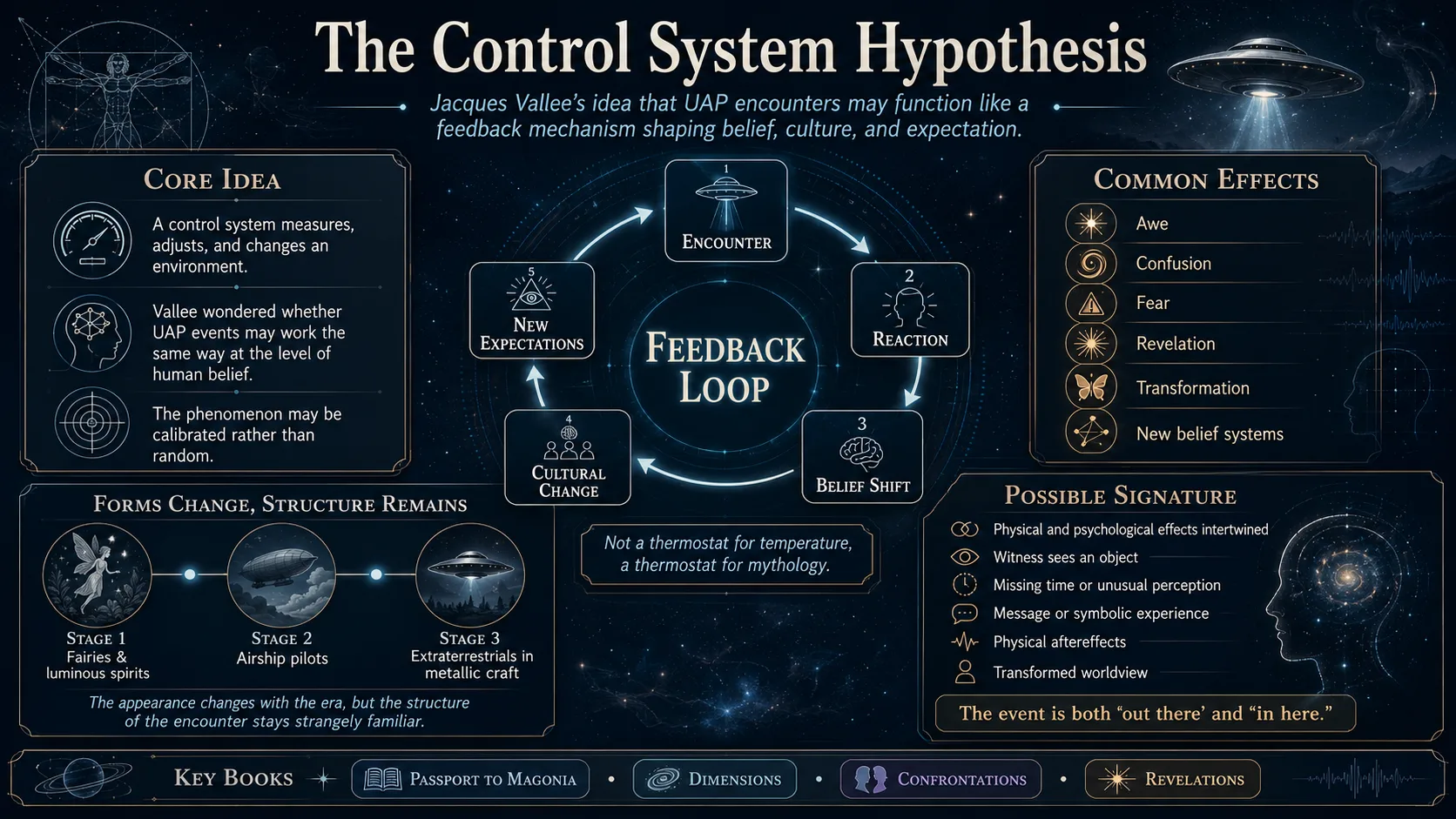
Vallée’s most provocative idea is often called the “control system” hypothesis.
The phrase can sound sinister, as if he were describing a giant machine secretly steering humanity. But his meaning was more subtle. A control system is a feedback mechanism. A thermostat, for example, measures temperature, adjusts output, and changes the environment. Vallée wondered whether UAP encounters might function in a similar way at the level of human belief.
Not a thermostat for temperature. A thermostat for mythology.
In this framework, UFO events are not random interruptions. They are calibrated experiences that produce certain effects: awe, confusion, transformation, fear, revelation, new belief systems, new religions, new expectations about the future.
The craft, beings, messages, and symbols may change from era to era because the phenomenon speaks in the language a culture can understand. In one century, the visitors arrive as fairies or luminous spirits. In another, they appear as airship pilots. In the space age, they become extraterrestrials in metallic craft. The form changes, but the structure of encounter remains strangely familiar.
This idea runs through Vallée’s work, especially Passport to Magonia and the later books Dimensions, Confrontations, and Revelations. Reviewers of Vallée’s trilogy have noted that he compared modern UFO reports with myths, legends, and folklore, arguing that the phenomenon is not simply extraterrestrial and not simply physical, but deeply psychosocial in its effects. (Journal of Scientific Exploration)
That does not mean Vallée reduced everything to psychology. Quite the opposite. His work is unsettling because he often treated the physical and psychological components as intertwined. A witness may see an object, experience missing time, receive a message, suffer physical effects, and leave with a transformed worldview. The event is both “out there” and “in here.”
For Vallée, that combination is not a flaw in the data. It may be the signature.
Interdimensional Doesn’t Just Mean “Aliens From Next Door”
The term “interdimensional hypothesis” can be misleading because it sounds like science fiction shorthand. People hear it and imagine beings stepping through a glowing portal from a parallel universe.
Vallée’s thinking is more flexible than that.
He has suggested that the phenomenon may involve forms of intelligence or reality that do not fit our normal assumptions about space, time, matter, and mind. In discussions of his work, the phenomenon has been described as appearing “inter-dimensional” and capable of manipulating physical realities in ways outside ordinary spacetime. (Journal of Scientific Exploration)
The important point is not that Vallée has proven a specific alternate dimension. He hasn’t. The point is that he challenged the assumption that the answer must look like NASA with better engines.
This is where his framework becomes especially important for modern UAP debates. The public conversation still tends to split into two camps: extraterrestrial vehicles or human technology. Vallée’s work suggests a third possibility. The phenomenon might involve intelligence, but not necessarily in the form of biological astronauts flying nuts-and-bolts spacecraft from a distant star.
It might be stranger than that.
It might be an intelligence that uses physical manifestations without being limited to them. It might be a system that interacts with consciousness as directly as it interacts with radar or terrain. It might be something that produces experiences designed to be remembered, retold, doubted, mythologized, and argued over.
That is a deeply uncomfortable possibility because it refuses to stay in one category. It is not cleanly spiritual, technological, psychological, or physical. It crosses boundaries.
And crossed boundaries are where human beings tend to lose confidence.
Rendlesham and the Problem of Military Context
The Rendlesham Forest incident remains one of the most discussed UAP cases in modern history. In late December 1980, U.S. Air Force personnel stationed at RAF Woodbridge and RAF Bentwaters in England reported strange lights and apparent close-range encounters in the surrounding forest.
Many researchers have treated Rendlesham as a classic military UFO case. Vallée approached it differently. In Revelations, he considered the possibility that at least some aspects of the incident might involve psychological warfare, experimental technology, or staged manipulation in a military environment. A review of the book notes that Vallée raised the possibility of a psychological warfare device being tested on military personnel. (Journal of Scientific Exploration)
That interpretation is controversial, but it shows how Vallée thinks. He does not automatically place a dramatic case into the alien box. He asks what else might be happening.
Could a real anomalous phenomenon be present? Could military deception be layered on top of it? Could witnesses be sincere but still manipulated? Could an event be both physical and staged, both strange and human-influenced?
Those are uncomfortable questions, but they are better than premature certainty.
AAWSAP, AATIP, and the Return of Serious Interest
For decades, UFO research lived mostly outside official respectability. That began to change publicly with renewed attention to UAP programs, military encounters, and government records.
Official documents now confirm that the Advanced Aerospace Weapon System Applications Program, often discussed alongside AATIP, was funded through the Defense Intelligence Agency to assess advanced aerospace threats. AARO’s historical report describes the program’s funding and time frame, while a DIA statement of objectives from 2008 describes work on advanced aerospace applications, including propulsion, control, power, materials, and even “spatial/temporal translation.” (U.S. Department of War)
That does not prove Vallée’s hypothesis. It does show that the kinds of questions long pushed to the margins, advanced propulsion, anomalous aerospace performance, exotic physics, and unusual UAP data, eventually returned to official study.
Vallée has also remained connected to scientists interested in harder evidence. Stanford professor Garry Nolan, for example, coauthored a 2022 paper with Vallée and others analyzing material from the Council Bluffs case. The results did not establish an extraterrestrial origin. The material was mostly iron and isotopically ordinary, but the broader significance was methodological: the authors were trying to build a serious pipeline for analyzing alleged UFO debris without leaping beyond the evidence. (Stanford Magazine)
That restraint is important. Vallée’s best work is not wild speculation dressed up as certainty. It is disciplined uncertainty.
Modern official assessments remain cautious. AARO has stated that it leads U.S. government UAP efforts through a scientific and data-driven framework, and public reporting has not established credible evidence of extraterrestrial or off-world technology. (AARO)
Vallée’s framework survives that caution because it was never dependent on a simple claim that “the aliens are here.” His question is more durable: what pattern is hiding inside the reports?
What Vallée Changes About Ancient Encounters
One of the richest implications of Vallée’s work is historical.
If modern UFO sightings are simply alien spacecraft, then ancient myths are usually treated as either primitive misunderstandings or possible records of ancient astronauts. Vallée offers a different reading. He asks whether human cultures have been encountering the same underlying phenomenon through different symbolic filters.
That changes the way we read old stories.
A medieval account of luminous beings descending from the sky does not need to be forced into the mold of astronauts in helmets. A fairy encounter involving missing time does not need to be dismissed as fantasy just because it sounds folkloric. A religious apparition does not need to be reduced to either divine revelation or hallucination.
Vallée’s approach asks us to compare structures:
- A being or object appears from “elsewhere.”
- The witness is separated from ordinary reality.
- Time behaves strangely.
- A message, warning, or symbolic exchange occurs.
- The witness returns changed.
- The culture absorbs the story into its existing belief system.
That structure appears in many forms. The vocabulary changes, but the pattern can remain.
This is why Vallée’s work matters for anyone thinking about interdimensional craft, stargates, multidimensional contact, or the possibility of nonhuman intelligence that is not simply extraterrestrial in the ordinary sense. He forces a more careful question. Are we looking at vehicles, or are we looking at manifestations? Are we studying visitors, or interactions? Are the beings the source of the event, or are they part of the event’s presentation?
In plain English: don’t assume the costume is the actor.
The Federation Question: Extraterrestrial or Extradimensional?
A lot of modern speculation about nonhuman intelligence assumes an organized off-world presence: councils, federations, alliances, civilizations, or competing factions. That may be possible. But Vallée’s framework complicates it.
If the phenomenon adapts its appearance to the expectations of the observer, then “extraterrestrial federation” may be one layer of interpretation rather than the final truth. A contact experience could be real and still be filtered through symbols the witness can understand. A being may present itself as a star traveler because that is the mythology our era is prepared to receive.
In another age, it might have used different language.
This does not mean every claim of contact is false. It means the surface story may not be the whole story.
That is the heart of Vallée’s challenge. He does not let believers keep the comforting version of the mystery. He also does not let skeptics dismiss the whole thing with a shrug. He insists that the pattern is too persistent, too strange, and too culturally important to ignore.
The result is a framework that feels less like a UFO theory and more like a theory of human encounter with the unknown.
Why Vallée Still Matters
Jacques Vallée’s lasting contribution is not that he solved the UFO mystery. He didn’t.
His contribution is that he made the mystery harder to simplify.
He gave researchers a way to think statistically instead of emotionally. He treated folklore as data without flattening it into superstition. He questioned the extraterrestrial hypothesis without retreating into debunking. He took witness reports seriously while still asking whether witnesses might be caught inside a larger system of influence, symbolism, and perception.
That balance is rare.
It is much easier to say, “They’re aliens,” or “It’s all nonsense.” Vallée’s answer is more demanding. He asks us to live with ambiguity long enough to notice the pattern.
And the pattern, if he is even partly right, points toward something deeper than visitors from another planet.
It suggests that the UAP mystery may not be only about craft in the sky. It may be about intelligence, reality, belief, and the way human beings are changed by encounters they cannot fully explain.
The old question was, “Where do they come from?”
Vallée’s question is better.
“What are these encounters doing to us?”

Cosmic Echoes
Share-ready comments you can copy in a click, then post wherever the conversation touches UFOs, UAP, or the Galactic Federation.
These comments belong to the Cosmic Echoes page under the section Jacques Vallée: Beyond Alien Myths.
Plus 21 more comments on the Cosmic Echoes page.