
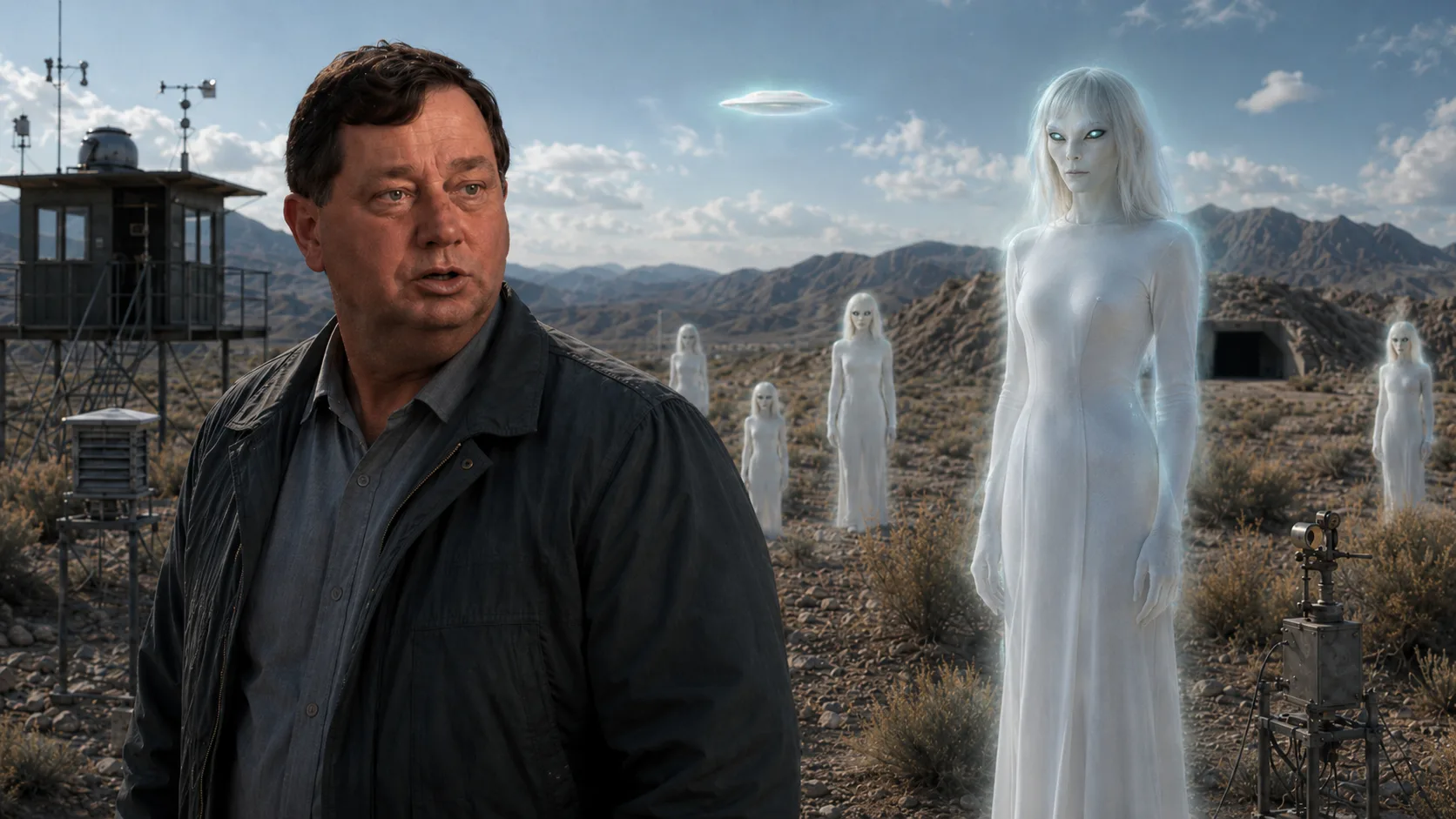
Charles Hall’s story is one of the strangest in modern contact lore because it doesn’t behave like a typical UFO account. There’s no single flash of light, no missing night, no dramatic landing witnessed by a crowd. Instead, Hall describes something much more unsettling, a long, tense coexistence in the Nevada desert, where the extraordinary slowly became part of the workday.
The cleanest way to approach the Tall Whites account is as testimony, detailed, emotionally charged, and still unverified. Hall’s claims have not been confirmed by the U.S. government. In fact, the Defense Department’s All-domain Anomaly Resolution Office has stated that it has found no verifiable evidence that any UAP sighting represents extraterrestrial activity or that the government has accessed extraterrestrial technology. (U.S. Department of War)
That said, the Hall case remains compelling because of its texture. It has geography, routines, named locations, social dynamics, injuries, fear, humor, children, military protocols, alleged technology transfers, and a surprisingly ordinary setting. In Hall’s telling, the biggest secret in the desert was not a single crashed craft. It was an ongoing relationship.
The Man Behind the Story
Charles James Hall says he enlisted in the U.S. Air Force in July 1964 and served for more than two years at Nellis Air Force Base outside Las Vegas. His work, according to his own biography, included extended duty as a weather observer on the gunnery ranges near Indian Springs, Nevada. After that, he served in Vietnam, then later earned degrees in thermal physics and applied nuclear physics. (Millennial Hospitality)
That timeline matters. The phrase “four years in the Nevada desert” is often used loosely around the broader arc of Hall’s Air Force years, but Hall’s own public timeline places the most intense Nevada portion between spring 1965 and May 1967, followed by Vietnam and discharge in 1968. (Paola Harris)
Hall eventually wrote the Millennial Hospitality series, which his website describes as memoir-like material written first for his children and grandchildren. The same biography notes that names, places, distances, and directions were changed to protect people connected to the account. It also says the books were not written to prove extraterrestrial life, but to tell the story in a way readers could experience like a novel. (Millennial Hospitality)
That creates a built-in tension. Hall presents the events as true, but the books use fictionalized elements. For a skeptic, that’s a problem. For a sympathetic reader, it’s part of the survival strategy of someone describing classified or socially explosive material. Either way, it means the story has to be handled carefully.
Why Indian Springs Matters
The setting is not incidental. Indian Springs was not just “some desert base.” The current Creech Air Force Base history says Indian Springs was redesignated Indian Springs Air Force Auxiliary Field in April 1964 and assigned to Nellis. During that era, it supported range maintenance and hosted military training connected to the large surrounding ranges. (Creech Air Force Base)
The Nevada Test and Training Range itself is vast. Nellis describes it as the largest contiguous air and ground space available for peacetime military operations in the free world, covering 2.9 million acres of land, 5,000 square miles of restricted airspace, and another 7,000 square miles of shared military operating area. (Nellis Air Force Base)
In other words, Hall’s story is set in a place where distance, secrecy, and military routine naturally overlap. Remote weather shacks, dry lake beds, mountain valleys, restricted airspace, and isolated night shifts make a perfect stage for either extraordinary events or extraordinary folklore.
Hall’s ordinary job also matters. He wasn’t describing himself as a pilot, intelligence officer, or elite insider. His work was weather observation, tracking winds, releasing balloons, and reporting conditions. One summary of his account notes that his duty involved releasing and tracking weather balloons, measuring winds aloft, and calling reports back to Nellis.
That ordinariness is one reason the story has lasted. It doesn’t begin with a man looking for aliens. It begins with a young airman doing a lonely job.
The First Encounters
According to Hall, the first encounters occurred in late May or early June 1965. He later told Paola Harris that it took him months to control his shock and fear, and that he initially tried to explain away what was happening rather than accept it. (Paola Harris)
That fear is one of the more human parts of the account. Hall doesn’t describe himself as calm or heroic at first. He describes terror, denial, and the slow process of learning how to behave around beings he believed could hurt him.
In his interview with Harris, Hall said other weather observers had also been frightened or attacked on the Indian Springs ranges. He described one replacement as badly attacked and medically discharged, and another two-man team as refusing to go back onto the ranges after being followed and harassed. Hall said that after those incidents, high-ranking officers and officials decided to send him alone as the primary weather observer while keeping him on temporary duty status. (Paola Harris)
Whether one accepts that or not, the dramatic arc is clear. Hall’s story is not “I met friendly visitors.” It is “I survived long enough for both sides to learn the rules.”
Who Hall Said the Tall Whites Were
Their appearance
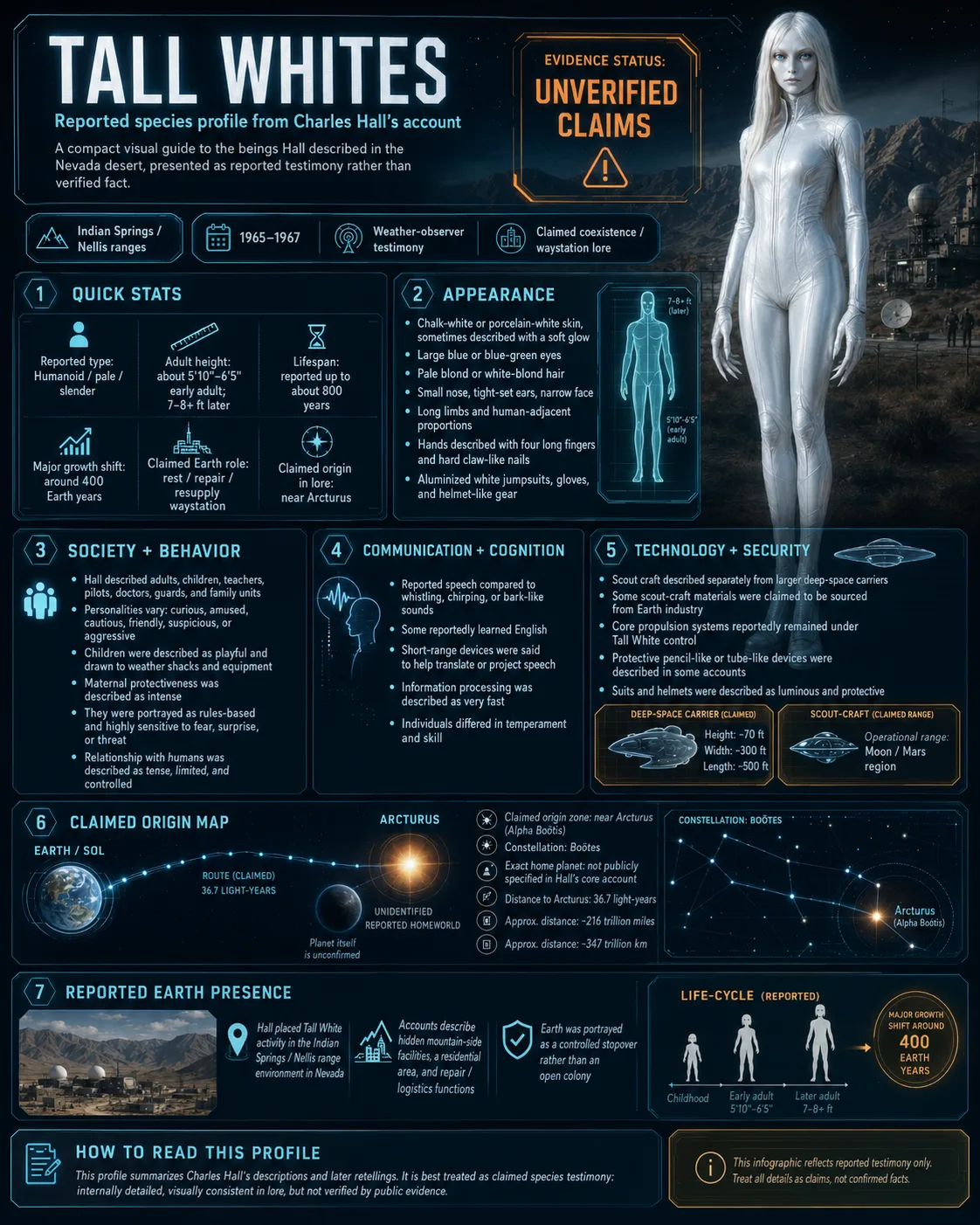
Hall’s descriptions of the Tall Whites are unusually specific. In various summaries and interviews, they are described as humanoid, pale, thin, and physically different from humans while still close enough in appearance to be mistaken for people under the right conditions.
A compiled account of Hall’s descriptions says the Tall Whites had chalk-white skin, humanoid bodies, and lifespans far longer than ours. It describes a second growth stage after roughly 400 Earth years, with some eventually reaching around eight or nine feet tall and dying around 800 years of age.
Other descriptions linked to Hall’s account portray them as having large blue eyes, short pale blond hair, small noses, tight-set ears, long fingers, and aluminized white clothing that could emit a soft glow.
This is where the “Tall Whites” name comes from. Not merely tall. Not merely pale. In Hall’s telling, their appearance was a whole category of difference, familiar enough to be disturbing.
Their society
The most interesting part of Hall’s account is not their appearance. It’s their social behavior.
He describes adults, children, teachers, guards, pilots, doctors, family units, and personalities that varied sharply from one individual to another. Some were frightened of humans. Some were aggressive. Some were curious. Some were amused. Some seemed almost affectionate.
One analysis of Hall’s claimed geography says the Tall White facilities included children’s playgrounds, and that Hall’s weather shacks themselves became play areas for Tall White children. The account says Hall gained their favor partly by leaving his theodolite available so the children could look through it.
That detail is easy to overlook, but it’s central to why the story feels different from many contact accounts. The Tall Whites are not presented as faceless entities. Hall describes them as a society with children, manners, fear responses, tempers, and rules.
He also describes maternal protectiveness as intense and dangerous. In Salla’s interview notes, Hall emphasized that frightening or harming Tall White children could trigger a violent response from adults, and that their personalities varied widely, from friendly to cruel. (Exopolitics)
That makes the relationship complicated. Hall’s Tall Whites are not benevolent space sages. They’re not simple villains either. They behave more like a powerful foreign culture living under strict security conditions, sometimes curious, sometimes warm, sometimes threatening.
Fear, Rules, and the Slow Growth of Trust
The emotional core of Hall’s account is his gradual movement from panic to functional coexistence.
In Salla’s interview notes, Hall said it took about six months before he could control his fear of the Tall Whites. He also said he relied heavily on memory and emotion when writing the books, because key episodes were “etched” into his mind. (Exopolitics)
There’s a practical lesson hidden inside that. Hall survived, in his telling, not because he was fearless, but because he became predictable. He learned not to run. Not to surprise them. Not to touch the children. Not to behave like a threat.
One of the most revealing details is the agreement Hall described making with them. He said they would not sneak up behind him and scare him, and he would not do the same to them. According to Hall, that simple boundary was followed closely and helped him survive. (Exopolitics)
That’s a small moment, but it gives the story its strange realism. No grand treaty. No shining revelation. Just a frightened airman and a frightening group of beings agreeing not to startle each other in the desert.
Hall also described at least one young female Tall White who could come within arm’s length of him without fear, while her male companion remained cautious and kept his distance. (Exopolitics)
Those moments are the reason the account has emotional staying power. The Tall Whites are alien, but not incomprehensible. They worry about their children. They test boundaries. They follow agreements. They have tempers. They can be curious, playful, and afraid.
The Alleged Facility in the Desert
Hall placed the Tall White presence in the mountains and valleys north of Indian Springs. In the Harris interview, he said their base was located in the mountains north of Indian Springs, and that the main hangar and living quarters were underground, built into a mountainside. (Paola Harris)
Other reconstructions of his account identify areas around Dog Bone Lake, French Peak, the Pintwater Range, and the north end of Indian Springs Valley as significant locations. One compiled mapping analysis says Hall described deep space craft first arriving at Dog Bone Lake, then moving toward a hangar entrance built into a mountainside.
The same material says Hall claimed scout craft used hidden corridors and terrain-following routes near French Peak to reduce radar visibility.
Again, this is not proof. But it shows why researchers keep returning to the case. Hall did not simply say, “There was a base somewhere.” He tied the story to geography, sightlines, dry lakes, mountain approaches, and specific range positions.
The Exchange Arrangement
The geopolitical implication of Hall’s account is the real reason it matters.
According to Hall, the Tall Whites were not simply hiding on U.S. military land. They had a working arrangement with high levels of the U.S. military. In his telling, Earth functioned as a logistics point, a place where deep space craft could refuel, repair, resupply, and continue their routes.
Salla’s interview notes record Hall saying the Tall Whites used the base much like the U.S. Navy would use a base in the Pacific, as a place to refuel, repair, and refit. Hall believed regular arrivals and departures implied commerce. (Exopolitics)
The alleged exchange was practical. Hall claimed the U.S. supplied food, clothing, metals, materials, and facilities. In Salla’s correspondence with Hall, Hall said the Air Force supplied clothing and non-animal based materials, and that refined metals like aluminum and titanium were likely part of the trade. (Exopolitics)
In return, according to Hall, the military received technology, but not the best technology.
That distinction matters. Hall did not claim the Tall Whites handed over unlimited deep space capability. He said they shared certain radio and communication technologies, helped with nuclear-powered craft, and allowed some collaboration on scout craft. He specifically said faster than light propulsion and deep space anti-gravity systems were not shared with the generals. (Exopolitics)
That creates a more believable political structure inside the claim. The Tall Whites were not generous benefactors. They were careful partners, offering only what served their own interests.
Scout Craft, Deep Space Craft, and Technology Limits
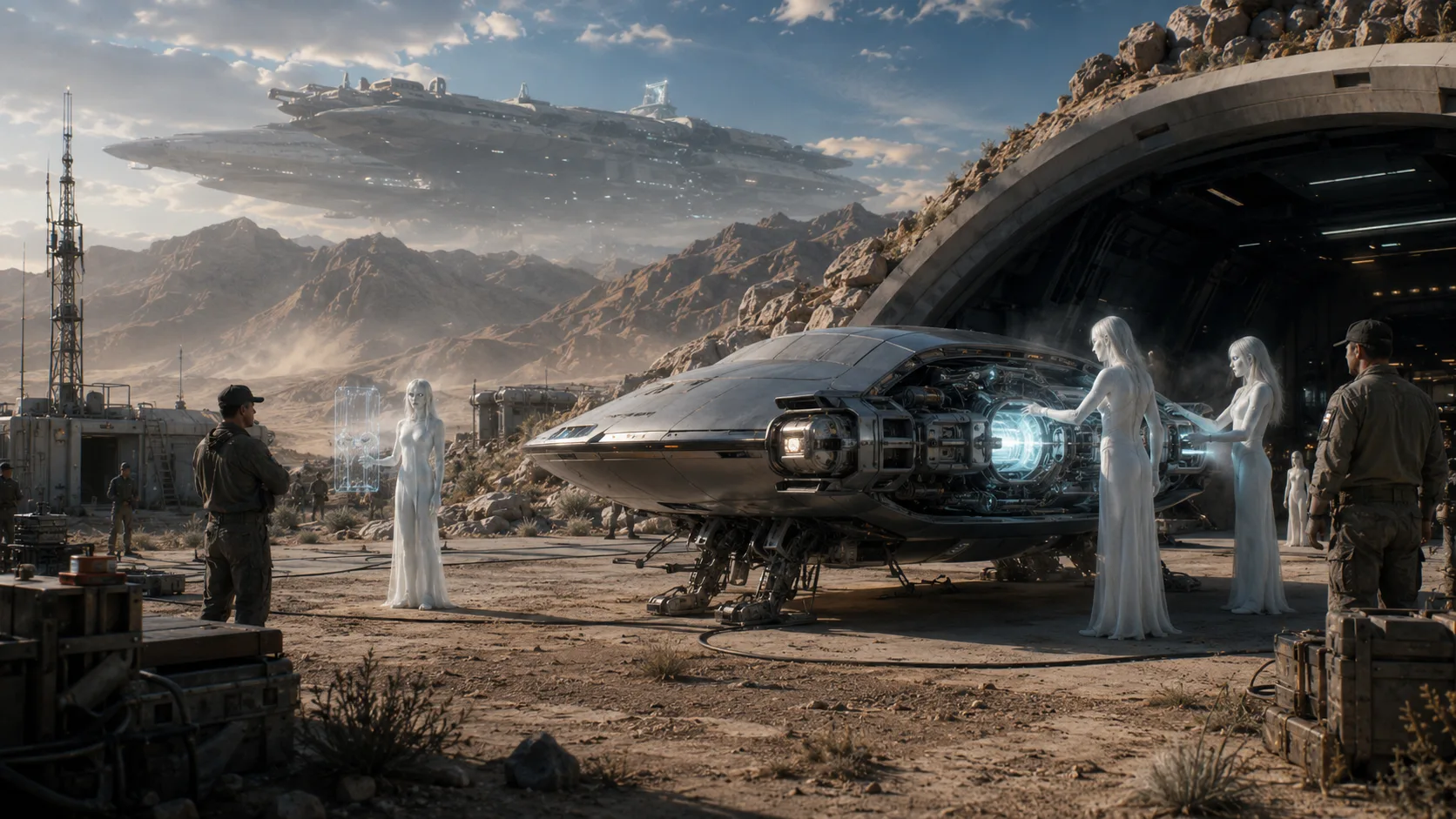
Hall’s technology descriptions divide the craft into smaller scout craft and larger deep space vessels. He claimed the scout craft were built or serviced using some Earth materials, while the more advanced propulsion systems remained under Tall White control.
In Salla’s correspondence, Hall said he saw markings from American industries on items inside one scout craft, including Boeing, Lockheed, and Airstream-related materials. He interpreted that as evidence that at least some components were locally sourced or adapted. (Exopolitics)
He also said the Tall Whites performed the work on propulsion systems themselves and did not allow U.S. personnel to observe the construction process closely. (Exopolitics)
That is one of the more interesting claims in the account. If Hall is describing a real exchange, it was not a simple “aliens gave us flying saucers” arrangement. It was more like restricted technical cooperation. Humans might supply materials and learn around the edges, but the core systems remained off limits.
That would fit the pattern of a superior power controlling the terms of access. It would also fit a broader deep national security model, where select officials gain limited technological advantage while the public sees nothing.
Did Other Servicemen See Them?
Hall repeatedly said yes.
In the Harris interview, he said other Air Force personnel saw the Tall Whites around buildings on the Indian Springs ranges, often interpreting them as ghosts, angels, fantastic creatures, or the legendary “Range Four Harry.” (Paola Harris)
The strongest supporting material is not direct proof of extraterrestrials, but contextual corroboration. Salla summarized David Coote’s interviews with three former military personnel connected to the Indian Springs environment. According to Salla’s summary, those interviews supported several surrounding elements, including Hall’s service in the isolated range environment, a pattern of “high strangeness,” the existence of the “Range Four Harry” legend, and claims that UFOs were known to senior personnel. Salla also clearly stated there was no direct confirmation of Hall’s Tall White claims. (Stealth Skater)
That distinction is crucial. The available corroboration does not prove the Tall Whites existed. It does suggest Hall’s story grew out of a real place, a real assignment, and a real culture of strange reports around Indian Springs.
For believers, that’s meaningful support. For skeptics, it’s not enough. Both reactions are reasonable.
The Weakest Point, Evidence
The most obvious weakness is simple. Hall did not produce photographs, official records, physical samples, or a clean chain of documentary evidence.
In the Harris interview, he acknowledged that he had no physical evidence, photographs, logbooks, printed reports, or written reports of his own. (Paola Harris)
That admission does not automatically make the story false. People in isolated military settings often leave with little more than memory. But it does mean the case rests heavily on Hall’s credibility, consistency, and the partial recollections of others.
This is why the official record matters. AARO’s position is that it has found no verifiable evidence of extraterrestrial technology, extraterrestrial activity, or hidden government access to alien technology. (U.S. Department of War)
So the Hall case lives in a familiar but uncomfortable space, detailed enough to be hard to dismiss casually, unsupported enough to remain unproven.
Why the Tall Whites Account Still Matters
Hall’s account matters because it changes the question.
Most UFO stories ask, “Did something strange appear in the sky?”
Hall’s story asks something larger: “What would long-term coexistence with a non-human society actually look like?”
His answer is not glamorous. It looks like fear, bureaucracy, supply chains, classified meetings, children’s clothing, medical risk, territorial rules, selective technology sharing, and tense misunderstandings. It looks less like a cosmic awakening and more like a dangerous foreign basing agreement.
That’s what makes the story so useful as a species profile. The Tall Whites, as Hall describes them, are not just bodies with blue eyes and pale skin. They are a political problem. A cultural problem. A governance problem.
If Hall is wrong, his account remains one of the most elaborate and psychologically interesting stories in UFO literature.
If Hall is partly right, then the implications are enormous. The real issue would not be whether aliens exist. It would be who negotiated with them, what was traded, who benefited, what was withheld, and what rules govern contact between civilizations when one side holds nearly all the power.
Conclusion: A Desert Story That Refuses to Stay Buried
Charles Hall’s Tall Whites account sits somewhere between testimony, folklore, military mystery, and alleged disclosure. It has the shape of a survival story, but also the scale of a geopolitical claim.
What makes it memorable is not just the idea of pale humanoids living near a restricted range. It is the slow, uncomfortable ordinariness of it all. A young weather observer doing his job. A remote desert facility. Children playing with equipment. Adults enforcing boundaries. Generals chasing technology. A frightened man learning that survival sometimes means standing still, speaking carefully, and remembering the rules.
The official world says there is no verifiable evidence for the larger claim. Hall’s supporters say the consistency, geography, and witness fragments deserve serious attention.
For now, the Tall Whites remain exactly where Hall placed them, at the edge of visibility, just beyond the weather shack, somewhere in the dry Nevada distance.


Cosmic Echoes
Share-ready comments you can copy in a click, then post wherever the conversation touches UFOs, UAP, or the Galactic Federation.
These comments belong to the Cosmic Echoes page under the section Desert Secrets: The Tall Whites Unveiled.
Plus 21 more comments on the Cosmic Echoes page.