
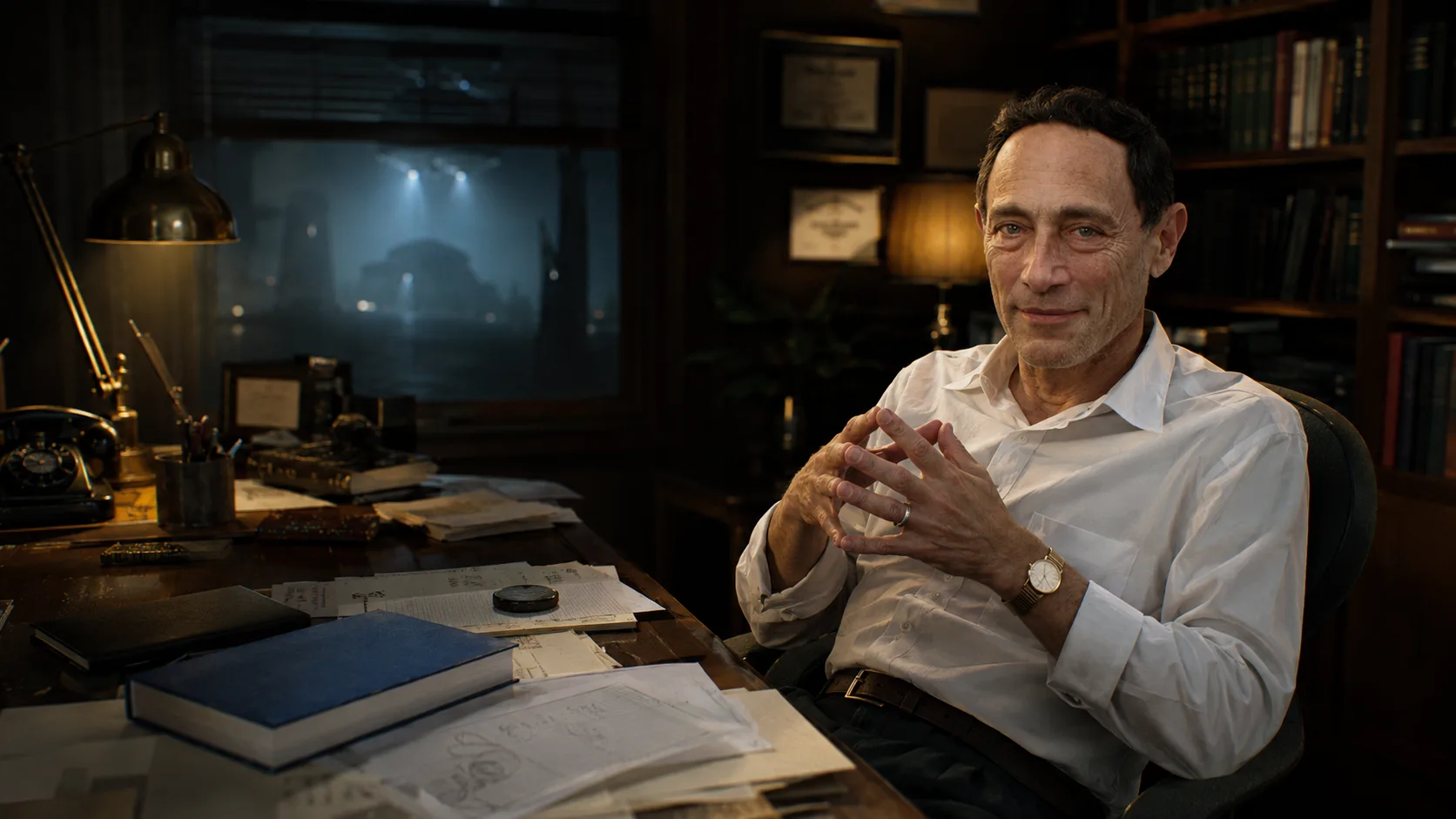
John E. Mack was not the kind of person the public usually expects to find at the center of the alien abduction question.
He was not a late-night radio personality, not a fringe theorist, and not a man building a career on UFO spectacle. Mack was a Harvard Medical School professor, a Pulitzer Prize-winning biographer, a trained psychiatrist, and a respected clinician whose earlier work dealt with dreams, adolescent suicide, nuclear conflict, and the psychology of human identity. Harvard’s own memorial described him as a man of “clinical excellence” whose accomplishments in psychiatry and scholarship would have counted as lifetime achievements for most people. (Harvard Gazette)
Then, in 1990, he began listening to people who claimed they had been taken by non-human intelligences.
That decision changed the rest of his life.
A Harvard Professor With Everything to Lose
Before alien abduction research made him controversial, Mack had already earned the kind of reputation most academics spend a lifetime trying to build. He graduated from Harvard Medical School, trained in psychiatry and psychoanalysis, helped build the psychiatry department at Cambridge Hospital, and became a professor of psychiatry at Harvard Medical School. (John Mack Institute)
In 1977, he won the Pulitzer Prize in Biography for A Prince of Our Disorder: The Life of T. E. Lawrence, his psychological biography of Lawrence of Arabia. The Pulitzer organization lists the award directly under Mack’s name. (The Pulitzer Prizes)
That background matters because Mack did not enter the abduction field as someone looking for a way into public attention. He already had status. He already had credentials. He already had a serious body of work. The alien abduction question gave him very little to gain professionally, and a great deal to lose.
That is one of the reasons his case still carries weight in disclosure research. Mack’s story is not just about alien encounters. It is about what happens when a credentialed expert follows witness testimony into territory that powerful institutions consider unacceptable.
The 1990 Turning Point
Mack’s entry into the subject came through artist and abduction researcher Budd Hopkins, who had spent years interviewing people who reported encounters with non-human beings. Mack’s first reaction was not belief. He reportedly wondered whether Hopkins himself had gone wrong for taking the subject seriously.
But after Mack began meeting experiencers directly in the winter of 1990, his position changed. He said it became clear to him that the cases could not be explained in a purely psychodynamic or psychosocial way. (The Harvard Crimson)
That did not mean Mack claimed to have solved the entire UFO mystery. He often presented himself less as a ufologist and more as a psychiatrist studying a profound human experience. On the John E. Mack Institute’s page for Abduction, Mack described himself as “a psychiatrist and a consciousness explorer,” and said his book was focused on thirteen people he had worked with closely, not the entire UFO field. (John Mack Institute)
That distinction is important. Mack’s central question was not simply, “Are spaceships visiting Earth?” It was deeper and more difficult: Why are sane, ordinary people from many backgrounds reporting intensely similar encounters that transform their lives?
What Mack Found in the Experiencers
Mack eventually studied more than 200 men and women who reported alien encounter experiences, according to the John E. Mack Institute’s biography of him. The Institute describes the work as a study of people whose reported encounters affected their worldview, spirituality, and concern for the environment. (John Mack Institute)
The patterns he found were hard for him to dismiss.
The experiencers came from different walks of life. They were not all UFO believers. They were not all seeking publicity. Many were frightened, confused, embarrassed, or reluctant to talk. Mack argued that the consistency of the accounts was one of the strongest reasons the phenomenon deserved serious attention.
In a PBS NOVA interview, Mack laid out five factors he believed conventional explanations failed to address:
- the consistency of accounts from person to person,
- the lack of an ordinary life experience that could explain the reports,
- physical marks or lesions reported by some experiencers,
- associations with UFO sightings independent of the experiencer,
- and reports from very young children. (PBS)
Mack did not argue that every account should be accepted uncritically. But he rejected the easy dismissal that all abductees were psychotic, fantasy-prone, or simply dreaming. In his view, the phenomenon was too consistent, too emotionally charged, and too transformative to be reduced to pathology.
The Question of Mental Illness
This is where Mack’s psychiatric background becomes central.
A less qualified researcher saying “these people are not crazy” might be dismissed. Mack, however, had spent his life studying the mind. He knew what psychosis, delusion, dissociation, trauma, and fantasy could look like clinically.
According to The Harvard Crimson, Mack argued that the people he studied were not expressing something produced by mental illness, and he pointed to the absence of personal psychopathology that could account for the experiences. (The Harvard Crimson)
That does not mean critics accepted his interpretation. Some challenged his use of hypnosis and warned that recovered memories can be unreliable. Others argued that cultural influence, suggestion, sleep phenomena, or fantasy could play a role. Those criticisms remain part of the debate.
But Mack’s position was not that every detail was automatically literal. His later work became more subtle, moving away from a simple physical-abduction model and toward the idea that these encounters may involve a reality that crosses psychological, spiritual, and physical boundaries.
“Abduction” and the Public Shock
In 1994, Mack published Abduction: Human Encounters with Aliens. Google Books describes the book as a work by a Harvard psychiatrist presenting accounts from more than sixty cases he had investigated, focused on people from many walks of life who described challenging and life-changing alien abduction experiences. (Google Books)
The book caused an immediate storm.
For supporters, Mack had brought clinical seriousness to a field long mocked by mainstream culture. For critics, he had crossed a dangerous line by giving credibility to claims that seemed impossible under conventional scientific assumptions.
The public did not simply see a UFO book. It saw a Harvard professor, with a Pulitzer Prize and a respected medical career, saying that the abduction phenomenon could not be dismissed as insanity or fantasy.
That was the real scandal.
The Harvard Investigation
In 1994, Harvard Medical School convened a special committee to investigate Mack’s work. The Harvard Crimson reported that the committee reviewed whether his work conformed with professional standards and whether it qualified as research on human subjects. (The Harvard Crimson)
The investigation became a major academic freedom issue. Alan Dershowitz, writing in The Harvard Crimson, argued that formal investigations of a professor’s ideas raised serious concerns about chilling academic freedom. He wrote that critics should answer Mack through reviews, rebuttals, debates, and books, not extraordinary institutional scrutiny. (John Mack Institute)
The American Association of University Professors also took notice of the case, according to a Washington Post report from the time. (The Washington Post)
In the end, Harvard did not censure Mack. The Medical School reaffirmed his academic freedom to study what he wished and state his opinions without impediment, while also warning him to maintain professional standards. (The Harvard Crimson)
Mack survived the inquiry, but the message was clear. A tenured Harvard professor could study almost anything, until the subject threatened the boundaries of acceptable reality.
“Passport to the Cosmos” and a Larger Reality
Mack’s second major book on the subject, Passport to the Cosmos: Human Transformation and Alien Encounters, appeared in 1999. It moved beyond the narrower language of abduction and focused more deeply on transformation, consciousness, ecology, and the possibility that the phenomenon was not purely material in the ordinary sense.
Google Books describes the book as Mack’s argument that alien encounter experiences call for a revolutionary new way of examining reality and humanity’s place in the cosmos. (Google Books)
The John E. Mack Institute frames Passport to the Cosmos as a book about a universe “filled with intelligence and life,” though not always in a densely embodied form familiar to human beings. (John Mack Institute)
That shift is key to understanding Mack’s mature position. He was not simply saying, “Aliens are physically taking people in metal ships.” He was asking whether human consciousness, non-human intelligence, and physical reality might interact in ways Western materialism is poorly equipped to understand.
The Transformation Pattern
One of Mack’s most important findings was that experiencers often changed after their encounters.
Many reported a reduced attachment to materialism, a stronger concern for the environment, a heightened sense of spiritual connection, and a broader view of reality. The John E. Mack Institute’s biography notes that Mack’s subjects often described increased spirituality and environmental concern after their experiences. (John Mack Institute)
Publishers Weekly’s review of Passport to the Cosmos also notes that Mack focused on experiencers who reported ecological messages and were left with a profound concern for the environment. (PublishersWeekly.com)
This pattern fascinated Mack because it did not fit neatly into a simple trauma model. Trauma often narrows a person’s world. Mack’s experiencers frequently described being terrified, but many also emerged with a larger sense of responsibility, connection, and meaning.
That does not prove every account is literally true. But it does make the phenomenon harder to dismiss as random fantasy.
The Ariel School Case
Mack’s work was not limited to adults reporting abductions. In 1994, he traveled to Zimbabwe to interview children at Ariel School after dozens of students reported seeing a UFO and beings near the school grounds.
The case remains controversial, but it became one of the most discussed mass-witness encounter reports of the 1990s. Reports describe more than sixty children claiming to have seen a craft and non-human figures, with some children later describing environmental messages. (Wikipedia)
The Ariel School case reinforced one of Mack’s central concerns: some reports came from children too young to easily fit adult psychiatric explanations, UFO subculture narratives, or deliberate hoaxing. Critics have proposed alternative explanations, including suggestion or social contagion, but the case remains part of Mack’s larger evidential landscape.
What Is Established, What Is Witness-Based, and What Remains Speculative
Mack’s story needs careful handling because it sits at the edge of documented history, witness testimony, and unresolved interpretation.
Established evidence: John E. Mack was a Harvard psychiatrist, Pulitzer Prize winner, and professor at Harvard Medical School. He studied experiencers for more than a decade, published Abduction and Passport to the Cosmos, was investigated by Harvard, retained his academic freedom, and died in London in 2004 after being struck by a drunk driver. (John Mack Institute)
Witness-based evidence: Mack’s core case rests on the testimony of experiencers, including repeated patterns across people who often did not know one another. He treated that testimony as evidence worthy of serious clinical and scholarly attention, not as proof to be accepted blindly.
Research-based analysis: Mack concluded that standard psychiatric explanations did not adequately account for the phenomenon as a whole. He believed the accounts pointed toward genuine contact with some form of non-human intelligence, though his later language became more nuanced about whether that contact was physical, spiritual, interdimensional, or some combination.
Speculative theory: Claims about the deeper origin of the beings, the full purpose of the encounters, or hidden forces behind Mack’s death remain speculative unless supported by stronger documentation.
That distinction matters. Mack’s legacy is strongest when presented honestly, not exaggerated.
Mack’s Death in 2004
On September 27, 2004, John Mack was killed in London after being struck by a car driven by a man under the influence of alcohol. Harvard’s memorial minute records the death plainly and describes it as tragic and unexpected. (Harvard Gazette)
Because of Mack’s controversial work, some researchers have noted the timing of his death and wondered what else he might have contributed had he lived longer. Those questions are understandable in the broader context of disclosure research.
But the documented record points to an accidental death caused by a drunk driver. Without stronger evidence, claims of foul play should remain in the category of speculation.
Why John Mack Still Matters
John Mack’s importance is not just that he studied alien abduction claims. Others did that before him.
His importance is that he brought elite psychiatric credibility to a subject that respectable institutions preferred to ridicule or ignore. He listened to witnesses carefully. He compared patterns. He looked for psychopathology and did not find an explanation that satisfied him. Then he said so publicly, knowing what it could cost him.
That cost was real.
He was mocked. He was investigated. His reputation was damaged in certain academic circles. Yet he continued to argue that human experience itself can be a legitimate field of evidence, especially when testimony is consistent, transformative, and resistant to conventional explanation.
Mack’s work does not force every reader to accept alien abduction as a simple physical fact. What it does force is a harder question:
What happens when credible people describe impossible things, and the easiest explanations fail?
For Mack, the answer was not ridicule. It was investigation.
And that may be his real legacy. Not certainty. Not blind belief. But the courage to sit with the witness, follow the evidence, and admit that reality may be larger than the institutions guarding its borders are willing to allow.



Cosmic Echoes
Share-ready comments you can copy in a click, then post wherever the conversation touches UFOs, UAP, or the Galactic Federation.
These comments belong to the Cosmic Echoes page under the section The Harvard Truth: When Science Meets the Unthinkable.
Plus 21 more comments on the Cosmic Echoes page.