
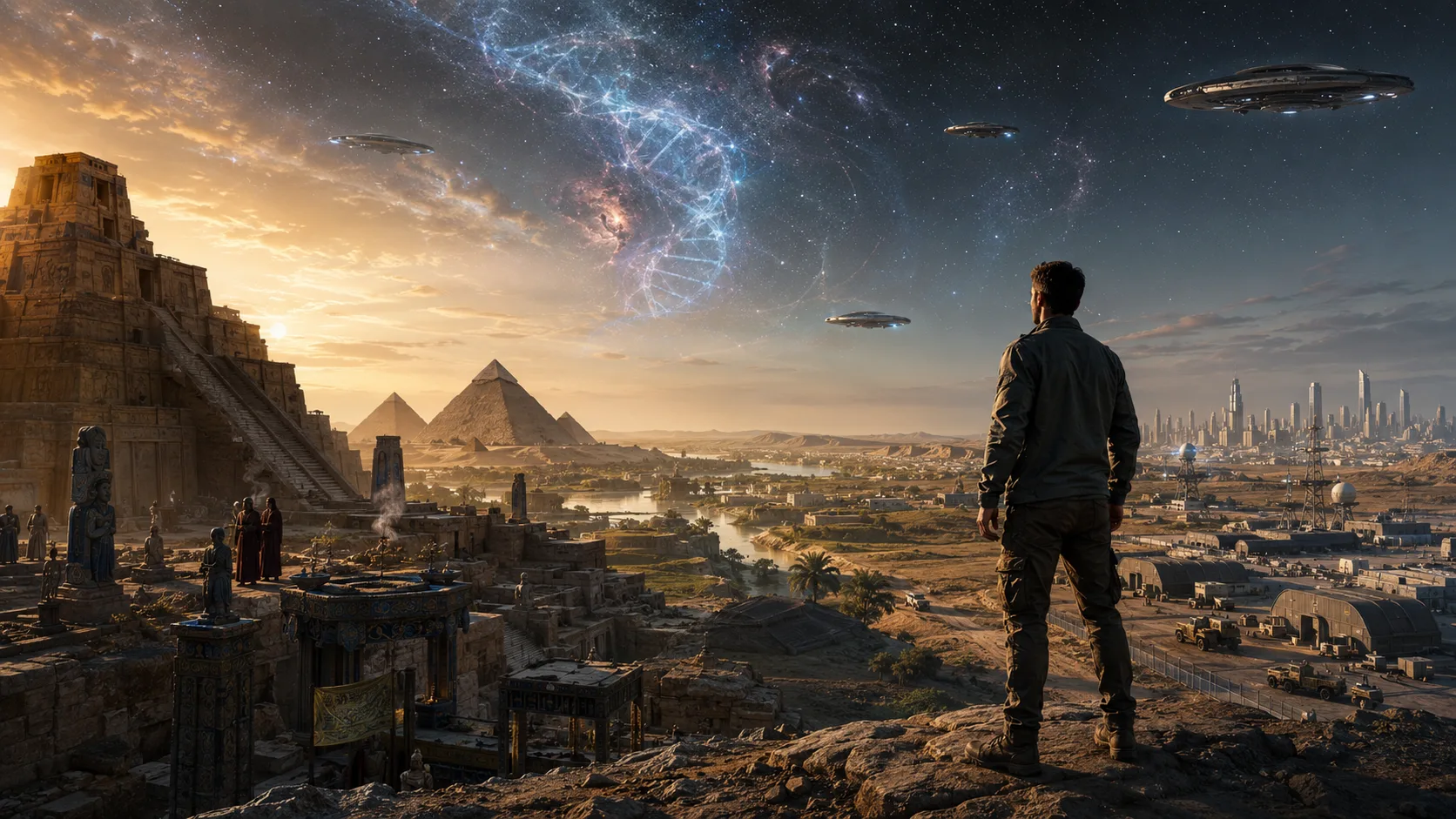
Humanity’s story has always carried a strange double quality. On one hand, it’s deeply earthly: bones, tools, migrations, farms, rivers, cities, wars, and written records. On the other, there are recurring moments when the timeline seems to leap forward so quickly that it invites bigger questions. Why did symbolic culture, urban civilization, kingship, astronomy, mathematics, and religious cosmology emerge with such force in the ancient world? Why do modern UAP reports cluster so strongly around military, technological, and nuclear-age concerns? And why does the idea of outside management keep reappearing, from ancient sky-god traditions to modern disclosure movements?
The Galactic Federation theory tries to answer those questions by treating Earth’s history as a sequence of managed phases rather than isolated mysteries. In this framework, the relationship between the Federation and humanity has moved through five broad eras: seeding, ancient civilization, withdrawal, modern surveillance, and the current transition toward disclosure.
This article approaches that theory as an interpretive model, not as established academic consensus. Mainstream archaeology, genetics, and government UAP investigations do not confirm extraterrestrial intervention. In fact, current scientific evidence places humans firmly within primate evolution, with modern human origins rooted in Africa and our DNA connected to the wider tree of life. (Human Origins) Still, the Federation narrative remains compelling to many because it attempts to connect patterns that are usually studied separately: human genetics, ancient civilization, myth, secrecy, nuclear weapons, and UAP disclosure.
Why a Phased History Matters
Looking at Earth’s possible Federation relationship in phases changes the question.
Instead of asking, “Did extraterrestrials appear here or there?” the better question becomes, “Has humanity’s development been guided differently at different moments?”
That distinction matters. A single event can be dismissed as myth, misidentification, or coincidence. A long pattern is harder to ignore, even if its meaning remains debated. The Federation theory suggests that Earth has never had one fixed contact policy. Instead, contact has shifted according to humanity’s maturity, technological risk, and the stability of the planetary experiment.
The five-phase model looks like this:
- The Seeding Era, when human biology was allegedly shaped or upgraded.
- The Ancient Civilization Era, when overt guidance appeared through early cultures and sky-being traditions.
- The Withdrawal and Isolation Era, when direct contact receded and influence became indirect.
- The Modern Engagement Era, when nuclear weapons triggered renewed monitoring.
- The Current Transition Era, when disclosure pressure, UAP reporting, and competing narratives entered public view.
Each phase ends with some kind of reset. Sometimes the reset is catastrophic, such as collapse, flood memory, war, or civilizational disruption. Sometimes it’s softer: a change in knowledge access, a reorganization of institutions, or a shift in what humanity is allowed to know.
Phase 1: The Seeding Era
The first phase is the most ancient and the hardest to prove. In the Federation model, Earth was not merely observed. It was prepared.
This theory argues that human DNA represents a deliberate composite, a biological vessel shaped from Earth-based primate evolution and enhanced through outside intervention. In this view, humanity is not “unnatural,” but hybrid by design: native to Earth, yet carrying a genetic and spiritual architecture meant to support unusually rapid consciousness development.
Mainstream science offers a different explanation. Fossil and DNA evidence show that Homo sapiens emerged through evolution, with deep roots in Africa and genetic continuity with other primates. Human beings also carry traces of ancient interbreeding with extinct relatives such as Neanderthals and Denisovans. Smithsonian notes that Neanderthals contributed roughly 1 to 4 percent of the genomes of many non-African modern humans, while Max Planck research describes interbreeding between modern humans and Neanderthals tens of thousands of years ago. (Human Origins)
For Federation theorists, that known genetic mixing is not the whole answer, but the doorway into a larger possibility. If human DNA already carries evidence of archaic blending, they ask, could deeper layers of intervention exist beyond what current tools can identify?
That is where the debate begins. The scientific record supports ancient human admixture, but not engineered extraterrestrial seeding. The Federation reading goes further, interpreting the unusual speed of symbolic, linguistic, and technological development as the result of guided preparation.
The Purpose of Seeding
Within the theory, the seeding era had three goals:
- To create a species capable of self-awareness and moral choice.
- To establish Earth as a genetic library, blending multiple lineages and potentials.
- To allow consciousness to develop under controlled limitation, without open knowledge of its origins.
That last point is central. Humanity, in this view, was not meant to begin with full memory. The amnesia was part of the experiment. A species that knows it is being managed behaves differently from one that must discover itself from the inside.
Phase 2: The Ancient Civilization Era
The second phase begins when human societies move from scattered settlements into organized civilizations with writing, temples, astronomy, agriculture, law, and kingship.
To Federation theorists, this is the period when outside involvement was most visible. Sumer, Egypt, and the Indus Valley are often treated as the great “contact civilizations,” not because every artifact proves extraterrestrial presence, but because each seems to appear with a striking level of symbolic and technical sophistication.
Mainstream archaeology does show that these civilizations had long developmental roots. Southern Mesopotamia, for example, was home to hunters, fishers, and farmers for thousands of years before Uruk became a major city around 3200 BCE. The Met describes Uruk by that time as a true city with monumental mud-brick architecture and extraordinary art. (The Metropolitan Museum of Art) Egypt also developed through long Predynastic phases before dynastic kingship, with Neolithic communities, art, ceramics, political centers, and eventually the Old Kingdom pyramid age. (The Metropolitan Museum of Art) The Indus civilization likewise had deep regional roots, with early farming and village development preceding the mature urban culture of Harappa and Mohenjo-daro. (Encyclopedia Britannica)
So the popular claim that these civilizations appeared with “no precursor” is too strong if taken literally. There were precursors. But the mystery, for alternative-history researchers, is the acceleration: the sudden density of writing, sacred architecture, cosmology, calendars, statecraft, and mythic memory once these civilizations reached maturity.
Sumer: The Template of Sky Authority
Sumer holds a special place in ancient astronaut theory because of its gods, kingship traditions, and early writing. The Anunnaki are often interpreted in Federation circles as memories of advanced beings who helped establish civilization, teach agriculture, regulate social order, and introduce astronomical knowledge.
Academically, Sumerian religion is studied as human mythology and political theology. But within the Federation model, the gods are not treated as fantasy. They are treated as cultural translations of contact: human language trying to describe beings with superior technology, longer lifespans, and administrative authority over Earth’s development.
Sumer, then, becomes the first major public interface between humanity and the “managers.”
Egypt: Initiation, Architecture, and the Afterlife Program
Egypt represents a different kind of contact memory. Where Sumer emphasizes divine administration, Egypt emphasizes initiation, death, rebirth, cosmic order, and the journey of the soul.
Federation theorists often point to Egyptian architecture and priestly astronomy as signs that ancient Egypt preserved fragments of a much older knowledge system. Mainstream Egyptology explains the pyramids, temples, and afterlife texts through dynastic religion, labor organization, engineering development, and royal ideology. The alternative reading doesn’t necessarily reject all of that. It asks whether those institutions were carrying encoded knowledge from a previous phase.
In this view, Egyptian civilization was not merely building tombs. It was preserving a map of consciousness.
The Indus Valley: The Quiet Civilization
The Indus Valley is more difficult to fold into a contact narrative because its script remains undeciphered and its cities do not present the same obvious king-and-temple pattern found in Mesopotamia and Egypt. That mystery makes it especially interesting.
The mature Indus civilization was one of the largest early urban cultures, known for planned cities, drainage systems, craft production, trade, and remarkable standardization. (Encyclopedia Britannica) Federation theorists sometimes read that orderliness as evidence of a different form of guidance: less theatrical, less mythologically loud, but highly systematic.
If Sumer was command, and Egypt was initiation, the Indus may have been balance.
Phase 3: The Withdrawal and Isolation Era
At some point, according to the Federation model, direct contact became too disruptive.
The ancient world was full of gods. Later history became full of institutions. That shift is the heart of Phase 3.
In this era, the Federation allegedly withdrew from overt involvement and allowed humanity to develop under conditions of partial isolation. The old sky-being encounters faded into scripture, myth, mystery schools, royal bloodlines, priesthoods, secret societies, and symbolic systems. Knowledge did not disappear, but it became compartmentalized.
This is also where the theory can easily slide into careless conspiracy thinking. Claims about “bloodline families” and hidden control structures should be handled carefully, without scapegoating ethnic, religious, or national groups. A more responsible version of the argument is that power became increasingly mediated through closed institutions: priesthoods, monarchies, empires, intelligence networks, financial systems, and cultural programming.
In the Federation interpretation, these structures served two purposes. Some preserved fragments of older knowledge. Others restricted humanity’s access to it.
Why Withdraw?
The theory gives several possible reasons:
Humanity may have become too dependent on outside authority. Competing non-human groups may have interfered with the original plan. Ancient civilizations may have misused inherited knowledge. Or the Federation itself may have adopted a non-intervention policy, allowing humanity to experience separation, conflict, and self-determination.
This is where the idea of “quarantine” enters the story. Earth becomes a managed but isolated world, watched from a distance, influenced through proxies, and prevented from full participation in a wider galactic community.
From the human side, this phase feels like abandonment. From the Federation side, it may have been containment.
Phase 4: The Modern Engagement Era
The fourth phase begins in the twentieth century, when humanity crosses a threshold no previous civilization is known to have crossed: nuclear weapons.
The Trinity test on July 16, 1945, marked the world’s first nuclear explosion and opened the atomic age. The U.S. Department of Energy identifies Trinity as the successful test of a plutonium implosion bomb at Alamogordo, New Mexico. (The Department of Energy’s Energy.gov) For Federation theorists, this was not just a military milestone. It was a planetary alarm.
Nuclear weapons changed humanity’s status. A species that could destroy cities, poison ecosystems, and potentially destabilize the planet had become dangerous not only to itself but, possibly, to surrounding dimensions, timelines, or inhabited systems. That is the core claim behind the “nuclear-UFO connection.”
The symbolic pivot year is 1947. That year sits at the center of modern UFO mythology because of Roswell, the birth of the national security state, and the explosion of “flying saucer” reports into public consciousness. Official U.S. Air Force Roswell reports attribute the incident to Project Mogul and related Cold War-era explanations, not extraterrestrial craft. (U.S. Air Force) But in the Federation narrative, Roswell represents something larger than one crash claim. It marks the moment when modern governments became aware, or more aware, that Earth was under direct observation.
Surveillance, Not Salvation
Modern engagement is not usually described as open contact. It is described as surveillance.
In this phase, UAP appear around military sites, aircraft, naval exercises, weapons systems, and restricted airspace. Modern government language has shifted from “UFO” to “UAP,” and official bodies now acknowledge that some reports remain unresolved. NASA’s 2023 independent study framed UAP as a scientific problem requiring better data, while AARO describes its mission as investigating UAP using a rigorous, data-driven approach. (NASA Science)
That does not equal confirmation of extraterrestrials. AARO states that it has found no evidence of extraterrestrial technology, and many cases resolve into balloons, drones, birds, atmospheric effects, or sensor issues. (AARO) But the existence of official investigation itself matters. The subject has moved from ridicule to bureaucracy.
In Federation terms, that shift is part of the transition.
Phase 5: The Current Transition Era
The current era is defined by pressure.
Public pressure. Congressional pressure. Whistleblower pressure. Scientific pressure. Spiritual pressure. Cultural pressure.
UAP are no longer confined to fringe radio shows and late-night documentaries. NASA, AARO, Congress, and the National Archives have all become part of the modern UAP landscape. The 2024 National Defense Authorization Act required the National Archives to establish a UAP Records Collection, and NARA has since published pages for UFO and UAP-related records across multiple record groups. (National Archives) The House Oversight Committee also held a public UAP hearing on November 13, 2024, titled “Unidentified Anomalous Phenomena: Exposing the Truth.” (Oversight Committee)
To mainstream observers, this is about transparency, national security, aviation safety, and data quality. To Federation theorists, it is something more: the managed breakdown of the old isolation system.
Disclosure as a Process, Not an Event
The biggest mistake people make about disclosure is expecting one announcement to settle everything.
Disclosure is more likely to behave like a slow thaw. First, the language changes. Then the stigma weakens. Then agencies admit that some cases are unresolved. Then archives open. Then private aerospace, defense, academic, and civilian research communities begin comparing data. Then the public adjusts to questions that would have sounded absurd a generation earlier.
That is already happening.
But the Federation narrative adds another layer: disclosure is not only a human political process. It is also, allegedly, a contested process among non-human factions.
Internal Federation Conflict and the Alcyone Council
Within some Galactic Federation and Pleiadian traditions, Earth is not managed by a single unified extraterrestrial authority. Different councils, alliances, and factions are said to disagree over how much humanity should know and how quickly intervention should occur.
The Alcyone Council, or Alcyone Pleiadian High Council, appears mainly in esoteric, channeled, and New Age-style material rather than in official UAP documentation. Online references describe it as connected with Pleiadian guidance, spiritual awakening, and resistance to more controlling Federation structures. (Echoes of the Infinite)
In the broader Federation story, the Alcyone Council represents the “resistance alliance” idea: a faction that believes humanity should be assisted more openly, liberated from secrecy, and allowed to reclaim sovereignty. Whether read literally or symbolically, it captures a powerful tension inside the disclosure movement.
Is humanity being protected by secrecy, or imprisoned by it?
That question sits at the center of the current transition era.
The Role of Resets
Every phase transition in this model involves a reset.
A reset does not always mean a global cataclysm. It means the operating conditions of human civilization are changed.
The Seeding Reset
The first reset was biological. Humanity’s baseline was allegedly altered, producing a species capable of language, abstraction, memory, and spiritual self-recognition.
The Civilization Reset
The second reset was cultural. Knowledge moved from scattered survival groups into temple cities, priesthoods, calendars, writing systems, law codes, and sacred kingship.
The Withdrawal Reset
The third reset was informational. Direct contact faded. Myth replaced memory. Institutions replaced gods. Humanity entered the long age of separation.
The Nuclear Reset
The fourth reset was technological. Atomic weapons forced renewed attention. Humanity could now damage itself at planetary scale, making passive observation impossible.
The Disclosure Reset
The fifth reset is psychological. Humanity is being asked to widen its idea of reality without collapsing into panic, fantasy, or blind trust.
That may be the hardest reset of all.
A flood can destroy buildings. A war can redraw borders. But disclosure changes the inner architecture of civilization. Religion, science, history, government, identity, and human purpose all have to stretch.
What the Evidence Can and Cannot Say
A serious article on this subject has to be honest about the evidence.
Archaeology does not prove open extraterrestrial management of Sumer, Egypt, or the Indus Valley. Genetics does not prove engineered seeding by non-human intelligences. Government UAP reports do not confirm a Galactic Federation. Current official U.S. sources repeatedly state that they have not verified extraterrestrial technology or beings. (AARO)
But the absence of confirmation is not the same as the absence of mystery.
There are unresolved UAP cases. There are ancient leaps in organization and symbolism that still inspire debate. There are mythological patterns that continue to feel strangely consistent across cultures. There is a modern disclosure process that would have seemed almost impossible a few decades ago. And there is a deep human intuition that our story may be larger than the version we inherited.
That is why the Federation theory persists. It gives structure to the unknown.
Where Humanity Stands Now
If the phased model is correct, humanity is no longer in the ancient contact era, and it is no longer fully in the isolation era. We are somewhere in between.
The old secrecy system is still active, but weaker. The old ridicule system still exists, but it no longer controls the conversation. Governments still deny confirmed extraterrestrial evidence, yet they now maintain formal UAP offices, release records, and hold public hearings. Scientists still demand better data, but the question itself has become legitimate enough for NASA to address. (NASA Science)
That is a major historical shift.
In Federation terms, this is the transition window: the period when humanity either matures into a more conscious planetary civilization or gets pulled back into another reset cycle.
The next phase may not begin with ships over every capital city. It may begin more quietly, with better questions.
Who are we when we stop thinking of Earth as isolated?
What happens when history becomes cosmic?
Can humanity handle contact without surrendering its sovereignty?
Can we face the possibility of guidance without becoming dependent on saviors?
The Federation story, whether read as literal history, spiritual mythology, or symbolic map, ultimately points to the same challenge. Humanity is being asked to grow up.
Not by waiting for rescue. Not by worshiping visitors. Not by blindly trusting governments, councils, whistleblowers, or channeled sources.
But by becoming the kind of civilization that could enter a wider community without losing itself.
That may be the real meaning of disclosure. Not simply learning that others are here, but proving that we are finally ready to meet them.


Cosmic Echoes
Share-ready comments you can copy in a click, then post wherever the conversation touches UFOs, UAP, or the Galactic Federation.
These comments belong to the Cosmic Echoes page under the section Cosmic Echoes: Humanity’s Hidden Galactic Journey.
Plus 21 more comments on the Cosmic Echoes page.