

In the early 1960s, before “channeling” became a familiar word in New Age circles, an American writer named Jane Roberts began receiving material from an intelligence who called himself Seth. What followed was not a handful of mystical sayings or a loose set of spiritual impressions. It became a vast, internally layered body of work on consciousness, time, identity, belief, dreams, probability, and the multidimensional nature of the soul.
From 1963 until Roberts’s death in 1984, Seth spoke through her while her husband, artist Robert F. Butts, recorded and annotated the sessions. The result was one of the most influential channeled archives of the modern era: 10 Seth-dictated books, thousands of transcribed sessions, extensive personal and class sessions, original audio recordings, and a literary record now preserved in major archival collections. Seth himself was careful about his identity. He did not present himself as a gray alien, Pleiadian ambassador, or religious angel, but as an “energy personality essence no longer focused in physical matter.” That single phrase tells you why the Seth Material sits in such an unusual place: not strictly ET, not conventionally spiritualist, but unmistakably multidimensional. (mitpressbookstore)
For modern ET-contact traditions, the Seth Material functions like philosophical bedrock. Many later transmissions assume ideas that Seth explained in depth: reality as consciousness-generated, time as simultaneous, the self as multidimensional, and physical life as one focus within a much larger field of identity. Read through that lens, Seth becomes less like a “channeled teacher” in the narrow sense and more like an advanced curriculum in how consciousness operates across worlds, timelines, and densities of experience.
Jane Roberts: The Writer Who Became the Channel
Jane Roberts was not looking to start a religion. She was a poet, novelist, and experimenter in consciousness, raised in Saratoga Springs, New York, and educated at Skidmore College. Yale’s archival guide describes her as an author of fiction, poetry, children’s literature, novels, and nonfiction works dealing with Seth and channeling. (Yale EAD PDFs)
The story began in 1963, when Jane and Robert Butts experimented with a Ouija board as part of Jane’s research into extrasensory perception. According to the Seth Center’s historical overview, that moment opened into hundreds of sessions over the next two decades, with Rob carefully transcribing the material in their apartment while Jane entered trance states. (Seth Center)
The earliest sessions were not polished public books. They were exploratory, sometimes experimental, and often intimate. The Seth Center describes The Early Sessions Books 1 through 9 as complete transcripts channeled by Roberts and annotated by Butts, beginning in 1963, before Seth began dictating material intended for the general public. (Seth Center)
That matters. The Seth Material did not arrive as branding. It began as a private investigation between two skeptical, creative people trying to understand what was happening in their living room.
Who, or What, Is Seth?
Seth’s self-description is one of the keys to understanding the whole body of work. He described himself as a personality essence no longer focused in physical matter, meaning a conscious identity not dependent on a physical body for existence. (mitpressbookstore)
That statement does not fit neatly into the usual categories. Seth was not “extraterrestrial” in the simple sense of being from another planet. He was not a deceased human personality in the traditional spiritualist sense either. He presented himself as a multidimensional consciousness, a teacher speaking from a level of reality where physical identity, linear time, and single-life memory are not the main organizing principles.
This is why the Seth Material has such relevance to ET and Federation-style contact frameworks. The deeper question in advanced contact is rarely, “Which planet are they from?” The deeper question is, “What level of consciousness is communicating, and through what dimensional interface?” Seth’s answer begins there.
Why the Seth Material Is So Unusual
Most channeled systems are fragmentary. They may contain beautiful ideas, but they often lack philosophical continuity. Seth is different. The material is broad, dense, and surprisingly systematic.
The Seth Center says Jane Roberts in trance dictated 10 books and conducted thousands of transcribed sessions between 1964 and 1984. (Seth – Jane Roberts) Yale University Library’s Jane Roberts Papers include 166.17 linear feet of material across 501 boxes, including correspondence, printed material, audio and videotapes, journals, poetry, and documents connected to her life and literary career. (Yale EAD PDFs)
The documentation is important because Seth was not merely a memory reported years later. There were transcripts, session notes, class records, and audio materials. Yale’s finding aid also lists ESP class sessions and session tapes, showing that the phenomenon left behind a substantial documentary trail. (Yale EAD PDFs)
Researcher Paul Cunningham’s case study of Jane Roberts describes a complete record made by Robert Butts from 1963 through 1984, supplemented by notes, witness reports, and class attendees. Cunningham also notes observed alterations during trance, including changes in facial features, gestures, voice volume, accent, word inflection, and pupils. (ResearchGate)
None of that proves Seth’s claimed origin by itself. But it does make the Seth case one of the more thoroughly documented modern channeling phenomena. It is not just a story. It is an archive.
Reality Creation: More Than Positive Thinking
The most famous Seth phrase is simple: “You create your own reality.” Unfortunately, simple phrases are easy to flatten.
In Seth’s framework, reality creation is not a motivational slogan. It is not the idea that smiling harder makes problems disappear. It is a metaphysical model of how consciousness, belief, emotion, expectation, and perception interact to produce lived experience.
The Seth Center summarizes the teaching as reality being shaped through thoughts, emotions, beliefs, and expectations. (Seth Center) Cunningham’s study describes The Nature of Personal Reality as Seth’s psychology and ethical teaching, centered on the idea that conscious beliefs and expectations influence subconscious processes that determine personal experience. (ResearchGate)
In plain language, Seth is saying that the physical world is not something consciousness merely looks at. It is something consciousness participates in forming.
That does not mean every event is consciously chosen by the ego. Seth’s model is far more layered than that. The waking personality is only one part of the self. Beliefs can be conscious or unconscious, personal or collective, inherited or chosen, emotional or symbolic. A person may reject an experience at the ego level while still participating in deeper belief structures, family patterns, collective agreements, or probable-life dynamics that shape what becomes physically real.
This is where the teaching often gets misunderstood. Seth’s reality creation is not victim-blaming. It is a theory of participation. It asks us to look beneath surface desire and examine the beliefs we actually hold, the fears we rehearse, the identities we protect, and the emotional assumptions we unconsciously treat as truth.
Beliefs as Reality Generators
In Seth’s system, beliefs are not just opinions in the mind. They are organizing instructions.
A belief tells perception what to notice. It tells emotion what to expect. It tells the body how to respond. It tells the imagination which futures feel possible. Over time, beliefs become filters, and filters become patterns of experience.
This is why Seth’s teachings place so much emphasis on identifying limiting beliefs. If someone believes the world is unsafe, they may unconsciously scan for danger. If someone believes love always ends in abandonment, they may interpret ambiguity as rejection. If someone believes success requires suffering, they may sabotage ease because ease feels suspicious.
Seth’s point is not that belief is “magic” in a shallow sense. It is that consciousness is creative at every level. The inner atmosphere of the self becomes the lens through which probabilities are selected, interpreted, and eventually lived.
Simultaneous Time and Probable Realities
Seth’s model of time is one of the most intellectually ambitious parts of the material.
According to Seth, linear time is not the ultimate structure of reality. It is a practical arrangement used by physical consciousness. Behind it, all moments exist in a larger simultaneity. The past is not dead. The future is not empty. Probable selves and probable realities are active dimensions of a larger field.
The Seth Center’s descriptions of The Early Sessions repeatedly reference probable realities, probable selves, parallel lives, simultaneous time, past and future selves, and the possibility of changing past or future events. (Seth Center)
This does not mean Seth was “doing physics.” But his model does resonate with certain philosophical and scientific interpretations of time and probability. In philosophy of time, eternalism holds that past, present, and future all exist, rather than only the present being real. The Internet Encyclopedia of Philosophy describes eternalism as the equal existence of all times, with past, present, and future events all real in the larger structure of time. (Internet Encyclopedia of Philosophy) Stanford’s entry on time similarly contrasts presentism with eternalism and notes that B-theory and eternalist views treat time more like a dimension than a flowing objective present. (Stanford Encyclopedia of Philosophy)
Quantum many-worlds interpretations also provide a useful comparison, though not proof. Stanford’s entry on the many-worlds interpretation describes it as the view that many worlds exist in parallel, with different outcomes realized in different worlds. (Stanford Encyclopedia of Philosophy)
Seth’s probable realities are not identical to many-worlds physics. Seth adds consciousness, meaning, identity, and psychological choice to the model. Still, the comparison is useful because it shows why Seth’s framework feels unusually modern. He was presenting a consciousness-based probability cosmology before “parallel realities” became a familiar phrase in mainstream culture.
The Multidimensional Self
For Seth, the human personality is not the whole self. It is a focus.
The physical person you call “me” is one expression of a larger entity. That entity may have many incarnational focuses, probable selves, dream selves, and parallel expressions. These are not merely symbolic. In Seth’s framework, they are real portions of a multidimensional identity exploring different angles of experience.
This idea is central to why the Seth Material matters for ET contact traditions. Many later contact systems speak of higher selves, oversouls, soul groups, parallel incarnations, density levels, and simultaneous lives. Seth gave one of the earliest and most detailed philosophical maps for understanding how such a structure could work.
The Seth Center describes the material as exploring the multidimensional nature of the self, the eternal validity of the soul, probable realities, parallel selves, dream selves, and interconnected facets of multidimensional existence. (Seth Center)
In this view, the soul is not a tiny spiritual object inside the body. It is more like a vast intelligence projecting many streams of experience. The physical lifetime is one window. The entity is the house.
The “Unknown Reality” Framework
Seth’s The “Unknown” Reality expands the map beyond ordinary physical identity. It deals with hidden dimensions of consciousness, unconscious sources, probable systems, and forms of awareness that do not depend on the waking ego.
Cunningham’s overview describes The “Unknown” Reality volumes as exploring hidden dimensions, unconscious sources, deeper realities, and topics that touch anthropology, psychology, sociology, physics, biology, history, evolution, parapsychology, religion, and philosophy. (ResearchGate)
This is where Seth becomes especially useful for contact research. Contact experiences often happen outside normal waking consciousness: in dreams, altered states, out-of-body episodes, telepathic impressions, synchronicities, missing time, and expanded states of knowing. Seth’s model does not treat those as random anomalies. It treats them as evidence that waking consciousness is only one band on a much wider spectrum.
The “unknown reality” is not somewhere else. It is the deeper structure already operating beneath the surface of physical life.
Seth and ET Contact Traditions
Seth was not an ET ambassador, but the Seth Material gives later ET contact traditions much of their philosophical grammar.
When a Federation-style contact speaks of consciousness creating timelines, Seth helps explain what that could mean. When an ET source speaks of simultaneous incarnations, Seth provides a model of probable selves and multidimensional identity. When contactees describe communication outside linear time, Seth’s framework of simultaneous time gives the experience a broader context.
The connection is structural, not literal. Seth does not need to be “from the Pleiades” or “part of a galactic council” to be relevant to ET contact. In fact, his refusal to fit into an easy category may be part of the value. Seth points toward a level of intelligence where the categories of extraterrestrial, interdimensional, spiritual, and psychological begin to overlap.
A useful comparison is the Law of One material. The Law of One website describes the Ra Material as 106 conversations between Don Elkins, Carla Rueckert, Jim McCarty, and Ra, who is presented as a sixth-density social memory complex associated with Venus, channeled between 1981 and 1984. (The Law of One)
The Law of One is more explicitly ET-coded than Seth. But both systems share major themes: multidimensional identity, consciousness evolution, nonordinary communication, and a universe structured by intelligence rather than dead mechanism. Seth is less cosmological in the UFO sense, but more psychologically and philosophically detailed. Ra gives a grand cosmic architecture. Seth explains the inner mechanics of the consciousness that would live inside such an architecture.
The Influence on Later Channeled Material
It is difficult to overstate Seth’s influence on later channeling.
The Seth Center describes Seth’s teachings as a major force in the New Age movement, with books selling millions of copies and translated into multiple languages. (Seth Center) The MIT Press Bookstore description of The Way Toward Health likewise calls the Seth books classics in psychology and personal growth and one of the major forces behind the New Age philosophical movement of the 1970s. (mitpressbookstore)
The Abraham-Hicks material shows one clear line of continuity. Catherine Albanese’s Oxford Academic chapter on Seth and Abraham states that Jane Roberts and Esther Hicks both functioned as trance channels, that Seth was more theoretically focused while Abraham was more practical, and that the involvement of Esther and Jerry Hicks in the Seth material created clear thematic continuity between the two. A 2007 interview also reports Esther Hicks saying Jerry had been reading the Seth books and that the couple read Seth for hours during the period before Abraham emerged. (Cult Education Institute)
The Law of One lineage also intersects with Seth historically. L/L Research materials recount Jim McCarty saying he encountered the Seth Material in 1972, read nearly everything Roberts channeled, corresponded with Jane Roberts, and received a publisher suggestion from her after sending early Ra sessions. (L/L Research) Another L/L Research letter notes that the publisher’s title “The Ra Material” was chosen partly to ride the coattails of “The Seth Material,” showing how prominent Seth already was within the channeling field. (L/L Research)
This does not mean later channels copied Seth. It means Seth created a conceptual field. After Seth, terms like “you create your reality,” “probable selves,” “higher consciousness,” “multidimensional self,” and “beliefs shape experience” became part of the shared vocabulary of modern metaphysics.
The Seth Material Map of Conscious Creation
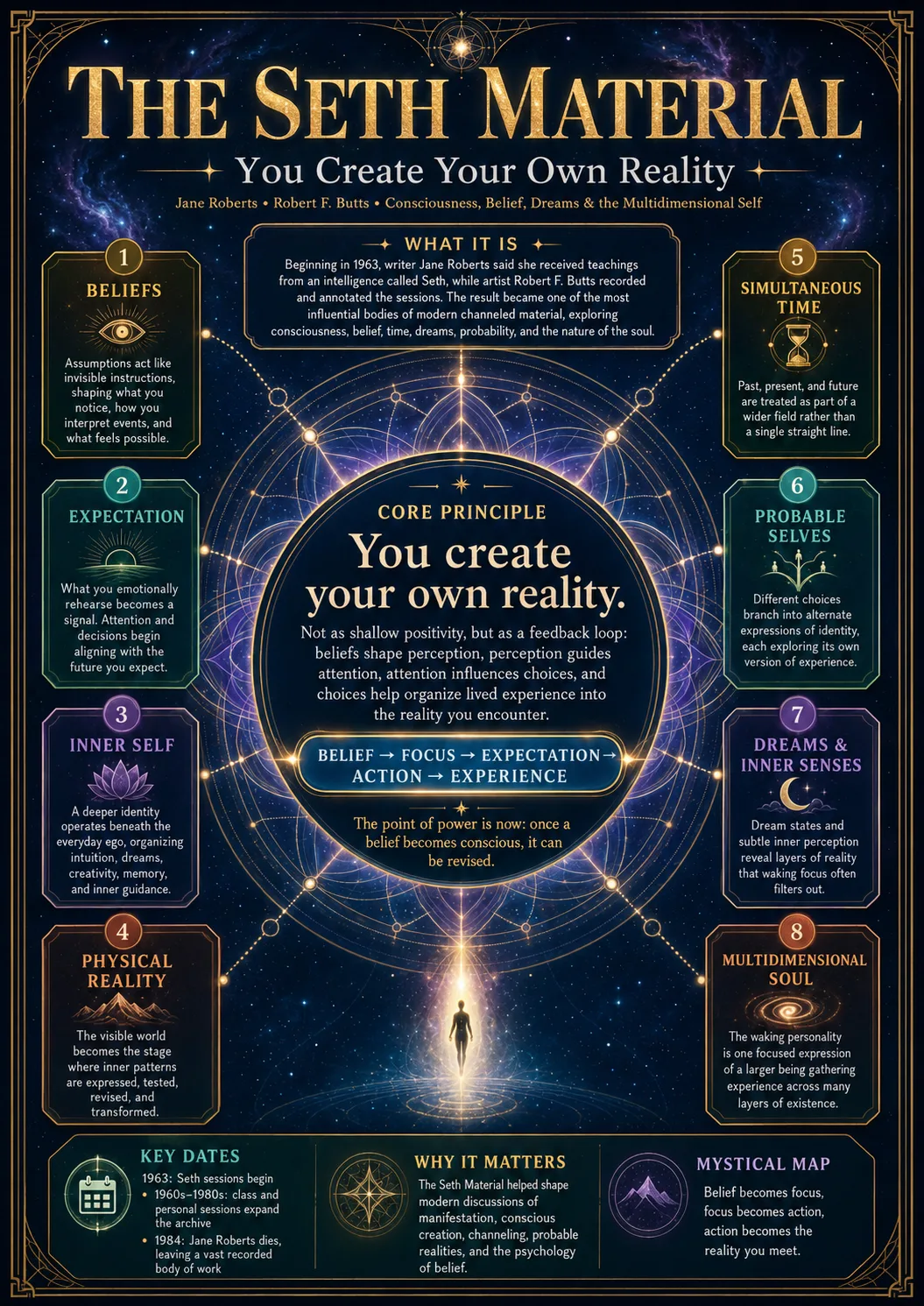
This infographic turns The Seth Material into a mystical map of consciousness. Instead of presenting reality as something fixed and separate from the observer, it frames experience as something shaped through belief, attention, expectation, choice, dreams, inner perception, and the deeper layers of identity.
The center of the image carries the main Seth principle: you create your own reality. In this context, that does not mean shallow wishful thinking or pretending life has no resistance. It points to a deeper feedback loop where beliefs influence perception, perception guides attention, attention shapes choices, and repeated choices help organize the experience a person eventually meets.
The surrounding cards expand that idea into a larger metaphysical framework. Beliefs become the invisible instructions behind what feels possible. Expectations become emotional rehearsals of the future. The inner self becomes the deeper organizing intelligence beneath the surface personality. Dreams and inner senses become doorways into layers of reality that ordinary waking focus may filter out.
What makes the image powerful is the way it organizes a complex body of channeled philosophy into one readable symbolic system. The gold geometry, starfield, mandala structure, and numbered concept panels make the material feel like a cosmic operating map. Every element points back to the same question: what happens when consciousness is not just reacting to reality, but actively participating in how reality is formed?
As an editorial visual for GalacticFederation.in, the infographic works as both an introduction and a reference point. It gives readers a fast way to understand why The Seth Material became so influential in modern discussions of manifestation, multidimensional identity, probable realities, channeling, dream exploration, and the psychology of belief.
Editorial concept for The Seth Material: a mystical infographic designed to explain conscious creation, belief revision, probable realities, and the multidimensional self in a clear, cinematic, and visually memorable way.
“`Evidence, Testimony, and Speculation
The Seth Material is best approached with intellectual honesty. It does not require blind belief, and it should not be dismissed simply because it comes through channeling.
A balanced evaluation looks something like this:
Established evidence: Jane Roberts existed, wrote extensively, conducted sessions with Robert Butts, and left behind a large archive of manuscripts, correspondence, session material, journals, audio, and video records. Yale’s Jane Roberts Papers preserve a substantial portion of that record. (Yale EAD PDFs)
Witness-based evidence: Robert Butts documented the sessions, class participants witnessed Jane in trance, and researchers have noted reported changes in voice, facial expression, gesture, and behavior during channeling. (ResearchGate)
Research-based analysis: Scholars and researchers have studied the Seth case as a major example of modern mediumship, New Age religion, and consciousness-based metaphysics. Cunningham’s work treats the case as difficult to classify and worthy of serious study rather than easy dismissal. (ResearchGate)
Speculative theory: Seth’s claimed identity as an independent nonphysical intelligence remains a matter of interpretation. The possibilities range from extraordinary creative subconscious production to genuine discarnate or multidimensional communication. The archive cannot force one conclusion, but it does make the phenomenon unusually rich.
That is the right posture for the Seth Material: open-minded, careful, and precise.
Why Seth Still Matters
The Seth Material remains powerful because it does not merely ask people to believe in invisible worlds. It asks them to rethink the architecture of experience itself.
What is a self? What is time? Where do events come from? Are dreams private hallucinations, or are they meetings with other layers of identity? Are beliefs just thoughts, or are they formative forces? Is consciousness inside matter, or is matter inside consciousness?
Seth’s answers are radical, but they are not sloppy. They form a coherent metaphysical system: consciousness is primary, physical reality is participatory, time is simultaneous at deeper levels, and the soul is multidimensional.
For ET contact research, that may be Seth’s greatest contribution. Before a person can understand interdimensional contact, they need a model of interdimensional consciousness. Before they can understand timeline shifts, they need a model of probable realities. Before they can understand higher-density intelligence, they need a model of identity that is larger than the body.
Seth gave that model.
Conclusion: The Philosophical Infrastructure of Modern Metaphysics
Jane Roberts and Robert Butts did not simply produce a famous channeled series. They preserved one of the most extensive modern records of a claimed nonphysical intelligence presenting a complete philosophy of consciousness.
Whether one views Seth as an independent entity, a higher aspect of Jane Roberts’s psyche, a multidimensional teacher, or an unexplained fusion of creativity and contact, the material stands as one of the most sophisticated transmissions in modern metaphysical history.
Its central teaching is not merely that thoughts become things. It is that consciousness is not a passive witness to reality. It is reality’s living source, selector, interpreter, and creative participant.
That is why the Seth Material still feels ahead of its time. It gave modern seekers, channelers, and ET-contact researchers a language for ideas that many traditions would only later begin to express: simultaneous time, probable selves, multidimensional identity, belief-generated experience, and consciousness as the foundation of worlds.
If later ET contact traditions built the house, Seth helped pour the foundation.



Cosmic Echoes
Share-ready comments you can copy in a click, then post wherever the conversation touches UFOs, UAP, or the Galactic Federation.
These comments belong to the Cosmic Echoes page under the section Seth Material: Unlocking Multidimensional Consciousness.
Plus 21 more comments on the Cosmic Echoes page.