
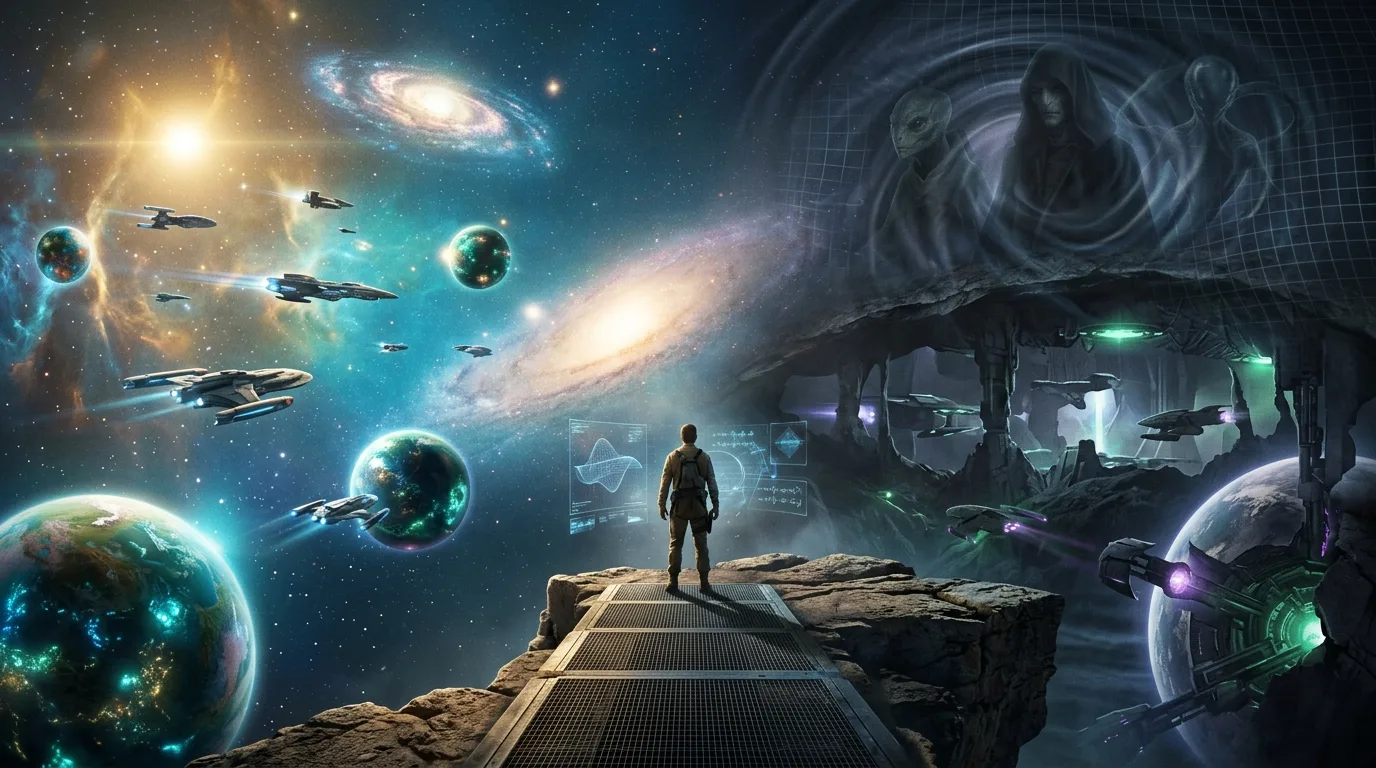
There’s something strangely disarming about The Orville. On the surface, it plays like a comedic love letter to classic sci-fi, but spend a little time with it and you realize it’s doing something deeper. It strips away the stiffness, the rigid perfection, and the almost ceremonial tone that defines Star Trek, and replaces it with something more human. Messy. Emotional. Real.
Where Star Trek often feels like a polished vision of how humanity should behave, The Orville shows how we actually would behave if we suddenly found ourselves exploring the stars. People joke. They make mistakes. They fall in love, argue, question authority, and wrestle with morality in ways that feel grounded and authentic. And yet, despite its humor, the show doesn’t hold back when it comes to serious themes, identity, war, ethics, and the cost of progress.
Visually, it’s stunning. The ships feel massive and alive, the space battles are cinematic, and the planetary environments carry a level of detail that rivals big-budget films. But the real magic isn’t just in how it looks. It’s in how believable it feels.
Because when you really step back, you start to ask a question:
What if this isn’t just entertainment?
The Union vs. The Federation: Two Mirrors of the Same Idea
In The Orville, humanity is part of “The Union,” a cooperative alliance of species working toward shared goals. In Star Trek, it’s the “Federation,” a nearly identical concept, built on exploration, diplomacy, and unity.
Different names, same idea.
A structured, interstellar system where multiple intelligent species collaborate, share knowledge, and maintain balance.
Now take that concept out of fiction for a second.
The idea of a larger governing body beyond Earth, a coalition of civilizations, isn’t new. It shows up across decades of sci-fi, across cultures, across writers who never collaborated. That repetition alone is enough to make you pause.
Why do we keep imagining the same structure?
Because at some level, it makes sense.
If intelligent life exists beyond Earth, and if it has existed for longer than we have, then cooperation isn’t just logical, it’s necessary. A system like “The Union” or “The Federation” isn’t fantasy, it’s the natural outcome of advanced civilizations interacting over time.
Technology That Changes Everything
Both shows present technology that feels impossibly advanced, yet oddly intuitive.
- Ships that bend space and travel faster than light
- Medical systems that can heal injuries in minutes
- Devices that can synthesize food, clothing, and materials instantly
- Energy sources that never run out
- Communication across vast distances without delay
These aren’t just cool ideas. They’re solutions.
Solutions to hunger.
Solutions to disease.
Solutions to energy scarcity.
Solutions to distance and isolation.
If even a fraction of that technology existed, the entire structure of our world would collapse and rebuild overnight.
Money would lose its grip.
Resource wars would become meaningless.
Entire industries would disappear.
The question then becomes:
If these technologies are theoretically possible, why don’t we see them?
The Gap Between What We See and What We’re Told
There’s a growing tension in modern culture between what people are told is possible and what they feel should be possible.
We’re taught that progress is slow, that breakthroughs take decades, that limitations are natural. But at the same time, we watch fictional universes casually bypass those limitations with solutions that feel… logical.
That disconnect is what makes shows like The Orville hit differently.
Because it doesn’t present technology as distant fantasy. It presents it as something that already fits together.
Warp travel isn’t magic, it’s engineering.
Matter synthesis isn’t fantasy, it’s control over structure.
Advanced medicine isn’t a miracle, it’s knowledge applied correctly.
It all feels like a continuation, not a leap.
The Bigger Question: What Kind of Reality Are We In?
Once you start thinking about advanced technology, it naturally leads to a bigger question about reality itself.
We exist in three dimensions, at least in the way we perceive the world. But physics has long suggested that higher dimensions may exist, layers of reality that operate beyond what we can directly observe.
If that’s true, then what we experience is only a slice of a much larger system.
Different dimensions could coexist, overlapping but unseen. Different timelines could branch, diverge, and evolve independently. Cause and effect might not be as linear as we assume.
Now bring that back to the kind of technology we see in these shows.
If you can manipulate space, you’re already bending the rules.
If you can manipulate time, you’re rewriting them.
If you can manipulate matter at its core, you’re operating at a level that redefines reality itself.
At that point, you’re not just traveling. You’re navigating a system most people don’t even realize exists.
Why These Stories Matter
It’s easy to dismiss all of this as entertainment. That’s the safe way to look at it. But storytelling has always been a reflection of possibility.
Every major technological leap in human history was imagined before it was built.
Flight.
Communication across distance.
Artificial intelligence.
All of it started as an idea.
What The Orville does so well is remove the barrier between idea and relatability. It shows a future that doesn’t feel alien. It feels like a natural extension of who we already are.
And that’s what makes it powerful.
Because it doesn’t just entertain you. It makes you question.
The Reality We’re Building
Whether you believe these ideas represent hidden truths, distant possibilities, or simply creative storytelling, one thing is undeniable:
Humanity is moving forward.
We’re pushing into space.
We’re advancing medicine.
We’re exploring energy systems that were once considered impossible.
Step by step, we’re building toward something bigger.
Maybe it won’t look exactly like The Union or The Federation. Maybe it will be messier, slower, more complicated.
But the direction is the same.
Final Thought
The Orville isn’t just a show. It’s a lens.
A way to look at humanity without the filters, without the rigidity, without the assumption that we have everything figured out.
It reminds us that progress doesn’t have to be sterile. It can be human. Emotional. Imperfect.
And maybe that’s the real takeaway.
Not that everything we see in these stories is real.
But that everything we see in them could be pointing toward something real.
Something bigger than what we’ve been told.
Something worth questioning.
Something worth exploring.
Because at the end of the day, whether it’s fiction or a glimpse of what’s possible, one truth remains:
The future isn’t decided for us.
It’s built by us.
If You’re Ready to Question Reality, Go Deeper
Step beyond the polished surface of science fiction and into the space where questions stop being comfortable. This is the part most people avoid, not because it’s impossible, but because it forces a shift in how reality itself is perceived.
There’s a narrative that has quietly persisted for decades, not just in fringe communities, but in the testimonies of individuals who claim to have operated inside highly compartmentalized systems. According to these accounts, the structure of power on Earth may not be as simple as elected officials and visible institutions. Instead, it’s described as layered, segmented, and intentionally fragmented so that no single group sees the full picture.
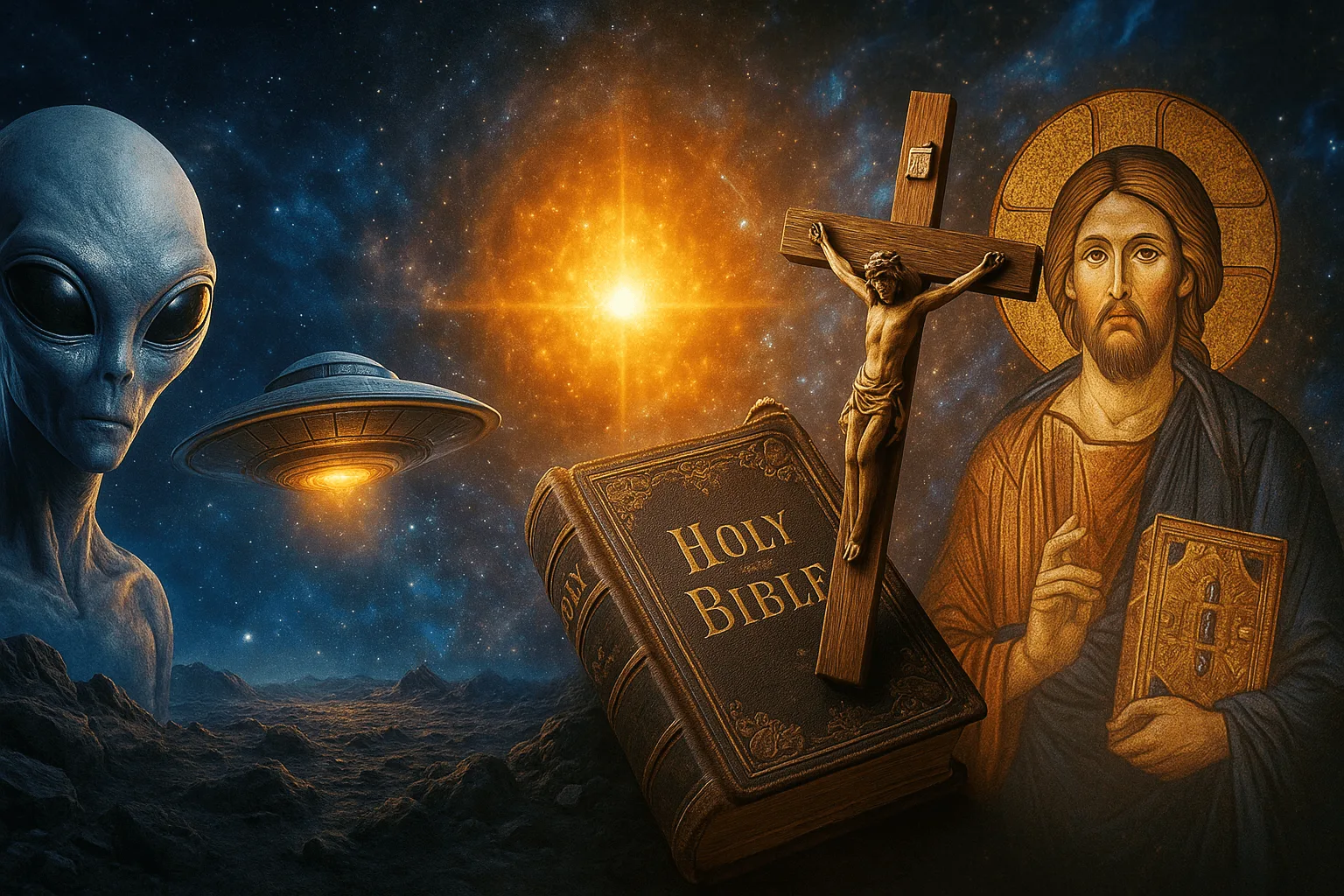
At the center of this rabbit hole is the idea that humanity is not operating alone.
The concept of a Galactic Federation, a collective of advanced civilizations interacting beyond the public eye, mirrors what we see in shows like The Orville and Star Trek. But in this narrative, it isn’t fiction. It’s described as an existing framework, one that has rules, boundaries, and a level of oversight that extends far beyond our planet. The suggestion isn’t that humanity is controlled outright, but that it exists within a larger ecosystem where influence, agreements, and limitations are part of a broader system.
Then there’s the opposing force often referenced in these same circles, the idea of ancient non-human entities, sometimes described as Draconian or reptilian in nature, that have maintained a long-standing presence or influence on Earth. The claim is that these forces operate through hierarchy, through control structures, through systems designed to maintain power over long periods of time. Not in obvious ways, but through subtle integration into leadership, institutions, and decision-making channels.
This is where the conversation shifts toward human organizations.
Groups like the 33rd degree Masons and the so-called Illuminati are often pointed to as bridges between visible society and hidden influence. The narrative suggests that these aren’t just symbolic or ceremonial groups, but networks of individuals positioned in key roles across government, finance, media, and technology. Not every member is aware of anything beyond their level, but those at the top are described as having access to deeper knowledge, knowledge about technology, about contact, about the true scale of what exists beyond public awareness.
Whether that’s true or not, the structure itself is worth examining.
Compartmentalization is real. Governments operate on need-to-know access. Intelligence is segmented. Information is controlled. That part isn’t speculation, it’s documented reality. The question is simply how far that structure extends.
From there, the rabbit hole expands into technology.
Accounts tied to these narratives often describe capabilities that align almost perfectly with what we see in advanced sci-fi, zero-point energy systems, propulsion methods that bypass conventional physics, medical technologies that regenerate tissue or reverse damage, and fabrication systems that can produce physical objects from raw energy or matter. The implication is that such technologies, if they exist, would fundamentally disrupt every system we rely on today.
Energy would become unlimited.
Scarcity would disappear.
The global economy, built on limitation and access, would no longer function the same way.
That alone would be enough reason for any powerful institution to tightly control how and when such advancements are revealed.
And then there’s the deeper layer, reality itself.
If higher dimensions exist, if timelines can branch, if space and time are not fixed but malleable, then the implications go beyond technology. They reach into existence, into identity, into the nature of cause and effect. Some theories suggest that altering timelines wouldn’t erase a current reality, but instead create parallel ones, new branches that coexist alongside the original. That means the universe isn’t a straight line, it’s a network.
A system.
One where multiple versions of events, outcomes, and even civilizations could exist simultaneously.
It sounds overwhelming, because it is. But it also aligns with a growing understanding in theoretical physics that reality may be far more complex than our day-to-day experience suggests.
So where does that leave us?
Somewhere between skepticism and curiosity.
This section isn’t about telling you what to believe. It’s about recognizing that there are questions worth asking, patterns worth noticing, and ideas that continue to surface across different sources, different people, and different points in time.
You don’t have to accept any of it outright.
But if you’re willing to look a little closer, to follow the threads, to question the boundaries of what you’ve been told is possible, you might start to see why so many people feel like there’s more going on beneath the surface.
Because whether these narratives represent hidden truth, misunderstood information, or something in between, they all point to the same underlying idea:
Reality may be bigger than we’ve been allowed to imagine.
Cosmic Echoes
Share-ready comments you can copy in a click, then post wherever the conversation touches UFOs, UAP, or the Galactic Federation.
These comments belong to the Cosmic Echoes page under the section Futures Unveiled: The Orville, Star Trek, and the Truth Beyond Fiction.
Plus 21 more comments on the Cosmic Echoes page.