
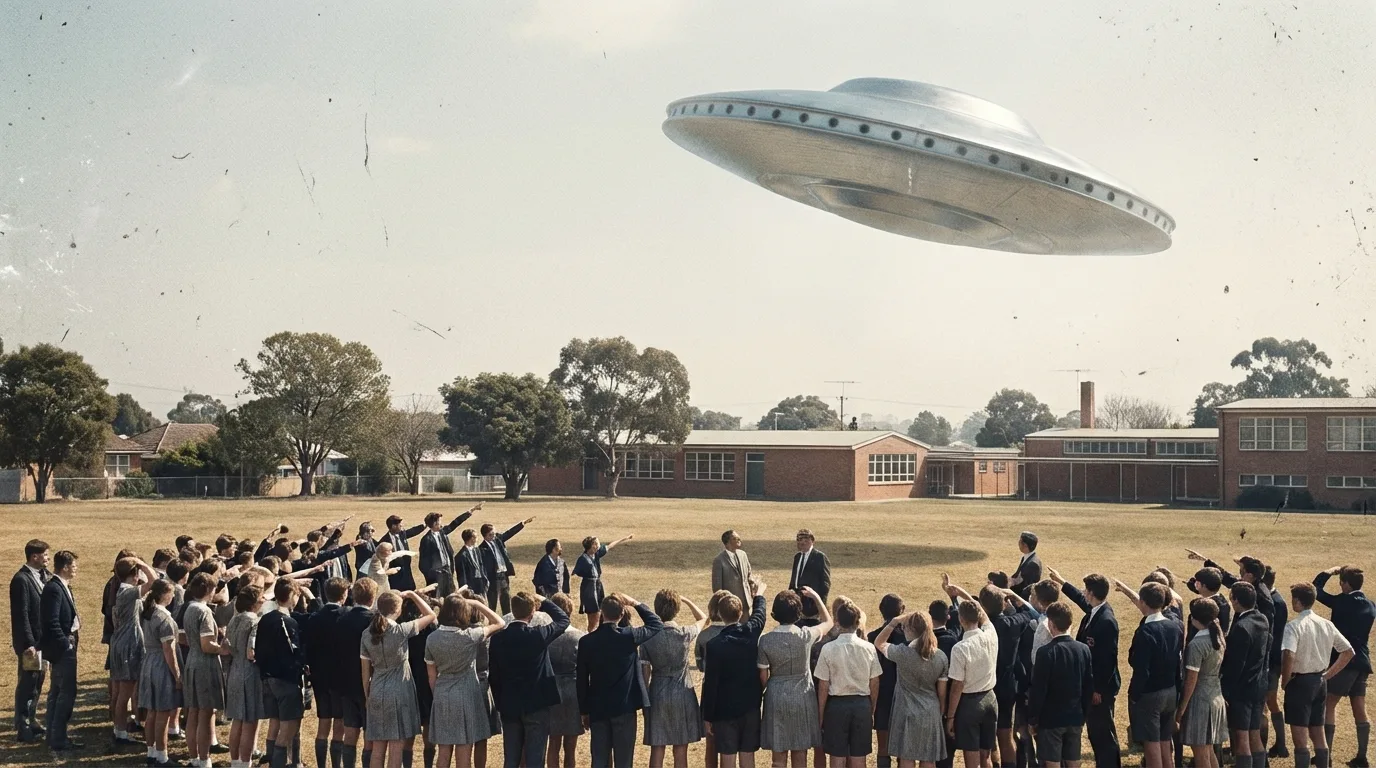
On Wednesday, April 6, 1966, two neighboring schools in Clayton South, in Melbourne’s south-east, were moving through an ordinary late-term day. Westall High School and Westall State School were close to The Grange, a scrubby patch of land edged with pines and open ground, the sort of semi-rural fringe that still existed in pockets of suburbia at the time. Then, in broad daylight, hundreds of students and staff would later say they watched something in the sky that did not behave like any aircraft they recognised. (State Library Victoria Blogs)
The Westall incident has survived for nearly six decades in a peculiar state: famous enough to be called Australia’s largest “mass UFO sighting,” yet obscure enough that many Australians have never heard of it. (Wikipedia)
What makes the story persist is not just the objects described, but what witnesses say happened next. Accounts describe a fast-moving official response, warnings not to talk, and evidence that allegedly disappeared into the hands of men who did not introduce themselves. Some of those claims are hard to document in the way historians would prefer. Others are supported by contemporary reporting, institutional collections, and long-running research efforts. Together, they form a case study in how an event can be widely seen, heavily discussed, and still remain unresolved.
Cold War Skies, Suburban Schools
Why the era matters
Australia in 1966 was living in the long shadow of the Cold War. Aviation had become an everyday presence, military alliances were tightening, and anxiety about surveillance and nuclear capability sat in the background of public life. When people looked up, they weren’t only watching passenger planes. They were also watching a world that felt technologically and politically unstable. The National Archives of Australia notes that “flying saucer” reports were taken seriously enough, in a national security sense, to be recorded and retained in government archival collections. (NAA)
That context doesn’t prove anything about Westall. It does, however, help explain why witnesses might interpret strange aerial activity as significant, and why authorities might respond quickly even if they had no neat answer.
The setting: Westall and The Grange
The Grange, repeatedly mentioned in accounts, sits just across from the school area and has been described in historical writing as scrubby, pine-ringed bushland, a place where something descending behind trees could plausibly vanish from direct view. (State Library Victoria Blogs)
In many retellings, The Grange is where at least one object appeared to descend, or “land,” before rising again. That detail becomes important later, because it shifts the story from “something in the sky” to “something close enough to leave traces,” which is a very different kind of claim.
April 6, 1966, Reconstructed as a Timeline
Around mid-morning: the first alarm
Most versions of the event place the initial sighting at Westall on the morning of April 6. Students and at least one teacher reportedly see an unusual object, often described as round with a domed top, and white, grey, or silver in colour. (Wikipedia)
The transcript you provided captures the flavour of witness memory: a daylight sighting, “silver metallic,” “basically silent,” moving at “incredible speeds,” and changing position quickly. Those themes recur across accounts gathered over time, even when exact shapes and numbers differ.
“They were flying saucers. That’s exactly what it looked like… moving like we’ve never seen anything move before.”
— Witness recollection, as presented in later interviews and documentary-style reporting (Apple TV)
Minutes later: more witnesses, more detail
As word spread, more people came out to look. This is where mass sightings become complicated and, paradoxically, useful. With many witnesses, you get more corroboration, but also more variation. Some people recall one object; others recall multiple. The Wikipedia summary, which draws from multiple published accounts, notes that details vary between witnesses, which increases the difficulty of identification. (Wikipedia)
That variation is not automatically a red flag. In real-world events, especially ones observed briefly and at distance, disagreement is normal. What matters is whether there is a stable “core” that remains consistent. In Westall’s case, the recurring core is simple: bright daytime conditions, a metallic-looking object (or objects), unusual motion, and a descent behind trees near The Grange. (Wikipedia)
The Grange: the moment the story gets physical
A key element in many accounts is that the object descended behind the tree line and into The Grange area, out of direct view from the school grounds. (Wikipedia)
Some witnesses also describe a disturbed patch of ground later, sometimes referred to as flattened grass or a “scorched” area. Those claims are harder to pin down to a single contemporary document available publicly, but they persist across later interviews and local historical writing, and they matter because they’re the kind of detail that, in theory, could have been investigated with evidence rather than memory.
The aviation angle: pilots and the nearby airfield
One reason Westall won’t stay neatly in the “kids saw something” box is its proximity to Moorabbin Airport. In later reporting, researcher Shane Ryan is described as having pursued leads involving multiple pilots who may have been in the air that day, including reports that at least one pilot allegedly got close and tried to chase the object. (9News)
If pilot testimony could be documented and matched to flight logs, it would be significant. It would not prove an extraordinary origin, but it would raise the evidentiary floor: trained observers, in operational aircraft, generally reduce the odds of simple misidentification.
The reported official response: uniforms, suits, and warnings
This is the most contentious part of the Westall narrative, because it blends plausible institutional behaviour with allegations that are difficult to verify decades later.
According to multiple accounts collected over time, witnesses say that officials arrived soon after the sighting and that students were discouraged from speaking about it. A 2019 report from Nine describes witnesses reporting stern visits from authorities and notes the long-running claims of a “shutdown” response. (9News)
The State Library Victoria’s discussion of Westall similarly frames the incident through a combination of newspapers, reports of the time, and the enduring role of The Grange as the focal geography of the story. (State Library Victoria Blogs)
In some retellings, the “men in suits” element slides easily into pop culture, and that’s where careful writing matters. The responsible approach is to keep the claims labelled as claims, and to acknowledge what we can and cannot confirm.
“If there was this response by government authorities… they must have some answers. But my feeling now is part of the reason… was there were no answers.”
— Shane Ryan, as quoted in Nine’s reporting (Nine.com.au, July 2019) (9News)
That quote is useful precisely because it resists the easy story. It leaves space for both possibilities: a response because something sensitive occurred, or a response because uncertainty itself can be treated as sensitive.
The Evidence Problem: What Exists, What’s Missing, What’s Claimed
The missing photos and missing footage
A dramatic element in the transcript is the claim that a teacher took photographs that were later taken, and that television interviews were conducted but never seen again. These details are compelling, but they also highlight the gap between lived experience and a public paper trail.
The best-supported public record, at scale, is that contemporary newspapers did report on Westall, and local history collections acknowledge the coverage. The City of Kingston’s local history site, for example, references the Dandenong Journal’s front page reporting on the “Westall Flying Saucers” affair in 1966. (Kingston Local History)
That doesn’t confirm confiscation. It does confirm the incident was “real” in the basic sense that it was reported at the time and entered local historical memory.
Archives and the quiet problem of “nothing there”
Researchers and residents have repeatedly run into a frustrating wall: the absence of a neat, publicly available government file that says, in plain language, what happened. The National Archives of Australia has published material explaining that UFO-related records exist in the archival collection, but that’s different from “the Westall file is available and answers everything.” (NAA)
Nine’s reporting describes archive searches turning up “flying saucer” results without a specific Westall incident file, while also pointing to the historical existence of government departments that might plausibly have been involved in an investigation. (9News)
The lack of a clean file isn’t proof of a cover-up. Archives can be incomplete for mundane reasons: misfiled records, destroyed records, records still restricted, or records that never existed because no formal investigation occurred. But the absence does have an effect. It leaves a vacuum that gets filled by the loudest story, not necessarily the best-evidenced one.
Shane Ryan and the Long Tail of Investigation
When a mystery outlives its witnesses
Westall has been investigated by many people across decades, but Shane Ryan stands out in recent public reporting as a persistent researcher who has interviewed hundreds of witnesses and continued pursuing new leads, including pilot testimony. (9News)
A 2025 local report describes renewed interest and mentions Ryan’s involvement with efforts to locate relevant files at the National Archives or government departments. (Cranbourne Star News)
This matters because it shifts Westall from a single-day event to a slow, ongoing process: memory aging, narratives hardening, and evidence becoming harder to retrieve with every passing year. A case like this is a race between documentation and forgetfulness, and forgetfulness tends to win unless someone is stubborn.
The Competing Explanations, and Why None Has Closed the Case
Theory one: a balloon program, including Project HIBAL
One of the most commonly cited “ordinary” explanations is that witnesses misidentified a balloon or related equipment. In Australia, that often leads to Project HIBAL, a program associated with high-altitude balloons used in atmospheric monitoring during the 1960s. Nine’s reporting notes suggestions that Westall may have been linked to HIBAL and describes it as a high-altitude balloon program used to sample radiation in the atmosphere. (9News)
Other commentary and reporting around the anniversary has similarly pointed to HIBAL balloons as a possible explanation and notes the period of operation in the 1960s. (7NEWS)
The problem is not that the balloon idea is ridiculous. It’s that it must account for multiple features described by witnesses: the apparent speed and sharp manoeuvres, the silence, the impression of structured craft-like shapes, and the reported descent behind trees into The Grange. Could a balloon plus optical effects plus confused distance estimates produce that? Possibly. Can we demonstrate it conclusively with public documentation tied to that exact day and place? Not yet, at least not in a way that has ended the debate. (9News)
Theory two: mass hysteria and social contagion
Another explanation is psychological: that students, primed by cultural narratives and each other’s reactions, converged on a shared interpretation. There is a reason this theory gets mentioned in cases involving large groups and ambiguous stimuli.
But Westall’s stubbornness is that it doesn’t sit neatly in a “kids got excited” frame. Teachers are part of the story. Some accounts include additional adult witnesses. And the aviation angle, if substantiated, complicates the idea that this was purely a schoolyard phenomenon. (Wikipedia)
A fair view is this: social influence may have shaped what people thought they saw, and it may have amplified certain details, but that does not automatically explain away a core event that multiple groups independently reacted to.
Theory three: secret military or experimental aircraft
A third category sits between “balloon” and “spaceship”: experimental technology. Cold War history is full of testing programs that were not publicly advertised, and the instinct to keep secrets around anything that looks like surveillance or defence capability is hardly unusual.
The challenge is that this theory needs to explain why such technology would appear over a school, and why it would vanish from public record so thoroughly that no credible documentation has surfaced. It also faces the “where did it go?” problem. If the manoeuvrability described was real and engineered, you would expect some lineage of that technology to become visible in later decades, even indirectly.
That doesn’t kill the theory. It simply keeps it in the “possible, unproven” bucket, which is where most Westall explanations live.
Why Westall Still Matters
The human side: credibility, ridicule, and time
One of the most consistent themes across Westall retellings is not fear of the sky, but fear of being laughed at. That is not a trivial point. In many historical cases involving anomalous experiences, ridicule becomes a social silencer more effective than any official warning.
Nine’s reporting explicitly discusses fear and ridicule as factors that may have kept some officials, as well as witnesses, from speaking openly. (9News)
The institutional side: uncertainty is itself a public story
Even if Westall were ultimately explained by a balloon, a misunderstanding, or a mundane aircraft, the story would still be an instructive case about information flow: how rumours become cultural memory, how missing records amplify suspicion, and how official silence functions as an accelerant.
The National Archives’ own framing of UFO reporting in the Cold War era is telling. The government didn’t need to believe in “little green men” to keep records. It only needed to believe that unidentified aerial observations might matter. (NAA)
So the key question becomes less “what do you believe Westall was?” and more “what is the most responsible way to describe what happened when the evidence is incomplete?” In Westall’s case, the responsible answer is both unsatisfying and honest: a large number of people reported seeing something unusual; some aspects of the reported response suggest official interest; and the public record does not currently contain a definitive explanation that closes the case. (State Library Victoria Blogs)
A Measured Conclusion, Not a Neat Ending
Westall endures because it is messy. It sits at the intersection of eyewitness testimony, Cold War culture, local geography, and the long afterlife of missing documentation. The incident is well-anchored to a date and place, and it was covered in contemporary press, which makes it more than an internet-era legend. (State Library Victoria Blogs)
At the same time, the most dramatic claims, confiscated photos, vanished footage, direct intimidation, remain difficult to verify with public documentation. They are not impossible. They are simply not settled.
The strongest journalistic stance is to hold two truths at once. Hundreds of people can sincerely report an extraordinary experience, and that experience can still have an ordinary explanation that we cannot currently prove. Westall, in that sense, is less a verdict and more a challenge: to treat witnesses with respect, treat evidence with discipline, and admit, without theatrics, that some historical questions remain stubbornly open. (9News)
Cosmic Echoes
Share-ready comments you can copy in a click, then post wherever the conversation touches UFOs, UAP, or the Galactic Federation.
These comments belong to the Cosmic Echoes page under the section When Melbourne's Sky Broke Reality.
Plus 21 more comments on the Cosmic Echoes page.