
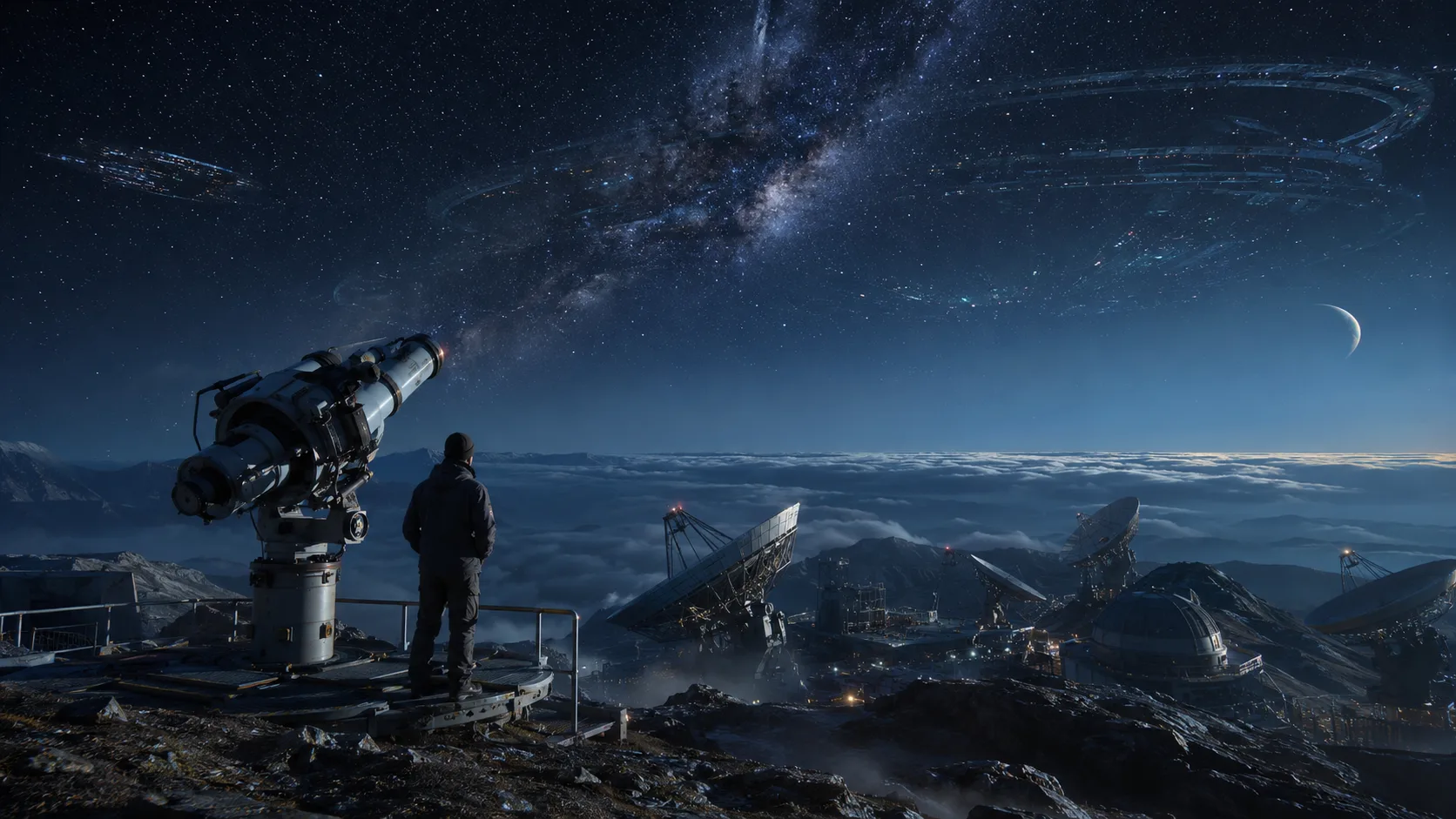
In the summer of 1950, physicist Enrico Fermi sat down for lunch at Los Alamos with Emil Konopinski, Edward Teller, and Herbert York. The conversation wandered through flying saucers, interstellar travel, and the possibility of alien civilizations. Then Fermi asked the question that still refuses to go away: “Where is everybody?” (UNT Digital Library)
That question sounds almost too simple. It isn’t.
We now know the galaxy is crowded with planets. NASA’s Exoplanet Archive listed 6,287 confirmed exoplanets as of its May 14, 2026 update, and NASA’s broader exoplanet overview notes that there are likely more planets than stars in the Milky Way. (exoplanetarchive.ipac.caltech.edu) If planets are common, and if even a modest fraction become habitable, and if even a modest fraction of those produce intelligence, then the night sky should not feel so empty.
Yet publicly, officially, there is still no confirmed alien signal, no acknowledged extraterrestrial embassy, no unmistakable artifact orbiting Earth, no open contact.
That tension is the Fermi Paradox.
It’s not merely a question about aliens. It’s a question about life, time, technology, survival, communication, ethics, and humanity’s place in the cosmic order. Over the decades, thinkers have proposed dozens of answers. Stephen Webb famously cataloged 75 possible solutions, ranging from “we are alone” to “they are here, but hidden” to “we are not looking correctly.” (University of Portsmouth)
But the deeper value of the Fermi Paradox is not just the list of answers. It’s what each answer implies.
Some solutions suggest humanity is rare and precious. Others suggest civilizations usually destroy themselves. Some imply the universe is dangerous. Others imply it may be governed, protected, or deliberately quiet. And one family of answers, the Zoo or Quarantine hypothesis, points directly toward what many would recognize as a Galactic Federation framework: a universe full of life, but one in which advanced civilizations follow protocols governing contact with younger worlds.
That idea is speculative. It is not publicly proven. But as a solution to the Fermi Paradox, it is more coherent than many people assume.
What the Fermi Paradox Is Really Asking
The Fermi Paradox is usually stated like this:
If the galaxy is old, vast, and full of planets, why don’t we see clear evidence of extraterrestrial civilizations?
The Milky Way is roughly 100,000 light-years across and far older than human civilization. Even slow interstellar expansion, given millions of years, could in principle spread across enormous portions of the galaxy. That is why the silence feels strange.
The Drake Equation, introduced by Frank Drake in 1961, gave scientists a way to organize the question. It does not produce one agreed-upon answer. Instead, it breaks the problem into factors: star formation, planets, habitable worlds, life, intelligence, technology, and the lifetime of communicating civilizations. The SETI Institute describes it as a roadmap for thinking about how many detectable civilizations might exist. (SETI Institute)
The paradox appears because some of those factors now look more promising than they once did. Planets are not rare. Potentially habitable environments may not be rare either. NASA’s Kepler work suggested that rocky, potentially habitable planets around Sun-like stars may be common enough to make the galaxy feel biologically inviting. (NASA)
So the mystery shifts.
Maybe life is rare. Maybe intelligence is rare. Maybe civilizations are short-lived. Maybe they hide. Maybe they are here, but we misunderstand the evidence. Maybe we are listening in the wrong way. Maybe advanced civilizations do not behave the way human empires behave.
The Fermi Paradox is less a single puzzle than a pressure test for our assumptions.
The Main Families of Fermi Paradox Solutions
The proposed solutions can be grouped into several broad families:
- Life is rare. Earth may be an extraordinary accident.
- Complex life is rare. Microbes may be common, but animals and intelligence may be unusual.
- Technology is rare. Intelligent life may not always become technological.
- Civilizations die young. Nuclear war, ecological collapse, artificial intelligence, pandemics, or other existential risks may stop civilizations before they spread.
- Expansion is not inevitable. Advanced societies may become sustainable, inward-looking, or uninterested in colonizing the galaxy.
- We are looking incorrectly. The signals may be too faint, too brief, too advanced, or outside our chosen search methods.
- They are hiding. The galaxy may be dangerous, and broadcasting may be suicidal.
- They are avoiding us. Earth may be protected, quarantined, or deliberately left alone.
- They are here, but not openly. Some anomalous phenomena may represent observation, probes, or controlled contact, though public evidence remains inconclusive.
- Reality itself is stranger than assumed. Simulation, dimensional, or consciousness-based explanations move the problem outside conventional astronomy.
The strongest explanations are not necessarily the most dramatic. The best ones are those that explain both sides of the paradox: why life might be common, and why the evidence remains ambiguous.
Let’s walk through the major hypotheses and what each one tells us.
1. The Rare Earth Hypothesis: Maybe We Really Are Unusual
The Rare Earth hypothesis argues that simple life may be common, but complex life may require an unusually precise combination of conditions. The idea is associated with Peter Ward and Donald Brownlee’s book Rare Earth: Why Complex Life Is Uncommon in the Universe. (Springer)
Under this view, Earth is not special because it has a planet-sized ego. It is special because many things had to go right.
A stable star. A rocky planet in the right orbit. Liquid water. Plate tectonics. A protective magnetic field. A large moon. A relatively stable climate. The right chemistry. Jupiter-like protection from some impacts, but not so much protection that evolution loses the pressure of catastrophe. A long stretch of time without total sterilization.
Rare Earth says the galaxy may have many planets, but very few Earths.
What it explains well
This hypothesis explains the silence by making complex life extremely uncommon. If microbial life exists all over the galaxy, but technological civilizations almost never emerge, then the lack of obvious contact is not surprising.
It also fits one uncomfortable fact from Earth’s history: life appeared early, but complex multicellular life took billions of years. Intelligence capable of radio astronomy took even longer. For most of Earth’s existence, there was no one here to wonder where everybody was.
Where it struggles
The main weakness is that we still have a sample size of one. We do not yet know how often life starts, how often it becomes complex, or how often intelligence appears. Exoplanet discoveries have made the “planets are rare” part of the argument much weaker than it once was, but they have not settled the biological question.
Rare Earth may be right. But at the moment, it is less a conclusion than a warning: do not assume habitability automatically becomes civilization.
What it tells us
If Rare Earth is true, humanity is not just one civilization among many. We may be one of the galaxy’s rare experiments in self-aware biology. That would make Earth almost unimaginably valuable.
2. The Great Filter: Something Stops Civilizations
The Great Filter is one of the most sobering answers to the Fermi Paradox. Developed by economist Robin Hanson, it proposes that somewhere between dead matter and galaxy-spanning civilization, there is a step that is extremely difficult to pass. (hanson.gmu.edu)
The filter could be behind us, or it could be ahead of us.
If it is behind us, then perhaps the hard part was the origin of life, the emergence of complex cells, the rise of intelligence, or the development of technology. In that case, humanity may have already passed the most dangerous bottleneck.
If it is ahead of us, the implications are darker. Civilizations may routinely reach our level and then fail. They may destroy themselves through war, ecological collapse, runaway technologies, artificial intelligence, engineered pathogens, or some other hazard we have not yet imagined.
Nick Bostrom famously argued that finding simple life elsewhere would be exciting, but finding evidence that many civilizations reached our level and vanished would be deeply worrying. The more common advanced life appears to be in the past, the more likely the filter may still be ahead. (Nick Bostrom)
What it explains well
The Great Filter explains the silence without requiring Earth to be physically unique. It allows for many planets, and maybe even many life-bearing worlds, while still predicting few long-lived technological civilizations.
It also fits the unsettling fact that technological power grows faster than wisdom. A species can split the atom before it learns how to govern itself. It can alter the climate before it fully understands the long-term consequences. It can build machine intelligence before it knows how to align incentives, ethics, and control.
Where it struggles
The Great Filter is powerful because it is broad. That is also its weakness. It can explain almost anything because the filter can be placed almost anywhere.
Is the filter abiogenesis? Complex cells? Intelligence? Nuclear weapons? Artificial intelligence? Interstellar travel? Civilizational coordination?
Until we know more, the Great Filter is a framework, not a single answer.
What it tells us
The Great Filter turns the Fermi Paradox into a mirror. It asks whether humanity is early, lucky, or endangered. It also gives cosmic significance to choices that might otherwise seem merely political or technological. Survival becomes not just a human priority, but a galactic one.
3. The “They Don’t Exist” or Hart-Tipler Argument
A harsher version of the paradox says: if advanced civilizations existed, they would already be here. Since they are not obviously here, they probably do not exist.
This argument is often linked to Michael Hart and Frank Tipler rather than Fermi himself. Fermi asked the famous question, but later thinkers sharpened it into the claim that a technologically capable species should be able to spread through the galaxy over astronomical timescales. (arXiv)
The logic is straightforward. A civilization does not need faster-than-light travel to become widespread. It only needs patience. Send probes. Build settlements. Expand slowly. Repeat. Over millions of years, even sublight expansion could become enormous.
What it explains well
This argument takes time seriously. The galaxy is old. Human civilization is young. If many civilizations arose millions or billions of years before us, at least one should have had time to leave visible traces.
It also challenges a common assumption: that “space is big” is enough to explain the silence. Space is big, but time is also deep.
Where it struggles
The argument depends heavily on human assumptions about expansion. It imagines advanced civilizations behaving like colonial powers, spreading outward because they can.
But what if mature civilizations do not expand exponentially? What if they become stable, local, ecological, virtual, inward, or governed by rules? What if interstellar colonization is possible but unattractive? What if civilizations send tiny probes rather than build giant empires? What if they deliberately avoid inhabited worlds?
The Hart-Tipler style argument is strong only if expansion is natural, desirable, and common. That may be more of a human projection than a universal law.
What it tells us
This solution exposes one of the central mistakes in Fermi thinking: assuming that technological capacity automatically creates expansionist behavior. That assumption may say more about us than about the galaxy.
4. The Signal and Detection Problem: We May Be Listening Badly
Another major answer is beautifully simple: they are out there, but we have not detected them.
SETI is often imagined as a giant radio ear listening for alien broadcasts. In reality, modern technosignature research is broader. NASA describes technosignatures as possible signs of advanced technology, including radio signals, laser emissions, atmospheric pollutants, infrared waste heat, and large artificial structures. The SETI Institute similarly describes searches across the electromagnetic spectrum and beyond traditional radio signals. (NASA Astrobiology)
The problem is scale.
We have not searched the whole galaxy. We have not searched every frequency, every time window, every signal type, every star system, or every possible form of communication. One “cosmic haystack” analysis compared the amount of SETI searching done so far to examining only a tiny fraction of Earth’s oceans for a fish. (arXiv)
That image matters. Saying “we found no aliens” may be less like saying “we searched the house and no one is home,” and more like saying “we glanced through one keyhole at midnight and saw no movement.”
What it explains well
The detection problem explains why the silence may be misleading. Civilizations may communicate with technologies we do not recognize. Their signals may be narrow, encrypted, intermittent, directional, or intentionally subtle. They may use neutrinos, gravitational effects, quantum systems, engineered biological carriers, or communication methods we have not discovered.
They may also have moved beyond broadcasting altogether. A civilization that used noisy radio for only a few centuries could be almost impossible to catch unless we were looking at the right place at the right time.
Where it struggles
The detection problem explains why we might miss signals. It has a harder time explaining why we do not see large-scale engineering, obvious artifacts, or unmistakable probes, assuming such things are common.
Still, that assumption may be wrong. Advanced civilizations may not build galaxy-sized billboards. They may value efficiency, stealth, ecology, or non-interference.
What it tells us
This hypothesis reminds us that absence of evidence is not always evidence of absence. It also humbles our imagination. We are a young technological species trying to detect civilizations that may be millions of years older. Expecting them to use our favorite channels may be like expecting the internet to communicate by smoke signal.
5. The Sustainability Solution: Advanced Civilizations Stop Expanding
The sustainability solution argues that long-lived civilizations may not expand aggressively because exponential expansion is unstable. Growth without restraint is not maturity. It is a phase.
This idea cuts against a common assumption in Fermi discussions: that any advanced civilization will eventually colonize everything it can reach. But that may not be true. A society that survives long enough to become truly advanced may have learned to control growth, reduce waste, preserve ecosystems, and avoid reckless interference.
The “sustainability solution” literature argues that the absence of obvious galactic empires does not automatically mean there are no extraterrestrial intelligences. It may mean that the civilizations capable of lasting are precisely the ones that do not expand like invasive species. (arXiv)
What it explains well
This solution explains why the galaxy might contain advanced civilizations without being visibly colonized. It also fits a pattern we can already understand on Earth: the more we learn about fragile environments, the more we create rules about contamination and protection.
NASA’s planetary protection policies, for example, are designed to prevent Earth organisms from contaminating other worlds and to protect Earth from possible biological contamination from returned samples. (sma.nasa.gov) That is not science fiction. It is already part of responsible space exploration.
If humans, barely spacefaring, can develop non-contamination rules, then older civilizations might have far more sophisticated versions.
Where it struggles
The challenge is universality. Even if most advanced civilizations become restrained, what about the reckless ones? What about the expansionists? What about machine probes? What about a civilization that simply does not care?
For sustainability to solve the paradox by itself, restraint has to be common enough to prevent obvious galactic spread.
What it tells us
This hypothesis suggests that survival and restraint may be linked. The civilizations that last may be the ones that stop behaving like adolescents with rockets.
6. The Transcension Hypothesis: They Go Inward, Not Outward
The Transcension hypothesis, associated with futurist John Smart, proposes that advanced civilizations do not expand endlessly into outer space. Instead, they move inward toward greater density, efficiency, miniaturization, computation, and complexity. (ScienceDirect)
In this view, a mature civilization may not cover the galaxy with megastructures. It may compress itself into extremely efficient computational environments. Its frontier is not physical territory, but intelligence itself.
Space expansion may look exciting to a young species. To a much older one, it may look crude.
What it explains well
Transcension explains why advanced civilizations might become harder, not easier, to detect. They may reduce waste heat, minimize leakage, avoid large visible structures, and operate at scales or densities we do not associate with civilization.
It also fits a pattern already visible in our own technology. Computers get smaller. Communication gets more compressed. Infrastructure becomes more efficient. A civilization does not necessarily become louder as it advances. It may become quieter.
Where it struggles
The hypothesis is elegant, but speculative. It assumes that most advanced civilizations converge toward similar high-density developmental paths. It also does not fully explain why no earlier expansion phase would leave visible traces.
What it tells us
Transcension challenges the assumption that the highest civilization is the biggest one. Maybe the future is not empire. Maybe it is depth.
7. The Aestivation Hypothesis: They Are Waiting
The Aestivation hypothesis is one of the stranger but more intellectually interesting solutions. It suggests that highly advanced civilizations may choose to become inactive for extremely long periods, waiting for the universe to cool so computation becomes more efficient.
The core idea is that if a civilization’s highest priority is maximizing computation, it may be rational to wait until the far future, when lower cosmic temperatures allow more processing for the same energy. One version of the argument suggests that such waiting could produce an enormous computational advantage. (arXiv)
In simple terms: the aliens are not dead. They are sleeping.
What it explains well
Aestivation explains why powerful civilizations might be hard to see right now. They may have harvested resources, secured their future, and entered a quiet state. The universe would look empty not because no one exists, but because the serious players are waiting for better operating conditions.
Where it struggles
Critics have challenged the thermodynamic assumptions behind the idea, arguing that advanced civilizations may not gain as much by waiting as the hypothesis requires. (arXiv)
It also raises the same universality problem. Even if some civilizations sleep, why would all of them? Why would none remain active, curious, expansionist, artistic, or communicative?
What it tells us
Aestivation stretches the imagination in a useful way. It reminds us that alien priorities may be profoundly non-human. A civilization a million years older than ours may not be in a hurry.
8. The Dark Forest Hypothesis: The Galaxy Is Dangerous
The Dark Forest hypothesis offers one of the most chilling answers to Fermi’s question.
The idea is that the universe is full of civilizations, but everyone stays quiet because announcing your location is dangerous. In a galaxy where intentions are uncertain and technological gaps may be enormous, the safest strategy may be concealment. If you reveal yourself, someone stronger may destroy you before you become a threat.
The phrase became famous through Liu Cixin’s science fiction, but the underlying logic has been discussed in game-theoretical terms: under conditions of extreme uncertainty, civilizations may fall into a cosmic version of mutual suspicion. (OUP Academic)
What it explains well
The Dark Forest explains silence very cleanly. If broadcasting is dangerous, then advanced civilizations would hide. The quiet sky becomes evidence not of emptiness, but of fear.
It also explains why we might not see open empires. A visible empire is a target. A loud civilization is a beacon. A species that survives may be one that learns to whisper.
Where it struggles
The Dark Forest requires a very bleak view of galactic sociology. It assumes that fear dominates over cooperation, that preemptive violence is common, and that civilizations cannot create reliable norms, alliances, or communication channels.
It also assumes that hiding is possible. A technologically advanced civilization may leak heat, alter planets, move resources, or create detectable signatures whether it wants to or not.
Most importantly, it must explain why no civilization has successfully created a cooperative order. If even one durable coalition formed, the galaxy might look less like a dark forest and more like a regulated preserve.
What it tells us
The Dark Forest is the inverse of the Federation model. One says silence comes from fear. The other says silence comes from policy. One imagines the galaxy as a killing field. The other imagines it as a governed ecosystem.
Both take silence seriously. They simply disagree about what kind of intelligence produces it.
9. The Zoo and Quarantine Hypotheses: They Are Watching, But Not Interfering
The Zoo hypothesis may be the most important Fermi solution for understanding the Galactic Federation framework.
In 1973, astronomer John A. Ball proposed that extraterrestrial intelligent life may be widespread, but that Earth has been deliberately set aside, like a wilderness area, preserve, or zoo. The reason we do not see open contact is not because no one is there. It is because they are avoiding interference. (ScienceDirect)
The SETI Institute describes this family of ideas similarly: aliens may intentionally avoid contact, treating Earth as a protected area or exhibit. (SETI Institute)
The Quarantine version is slightly different. It suggests Earth is not merely being observed, but actively isolated until humanity reaches some threshold: technological, ethical, social, spiritual, or political.
This is where the Federation framework enters naturally.
A Galactic Federation narrative is essentially a strong-form Zoo/Quarantine hypothesis. It says the galaxy is not empty. It says advanced civilizations exist. It says they are coordinated. It says contact with developing worlds is regulated. It says non-interference is not an accident, but a rule.
That may sound dramatic, but structurally, it solves several problems at once.
Why Zoo/Quarantine is unusually strong
The Zoo/Quarantine hypothesis explains why:
- The galaxy can be rich with life while still appearing quiet.
- Earth can be observed without receiving open contact.
- Anomalous evidence can exist without becoming undeniable public proof.
- Advanced civilizations may avoid contaminating our development.
- Contact may occur only after a threshold is reached.
It also fits something we already understand: responsible observers often avoid disturbing the system they study. Wildlife biologists do not walk into a nesting area with fireworks. Anthropologists have ethical rules about contact. Space agencies worry about contaminating other worlds.
If humans can grasp non-interference at our current stage, it is not absurd to imagine older civilizations developing it into law.
The strongest objection
The biggest objection is the “rogue civilization” problem.
Even if most advanced civilizations agree not to contact Earth, wouldn’t one of them break the rule? Wouldn’t one reckless group land on the White House lawn? Wouldn’t one missionary species, prankster probe, profit-seeking empire, or lonely artificial intelligence ignore the quarantine?
This is a serious challenge. Research on the Zoo hypothesis has pointed out that a galactic non-contact agreement would require coordination, enforcement, and causal connectivity among civilizations. Without something like a “Galactic Club,” the quarantine could fail. (arXiv)
But that objection is also exactly where the Federation framework becomes relevant.
A Federation model does not merely say “everyone independently decides to leave Earth alone.” It says there is governance. There are protocols. There are membership structures. There are consequences. There may be monitoring systems. There may be thresholds for lawful contact. There may be a shared understanding that premature interference damages both the younger civilization and the wider order.
In other words, the Federation framework is not an add-on to the Zoo hypothesis. It is one of the few ways the Zoo hypothesis becomes stable.
The Sturrock Paper, UAP, and Ambiguous Evidence
A full Fermi analysis also has to address the uncomfortable middle ground between “no evidence” and “confirmed contact.”
In 1998, a scientific panel organized by physicist Peter Sturrock reviewed physical evidence associated with UFO reports. The panel did not conclude that UFOs were extraterrestrial. In fact, it explicitly said the evidence did not prove alien technology or unknown physical laws. But it also concluded that some cases involved physical evidence worthy of scientific study. (ScienceDaily)
That is an important distinction.
The Sturrock position is not “aliens are here.” It is “some anomalous reports deserve better data and better study.”
NASA’s more recent UAP work has taken a similarly careful stance. NASA has said there is no data supporting the conclusion that UAP are alien technologies, while also emphasizing that limited data makes many cases difficult to evaluate. (NASA Science)
This ambiguity matters for the Fermi Paradox.
If there were absolutely no anomalous evidence, Rare Earth and Great Filter explanations would feel stronger. If there were undeniable public evidence, the paradox would be over. But the actual situation is stranger: there are persistent reports, some physical traces, official interest, and unresolved cases, but no publicly confirmed extraterrestrial conclusion.
That pattern is not proof of a Federation. But it is compatible with a controlled-contact or observation framework.
Under a Federation-style quarantine model, one would not necessarily expect giant ships over major cities. One might expect monitoring, rare encounters, deniable interactions, probes, ambiguous signatures, and a long period in which evidence remains suggestive rather than decisive.
Again, compatibility is not confirmation. But it is not nothing.
Why the Federation Framework Is a Coherent Fermi Solution
The Galactic Federation narrative answers the Fermi Paradox in a specific way:
The universe is not empty. The silence is managed.
That one sentence changes the entire problem.
Rare Earth says we are mostly alone.
The Great Filter says most civilizations fail.
The Dark Forest says everyone is hiding in fear.
Transcension says advanced civilizations disappear inward.
The detection problem says we are not looking correctly.
The Federation framework says advanced civilizations are present, organized, and restrained by contact protocols.
Its strength is that it combines several otherwise separate insights:
- From the Drake Equation, it accepts that life may be widespread.
- From SETI’s silence, it accepts that open contact has not occurred publicly.
- From Zoo/Quarantine thinking, it explains silence as deliberate non-interference.
- From planetary protection ethics, it shows that non-contamination logic is plausible.
- From Sturrock-style anomaly research, it allows for suggestive evidence without requiring immediate public proof.
- From critiques of the Zoo hypothesis, it answers the rogue-actor problem through governance.
That is why the Federation framework is one of the more coherent speculative solutions. It does not require Earth to be unique. It does not require every civilization to self-destruct. It does not require all aliens to be paranoid predators. It does not require us to have already searched the entire cosmic haystack. It simply requires that mature civilizations behave less like conquerors and more like stewards.
That may be optimistic. But it is not irrational.
The biggest weakness, of course, is evidence. A coherent model is not the same as a proven model. The public record still lacks a confirmed extraterrestrial signal, artifact, or official contact event. NASA’s UAP position remains cautious. SETI has not announced a verified alien transmission. The Federation framework therefore belongs in the category of serious interpretive possibilities, not established fact.
Still, within the Fermi debate, it deserves more respect than it often receives. As a hypothesis, it explains the silence without emptying the galaxy.
Why So Many Solutions Exist
The proliferation of Fermi Paradox solutions tells us something important: we are uncertain at almost every major step.
We do not know how often life begins.
We do not know how often intelligence evolves.
We do not know how long technological civilizations survive.
We do not know whether interstellar expansion is common.
We do not know what advanced civilizations want.
We do not know whether they communicate in ways we can detect.
We do not know whether they would contact us directly, avoid us, study us, protect us, or fear us.
That uncertainty is not a failure. It is the honest state of the field.
The Fermi Paradox sits at the intersection of astronomy, biology, technology, sociology, risk theory, and philosophy. Each proposed solution reveals a different assumption about intelligence.
Rare Earth says nature is selective.
The Great Filter says survival is hard.
The Dark Forest says intelligence may become dangerous.
Transcension says maturity may become invisible.
The detection problem says humility is required.
The Zoo hypothesis says restraint may be real.
The Federation framework says the galaxy may be organized.
The question, then, is not just “Where is everybody?”
It is also: What kind of universe do we think intelligence creates?
The Most Likely Answer May Be Layered
The best answer to the Fermi Paradox may not be one answer.
It may be a stack.
Some planets never produce life.
Some produce only microbes.
Some produce complex life but not intelligence.
Some intelligent species never become technological.
Some technological civilizations destroy themselves.
Some survive but turn inward.
Some communicate in ways we cannot detect.
Some hide.
Some observe.
Some may belong to larger structures that regulate contact.
That layered view is probably more realistic than any single grand solution. The galaxy is enormous. It does not need one rule for every civilization.
But if the specific question is, “Which solution best explains a universe where life may be common, open contact is absent, anomalous evidence persists, and non-interference is plausible?” then the Zoo/Quarantine family deserves special attention.
And if the question goes one step further, “What would make Zoo/Quarantine stable across many civilizations?” then the Federation framework becomes one of the cleanest answers available.
Not proven. Not settled. But coherent.
Conclusion: The Silence May Not Mean Emptiness
Fermi’s question has lasted because it is almost rude in its simplicity.
Where is everybody?
After decades of thought, the answer is still not obvious. But the proposed solutions have taught us a great deal.
If Rare Earth is right, we are precious.
If the Great Filter is right, we are in danger.
If the Dark Forest is right, we should be quiet.
If the detection problem is right, we should be humbler.
If Transcension is right, we are looking for the wrong kind of civilization.
If Zoo/Quarantine is right, we are being left alone for a reason.
If the Federation framework is right, then the silence above us is not empty space. It is policy.
That final possibility is worth taking seriously, not because it has been publicly proven, but because it elegantly resolves the central tension of the Fermi Paradox. It allows the universe to be alive without requiring it to be loud. It allows advanced civilizations to exist without behaving like empires. It allows contact to be real without being careless.
The Fermi Paradox began as a lunchtime question. It has become one of the deepest questions humanity can ask.
Maybe the answer is that no one is there.
Maybe the answer is that everyone is hiding.
Or maybe the answer is that we are not alone, but not yet ready.


Cosmic Echoes
Share-ready comments you can copy in a click, then post wherever the conversation touches UFOs, UAP, or the Galactic Federation.
These comments belong to the Cosmic Echoes page under the section The Cosmic Silence: Why We’re Truly Alone or Not.
Plus 21 more comments on the Cosmic Echoes page.