
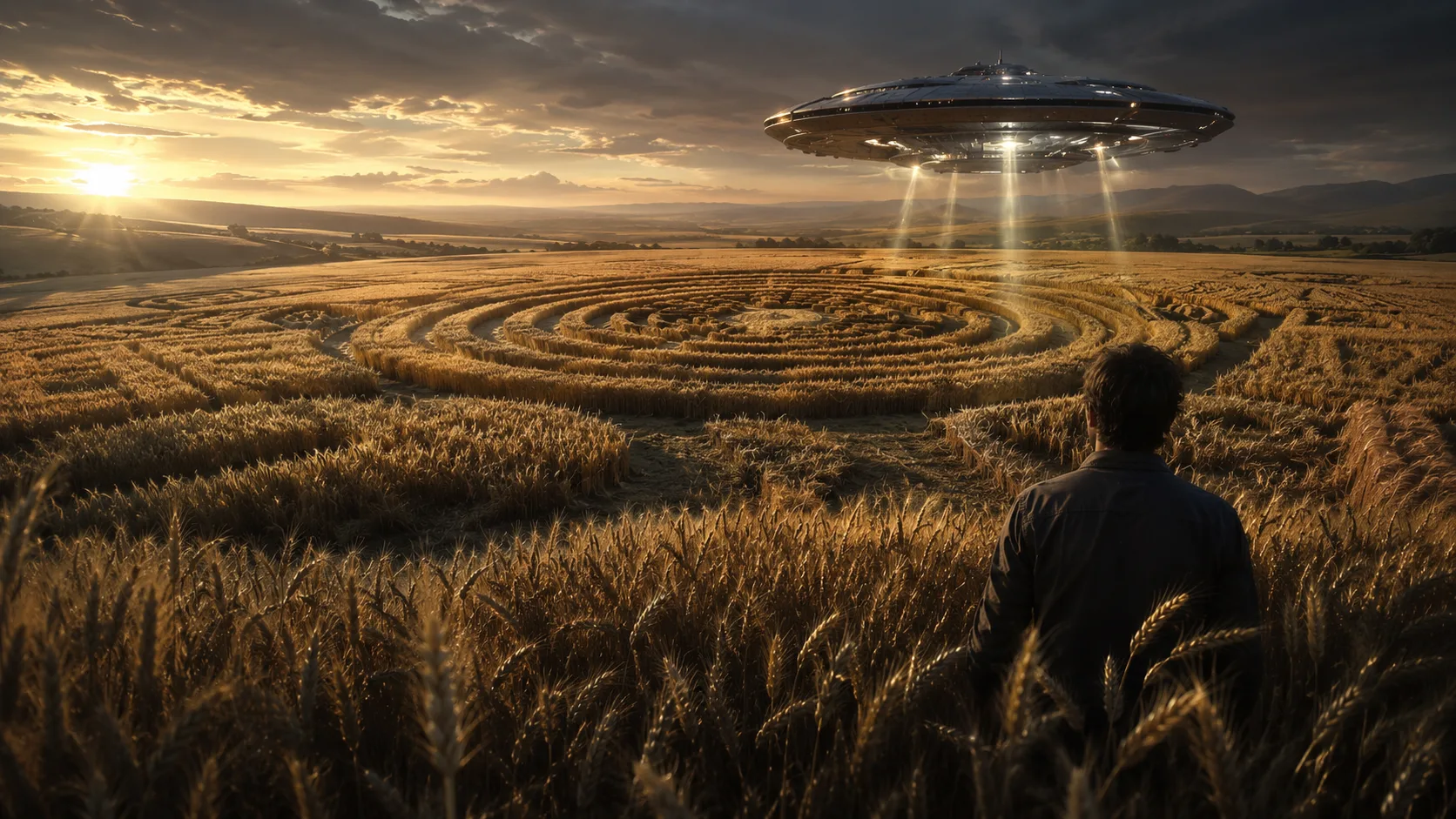
At sunrise, a farmer walks out into a field and finds the impossible waiting in the wheat.
Not just a circle. Not just a patch of flattened crop. A design. A clean, deliberate, often enormous pattern that looks better from the air than from the ground. Sometimes it’s a spiral. Sometimes it’s a mandala. Sometimes it appears to encode mathematics, astronomy, molecular structures, or a message that seems to answer one humanity once sent into deep space.
Crop circles are easy to laugh at. They’re also easy to romanticize. The problem is that both reactions skip over what makes the phenomenon so interesting.
Yes, many crop circles are hoaxes. That part is not in serious doubt. Human circle-makers have admitted to creating them, demonstrated their techniques, and even turned the practice into a kind of underground land art. The famous British pranksters Doug Bower and Dave Chorley said they began making simple “saucer nests” in Wiltshire in the 1970s, and the designs grew more elaborate as public fascination exploded. Since then, artists, advertisers, and anonymous teams have made formations using boards, ropes, planning, and patience. (Smithsonian Magazine)
But the clean “it’s all hoaxes” answer is too tidy. A fake painting doesn’t prove that art doesn’t exist. A forged banknote doesn’t prove money is imaginary. The real question is not whether some crop circles are made by people. They are. The better question is whether every significant formation can be explained that way, and whether the physical, mathematical, and symbolic evidence has been treated with the seriousness it deserves.
That’s where crop circles stop being a punchline and become one of the strangest open files in modern anomaly research.
The Hoax Narrative Is True, But Incomplete
The modern crop-circle story begins humbly enough. In the 1970s, southern England saw simple circular patches of flattened crop. By the late 1980s and early 1990s, the formations had changed dramatically. They were no longer just circles. They became rings, spirals, fractals, grids, pictograms, and elaborate geometric constructions stretching hundreds of feet across fields.
That escalation is one reason skeptics point to human artists. Human designs evolve. Once the public pays attention, creators compete. Patterns become more daring, more precise, and more media-friendly. That’s exactly what happened in England, where crop circles became part prank, part folklore, part landscape art, and part tourist economy. (Smithsonian Magazine)
And yet, the hoax explanation often gets stretched too far. It becomes a blanket answer rather than an investigation. Instead of asking, “Which formations show signs of human construction?” the media often asks, “How quickly can we dismiss the entire subject?”
That matters because not all formations are equally easy to explain. Some appear in short windows of time. Some are reported in wet fields with no obvious tracks beyond existing tramlines. Some contain unusual plant effects that researchers argue are not consistent with simple mechanical flattening. Some carry mathematical or symbolic content that is sophisticated enough to deserve attention regardless of origin.
The honest starting point is this: crop circles are not one phenomenon. They are a category. Inside that category are hoaxes, artworks, possible natural effects, possible experimental technologies, and, depending on your framework, possible communications.
What Researchers Mean by a “Genuine” Formation
When serious crop-circle researchers talk about a potentially genuine formation, they’re usually not talking about how beautiful it looks from a helicopter. They’re talking about physical signatures in the plants and soil.
The commonly cited indicators include:
- Stalks bent close to the ground rather than snapped
- Lengthened or swollen growth nodes in the stems
- Expulsion cavities in the nodes, as if internal moisture rapidly expanded
- Changes in seed germination or seedling development
- Crop laid in flowing, layered patterns rather than crushed randomly
- Occasional reports of unusual magnetic or heat-related effects in the soil
The most cited laboratory work comes from biophysicist W. C. Levengood, whose 1994 paper in Physiologia Plantarum reported anatomical changes in plants taken from crop formations. The paper described abnormal nodal swelling, changes in seed development, cellular effects, and signs the authors associated with transient heating. Levengood also made an important caution that often gets ignored by believers: node changes alone cannot prove a formation is “genuine,” because plant stress and natural lodging can also affect stems. (BLT Research)
That caveat is crucial. A longer node is not a cosmic calling card. A bent stalk is not proof of extraterrestrials. But the cluster of effects reported in some formations is still interesting, especially when compared with control samples taken outside the circles.
Dr. Eltjo Haselhoff, a physicist, later published commentary in Physiologia Plantarum on the node-length data, arguing that the pattern of node elongation was consistent with a heat or radiation source above the field, rather than uniform mechanical pressure across the crop. His interpretation remains controversial, but it helped push the discussion away from “pretty patterns” and toward measurable plant physiology. (Wiley Online Library)
Skeptics have pushed back hard. Joe Nickell, writing in Skeptical Inquirer, criticized the crop-circle plant studies for methodological weaknesses, including concerns about circular reasoning, insufficient double-blind procedures, and lack of robust independent replication. (skepticalinquirer.org)
That’s where the subject should live: not in blind belief, and not in automatic ridicule. The physical evidence is not strong enough to declare the mystery solved in favor of nonhuman intelligence. It is also not weak enough to justify pretending there is nothing to study.
Bent, Not Broken: Why the Plant Evidence Matters
The phrase “bent but not broken” appears often in crop-circle discussions because it goes to the heart of the mechanical problem.
If you flatten plants with a board, boot, roller, or plank, you’re applying pressure. Depending on the crop type, maturity, moisture, and angle of force, stems may crack, bruise, split, or break. Human-made circles can be skillful, and flattened crops can sometimes survive mechanical lodging. But researchers argue that in certain formations, the stems appear softened, bent, or reoriented in ways that look more like rapid heating or internal moisture expansion than brute force.
This is where the microwave hypothesis enters the picture. Richard Taylor, writing about the physics of crop-circle construction, noted that microwave energy can heat moisture inside plant stems, making them more pliable and allowing them to bend as they cool. He also suggested that if some circle-makers used portable microwave equipment, it could help explain plant effects usually claimed as anomalous. (Phys.org)
That possibility is fascinating because it cuts both ways.
For skeptics, it means some “impossible” plant effects may be reproducible with human technology. For anomaly researchers, it means the plank-and-rope explanation is too simple for at least some cases. Either way, the conversation moves from mockery to physics.
The real question becomes: what energy interacted with the plants, and who or what applied it?
Barbury Castle and the Mathematical Turn
If crop circles had remained simple rings in wheat fields, the mystery might have faded decades ago. What kept it alive was the sudden appearance of complex geometry.
Barbury Castle in Wiltshire became one of the symbolic centers of this shift. The 1991 Barbury Castle formation is widely remembered as one of the early complex formations that moved the phenomenon beyond plain circles and into the realm of sacred geometry. But another Barbury-area formation, the 2008 “Pi” crop circle, is the better example of explicit mathematical encoding.
On June 1, 2008, a formation appeared near Barbury Castle that was later decoded as Pi to ten digits: 3.141592654. The design used a spiral divided into angular segments, with each step corresponding to a digit. Retired astrophysicist Michael Reed is credited with recognizing the encoding. (Plus Maths)
That doesn’t prove extraterrestrial authorship. Humans know Pi. Humans enjoy puzzles. Humans are very capable of creating elegant mathematical art.
But the Pi formation still matters because it shows what crop circles became: not random damage, but symbolic compression. A field became a page. Geometry became language. The viewer had to decode rather than merely observe.
That shift is what separates the crop-circle phenomenon from ordinary vandalism. Even when a formation is human-made, the best examples operate like messages.
The Chilbolton “Arecibo Reply”
No crop-circle case captures the communication angle better than Chilbolton.
To understand why, we need to go back to November 16, 1974, when the Arecibo radio telescope in Puerto Rico transmitted a message toward the globular star cluster M13. The message contained 1,679 binary bits, a number chosen because it can be arranged into a 23-by-73 grid. When displayed correctly, it forms a symbolic image containing numbers, key chemical elements of life, DNA information, a human figure, the Solar System, and a representation of the Arecibo telescope. It was less a serious attempt at conversation than a demonstration of human technological capability, but it became one of the most famous transmissions in SETI history. (Cornell Chronicle)
Then, in August 2001, two formations appeared near the Chilbolton radio telescope in Hampshire, England. One resembled a pixelated face. The other looked unmistakably like a modified version of the Arecibo message, laid out in a similar grid-like format. Researcher Paul Vigay documented the formation and noted several differences from the original Arecibo design. (vigay.com)
The Chilbolton formation appeared to keep some parts of the Arecibo message intact while changing others:
- The number sequence remained similar.
- Silicon appeared to be added alongside the familiar life elements.
- The DNA section looked altered.
- The human figure was replaced by a smaller-bodied, larger-headed being.
- The Solar System section appeared modified.
- The telescope image at the bottom was replaced by a crop-circle-like symbol.
To believers, this looked like a direct reply: “We received your message, and here is who we are.”
To skeptics, it looked like an extremely clever hoax. They point out that the original Arecibo message had not reached M13 by 2001. It had traveled only a tiny fraction of the roughly 25,000 light-year distance. They also argue that a civilization capable of receiving and answering radio transmissions would presumably respond by radio, not by flattening crops in Hampshire. The alien figure also resembles the familiar pop-culture “Grey,” which makes the formation feel, to skeptics, more like human mythology than interstellar diplomacy. (The Skeptic)
Those are fair objections.
But the Chilbolton case remains powerful because it understood the Arecibo message as a visual grammar. Whoever made it, human or otherwise, grasped the symbolic structure of humanity’s message and mirrored it back in a way that was immediately legible to those who knew the original.
If it was a hoax, it was brilliant conceptual art.
If it was not a hoax, it may be one of the most important symbolic communications ever placed on Earth.
Either way, it refuses to be boring.
The Plasma Vortex Hypothesis
Before crop circles became tied so strongly to aliens and hoaxers, some researchers looked to atmospheric physics.
Meteorologist and physicist Terence Meaden proposed that simple circles could be created by unusual whirlwinds or plasma-like atmospheric vortices. The idea was that rotating columns of charged air might descend into fields, flattening crops in circular patterns. As formations became more complex, that explanation struggled to keep up. A whirlwind might explain a circle. It does not easily explain a pixelated face, a Julia set, or Pi encoded to ten digits.
Still, the plasma idea did not disappear. It evolved into broader theories involving ionized air, electromagnetic discharge, microwave-like effects, and localized heating. Levengood and others argued that some plant anomalies could be consistent with rapid energy exposure rather than direct physical pressure. (BLT Research)
This is where the phenomenon becomes especially slippery. A plasma vortex could be natural. It could be unknown atmospheric physics. It could be a side effect of experimental technology. Or, in the more exotic interpretations, it could be the mechanism by which nonhuman intelligences produce formations without landing in the field.
That doesn’t make the plasma hypothesis proven. It does make it useful. It gives researchers a model that can be tested, criticized, refined, or rejected.
And that’s exactly what crop-circle research needs more of.
Why Mainstream Media Defaults to “It’s All Fake”
The mainstream media’s treatment of crop circles has been remarkably consistent: show the weird picture, mention aliens, cut to a smirking skeptic, then end with pranksters and planks.
Part of that is understandable. Many formations are fake. Farmers suffer real crop damage. Hoaxers have confessed. Some circles are made for advertising. Some are plainly derivative. And once a subject is associated with UFOs, channeling, and conspiracy culture, editors tend to treat it as entertainment rather than investigation.
Richard Taylor has argued that the “crazy” label has discouraged scientists from studying crop circles seriously, even though the subject raises legitimate questions about design, construction, plant damage, and large-scale geometry. (ABC News)
That stigma has consequences. If every formation is assumed fake before evidence is gathered, then no one collects good samples. If no one collects good samples, the evidence remains weak. Then the weakness of the evidence is used to justify not collecting it.
It becomes a loop.
A better approach would be simple: treat crop circles like field evidence. Document them quickly. Use independent teams. Sample inside and outside the formation. Preserve chain of custody. Test plant nodes, soil chemistry, magnetic anomalies, and seed germination under blinded conditions. Record access points, tramlines, weather, witnesses, and farmer testimony.
The subject doesn’t need more belief. It needs better protocols.
The Swaruu/Federation Framework: Communication With Plausible Deniability
Within the Swaruu/Federation material, crop circles are framed very differently from the usual media debate.
The Swaruu material does not claim that every crop circle is nonhuman. In fact, it repeatedly allows for human-made formations and pranksters. But it also describes a subset as extraterrestrial in origin, created for multiple purposes: symbolic communication, temporal markers, navigation markers, DNA activation, and messages between nonhuman groups rather than messages only for humanity. (Swaruu)
That last point changes the lens.
From this perspective, humans may not always be the primary audience. Some formations may be more like signs, coordinates, timestamps, or energetic markers. The Swaruu material specifically describes crop circles as finite markers used by ship crews, sometimes connected with navigation corridors or portal-like areas, and in some cases made through tractor-beam-like technology. (Swaruu)
It also connects crop-circle geometry with base-12 mathematics and advanced geometric systems, suggesting that some formations are meant to stretch human perception rather than deliver a simple sentence in plain language. (Swaruu)
Whether one accepts that framework or not, it offers a surprisingly coherent answer to a common objection: “Why would aliens communicate in wheat?”
Because wheat is deniable.
A radio signal can be recorded, triangulated, and treated as an official contact event. A landing on the White House lawn forces belief. A crop circle does not. It creates a choice.
You can dismiss it as a hoax.
You can decode it as mathematics.
You can study it as plant physics.
You can feel it as a symbol.
You can ignore it completely.
That is exactly the kind of communication one would expect if the goal were to nudge consciousness without overriding free will. In the Federation or non-interference framework, ambiguity is not a flaw. It is the mechanism.
The Non-Interference Paradox
The deeper mystery of crop circles is not just “who made them?” It is “what kind of communication leaves room for disbelief?”
Most people imagine contact as an unmistakable event. A ship lands. A being steps out. A message is broadcast worldwide. No ambiguity. No debate.
But that kind of contact would also be coercive. It would collapse cultures, religions, governments, markets, and personal belief systems overnight. If a nonhuman intelligence were trying to communicate without forcing humanity into a single interpretation, it would need a softer method.
Crop circles fit that strange requirement.
They are public, but not official.
Physical, but temporary.
Mathematical, but symbolic.
Impressive, but dismissible.
They appear in food crops, which is itself meaningful. Grain fields are ancient human symbols of survival, harvest, fertility, and civilization. A message in wheat is not just a message in dirt. It’s a message in the human relationship with Earth.
That may be why the phenomenon has such emotional charge. It sits right at the boundary between the ordinary and the impossible. A field is familiar. The design is not.
So What Are Crop Circles?
The most responsible answer is layered.
Crop circles are definitely human art and hoaxing in many cases. That part should not be minimized.
They are also a legitimate design phenomenon, with some formations requiring planning, geometry, teamwork, and technical skill.
They may be a plant-physics question, especially where unusual node elongation, heating effects, or seed changes are credibly documented.
They may be symbolic communications, whether from humans, nonhuman intelligences, or both.
And in the most provocative cases, such as Chilbolton, they may represent a kind of contact protocol built around plausible deniability.
The mistake is trying to force all crop circles into one box.
A crude circle made by teenagers and a mathematically encoded formation near Barbury Castle are not the same kind of event. A commissioned advertising logo and the Chilbolton Arecibo-like formation do not deserve the same level of interpretation. A known hoax should be called a hoax. A formation with unusual physical evidence should be tested, not laughed away.
Good investigation requires discrimination. Not every mystery is profound. Not every explanation is sufficient.
The Message Hidden in the Method
Crop circles may never give us the clean answer people want. That might be the point.
If the phenomenon is entirely human, then it still reveals something fascinating about us. We are a species that sneaks into fields at night to draw geometry large enough for the sky to read. We create mysteries, then argue about them. We encode Pi in barley. We answer our own interstellar messages in wheat. That alone is worth studying.
If even a small percentage of formations are not human, then crop circles become something far more significant: a communication system hiding in plain sight.
The best position is neither gullibility nor ridicule. It is disciplined curiosity.
The hoaxers are real. The mathematics is real. The plant anomalies deserve better research. The Chilbolton formation remains one of the strangest symbolic events of the modern era. And the Federation-style interpretation, whether taken literally or as a philosophical model, explains something the conventional debate often misses: a message does not have to remove doubt in order to be a message.
Sometimes the most powerful communication is the kind that lets you walk away.
Sometimes the field is flattened, but the choice remains standing.

Cosmic Echoes
Share-ready comments you can copy in a click, then post wherever the conversation touches UFOs, UAP, or the Galactic Federation.
These comments belong to the Cosmic Echoes page under the section Crop Circles: Beyond Hoaxes and Into Mystery.
Plus 21 more comments on the Cosmic Echoes page.