
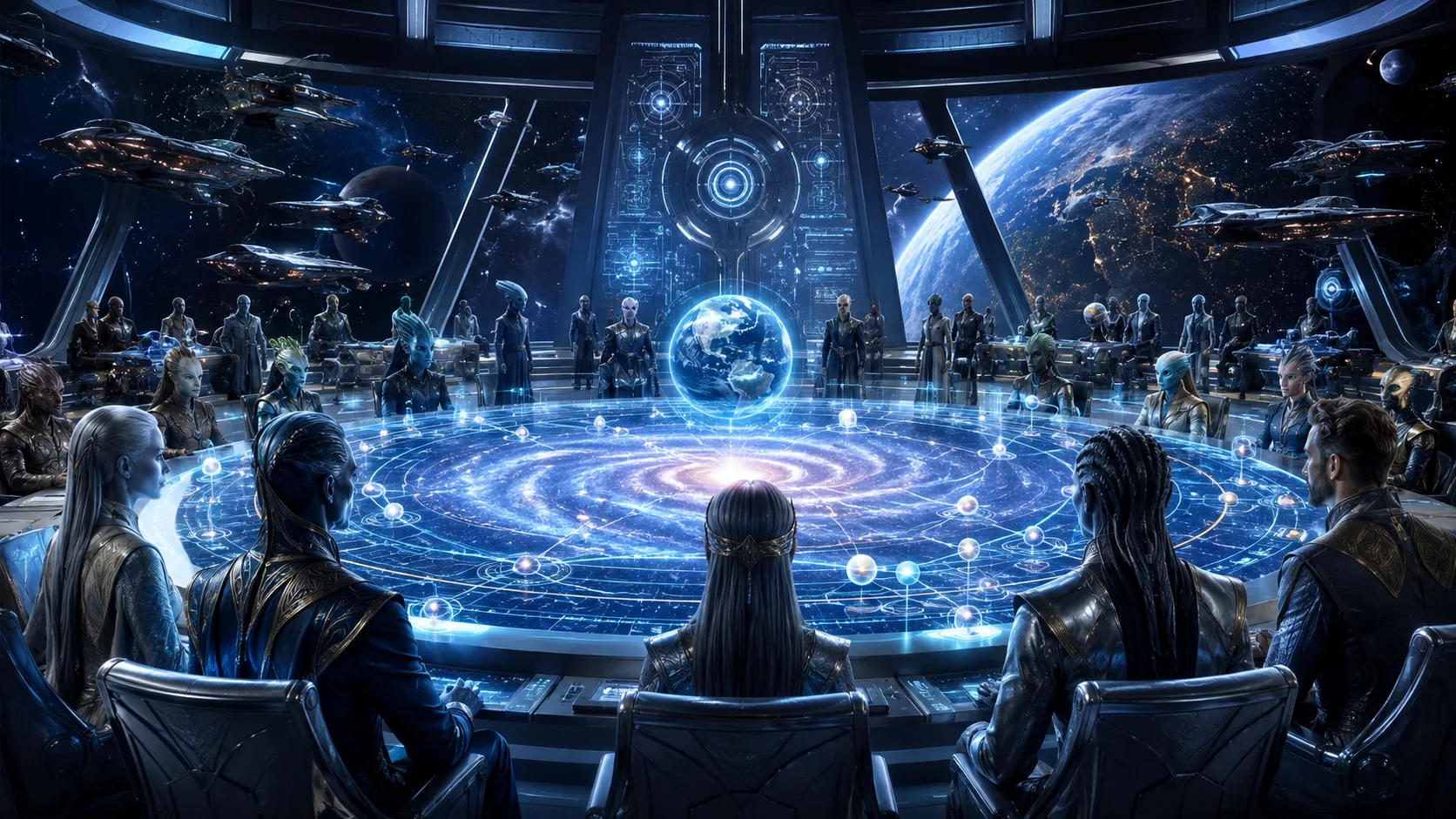
Introduction: Beyond the Myth of “Light Beings”
When most people first hear about the Galactic Federation, the image that comes to mind is often mystical—an assembly of enlightened beings made of pure light, guiding humanity from a higher plane.
But that version, while popular, doesn’t fully reflect how the Federation is described in many detailed accounts.
Instead, the Galactic Federation is often presented as something far more grounded—and, in many ways, more complex. Not an ethereal council, but a vast, organized alliance of physical civilizations. Not perfect beings, but advanced societies working together under shared rules, responsibilities, and challenges.
Understanding that shift changes everything.
A Physical Alliance Operating in Our Reality
Not Light Beings, But Advanced Civilizations
One of the most important clarifications about the Galactic Federation is that it is not a purely spiritual or non-physical entity.
It exists in the same general realm as Earth—what some describe as a slightly higher vibrational state, often referred to as a fifth-density environment. That doesn’t mean it’s unreachable or imaginary. It means it operates with a level of refinement and awareness that differs from what humanity currently experiences.
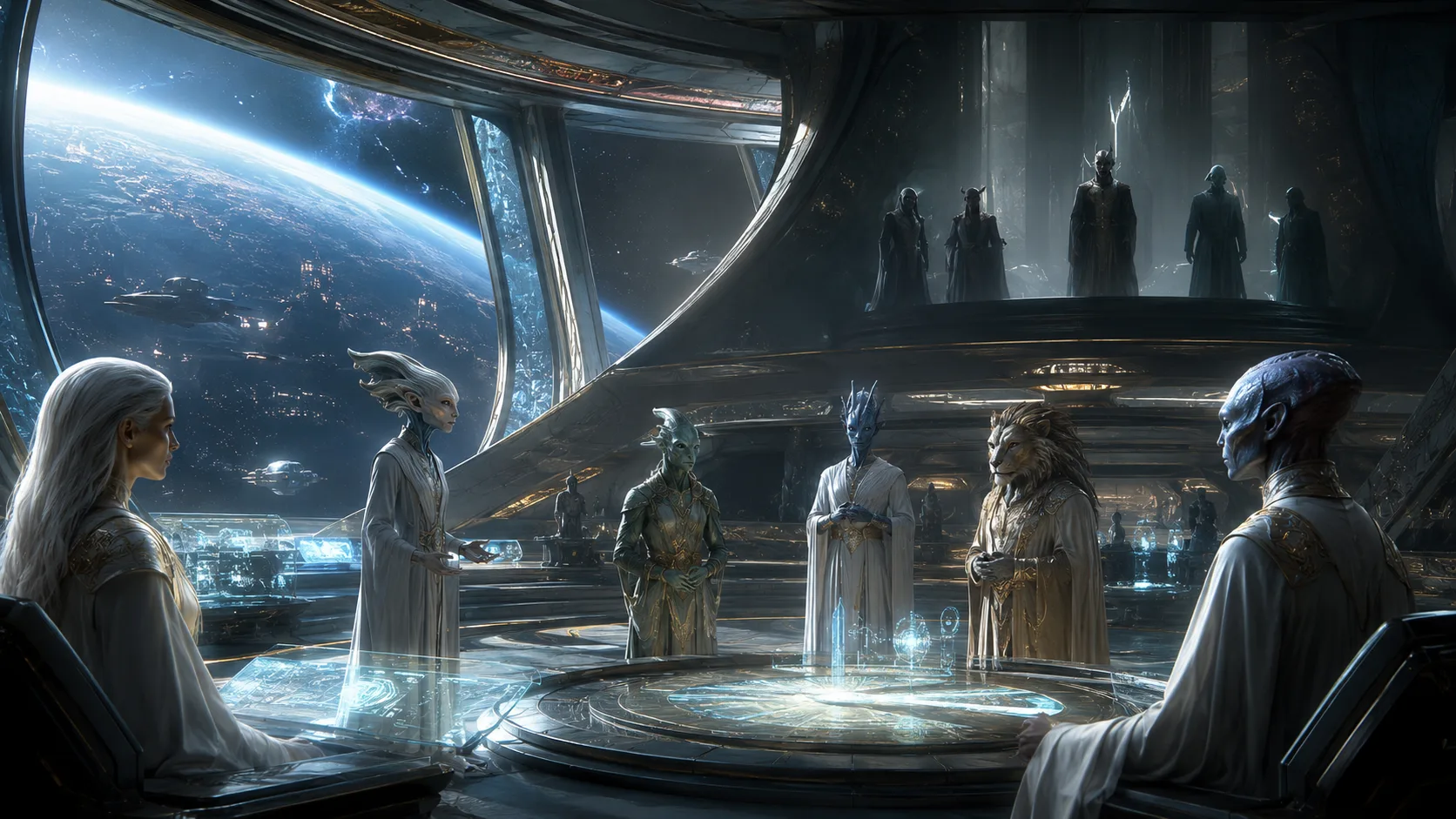
The beings within the Federation are described as physical. They have societies, technologies, cultures, and governance systems. They are not angels, nor are they ascended masters detached from reality.
They are people—just far more advanced.
Origins Rooted in Conflict and Survival
The Expansion from Lyra
The formation of the Galactic Federation is often traced back to a period known as the great expansion from Lyra.
During this era, multiple humanoid races spread across different star systems. But this expansion was not peaceful. Many of these civilizations faced persecution and conflict, particularly from aggressive, regressive species often associated with the Orion region.
These events are sometimes referred to as the Orion Wars—a series of large-scale conflicts that shaped the structure of interstellar relations.
Out of that chaos came the need for order.
The Federation emerged as a response—a way to unify different species, establish cooperation, and prevent future large-scale destruction.
The Founding Civilizations
Three Core Species
At the heart of the Federation’s formation are three primary groups:
- Andromedans – Often associated with diplomacy and long-term planning
- Arcturians – Known for advanced technological and energetic understanding
- Lyrians – One of the earliest humanoid lineages connected to many other species
These civilizations played a central role in building the framework that would later expand into a massive interstellar alliance.
Their goal wasn’t dominance.
It was coordination.
Purpose and Function: More Than Just Observation
Maintaining Order Across a Vast Region
The Galactic Federation isn’t described as a passive observer. It functions more like a governing alliance that operates under a defined set of rules.
Its core objectives are often said to include:
- Establishing alliances between different star systems
- Resolving conflicts before they escalate
- Maintaining stability across large regions of space
- Enforcing agreed-upon legal and ethical standards
In that sense, it operates less like a mystical council and more like a structured interstellar organization.
It’s not just watching.
It’s managing.
A Structured System With Boundaries
Law, Ethics, and Cooperation
One of the defining characteristics of the Federation is its emphasis on rules.
Interactions between civilizations are not random or unregulated. They are governed by frameworks designed to balance autonomy with collective stability.
These guidelines often include:
- Respect for the development of emerging civilizations
- Limits on direct interference
- Protocols for contact and communication
- Agreements on technological sharing and containment
This structured approach suggests something important:
The Federation is not driven purely by idealism. It operates within systems—systems that require negotiation, compromise, and enforcement.
Earth’s Place Within the Federation
A Long, Evolving Relationship
Earth’s relationship with the Galactic Federation is often described as ongoing, though not always visible.
Rather than a single point of contact, the interaction is said to have moved through different phases over long periods of time—sometimes closer, sometimes more distant.
This fluctuating involvement raises questions.
Why isn’t contact more obvious?
Why does interaction seem indirect rather than open?
One explanation often given is timing.
Civilizations are believed to reach certain stages of development before open interaction becomes possible. Until then, involvement remains limited or carefully managed.
The Scale of the Federation
A Galactic-Level Presence
Perhaps the most striking aspect of the Galactic Federation is its scale.
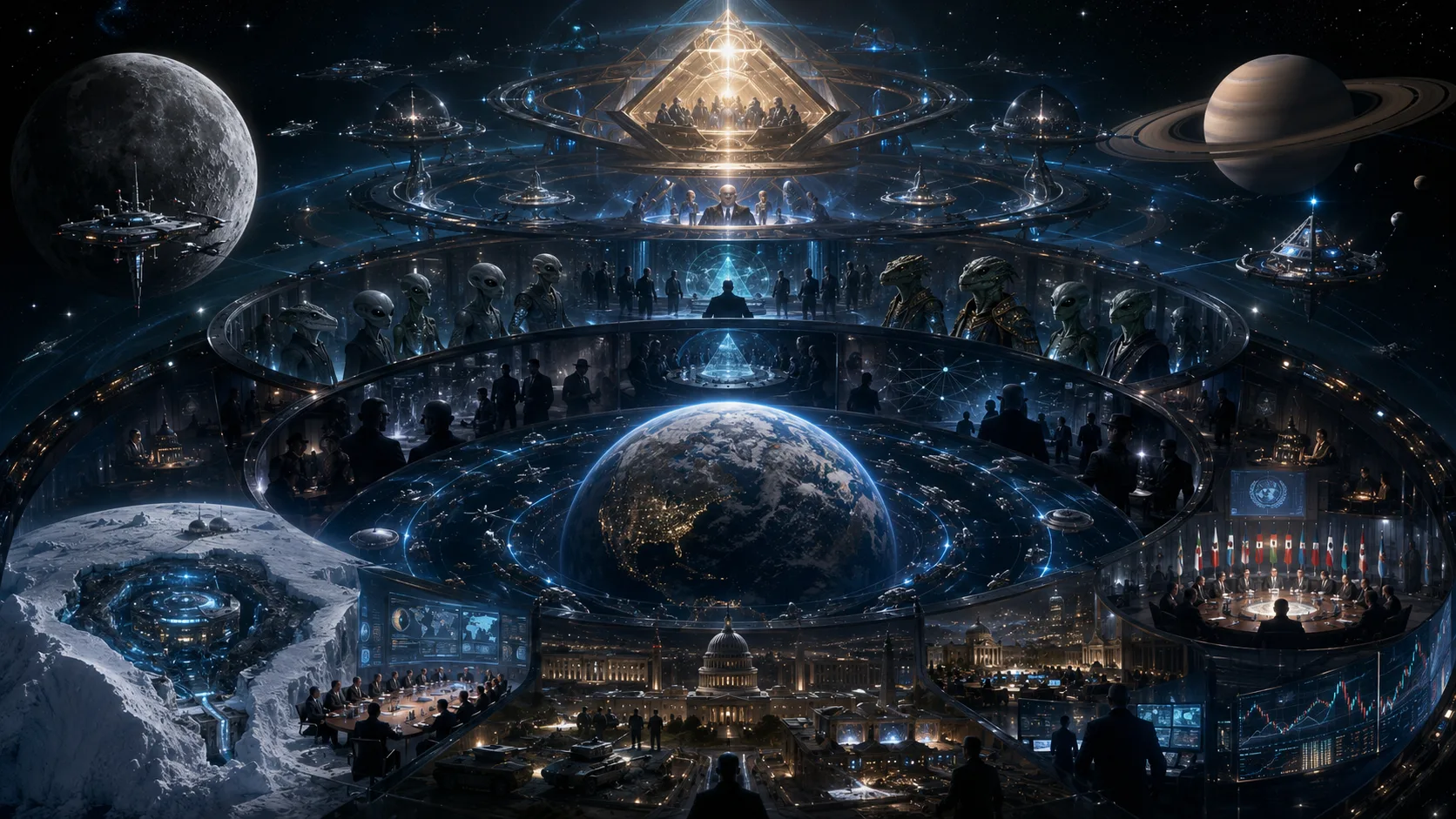
It is not described as a small group or a localized alliance. It spans a massive portion of the galactic quadrant, bringing together a wide range of species, cultures, and technologies.
This level of coordination implies something significant:
A long history of cooperation—and a need for it.
Because at that scale, without structure, conflict would be inevitable.
A More Grounded Perspective
Moving Beyond Simplified Narratives
It’s easy to fall into extremes when thinking about something like the Galactic Federation.
On one end, it becomes a perfect, benevolent force. On the other, it becomes a controlling or manipulative presence.
But the more detailed perspectives suggest something more nuanced.
The Federation is not portrayed as flawless.
It is a system.
A complex one.
Made up of different groups with different priorities, working together under shared agreements.
That doesn’t make it good or bad in absolute terms.
It makes it real—at least within the framework of these accounts.
Why This Perspective Matters
Understanding Through Complexity
Whether someone fully believes in the existence of the Galactic Federation or views it as a conceptual framework, the idea itself offers something valuable.
It challenges simple thinking.
It introduces the possibility that advanced systems—whether on Earth or beyond—are rarely defined by a single motive.
They are shaped by:
- History
- Conflict
- Cooperation
- Compromise
And that’s something we already understand from our own world.
Conclusion: An Open Question With Expanding Meaning
So what is the Galactic Federation?
According to many accounts, it is a vast, physical alliance of advanced civilizations formed out of necessity, built on cooperation, and governed by structured principles.
It is not a myth of perfect beings.
It is not simply a story of cosmic saviors.
It is something more layered—an organization that reflects both order and complexity on a scale far beyond Earth.
Whether seen as literal, symbolic, or somewhere in between, the concept invites a deeper question:
If such systems exist beyond our world, what does that say about the systems we are building here?
Because in the end, understanding something like the Galactic Federation may not just be about looking outward.
It may also be about recognizing how growth, cooperation, and responsibility evolve—no matter where they take place.
Cosmic Echoes
Share-ready comments you can copy in a click, then post wherever the conversation touches UFOs, UAP, or the Galactic Federation.
These comments belong to the Cosmic Echoes page under the section Galactic Alliance: Truth Beyond Light Beings.
Plus 21 more comments on the Cosmic Echoes page.