
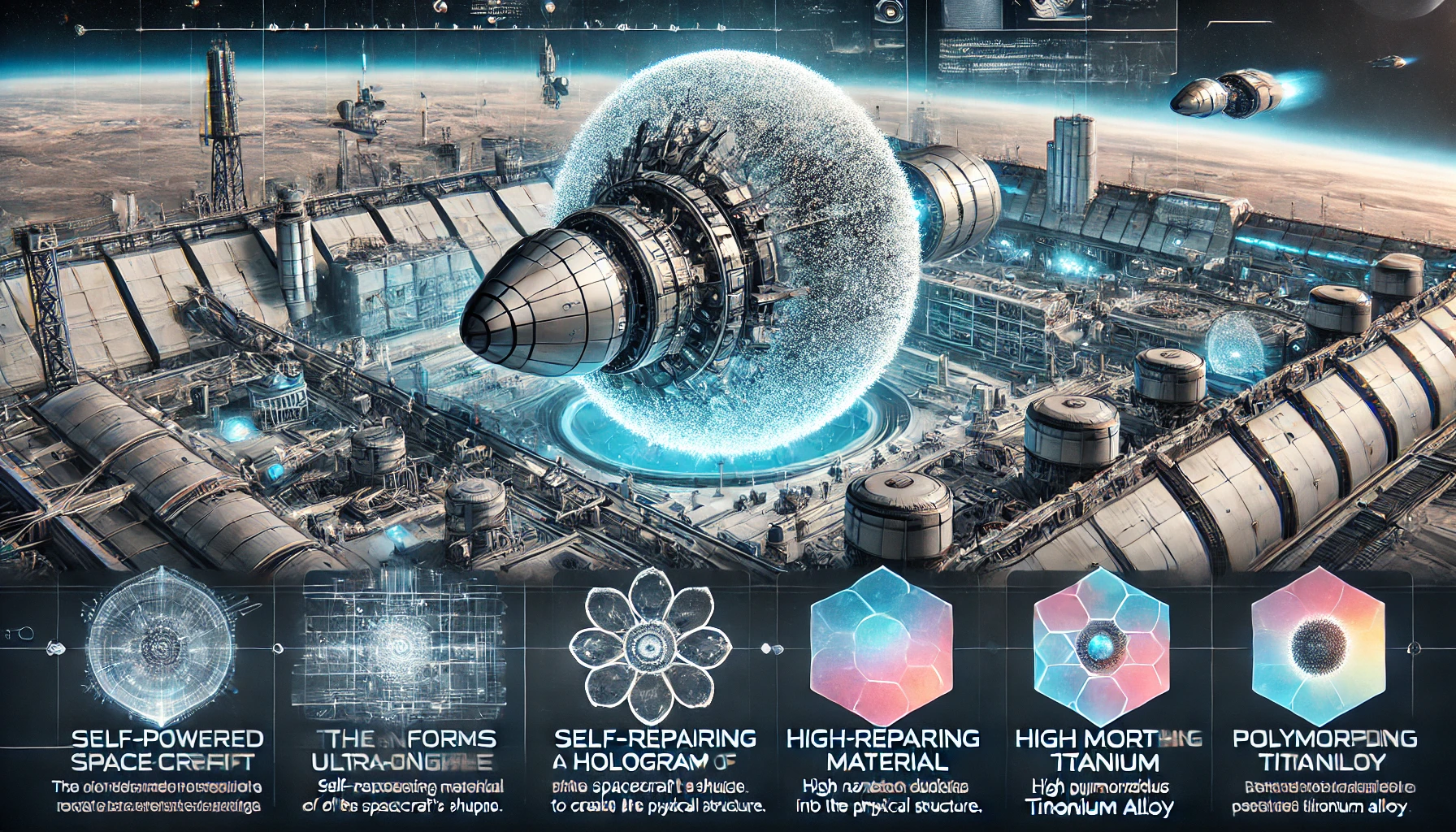
Introduction: The Evolution of Nanotechnology in Spacecraft Design
Exploring the Andromedan and Taygetan techniques in crafting spacecraft like the Toleka.
Key Highlights:
- Self-Repairing Material: This metal heals itself after impacts, similar to how living tissue regenerates.
- High Tensile Strength: The metal withstands extreme temperatures, often in the thousands of degrees Celsius.
- Polymorphous Titanium Alloy: This alloy is known for its resilience and strength.
Crafting the Hull: Nanotechnology and Molecular Precision
The hulls of Andromedan and Taygetan spacecraft are created with a revolutionary nanotechnological metal. This metal aligns itself at a molecular level, enabling complex designs and self-repair capabilities.
“The engine forms a high-powered hologram of the spacecraft’s shape, guiding the nanotech particles to create the physical structure.”
Steps Involved:
- Engine Construction: The core of the ship’s functionality.
- Holographic Blueprinting: High-energy holograms outline the ship’s structure.
- Nanotech Dust Application: The metallic nanotech powder is poured over the blueprint, which then solidifies in place.
Material Science: Polymorphous Titanium vs. Traditional Metals
Unlike conventional metals, the polymorphous titanium alloy:
- Doesn’t Corrode: The material maintains integrity under extreme stress.
- Self-Heals: Similar to how cells repair, this metal realigns its molecular structure.
- High Plasticity: It can morph into any required shape and density.
Comparative Table:
| Property | Polymorphous Titanium | Conventional Metals |
|---|---|---|
| Corrosion Resistance | High | Medium |
| Self-Healing Ability | Yes | No |
| Tensile Strength | Extremely High | Moderate to High |
| Fatigue Resistance | Excellent | Low |
Layers of Protection: Shields and Energy Fields
Taygetan ships incorporate multiple layers of shields around their hulls, often up to 90 cm thick in standard areas and up to 2 meters in critical zones. These shields form an electromagnetic barrier that repels unwanted particles and debris.
Manufacturing Technology: The Intelligent Nanopowder
The primary material for Taygetan and Andromedan ships is a unique nanotechnological dust, which can be directed by a ship’s computer to form precise structures.
Fact Box:
- Nanopowder Particles: Spherical with tiny spikes, each aligning via electromagnetic frequency to create a robust structure.
Real-World Applications of Taygetan Nanotechnology
Although primarily used in spacecraft construction, the applications of this programmable material extend far beyond:
- Temperature Resistance: Survives in ultra-high-temperature environments.
- Fatigue-Free: Unlike steel or titanium, this material doesn’t experience metal fatigue.
- Adjustable Reflectivity: The final color or transparency of the material can be programmed.
The Role of Taygetan AI in Ship Functionality and Repairs
Taygetan spacecraft are renowned for their integration of advanced artificial intelligence (AI) systems that play a critical role in maintaining ship functionality and performing repairs. These AI systems are designed to operate autonomously, capable of diagnosing and rectifying a range of mechanical and technical issues without human intervention.
Autonomous Repair Capabilities
The AI systems on Taygetan ships are embedded within the spacecraft’s core operational framework, allowing them to continuously monitor the integrity of the spacecraft’s systems and structure. Equipped with sensors and diagnostic tools, the AI can detect anomalies and malfunctions as they arise and respond instantly. For basic repairs, the AI deploys nanotech-based agents—tiny robots that can manipulate molecular structures to mend cracks, seal breaches, and replace worn components.
Manual Intervention in Complex Repairs
Despite the high level of autonomy, there are instances where Taygetan technology necessitates manual intervention. Complex mechanical failures or system malfunctions that involve critical decision-making or intricate physical repairs often require the expertise of a skilled technician. In such cases, the AI system provides detailed diagnostics and procedural recommendations but steps back to allow crew members to execute precise, hands-on repairs. This blend of AI guidance and human expertise ensures that each repair is handled optimally, balancing speed and precision.
Pro/Con Box: Evaluating AI in Spacecraft Management
| Pro | Con |
|---|---|
| Reduces dependency on crew | Over-reliance on AI can lead to complications |
| AI systems enhance operational efficiency by performing routine maintenance and repairs autonomously, reducing the need for constant human oversight. | Over-reliance on AI could potentially lead to a scenario where unexpected AI failures or limitations could jeopardize a mission, especially if the crew is not adequately trained to handle issues manually. |
| Enables more complex missions | Potential for AI malfunctions |
| With AI handling many of the ship’s functions, Taygetan spacecraft can undertake more complex, longer-duration missions with fewer crew members, allowing for broader exploration. | AI systems, while sophisticated, are not infallible and can malfunction, especially in the unpredictable environment of space, requiring swift human correction to prevent critical failures. |
| Continuous learning and adaptation | Issues with AI autonomy |
| Taygetan AI systems are equipped with machine learning algorithms that allow them to learn from each repair and improve over time, enhancing their effectiveness and reducing similar future failures. | High levels of autonomy in AI could lead to scenarios where the AI makes decisions that are not aligned with crew safety or mission objectives, particularly in rapidly changing situations. |
The integration of AI in Taygetan spacecraft represents a significant advancement in space travel technology, combining the strengths of both artificial intelligence and human capabilities to create a resilient and efficient system. However, as with any technology, it requires careful management to balance its benefits against potential risks, ensuring that the reliance on AI enhances, rather than hampers, mission success.
Environmental Impact: Sustainable Resource Management
Interestingly, Taygetans practice sustainable use of resources. They don’t cut down trees unnecessarily and rely on naturally available wood from dead trees for essential constructions, showing their commitment to eco-friendly practices.
Cross-Race Collaborations: Taygetans and Their Allies
Though Taygetans handle most of their shipbuilding, they occasionally collaborate with races like Engans and Antarians for specific technologies.
Information Box:
- These partnerships enhance resource-sharing and technological advancements, benefiting each race.
Frequently Asked Questions (FAQs)
Q1: How long does it take to construct a Taygetan spacecraft?
Constructing a Taygetan spacecraft is a complex and labor-intensive process. A ship like the Toleka, which is among the most advanced of its kind, typically requires up to five years to complete. This timeline includes various stages of production—from the initial design phase to the final assembly. The construction involves thousands of skilled workers specializing in different aspects of spacecraft technology, such as nanotechnology, electromagnetic engineering, and artificial intelligence. These professionals work in coordination to ensure that each component of the spacecraft meets the high standards required for interstellar functionality.
Q2: What propulsion system do Taygetan spacecraft use?
Taygetan spacecraft do not use traditional combustion-based fuels. Instead, they are powered by advanced propulsion systems that utilize electromagnetic energy. This method of propulsion is based on the manipulation of electromagnetic fields to create thrust, allowing for efficient and high-speed travel through space. The advantage of this technology is twofold: it eliminates the reliance on finite energy resources, and it supports the Taygetan commitment to sustainability and minimal environmental impact. The ships are equipped with energy converters that can harness ambient cosmic radiation, transforming it into usable power, thus sustaining the spacecraft over long interstellar journeys.
Q3: Are Taygetan spacecraft equipped for deep space missions?
Yes, Taygetan spacecraft are specifically designed for extended deep space missions. They are built with self-sustaining life support systems, advanced navigation arrays, and communication technologies that allow them to travel beyond the solar system. The materials used in the spacecraft construction, such as the polymorphous titanium alloy mentioned earlier, are selected for their durability and ability to withstand the harsh conditions of space, including extreme temperatures and cosmic radiation. The ships’ intelligent AI systems continuously monitor and maintain all spacecraft functions, ensuring safety and efficiency throughout the journey.
Q4: How do Taygetans ensure the safety of their spacecraft?
Safety is a paramount concern in the design and operation of Taygetan spacecraft. Multiple layers of protection are implemented, starting with the structural design, which includes robust shields around the hull. These shields are capable of repelling micro-meteoroids and other space debris. Internally, the spacecraft are equipped with advanced diagnostic and repair systems that can autonomously address many potential issues, from structural integrity to system malfunctions. Additionally, Taygetans use sophisticated artificial intelligence to predict and prevent failures before they occur, significantly enhancing the safety and reliability of their space travels.
Q5: Can Taygetan technology be adapted for human use?
The adaptability of Taygetan technology for human use is currently a subject of intense study and collaboration. While certain aspects of Taygetan technology, like their nanomaterials and AI, have potential applications in human aerospace engineering, significant modifications are necessary to align with human technological capabilities and safety standards. Collaborative programs are exploring these possibilities, aiming to integrate alien technology with human engineering to advance our own space exploration efforts.
Conclusion: The Future of Spacecraft Innovation
The Taygetan and Andromedan technologies mark a new era in space engineering, where nanotechnology, sustainable practices, and advanced AI come together. These innovations lay a foundation for future advancements in interstellar travel.
Takeaway Points:
- Nanotech metals enable ships to repair themselves, withstand extreme temperatures, and morph according to design.
- Taygetan ships incorporate multiple shields for protection and use environmentally conscious materials.
- Collaborations with other interstellar races further Taygetan technological prowess.
For more articles on advanced extraterrestrial technology, visit GalacticFederation.IN.
Related Articles


2021: Materials and Technology Behind Andromedan and Taygetan Spacecraft Construction
Explore the fascinating world of Andromedan and Taygetan spacecraft technology, particularly the use of a revolutionary nanotechnological metal in constructing ships like the Toleka. This video dives into the cutting-edge materials that make these spacecraft unique, including polymorphous titanium alloys and intelligent nanotech dust that can align at a molecular level. Witness the remarkable construction process that begins with an engine-generated high-energy hologram, guiding the metallic dust to form the ship’s structure precisely. The video also covers the materials’ self-healing capabilities, which allow the hull to repair itself instantly after impacts, much like living tissue.
Cosmic Echoes
Share-ready comments you can copy in a click, then post wherever the conversation touches UFOs, UAP, or the Galactic Federation.
These comments belong to the Cosmic Echoes page under the section Nanotech Marvels: Andromedan & Taygetan Spacecraft Secrets.
Plus 21 more comments on the Cosmic Echoes page.