
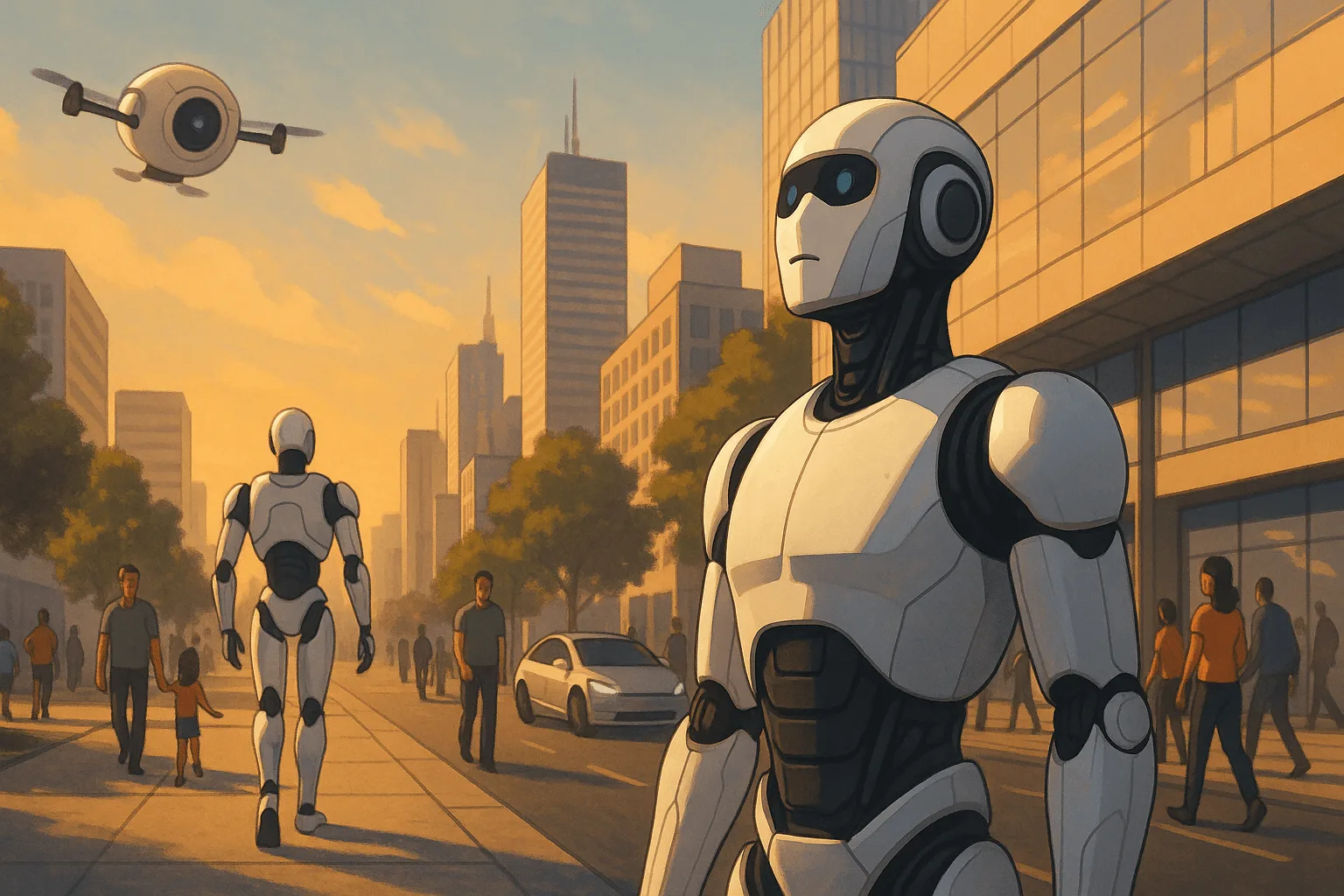
Introduction: A Turning Point for Robotics
We stand at the threshold of a robotics revolution. With breakthroughs like Nvidia’s Cosmos Reason and global humanoid competitions, the technology is no longer confined to labs—it’s ready for homes, streets, and communities. But instead of waiting for a perfect, secret rollout, the smartest approach may be to launch public beta programs: fully functional robots introduced directly into society, tested in real-world conditions, and constantly evolving.
Such a program wouldn’t just test machines; it would reshape how we live, work, and interact with technology.
Why a Public Beta Program Works
1. Real-World Stress Testing
Robots can’t be perfected in sterile labs alone. A beta rollout allows them to adapt to unpredictable human environments:
- Crowded streets, loud kids, dogs running underfoot.
- Unexpected challenges like slipping on ice or being jostled in a crowd.
- Stress-resilience: robots must fall, recover, and keep going.
This transforms robotics from novelty into reliability.
2. Direct User Customization
Each household or business could configure their robot like an app ecosystem:
- Core skills: walking, running, balancing, natural conversation.
- Specialized modules: firefighting, hair trimming, lawn mowing, companionship, wheelchair assistance.
- AI safety protocols: ethics layers that enforce politeness, prevent aggression, and adapt to local laws.
Think of it as downloading “skills” for your robot—like apps for a smartphone.
3. Revenue and Financing Systems
Robots can be priced for accessibility with creative finance models:
- Credit-based systems.
- Self-repossession features (robots quietly returning to service hubs if payments lapse).
- Repo centers in every major city, ensuring safe storage and retrieval.
This democratizes access, making high-end robotics affordable to the middle class.
Building the Ultimate Base Model
Strength & Speed
- Capable of running 20+ mph.
- Durable enough to take impacts from accidents or hostile individuals.
- Agile: can roll, get back up, and stabilize quickly.
Integrated Sensors
- Cameras, microphones, and radar/LiDAR.
- Biometric awareness (recognizing falls, fires, or distress signals).
- Environmental awareness (smoke, gas leaks, intruders).
Connectivity & Control
- Synced with smartphones for live monitoring.
- Cloud updates for new features.
- NSA-level security protocols (with privacy guarantees for non-criminals).
Use Cases That Save Lives
Firefighting & Emergency Response
- Home-defense firefighting robots with extinguishers and hazard sensors.
- Automatic alerts to fire departments, with livestreaming of the incident.
Policing & Public Safety
- Robots acting as AI “partners” for officers.
- Amber alerts linked directly to robots—instantly tracking abducted children through sensors and phone signals.
- Real-time crime reporting: license plates, descriptions, and GPS coordinates relayed to dispatch.
Healthcare & Companionship
- Assisting the elderly with mobility and daily routines.
- Acting as in-home physical trainers or therapy assistants.
- Offering companionship with natural conversation and emotional intelligence.
Government Transparency and Public Trust
Why Go Public?
Secrecy erodes trust. By making robotics development open-source, transparent, and accessible, governments flip the narrative:
- Citizens see benefits firsthand.
- Fears of hidden surveillance transform into trust through visibility.
- Robotics becomes a shared public utility, not a shadow project.
Positive Scenarios
- Safer streets: AI detects threats before crimes occur.
- Safer police: flagged suspects trigger silent alerts to nearby officers.
- Safer children: instant abduction detection through phones and audio recognition.
- Safer homes: fire prevention, fall detection, medical monitoring.
Beyond Earth: Prison Planets and the Future of Justice

A New Kind of Separation
On Earth, prisons lock people in cells, stacked behind walls, hidden from society. But what if instead of concrete cages, offenders were separated from the general population by entire planets?
In this vision, dangerous offenders — murderers, rapists, child predators, violent offenders, and chronic criminals — are transported to a rehabilitation planet, permanently separated from Earth but given the tools to build new lives. This is not freedom. This is not exile. This is prison — but a prison designed to rebuild society instead of destroy people.
Open-Society Prisons, Not Cells
On these prison planets:
- There are no jail cells. Offenders roam freely.
- They live under laws mirroring those of Earth — the U.S. Constitution, human rights, and fair governance.
- Men and women live on opposite sides of the planet. Over time, as they build trust, they may cross paths, form families, and grow villages into communities.

This is incarceration reimagined: offenders are separated, monitored, and held accountable — but also challenged to survive, grow, and contribute.
Full Transparency: A Window for Earth

Unlike today’s closed-door prison systems, these planetary prisons would be fully visible to the world.
Every surveillance camera, every robot guard, every mounted drone feed would be accessible through a public software interface. Citizens on Earth could:
- Log in and watch live streams of daily life inside these prison societies.
- Record, clip, and share footage on platforms like TikTok, YouTube, and beyond.
- Witness rehabilitation — or failure — in real time.
This transparency removes secrecy from justice. No one can claim abuse, neglect, or injustice is hidden. At the same time, society can directly see the price of crime and the effort of redemption.
Rehabilitation Through Responsibility

Life on a prison planet would not be easy. Offenders must:
- Grow their own food: provided starter seeds, livestock, and tools, but survival depends on their labor.
- Build their own shelter: houses, workshops, and communities must be constructed from raw materials.
- Govern themselves: voting, law-making, and dispute resolution all conducted under constitutional guidelines.
AI-driven robots act as teachers, mentors, and guardians — guiding the community forward, not punishing it.
The Fear of the Harsher World: A System of Absolute Accountability
Rehabilitation is always the first priority. The prison planet system is designed to give even the most hardened offenders — murderers, violent repeat offenders, rapists, predators, and chronic abusers — a chance at a new beginning. Removed permanently from Earth, these individuals are sentenced to life on a world where they are no longer a threat to the general population. But unlike the stone-and-steel cages of Earth’s prisons, this new world is both a test and an opportunity: offenders are given land, tools, communities, and guidance from AI mentors and robotic guardians. They can either choose to build a society worth living in or fall back into the destructive behaviors that placed them here.
The First Planet: Paradise, If They Make It So

The first destination is not a wasteland — it is a paradise in potential. Fertile land, clean air, renewable energy, and advanced robotics infrastructure create the foundation. Offenders are read the rules of society upon arrival: they must live under the Constitution, uphold human rights, and follow the regulations of the planetary system.
They are told plainly: “This is not exile. This is not freedom. This is prison. But you have the chance to make it a community. You may choose to build families, create neighborhoods, govern yourselves, and live in peace. But violence, exploitation, or predatory behavior will not be tolerated.”
Men and women are initially separated, building their own sides of society before earning the right to integrate. Communities form based on shared values and goals, and offenders can move between groups or even establish their own enclaves. Land is communal — every person has the right to their own piece, regulated to prevent chaos, while core governance is enforced by AI guardians and monitored through robotic police.
Transparent Justice: Cameras, Courts, and Constant Oversight

Every action on this planet is observed through robotic surveillance: guard drones, mounted cameras, and AI-powered monitoring systems. The public on Earth has full access to live feeds — ensuring that no abuse, violence, or neglect is hidden. People can log in, watch offenders build homes, farm crops, or attend public councils. They can record and share clips online, turning rehabilitation into a transparent societal process.
When violence or repeated misconduct occurs, offenders are not left unchecked. Robotic police intervene, making arrests when necessary. Their cases are brought before an Artificial Intelligence Judicial Council — a panel of AI judges designed with multiple personalities and interpretive models (strict, lenient, logical, empathetic), alongside one human judge and a “Judge of the People” — a rotating citizen representative. Together, they deliberate transparently and determine whether the offender can remain in the rehabilitation society or be transferred to the harsher world.
This system ensures no one is wrongfully punished, while also making it clear: if you repeatedly choose violence, you will not be allowed to remain in paradise.
The Harsher Planet: Where Violence Leads

For those who refuse reform — serial killers, irredeemably violent offenders, organized predators — the next destination is a second-tier planet, vastly different from the first. This harsher world is stripped of the luxuries of rehabilitation:
- Scarcer resources.
- Harsher climate and terrain.
- Minimal robotic oversight — survival depends on cooperation, or it ends quickly.
- Reduced medical and technological support.
Here, offenders face the reality of their refusal to change. The fear of this transfer becomes a powerful deterrent on the first planet, pushing many to reform rather than risk a life of desperation and survivalism.
Homelessness and Minor Offenses: Rehabilitation, Not Eradication

This system also addresses social collapse on Earth. Those who are homeless, abandoned, or lost in cycles of addiction can enter the first planet voluntarily. They are not labeled as “criminals,” but as citizens in need of a structured new beginning. They join communities, work the land, and learn governance under the same system.
For offenders with lesser crimes, rehabilitation periods may last three to five years. They enter communities, contribute to building society, and eventually earn the right to return to Earth — equipped with new skills, values, and accountability.
A Collective Vision: With Us or Without Us

At its core, the prison planet system represents a clear choice: you are either with humanity’s vision of a safe, positive, uplifting civilization, or you are without it. Those who cooperate and reform can live in communities that grow into thriving, self-sustaining societies across the stars. Those who reject that path consign themselves to harsher, less forgiving worlds.
This is not cruelty. It is clarity. A collective that values safety, transparency, and progress must draw firm lines. The rules are not hidden. The surveillance is not secret. Every offender knows: their actions, their choices, and their willingness to contribute determine whether they rise to community leadership or fall into harsher exile.
✨ In this future, violent crime no longer poisons Earth’s cities. Homelessness and hopelessness are given structured alternatives. And for the first time in history, prisons cease to be cages and instead become crucibles where humanity tests its darkest members — forcing them either to embrace civilization or to fade into harsher isolation..
Robots as Guardians and Teachers
- Guardians: AI robots monitor all activity, preventing violence and enforcing order.
- Mentors: They provide education, therapy, and work training.
- Reporters: Their cameras serve as live feeds for Earth, broadcasting honesty and transparency.
The robots are not just enforcers — they are guides to a new way of life.
Why This Is Good for Earth

- Safer communities: Offenders are fully removed from general population.
- Transparent justice: The world watches rehabilitation in real time.
- Cost-effective: Instead of pouring billions into overcrowded prisons, resources go toward sustainable colonies.
- Redemptive, not destructive: Offenders are given a chance to rebuild instead of being warehoused until death.
And perhaps most importantly: this system forces truth and honesty. No more secret prisons. No more abuse hidden behind stone walls. Society sees everything.
The Role of UAP Technology

For this vision to work, the government must finally reveal its UAP transportation technology — capable of safely relocating populations across space. This technology, long rumored to exist, would allow the creation of prison planets that are secure, distant, and stable.
This is not science fiction. It’s the natural evolution of justice in a world where robotics, AI, and interstellar technology converge.
Case Study: How a Connected Robotics System Could Have Prevented the 2014 Las Vegas Shootings
The Incident in Context

On June 8, 2014, Jerad and Amanda Miller ambushed and killed two Las Vegas police officers at a CiCi’s Pizza, declared their attack the beginning of a “revolution,” and then moved into a Walmart where they killed a civilian attempting to intervene. The tragedy highlighted the vulnerability of unprepared officers, the failure to detect extremist threats in real time, and the limits of traditional reactive policing.
In a world operating under the transparent robotics + AI security system described earlier, the sequence of events would have unfolded very differently.
Early Threat Detection: AI as a Continuous Watchdog

- Digital Red Flags
- Jerad Miller had a long history of anti-government social media posts, threats, and extremist rhetoric.
- AI monitoring systems would have flagged his online behavior, linking it to prior arrests and associating him with militia movements.
- Instead of being ignored or buried in federal files, the data would flow into a live national risk-rating system, constantly updating individual profiles.
- Behavioral Heat Maps
- AI cross-referencing cellphone pings, geolocation data, and online behavior would have marked the Millers as high-risk individuals.
- Proximity alerts would be triggered any time flagged individuals entered areas with police presence.
- Pre-emptive Alerts to Officers
- The officers at CiCi’s Pizza would have received silent alerts on their phones or wearable HUDs:
- “High-risk individual nearby.”
- Profile data, photos, and recent behavior instantly available.
- Instead of being ambushed at lunch, they would have been situationally aware and on guard.
- The officers at CiCi’s Pizza would have received silent alerts on their phones or wearable HUDs:
Robotics and Surveillance in Action

- Restaurant Entry Detection
- As Jerad entered CiCi’s Pizza to “scout,” cameras equipped with facial recognition + AI threat detection would have identified him as a flagged risk.
- Humanoid police-assist robots or drones stationed in public spaces could have followed quietly, monitoring his movements and transmitting data live.
- Robotic Intervention
- At the moment Jerad returned with Amanda and drew a weapon, a nearby law enforcement robot would have deployed:
- Sound cannons or non-lethal strobe disruptors to disorient the attackers.
- Immediate livestream to dispatch and command centers.
- Public warning systems inside the restaurant to move civilians to safety.
- At the moment Jerad returned with Amanda and drew a weapon, a nearby law enforcement robot would have deployed:
- Civilian Protection
- Instead of officers being taken by surprise, the attackers would have faced multiple robotic units trained to absorb damage, pin down shooters, and protect lives until backup arrived.
Walmart Shooting Prevention

- Entry Point Monitoring
- Walmart’s AI-linked cameras would have immediately flagged both suspects upon entering, broadcasting alerts to nearby police units and robotic patrols.
- Customers would have been directed out safely by emergency drones with voice projection, avoiding chaos.
- Protecting Armed Civilians
- Joseph Wilcox, the armed civilian who bravely tried to intervene, would not have walked blindly into danger.
- His phone could have received a live AI broadcast warning: “Two armed suspects, male and female. Do not engage. Police robots en route.”
- Containment and Resolution
- With robotic backup inside Walmart:
- The Millers would have been quickly cornered.
- Non-lethal incapacitation (tasers, foam rounds, chemical immobilizers) could have neutralized them.
- A fatal shootout could have been avoided, preserving innocent lives.
- With robotic backup inside Walmart:
Transparency and Public Oversight
Perhaps most importantly, the entire sequence would have been visible to the public.
- Live feeds from robot cameras, drones, and surveillance systems would have shown the Millers’ movements, the intervention, and the outcome in real time.
- Citizens on Earth could record, share, and witness justice being applied transparently.
- This destroys the martyrdom narrative extremists seek — their “revolution” becomes a livestream of failed violence, neutralized by technology and truth.
Parameters of Protection
This system functions through layers of interconnected safeguards:
- AI Risk Profiles: Continuously updated records cross-referencing criminal history, online threats, and extremist networks.
- Geofencing Alerts: Officers instantly notified when flagged individuals enter their vicinity.
- Robot Patrols: Non-lethal, always-on guardians in public spaces.
- Surveillance Integration: Every building, drone, and robotic guard tied into one open-access live feed.
- Citizen Oversight: Transparency ensures no abuse of power, while reinforcing public trust.
- Failover Protocols: If rehabilitation fails, offenders are relocated to prison planets, permanently removed from Earth’s population.
A Safer Future
The 2014 Las Vegas shootings were the result of blind spots — ignored warnings, officers caught off guard, and civilians left vulnerable.
With an integrated robotics + AI + transparency system, such an incident would likely never occur again. Officers would have been warned, the attackers tracked, the public shielded, and the entire event broadcast live as proof of a safer, more accountable society.
✨ In this future, justice is proactive, not reactive. Violence is flagged before it erupts. And every citizen becomes a witness to truth, not a victim of secrecy.
Conclusion: A Future of Transparency and Transformation
Robots are no longer just products; they are the backbone of a new civilizational infrastructure.
- They enhance safety.
- They democratize access to essential services.
- They rebuild trust between citizens and government.
- And they become America’s next great export — a symbol of freedom, safety, and progress.
This is why governments must go public. Not as secret NSA or CIA projects hidden in the shadows, but as a national program for peace, prosperity, and accountability. The public beta is more than a product trial — it becomes a social contract between humans and machines, ushering in a safer, smarter, more connected world.
And that vision does not stop at Earth’s borders.
In this future, justice itself transforms. Rehabilitation is no longer a guess. Prisons are no longer cages. Instead, offenders are placed on new worlds where they must prove their humanity again — farming, building, cooperating, and living under the same constitutional laws we honor on Earth.
For the people of Earth, the window is always open: every camera, every robot, every corner of these prison societies visible through public feeds. Justice is not only served — it is seen.
✨ Beyond Earth, robots build the foundation of trust, while prison planets become communities. Communities grow into societies. And societies become proof that even the worst among us can either rise to humanity — or fall into harsher exile. Together, these systems form the blueprint for a transparent, rehabilitative, and truly futuristic civilization.the robotics revolution could be the greatest leap forward in human history.
DEMOLITION MAN – Sylvester Stallone u0026 Wesley Snipes,,, Hollywood movies full movie
In 1996, tough-as-nails cop John Spartan (Sylvester Stallone), known as the “Demolition Man” for the massive collateral damage he’s caused, botches a hostage rescue by crime lord Simon Phoenix (Wesley Snipes). Both men are sentenced to cryogenic prison — frozen in time until the future.nnFast forward to 2032: Los Angeles has become San Angeles, a pacifist utopia with zero crime—but also no real police force. When Phoenix escapes during a parole hearing, authorities thaw Spartan out to catch him. Spartan teams up with streetwise officer Lenina Huxley (Sandra Bullock) to restore order in this weird, sanitized world.nnBlending explosive action, satirical humor, and disturbing dystopian overtones, *Demolition Man* is a sharp, futuristic adventure that’s as entertaining today as ever.n


Cosmic Echoes
Share-ready comments you can copy in a click, then post wherever the conversation touches UFOs, UAP, or the Galactic Federation.
These comments belong to the Cosmic Echoes page under the section Robotics Revolution: The Transparent Beta Era.
Plus 21 more comments on the Cosmic Echoes page.