From Draco to Earth: The Struggle for Cosmic Control and Humanity’s Future
Humanity has long looked to the stars with wonder, but what if the answers to our origins and destiny lie not in the future but in the shadows…

Also known as: Iguana-like Beings, Iguanoid Reptilians, Iguana Reptilians, Iguanoid, Iguanoids, Lizard People, Draconians, Naga, Serpent Race
A subtype of reptilian humanoids resembling terrestrial iguanas, often described in contact reports as shorter than Draco reptilians, with scaly skin, dorsal ridges, and a herbivorous or omnivorous diet.
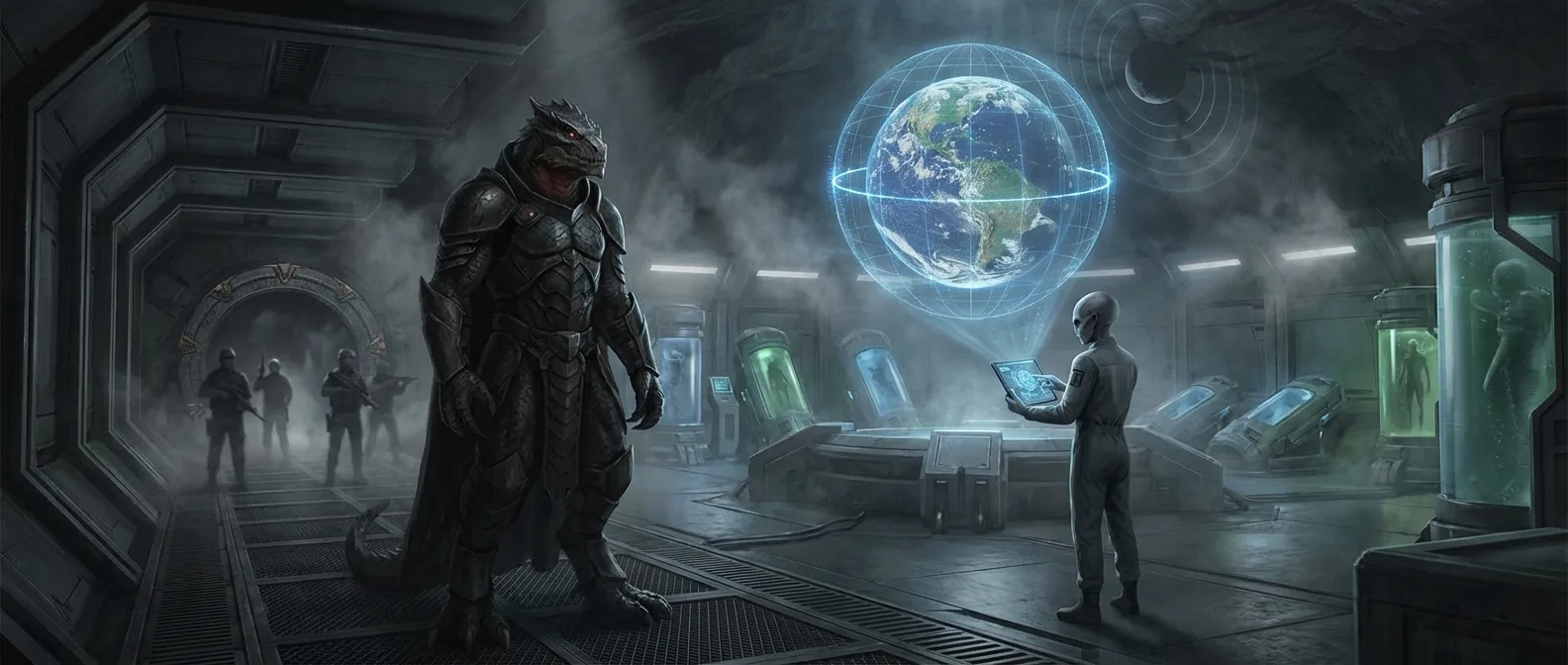
Iguanoid Reptilians are a distinct phenotype within the broader reptilian extraterrestrial classification. They are reported in encounter accounts as less aggressive than Draco reptilians, often associated with underground bases or specific star systems. Their appearance includes greenish scales, a pronounced crest or ridge along the back, and large eyes. They are often depicted as a worker or soldier caste serving higher-ranking Draco species, with a rigid hierarchical society and advanced technology.
Homeworld is likely a planet within the Draco constellation, possibly a colony world. Some sources suggest they may share a system with other reptilian races but occupy separate territories.
Iguanoid Reptilians are believed to have been active in Earth's region for millennia, possibly arriving via colonization or as part of a larger reptilian expansion. They are reported to have established underground bases on Earth and the Moon.
Trace this species entry through its recorded origin system, homeworld references, distance from Earth, constellation data, and known relationship points inside the Galactic Federation archive.
Iguanoid Reptilians have scaly skin varying from light green to olive or brown, with a distinctive dorsal ridge or crest running from the head down the back. Their faces are elongated with a snout, and they possess large eyes with vertical pupils, often yellow or red. They have a tail, which may be retracted in humanoid form; hands and feet end in claws. They are bipedal but can move quadripedally. As ectotherms, they require external heat sources to regulate body temperature.
Reported to emanate a cold, calculating energy, often described as pragmatic and emotionally detached. Their presence may feel oppressive or intimidating, but not necessarily malevolent. Some contactees note a sense of hierarchical dominance.
Iguanoid Reptilians are believed to have participated in hybridization programs, creating human-reptilian hybrids for purposes such as creating a slave workforce, genetic diversity, or establishing infiltrators. Hybrids are said to possess both human and reptilian traits, often with enhanced telepathic abilities.
Explore lineage, alliance, origin-system, and transmission links radiating from this species entry.
Iguanoid society is said to be authoritarian with a rigid caste system, where individuals are assigned roles based on genetics and breeding. They value discipline, order, and loyalty to the hierarchy. Their culture emphasizes practicality and efficiency, with little emphasis on art or spirituality. They are often described as serving higher-ranking Draco species in a military or oversight capacity.
Materialistic and devoid of spiritual development. Some sources suggest they view spirituality as weakness and suppress any metaphysical tendencies within their society. They may, however, have a utilitarian understanding of consciousness as a tool for control.
Primarily telepathic, supplemented by a verbal language that includes hissing, clicking, and guttural sounds. Telepathic communication is direct and often devoid of emotional nuance, favoring logical data exchange.
Level: Advanced, with mastery over interstellar travel, genetic engineering, energy weapons, and cloaking technology. Their technology is considered less advanced than some other reptilian races (e.g., Draco) but far superior to contemporary human tech.
Iguanoid craft are reported to include triangular and cigar-shaped ships, capable of both atmospheric and deep-space flight. They utilize anti-gravity propulsion and energy-based weapons. Their underground bases employ molecular restructuring, artificial gravity, and advanced life-support systems. They are known for extensive genetic manipulation, including the creation of hybrid humans.
Iguanoid Reptilians have a long and often covert history with Earth, including involvement in genetic manipulation of early hominids, establishment of underground bases, ongoing abduction programs, and possibly shaping human mythological archetypes. They are seen as part of a larger pre-existing power structure influencing human development.
Ancient Sumerian, Mayan, and Hindu texts depict reptilian beings that may correspond to Iguanoid types. The 'Naga' of Hindu mythology and the 'Draconians' in various cultures could be references. Some cave paintings from South America and Australia show lizard-like humanoids.
Reported in abduction and contactee accounts from the 1940s onward, with a notable increase in the 1980s. They are less common than Grey aliens but frequently mentioned by whistleblowers such as John Lear, Milton William Cooper, and in the testimonies of individuals like Alex Collier and David Icke (though Icke focuses on more general reptilians).
Channeled sources such as those from Barbara Marciniak (the 'Pleiadian' material) mention reptilian races including 'Draco' and a 'lower' type resembling iguanas. The Cassiopean material references a race called 'Lizard people'. Other channelers like Darryl Anka (Bashar) and Kryon occasionally touch on reptilian subtypes but with less specificity.
Iguanas were sacred in Mesoamerican cultures, possibly linked to the feathered serpent god Kukulkan/Quetzalcoatl, though that figure is more bird-like. Some legends of 'lizard men' in Native American, Australian Aboriginal, and African folklore may stem from remote encounters with these beings.
There are claims of 'Iguanoid starseeds'—human souls who began their journey in this species. These individuals are said to feel an affinity for reptiles, struggle with emotional expression, and have a natural inclination toward discipline and structure. However, such claims are rare and not widely accepted.
First Contact Period: Ancient times, possibly as early as 2000 BCE or earlier, with ongoing intermittent contact. Modern contact escalated in the 20th century with the rise of official disclosure efforts.
Iguanoid Reptilians are portrayed as a middle-tier species within the reptilian hierarchy, often serving as soldiers, overseers, or scientists. They are considered expendable assets by higher Draco ranks. Their political structure is likely a militaristic oligarchy with a strong emphasis on bloodlines and genetic purity.
Humanity has long looked to the stars with wonder, but what if the answers to our origins and destiny lie not in the future but in the shadows…
From Draco to Earth to Rule and Control What if the Draconian fear of humanity’s potential to reach the stars reveals a deeper truth about our species? Could…
Introduction Alien civilizations have long been the subject of mystery and speculation. With mounting evidence and testimonials, the concept of hidden extraterrestrial bases on Earth has gained traction.…
In a world of hidden agendas, shadowy cabals, and mysterious beings lurking beneath the surface, the idea of reptilian overlords might seem far-fetched. But among conspiracy enthusiasts, the…
Introduction: The Complex Web of Illuminati Lineages The origins of the Illuminati races are deeply intertwined with the Anunnaki and Seraphi extraterrestrial beings. Throughout history, their genetic experimentation…
Information synthesized from Exopaedia, contactee reports, channeled material (e.g., Barbara Marciniak, Cassiopean sessions), researchers such as David Icke and John Lear, and comparative mythology. Specifics about Iguanoid Reptilians as a phenotype are primarily drawn from Exopaedia and isolated encounter accounts.