
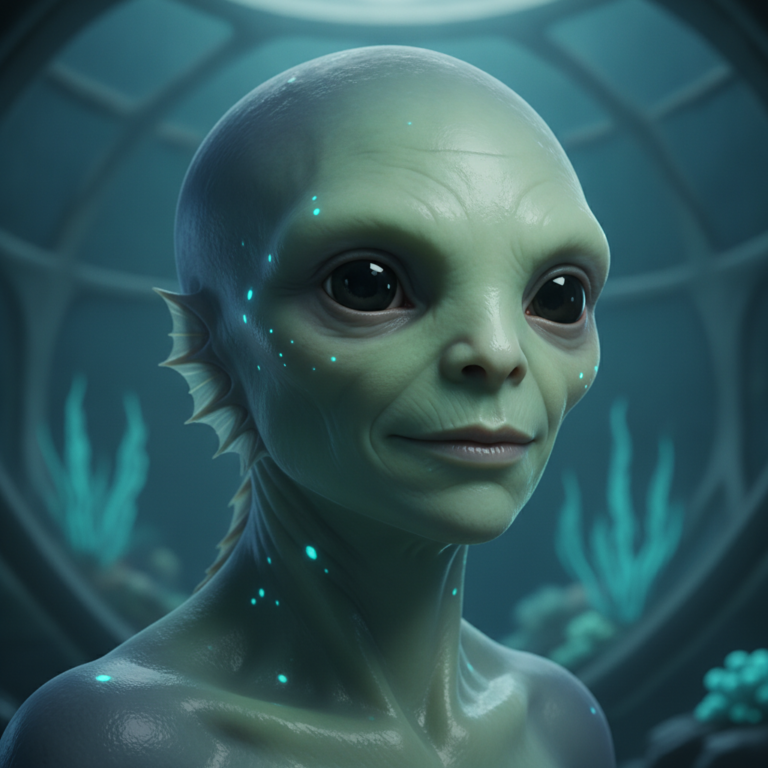
Caponi-Type Amphibians
Also known as: Caponi Type, Caponi Beings, Caponi Amphibians, Caponi, Aquatic Humanoids, Water Folk
A bipedal amphibian humanoid species adapted to aquatic and terrestrial environments, known for their peaceful nature and advanced bio-engineering.
Overview
The Caponi-Type Amphibians are a humanoid species with amphibious characteristics, classified under the Exopaedia phenotype system. They are believed to originate from a water-rich world and have developed a culture deeply intertwined with aquatic and terrestrial ecology. Their presence in galactic lore is often associated with environmental stewardship and subtle interactions with Earth’s water bodies.
Identity Matrix
- Common Name
- Caponi-Type Amphibians
- Singular Name
- Caponi Amphibian
- Plural Name
- Caponi Amphibians
- Alternative Names
- Caponi Type, Caponi Beings, Caponi Amphibians, Caponi, Aquatic Humanoids, Water Folk
- Origin Star System
- Unknown water-rich system (cataloged as 'Aqua Prime' in some exopolitical databases)
- Origin Star
- Unknown (likely a G-type or K-type star with a humid habitable zone)
- Homeworld
- Caponia (a designation from contactee reports)
- Constellation
- Uncorrelated (possibly associated with Cetus or Aquarius)
- Distance from Earth
- Unknown (estimated within several hundred light-years based on reported contact regions)
- Civilization Type
- Aquatic Bipedal Humanoid
- Average Height
- 1.5 - 1.8 meters (4.9 - 5.9 feet)
- Density Range
- Fourth density (approaching fifth)
- Primary Role
- Environmental Scientist / Empathic Mediator
- Primary Traits
- Amphibious adaptability, Empathic sensitivity, Environmental stewardship, Non-violent conflict resolution, Scientific curiosity focused on biology
- Known Abilities
- Underwater breathing both through gills and lungs, Extended breath-holding (up to several hours), Echolocation in dark waters, Bio-luminescent signaling, Telepathic communication with aquatic life
- Technology Level
- Advanced Type II on the Kardashev scale, with mastery over bio-engineering and energy fields. Their technology often appears organic and integrated with living tissues.
- Spiritual Orientation
- Pantheistic with a focus on the consciousness of water and planetary ecosystems. They practice meditative immersion and communicate with the ‘World Ocean’ as a living entity.
- Federation Status
- Unknown
- Council Affiliations
- Galactic Federation of Worlds (Environmental Council), Interstellar Alliance for Water Preservation, Planetary Stewardship Assembly
- Earth Relationship
- Covert monitoring, limited direct contact, ancient cultural influence
- First Contact Period
- Estimated at ancient (pre-10,000 BCE) with sustained intermittent contact through human history.
- Known Representatives
- Ambassador Nala (reported contactee with UN exopolitical briefings), High Biologist K’tarr (channeled from the Sirian Pleiadian Alliance)
Origins
- Homeworld
- Caponia (a designation from contactee reports)
- Star System
- Unknown (likely a G-type or K-type star with a humid habitable zone)
- Coordinates
- Unknown
- Distance from Earth
- Unknown (estimated within several hundred light-years based on reported contact regions)
The homeworld is thought to be a world with extensive shallow seas, archipelagos, and high humidity, possibly tidally locked or with a slow rotation to maintain stable temperatures. Surface gravity may be slightly lower than Earth's to support their lighter skeletal structure.
Migration History
As an amphibious species, the Caponi are likely native to their homeworld and have established colonies on other water-rich planets. Some channeled sources suggest they have outposts within Earth's oceans, particularly in the Pacific and Atlantic.
Origin Star Map
Trace this species entry through its recorded origin system, homeworld references, distance from Earth, constellation data, and known relationship points inside the Galactic Federation archive.
Physiology
- Average Height
- 1.5 - 1.8 meters (4.9 - 5.9 feet)
- Lifespan
- 200 - 300 Earth years (estimated based on exopolitical data)
- Density
- Fourth density (approaching fifth)
Bipedal humanoids with smooth, moist skin ranging from pale green to bluish-gray. They possess large, dark eyes adapted for low-light aquatic environments, webbed fingers and toes, and a fin-like ridge along the spine or limbs. Their heads are slightly domed with no external ears, and they have small slits for nostrils and gill-like openings on the neck. Bodies are slender and flexible, with long limbs and a slight forward lean.
Energetic Traits
Associated with water and emotional fluidity; they are said to emit a calm, soothing energy. Their auric field is described as having blue-green wavelengths, and they are sensitive to emotional currents in their surroundings.
Hybridization Notes
Reportedly capable of hybridization with humans through genetic manipulation, producing offspring with enhanced aquatic adaptability and empathic abilities. Such hybrids are rare and often integrated into oceanic research communities.
Relationship Graph
Explore lineage, alliance, origin-system, and transmission links radiating from this species entry.
- Species
- Origin Systems & Homeworlds
- Councils & Factions
- Related Articles
Culture
Known Abilities
Caponi society is organized around aquatic bioregions, with floating cities and submerged domes. They value harmony with nature and view water as a sacred medium. Art and music are based on water rhythms and cetacean-like vocalizations.
Spiritual Orientation
Pantheistic with a focus on the consciousness of water and planetary ecosystems. They practice meditative immersion and communicate with the ‘World Ocean’ as a living entity.
Communication Style
Primarily telepathic, supplemented by subtle body language and bioluminescent flashes. Verbal speech is possible but not preferred; sounds are like clicking and whistling.
Technology
Level: Advanced Type II on the Kardashev scale, with mastery over bio-engineering and energy fields. Their technology often appears organic and integrated with living tissues.
They utilize water-based energy converters, sonar mapping systems, and biodomes that mimic natural environments. Spacecraft employ field propulsion and are often designed to submerge in oceans.
Earth Connection
Caponi-Type Amphibians have a long-standing interest in Earth's oceans, both as a source of study and as a refuge for their kind. They are believed to have underwater bases and to monitor human impact on marine ecosystems.
Ancient Contact
Ancient human cultures, particularly those near water (e.g., Mesopotamian, Polynesian, and Native American tribes), may have encountered Caponi beings and recorded them as mermen, water spirits, or sea gods.
Modern Contact
Modern reports include sightings of humanoid figures emerging from or entering the ocean, often near underwater military installations. Some contactees claim to have been taken to underwater facilities for education on ecology.
Channeled Material
Multiple channelers describe the Caponi as a gentle, wise species that communicate through emotional resonance. They are said to be part of a ‘Water Alliance’ working with Earth's whales and dolphins.
Mythology & Lore
Likely inspiration for mermaids, sirens, and water deities across global mythologies, such as the Mesopotamian Oannes, Greek Triton, and Hindu Makara.
Starseed Notes
Starseeds identifying with the Caponi often feel a deep connection to water, have an affinity for marine biology, and experience strong empathic reactions to ocean pollution.
First Contact Period: Estimated at ancient (pre-10,000 BCE) with sustained intermittent contact through human history.
Federation Relationship
- Status
- Unknown
- Council Affiliations
- Galactic Federation of Worlds (Environmental Council), Interstellar Alliance for Water Preservation, Planetary Stewardship Assembly
- Known Representatives
- Ambassador Nala (reported contactee with UN exopolitical briefings), High Biologist K’tarr (channeled from the Sirian Pleiadian Alliance)
They are generally neutral but advocate strongly for the protection of water-bearing worlds. They have mediated conflicts between aquatic species and land-based civilizations.
Gallery
Source Notes
Primary data from Exopaedia phenotype classification (Caponi Type). Additional synthesis from channeled works (e.g., Barbara Marciniak, Lyssa Royal) and contactee testimonies (e.g., Charles Hall, Richard Boylan).